
三六零

Search documents
周鸿祎预言2026年将迈入“百亿智能体时代” AI竞争焦点从参数转向落地
Zhong Guo Jing Ying Bao· 2026-01-09 09:16
Core Insights - The year 2026 is predicted to be defined as the "Year of Hundred Billion Intelligent Agents," with a shift in AI competition focus from "parameter comparison" to "practical application" [1] - AI industry dynamics will fundamentally change, with a move towards "reasoning applications" that directly employ AI to solve real-world problems, leading to a significant increase in demand for computing power [1][2] - The chip market is expected to transition from a single-dominant player (NVIDIA) to a dual-track model, emphasizing both training and diverse reasoning capabilities [1] Infrastructure and Market Dynamics - The demand for reasoning tasks is projected to grow by "hundred-fold" in the short term, surpassing the scale and growth of training computing power [1] - The energy supply will become the core bottleneck, leading to an escalation in global technological competition characterized as an "energy war" [1] - China's early advantage is highlighted through the "East Data West Calculation" national project and its green power capabilities [2] Model Evolution and Open Source - The evolution of AI models is expected to transition from "static tools" to "continuously evolving systems," with a new paradigm of "general foundation + industry specialization + reasoning evolution" [2] - Chinese open-source models, such as DeepSeek and Tongyi Qianwen, are becoming central to the global AI ecosystem, creating a "siphoning effect" on global intellectual resources [2] - The shift towards open-source AI is democratizing technology, particularly benefiting countries involved in the "Belt and Road" initiative [2] Social Integration and Workforce Changes - By 2026, AI is anticipated to develop mature long-term memory capabilities, evolving into a personal "second brain" and becoming an extension of human consciousness [2] - The integration of "silicon-based digital employees" into the workforce will lead to a mixed team of carbon-based and silicon-based entities, resulting in a flatter organizational structure [2] - Companies that can effectively translate industry know-how into AI-learnable knowledge will establish a significant competitive moat [2] Economic and Security Implications - The integration of hundred billion intelligent agents into the economy will rewrite business rules and security boundaries, marking a third leap in human commerce towards an "automated economy among intelligent agents" [3] - AI will replace apps as the core service entry point, necessitating the establishment of silicon-based regulatory frameworks, including identity verification and blockchain contracts [3] - AI security will transition from an elective concern to a critical priority, requiring the development of fully traceable systems and maintaining human oversight in key decision points [3]

引爆港股A股两地行情,市场为何「抢购」MiniMax?
3 6 Ke· 2026-01-09 09:10
Core Viewpoint - The AI sector in both Hong Kong and A-shares has seen significant growth, with MiniMax's unique approach to AI applications and its strong financial performance positioning it favorably in the market [2][3][16]. Group 1: Market Performance - In the Hong Kong market, companies like iFlytek Medical Technology and Fourth Paradigm saw stock increases of approximately 20% and 7%, respectively [2]. - A-share AI stocks experienced a rare resonance, with Kunlun Wanwei hitting a 19.99% limit up and 360 increasing over 6%, leading to a 5% rise in the Wande Multi-Modal Model Index [2]. - MiniMax's public offering was met with overwhelming demand, achieving 1837 times oversubscription in the public offering segment and 37 times in the international offering, potentially raising around 5.54 billion HKD [2]. Group 2: Company Overview - MiniMax reported a revenue of 53.44 million USD for the first nine months of 2025, marking a year-on-year growth of 174.7% [3][12]. - The company has over 200 million individual users across more than 200 countries, with over 70% of revenue coming from overseas markets [3]. - MiniMax's M2 model became the first Chinese model on OpenRouter to exceed a daily token consumption of 50 billion [3]. Group 3: AI Native Applications - MiniMax's CEO emphasized the importance of "model as product," arguing that the core product in the era of large models is the model itself, rather than APIs or applications [5]. - The company has shifted its focus from balancing models and products to concentrating on model capabilities, leading to significant advancements in video modeling technology [6][7]. Group 4: Financial Metrics - MiniMax's revenue from AI native products is projected to reach 38.02 million USD in 2025, with a gross margin of 71.1% [9]. - The company has seen a substantial increase in paid users, with a 15-fold growth in AI native product paid users over less than two years [8]. - The adjusted net loss increased only by 8.6% despite a significant revenue increase, indicating a reduction in loss per unit of revenue by 60% [12]. Group 5: Organizational Efficiency - MiniMax employs 385 people with an average age of 29, and 73.8% of its workforce is in research and development [15]. - The company has achieved high output efficiency, with over 80% of its code generated by AI, demonstrating a focus on talent density rather than sheer manpower [15]. - MiniMax's cash reserves exceed 1.1 billion USD, allowing for over 53 months of operational sustainability without additional fundraising [11].

引爆港股A股两地行情,市场为何「抢购」MiniMax?
36氪· 2026-01-09 08:57
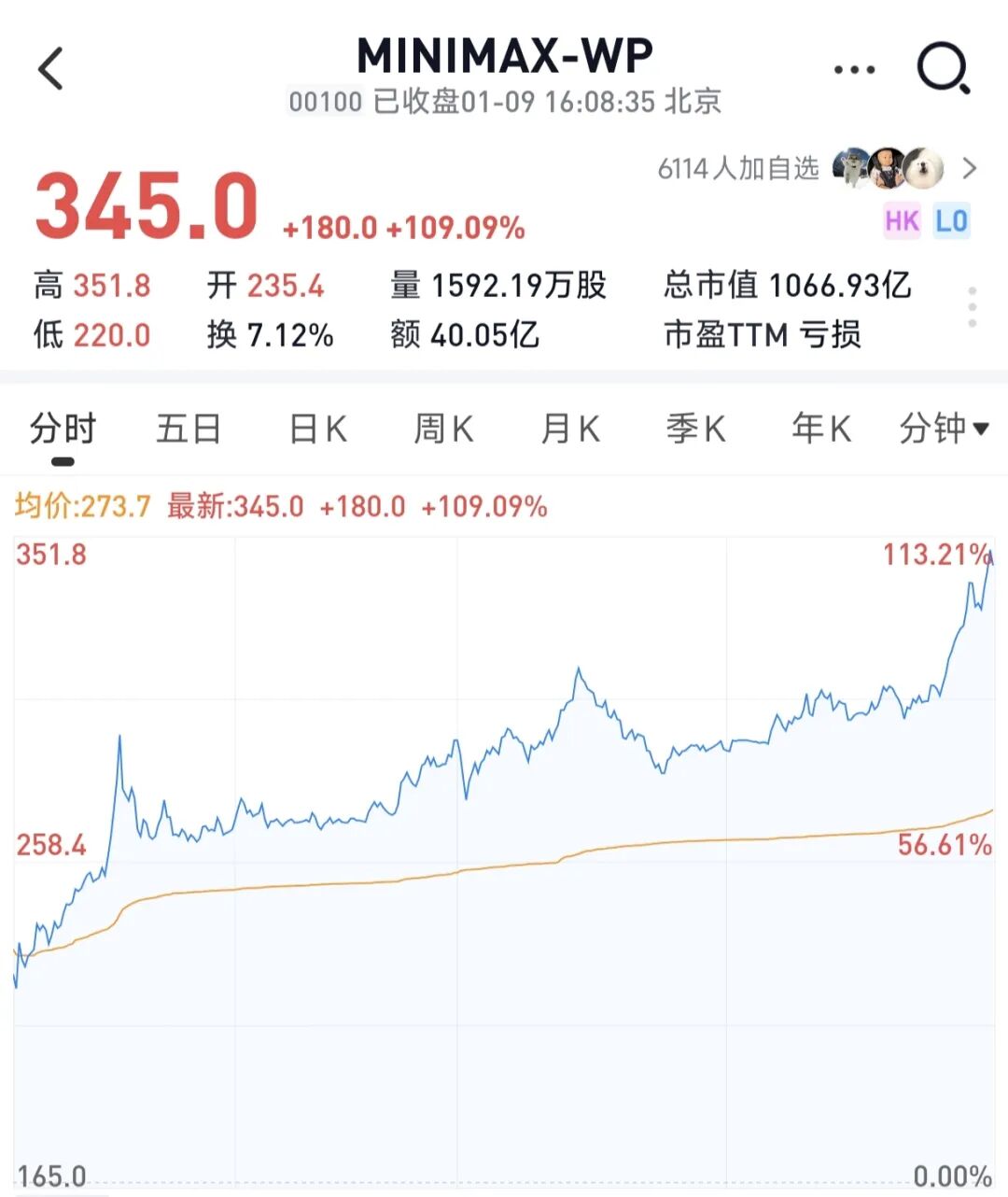
Core Viewpoint - MiniMax's successful listing on the Hong Kong Stock Exchange has ignited enthusiasm in the AI sector, with significant stock price increases and market capitalization exceeding HKD 100 billion [3]. Group 1: Market Performance - MiniMax's stock surged by 109% on its debut, leading to a market capitalization surpassing HKD 100 billion [3]. - The AI sector in both Hong Kong and A-shares experienced a notable rally, with companies like iFlytek Medical Technology and Fourth Paradigm seeing increases of approximately 20% and 7%, respectively [5]. - MiniMax's public offering was met with overwhelming demand, achieving 1,837 times oversubscription for the public tranche and 37 times for the international tranche, potentially raising around HKD 55.4 billion through the exercise of the greenshoe option [5]. Group 2: Company Performance - MiniMax reported a revenue of USD 53.44 million for the first nine months of 2025, reflecting a year-on-year growth of 174.7% [6]. - The company has over 200 million personal users across more than 200 countries and regions, with over 70% of revenue coming from international markets [6]. - MiniMax's M2 model became the first Chinese model on OpenRouter to exceed a daily token consumption of 50 billion, indicating its significant usage [7]. Group 3: Business Strategy - MiniMax's CEO emphasizes the concept of "model as product," asserting that the core product in the era of large models is the model itself, rather than applications or APIs [11][12]. - The company has shifted its focus from a dual emphasis on models and products to prioritizing model capabilities, believing that improved model performance will naturally enhance product quality [13]. - MiniMax's revenue model is evolving, with a notable increase in paid user growth, particularly in AI-native applications, as the company anticipates a convergence of B2B and B2C markets [16][18]. Group 4: Financial Health - MiniMax boasts a cash reserve exceeding USD 1.1 billion, allowing for over 53 months of operational sustainability without additional fundraising [24]. - The company's gross margin has improved significantly, moving from -24.7% in 2023 to 23.3% in the first nine months of 2025, while adjusted net losses have only slightly increased despite substantial revenue growth [24][25]. - The company has achieved a remarkable 15-fold increase in paid users for AI-native products within two years, demonstrating effective scaling and cost management [18][26]. Group 5: Organizational Structure - MiniMax employs 385 staff, with an average age of 29 and 73.8% being R&D personnel, showcasing a high talent density and efficient output [26]. - The company utilizes AI to enhance productivity, with over 80% of its code generated by AI, reflecting a commitment to innovation and efficiency [27]. - MiniMax's strategic vision remains consistent since its inception, focusing on long-term goals and maintaining a strong organizational structure to adapt to market changes [28][29].
38.70亿主力资金净流入,智谱AI概念涨4.54%
Zheng Quan Shi Bao Wang· 2026-01-09 08:40
Group 1 - The Zhipu AI concept index rose by 4.54%, ranking 6th among concept sectors, with 62 stocks increasing in value [1] - Leading stocks in the Zhipu AI sector included Yidian Tianxia, which surged by 20%, followed by BlueFocus, Jinxiandian, and Yaxin Security, which rose by 14.08%, 12.87%, and 12.45% respectively [1][2] - The sector experienced a net inflow of 3.87 billion yuan from main funds, with 48 stocks receiving net inflows, and 13 stocks exceeding 100 million yuan in net inflows [2] Group 2 - The top three stocks by net inflow were Yidian Tianxia with 732 million yuan, BlueFocus with 722 million yuan, and 360 with 336 million yuan [2] - The net inflow ratios for leading stocks included Jinxiandian at 17.12%, Boyan Technology at 14.91%, and Yidian Tianxia at 11.92% [3] - The overall performance of the Zhipu AI concept was supported by significant trading volumes, with Yidian Tianxia achieving a turnover rate of 31.68% [3]

周鸿祎发布2026年20个AI预言:我们正迈向百亿智能体时代
Jin Rong Jie Zi Xun· 2026-01-09 06:34
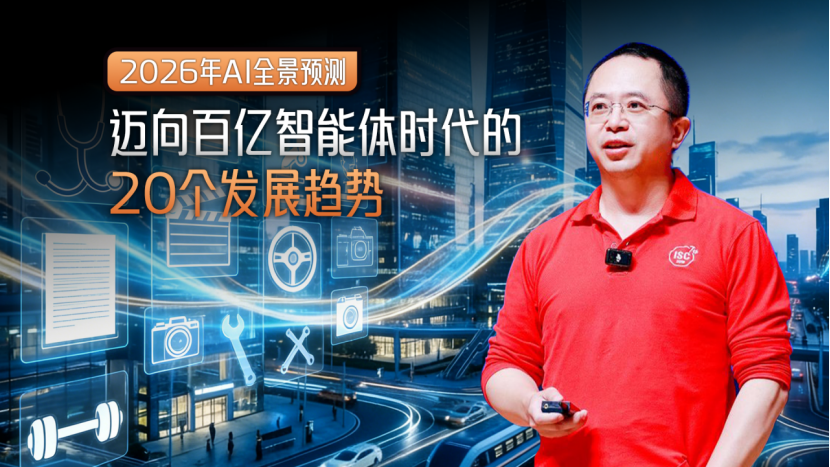
Core Insights - The article presents a comprehensive forecast for the development of artificial intelligence (AI) in 2026, predicting a transition to a "hundred billion intelligent agents" era, where AI will be deeply integrated into the economy and society, shifting the focus from model parameters to practical applications [1] Group 1: Infrastructure Transformation - The AI industry will experience a fundamental shift from "training competition" to a "reasoning revolution," with a significant increase in demand for reasoning capabilities, expected to grow by "hundredfold" in the short term, surpassing training capabilities [3] - The dominance of Nvidia in the AI chip market will be challenged, leading to a dual-track industry structure where Nvidia leads training while multiple vendors share the reasoning market [3] - The core bottleneck for development will shift from computing power to stable and sufficient energy supply, with China leveraging its "East Data West Computing" initiative and green energy capabilities to gain a competitive edge [3] Group 2: Model Intelligence Evolution - AI is predicted to evolve from a "static tool" to a "continuously evolving system," with a new paradigm of "general foundation + industry specialization + reasoning evolution" replacing the traditional "pre-training + fine-tuning" model [4] - Chinese open-source models, such as DeepSeek and Tongyi Qianwen, are emerging as core components of the global AI ecosystem, creating a "siphoning effect" on global intellectual resources [4] - Edge AI is expected to see explosive growth, with devices capable of offline independent decision-making becoming the "last line of defense" for AI security [4] Group 3: Social Integration Deepening - AI will fundamentally reshape relationships between individuals and organizations, evolving into a "second brain" that records, understands, and utilizes personal data [5] - "Silicon-based digital employees" will be integrated into the workforce, requiring managers to transition from "commanders" to "business coaches," leading to flatter organizational structures [5] - Individuals who can define problems and direct intelligent agents will become central to the workforce, marking the onset of the "super individual" era [5] Group 4: Economic and Security Rule Reconstruction - The integration of hundred billion intelligent agents into the economy will rewrite commercial rules, leading to an "automated economy" where intelligent agents negotiate and transact directly [6] - A new silicon-based rule system will be necessary, including identity verification for intelligent agents and innovations like blockchain contracts and "AI-native insurance" [6] - AI security will become a critical concern, necessitating a full traceability system and maintaining human oversight in key decision-making processes [6] Group 5: Opportunities for China in the "Hundred Billion Intelligent Agents" Era - China is well-positioned to seize strategic opportunities in the "hundred billion intelligent agents" era due to its complete industrial chain, robust computing and energy foundation, and active open-source ecosystem [7] - The predictions provide a clear roadmap for technological evolution while highlighting the urgent need for proactive restructuring of industry logic, security paradigms, and governance systems [7]
AI产业价值重心加速向Agent应用层迁移,软件ETF(159852)一键掘金计算机软件行业
Xin Lang Cai Jing· 2026-01-09 05:39
Core Insights - The software development and internet services sectors are experiencing significant upward movement, with the Zhongzheng Software Service Index rising by 2.08% as of January 9, 2026, driven by strong performances from key stocks such as Weining Health (+12.00%) and Zhongke Xingtong (+7.41%) [1] Group 1: Industry Trends - The ongoing policy push for intelligent upgrades in manufacturing is creating new opportunities for industrial software, as outlined in the "AI + Manufacturing" initiative, which aims to establish 1,000 high-level industrial intelligent systems and promote 500 typical application scenarios by 2027 [1] - The adoption rate of large models and intelligent systems among Chinese industrial enterprises has surged from 9.6% in 2024 to 47.5% in 2025, with leading companies expected to reach a 60% penetration rate in industrial AI over the next three years, indicating a significant demand release for industrial software [1] - The computer and software development industry is witnessing rapid growth, particularly in the GPU chip sector, with a notable shift in the AI industry's value focus towards agent application layers [1] Group 2: Market Dynamics - Meta's acquisition of the AI agent company Manus highlights the increasing market recognition of AI applications capable of solving specific problems, such as research, coding, and data analysis [1] - As of December 31, 2025, the top ten weighted stocks in the Zhongzheng Software Service Index include iFlytek, Kingsoft Office, and Tonghuashun, collectively accounting for 60.89% of the index [2] - The Software ETF (159852) serves as a convenient tool for investors looking to capitalize on opportunities within the computer software industry [3]
中科星图涨超11%,雷达业务受关注,软件50ETF(159590)放量大涨2%!GEO登上风口,航空AI软件爆发,软件板块或迎多重催化
Xin Lang Cai Jing· 2026-01-09 03:33
Group 1: AI and Marketing Trends - The shift from traditional SEO to GEO (Generative Engine Optimization) is highlighted as a long-term growth opportunity in the context of AI search becoming the main entry point for information retrieval [2][3] - Traditional SEO is facing systematic decline as search algorithms transition from keyword matching to generative reasoning, leading to a change in traffic distribution from "click-driven" to "citation-driven" [2][3] - Leading marketing companies are advancing their GEO strategies at the technical, product, and organizational levels, validating the feasibility of this new approach [2][3] Group 2: Market Performance and Developments - The software 50ETF index shows positive performance with significant gains from companies like Zhongke Xingtou (up over 11%), Aerospace Information (up over 5%), and Tonghuashun (up over 3%) [4] - The establishment of a new company, Hanxiang Xingyu Technology, is noted, which focuses on smart UAV manufacturing and AI public data platforms, indicating growth in the AI and aerospace sectors [4] Group 3: AI in Manufacturing - The "AI + Manufacturing" policy aims to address bottlenecks in industrial software and promote the integration of AI into core manufacturing processes [5][6] - The market for AI applications in Chinese manufacturing is projected to grow significantly, with an expected market size of 141 billion yuan by 2025, up from 56 billion yuan in 2023 [6] - The revenue from industrial software products in China is expected to exceed 500 billion yuan by 2029, driven by the implementation of supportive national policies [6]




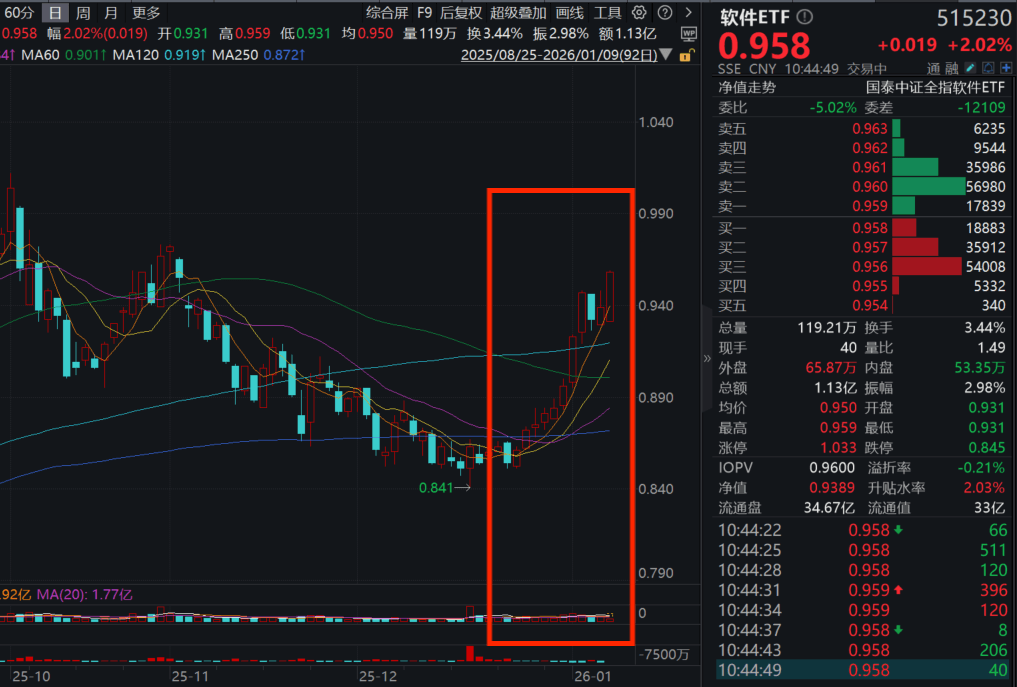
八部门联合印发《“人工智能 + 制造” 专项行动实施意见》,软件板块活跃度攀升,软件 ETF(159852)表现强势
Jin Rong Jie· 2026-01-09 03:28
行业与指数层面,软件板块受益于技术迭代与场景落地,科大讯飞等企业在大模型领域的突破进一步带 动板块情绪,中证软件服务指数选取业务涉及软件开发领域的上市公司证券作为样本,精准覆盖板块核 心标的;需注意的是,当前市场上同名软件相关产品跟踪的指数存在明显差异,投资者需区分标的以精 准布局。 软件 ETF(159852)当前管理费率为 0.50%(每年),托管费率为 0.10%(每年),没有股票账户的投 资者还可以通过联接基金(012619.OF,012620.OF,021861.OF)布局板块投资机遇。 声明:市场有风险,投资需谨慎。本文为 AI 基于第三方数据生成,仅供参考,不构成个人投资建议。 资讯所属栏目还有更多独家策划、专家专栏,免费查阅>> 1月9日消息,据数据显示,截至10:48,个股方面,中科星图、卫宁健康涨超 11%,光环新网涨超 7%,宝信软件、深信服涨超4%,合合信息、同花顺、三六零等涨超 3%. 热门 ETF 方面,软件 ETF(159852)涨 2.63%,盘中成交额达 2.57亿元,换手率达3.81%。天天基金网 数据显示,该基金近 6 月涨 14.22%,近 1 年涨 29.90%。 消 ...
多家中概股拟高溢价私有化退市
Shen Zhen Shang Bao· 2026-01-09 01:23
分众传媒 三六零 罗欣药业 金浔资源 分时图 日K线 周K线 月K线 7.58 -0.04 -0.52% 0.79% 0.52% 0.26% 0.00% 0.26% 0.52% 0.79% 7.56 7.58 7.60 7.62 7.64 7.66 7.68 09:30 10:30 11:30/13:00 14:00 15:00 28万 164万 300万 436万 回归A股。 近日,掌门教育宣布与母公司签署了私有化的最终协议和合并协议,正式启动了私有化进程。在交易 中,掌门教育将由公司创始人、董事长张翼收购。 协议规定,在合并生效时间内,每股ADS收购价格为0.56美元;或每A类普通股现金0.0077778美元(代 表0.56美元除以72)。这一收购价格相对于过去30个交易日和90个交易日的ADS成交量加权平均价格分 别溢价约115%和56%。 2021年6月8日,掌门教育正式登陆美股。上市首日,掌门教育盘中大涨78%,三度触发熔断,收盘上涨 47.74%,公司彼时市值约26.79亿美元。不过,在"双减"政策出炉后,掌门教育一度跌去90%市值,并 传出大规模裁员消息。2022年6月2日,纽约证券交易所宣布, ...
MiniMax港股上市引爆AI热潮!国产大模型产业链如何布局?
Jin Rong Jie· 2026-01-09 01:20
Group 1: MiniMax Group Inc. IPO Details - MiniMax Group Inc. is set to list on the Hong Kong Stock Exchange on January 9, with a final offer price of HKD 165 per share, at the upper limit of the price range [1] - The total number of shares offered globally is approximately 29.1976 million, with an overallotment option involving 4.37964 million shares [1] - The total proceeds from the global offering are estimated to be around HKD 4.82 billion, with a net amount of approximately HKD 4.6 billion after estimated listing expenses [1] - The Hong Kong public offering received 417,646 valid applications, resulting in a subscription rate of 1,837.17 times, triggering a reallocation mechanism [1] - The final number of shares allocated in the Hong Kong public offering is 5.07786 million, accounting for 17.4% of the total shares offered [1] - In the international offering, the number of participants was 376, with a subscription level of 36.76 times, leading to an allocation of 24.11974 million shares, which is 82.6% of the total shares offered [1] - There were 15 cornerstone investors participating in the offering, collectively receiving 16.50404 million shares, representing 56.53% of the total shares offered [1] Group 2: Industry Insights and Opportunities - MiniMax is recognized as a leading global general artificial intelligence technology company, employing a dual strategy of large models and native applications [2] - The company’s large model portfolio includes large language models, video generation models, and models for voice and music generation, with rapid revenue growth driven by AI native products [2] - The semiconductor industry is witnessing a surge in domestic GPU companies aiming for capital market entry, with the high-end computing chip localization process expected to accelerate under the influence of capital markets and national policies [2] - MiniMax is identified as an entry-level company in the domestic C-end AI application market, highlighting the potential for independent AI applications to create commercial value [2]