常熟银行

Search documents
买买买!7万亿股份行股东,出手增持!
券商中国· 2025-11-27 23:29
11月27日晚,光大银行公告,该行第三大股东中信金融资产7月24日至11月27日增持公司A股和H股股份合 计1%,中信金融资产持股比例增至9.00%。 下半年来,银行股在A股众板块中逆势上扬,上市银行股东们也频频出手,以"真金白银"助力。截至最新收 盘,光大银行A股报收3.65元/股。 狂扫A+H近6亿股 根据光大银行公告,中信金融资产于2025年7月24日至11月27日期间,增持光大银行A股股份2.75亿股,H股股 份3.15亿股,合计占该行总股本的1%。中信金融资产持股比例由8.00%增加至9.00%。 光大银行2025年三季度报告显示,截至9月末,中信金融资产持有该行A股和H股合计47.39亿股,为该行第三 大股东。截至2025年9月末,光大银行的总资产为7.22万亿元,同比增长4.84%。 这并非年内中信金融资产首次增持光大银行。 7月24日,光大银行公告,中信金融资产于2025年1月20日至7月22日期间,增持光大银行A股股份2.64亿股,H 股股份2.79 亿股,合计占该行总股本的0.92%。增持后,中信金融资产持股比例由7.08%增加至8.00%。 不仅仅是光大银行,今年10月以来,上市银行再次 ...


超2600亿“红包”落地!13家银行中期分红,六大行贡献七成
Xin Jing Bao· 2025-11-27 12:05
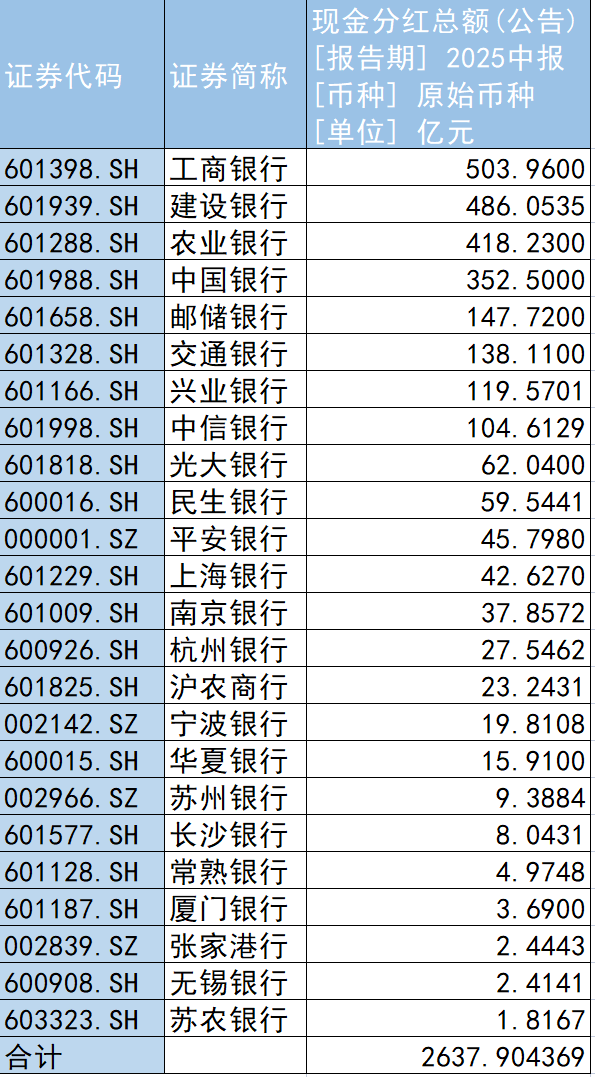
Core Viewpoint - The mid-term dividends of listed banks have exceeded 260 billion yuan, reflecting a trend towards enhancing shareholder returns and stabilizing market confidence [1][2][5]. Group 1: Dividend Distribution - As of November 26, 2025, 42 A-share listed banks have distributed a total of 263.79 billion yuan in mid-term dividends, with 13 banks having completed their distributions [1][2]. - The six major state-owned banks contributed over 70% of the total mid-term dividends, amounting to 204.66 billion yuan, with Industrial and Commercial Bank of China leading at 50.40 billion yuan [2][3]. - Several banks, including Shanghai Bank and Nanjing Bank, have also participated in mid-term dividends, with total distributions from city commercial banks reaching 3.10 billion yuan [2][4]. Group 2: Market Impact and Investor Confidence - The implementation of mid-term dividends is seen as a signal of stable operations, enhancing market confidence and attracting long-term capital [1][5][9]. - First-time dividend issuers have experienced positive short-term stock performance, indicating that dividends can boost shareholder confidence and improve capital efficiency [5][9]. - The trend of mid-term dividends is aligned with regulatory encouragement for banks to optimize dividend policies and improve shareholder returns [1][6]. Group 3: Future Outlook and Strategic Considerations - The decision to implement mid-term dividends reflects banks' strong financial performance and stable profit models, which provide a solid foundation for such distributions [6][9]. - Analysts suggest that banks should balance short-term dividend payouts with long-term growth strategies, ensuring that capital is adequately retained for future development [9]. - The ongoing trend of mid-term dividends is viewed as a sign of the maturation of China's capital markets and a shift towards greater emphasis on investor returns [9].



“首发额度已经抢完了”,银行理财、基金、保险“开门红”营销战提前打响
Hua Xia Shi Bao· 2025-11-27 11:17
Core Insights - The "opening red" marketing campaign by banks has started earlier this year compared to previous years, with various banks launching special marketing plans for mutual funds, bank wealth management, and insurance products [2][3] - Banks are employing a combination strategy of "products + rates" to capture market share, offering exclusive products and rate discounts [2][5] Group 1: Marketing Activities - Many banks have initiated their marketing activities for asset management products earlier than usual, with several banks holding "special launch meetings" to set sales targets [3] - Banks like China Bank and Ping An Bank are focusing on wealth management as a key component of their marketing strategies for the upcoming peak season [4] - The demand for "opening red" wealth management products has been strong, with some products selling out quickly upon launch [4] Group 2: Product Offerings - Banks are introducing a wider variety of "opening red" insurance products to meet diverse investor needs, with more options available compared to previous years [4] - Some banks are offering exclusive wealth management products for new customers transferring assets, with competitive performance benchmarks around 2.45% [5] Group 3: Fee Discounts - A competitive trend of fee reductions has emerged, with several banks announcing discounts on fund products, including a 90% discount on certain fund subscription fees [6][7] - Banks like Industrial and Commercial Bank of China and Minsheng Bank have implemented fee reductions for various fund products, enhancing their attractiveness to investors [6][7] Group 4: Financial Performance - Wealth management is a significant source of income for banks, with a reported net income from fees and commissions reaching 578.2 billion yuan in the first three quarters of 2025, marking a 4.6% year-on-year increase [8] - Some banks have seen substantial growth in fee income, with notable increases reported by Changshu Bank and others [8]

农商行板块11月27日涨0.91%,沪农商行领涨,主力资金净流出9045.9万元
Zheng Xing Xing Ye Ri Bao· 2025-11-27 09:07
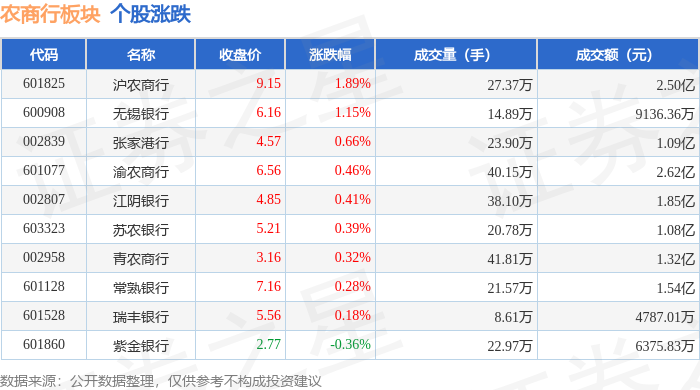
证券之星消息,11月27日农商行板块较上一交易日上涨0.91%,沪农商行领涨。当日上证指数报收于 3875.26,上涨0.29%。深证成指报收于12875.19,下跌0.25%。农商行板块个股涨跌见下表: 从资金流向上来看,当日农商行板块主力资金净流出9045.9万元,游资资金净流入5546.78万元,散户资 金净流入3499.12万元。农商行板块个股资金流向见下表: | 代码 | 名称 | 主力净流入(元) | 主力净占比 游资净流入 (元) | | 游资净占比 散户净流入 (元) | | 散户净占比 | | --- | --- | --- | --- | --- | --- | --- | --- | | 002839 张家港行 | | = 592.02万 | 5.43% | -80.35万 | -0.74% | -511.66万 | -4.70% | | 601077 | 渝农商行 | -312.30万 | -1.19% | 414.72万 | 1.58% | -102.42万 | -0.39% | | 601528 | 瑞丰银行 | -382.47万 | -7.99% | 117.62万 | 2.46 ...
大利好来了!工信部、央行等联合发布!
2 1 Shi Ji Jing Ji Bao Dao· 2025-11-26 14:51
热点情报 消费领域迎来利好 11月26日下午,工信部、中国人民银行等六部门印发《关于增强消费品供需适配性进一步促进消费的实 施方案》。其中提出,到2027年,消费品供给结构明显优化,形成3个万亿级消费领域和10个千亿级消 费热点,打造一批富有文化内涵、享誉全球的高品质消费品。 华创证券研报称,部分消费者服务行业的结构性复苏趋势正愈发明确,经营层面已现企稳改善迹象,逐 步走出底部区间,重点推荐关注以下两条主线:一是酒店行业,供需格局优化,经营数据稳步回暖。二 是免税行业,政策红利加持,静待行业新增量。 特发信息连收4个涨停板 11月26日,特发信息再度涨停,实现四连板走势,累计涨幅为46.53%。截至收盘,该股成交量229.63万 手,成交金额31.22亿元,换手率25.84%。最新A股总市值达125.33亿元,A股流通市值123.70亿元。 | 今开 13.65 | | 最高 | 13.92 | 成交量 229.63万手 | | --- | --- | --- | --- | --- | | 昨收 | | 曼低 | | 成交额 | | 换手率 | 25.84% | 市盈(TTM) | 亏损 | 总市值 125 ...

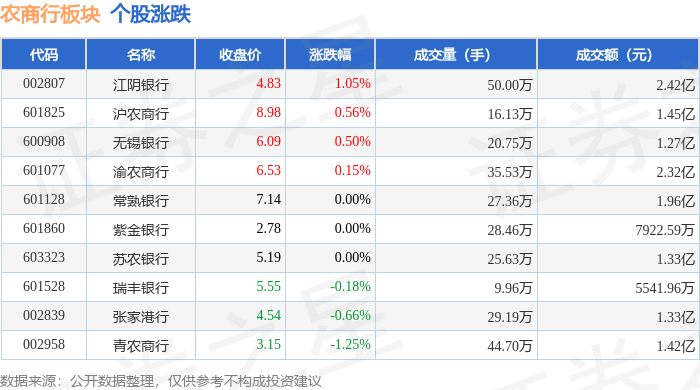
农商行板块11月26日涨0.17%,江阴银行领涨,主力资金净流出1257.83万元
Zheng Xing Xing Ye Ri Bao· 2025-11-26 09:05
Core Insights - The rural commercial bank sector experienced a slight increase of 0.17% on November 26, with Jiangyin Bank leading the gains [1] - The Shanghai Composite Index closed at 3864.18, down 0.15%, while the Shenzhen Component Index rose by 1.02% to 12907.83 [1] Stock Performance - Jiangyin Bank (002807) closed at 4.83, up 1.05% with a trading volume of 500,000 shares and a transaction value of 2.42 billion [1] - Other notable performances include: - Hu Nong Commercial Bank (601825) at 86.8, up 0.56% with a transaction value of 145 million - Wuxi Bank (600908) at 6.09, up 0.50% with a transaction value of 127 million - Yunnan Agricultural Commercial Bank (601077) at 6.53, up 0.15% with a transaction value of 232 million [1] Capital Flow - The rural commercial bank sector saw a net outflow of 12.58 million from institutional investors, while retail investors experienced a net outflow of 46.30 million [1] - Notably, speculative funds had a net inflow of 58.87 million [1] Individual Stock Capital Flow - Jiangyin Bank had a net inflow of 34.67 million from institutional investors, but a net outflow of 22.04 million from retail investors [2] - Qingnong Commercial Bank (002958) saw a net inflow of 4.52 million from institutional investors, while retail investors had a net outflow of 5.52 million [2] - Zhangjiagang Bank (002839) experienced a net inflow of 4.19 million from institutional investors and a net outflow of 15.75 million from retail investors [2]


股价回撤、增速放缓,成都银行股东为何逆势加仓6.11亿元
Nan Fang Du Shi Bao· 2025-11-26 04:17
Core Viewpoint - Chengdu Bank's two major state-owned shareholders have invested 611 million yuan to increase their stake, indicating confidence in the bank despite recent stock price declines and mixed financial performance [2][4]. Shareholder Actions - The investment by Chengdu Industrial Capital Holding Group and Chengdu Xintianyi Investment Co. occurred between August 27 and November 21, totaling approximately 34.247 million shares, representing 0.808% of the total share capital [2]. - The initial buyback plan began in April, with a target price of no more than 17.59 yuan per share, but the stock price exceeded this limit shortly after the announcement [3][4]. - The buyback plan was adjusted in August to remove the price cap, allowing for a total investment of 700 million to 1.4 billion yuan over the next 12 months [4]. Financial Performance - Chengdu Bank's total assets surpassed 1 trillion yuan in mid-2023, reaching 1.39 trillion yuan by the end of September 2025, establishing it as a leading city commercial bank in Southwest China [5]. - For the first three quarters of 2025, the bank reported a revenue of 17.761 billion yuan, a year-on-year increase of 3.01%, and a net profit of 9.493 billion yuan, up 5.03% [5]. - However, the third quarter saw a revenue decline of 2.92% year-on-year, with net profit growth slowing significantly to just 0.17% compared to 11.27% in the previous year [5][6]. Business Structure Challenges - The bank's net interest income accounted for 83.15% of total revenue, while fee and commission income fell by 35.17%, indicating a reliance on interest income [6]. - The bank's loan portfolio remains skewed towards corporate loans, with retail loans showing a significant slowdown, adding to concerns about business diversification [7]. Industry Trends - The increase in shareholding by Chengdu Bank's major shareholders reflects a broader trend in the banking sector, where several banks have seen similar shareholder buybacks amid favorable valuation conditions [8]. - The financing balance for A-share banks has risen from under 56 billion yuan in early July to approximately 75.6 billion yuan, indicating a growing interest in bank stocks [8]. - Local state-owned enterprises increasing their stakes in regional banks is seen as a strategy to enhance control over local financial resources and ensure the stability of state assets [9].
银行股增持潮起股东用资本投票
Zhong Guo Zheng Quan Bao· 2025-11-25 20:27
Core Viewpoint - The recent surge in share buybacks by shareholders and executives in A-share banks, particularly city commercial banks like Nanjing Bank and Chengdu Bank, reflects strong confidence in the banks' fundamentals and a market preference for high-dividend assets [1][2]. Group 1: Shareholder and Executive Buybacks - Nanjing Bank announced that BNP Paribas (QFII) increased its stake by 12.8 million shares, raising its total holding from 17.02% to 18.06% [1]. - Chengdu Bank's major shareholders, Chengdu Industrial Capital Group and Chengdu Xintianyi, collectively spent 611 million yuan to buy 3.4247 million shares, with plans for further purchases [2]. - Executives from Changshu Bank and Shanghai Rural Commercial Bank also announced their intentions to buy shares, indicating a commitment to their banks' long-term value [2]. Group 2: Market Conditions and Valuation - The increase in buybacks is attributed to expectations of economic recovery, improved performance, and valuation corrections, with 38 out of 42 A-share listed banks seeing stock price increases this year [2][3]. - The banking sector's overall price-to-book ratio remains at historical lows, suggesting potential for valuation recovery [2][3]. Group 3: Investment Outlook - Analysts express optimism regarding the banking sector, highlighting the appeal of high-dividend, low-valuation characteristics of bank stocks, especially during periods of economic stagnation [4]. - Investment strategies focus on banks with regional advantages and strong performance certainty, particularly in areas like Jiangsu, Shanghai, Chengdu, Shandong, and Fujian [4].
银行股增持潮起 股东用资本投票
Zhong Guo Zheng Quan Bao· 2025-11-25 20:26
Core Viewpoint - The recent surge in share buybacks by shareholders and executives in the A-share banking sector reflects strong confidence in the banks' fundamentals and a preference for high-dividend assets in the market [1][4]. Group 1: Shareholder and Executive Buybacks - Several city commercial banks, including Nanjing Bank and Chengdu Bank, have announced significant share buybacks, indicating a robust trend among mid-sized banks [1][2]. - Nanjing Bank reported that BNP Paribas increased its stake by 1.28 million shares, raising its total holding from 17.02% to 18.06%, marking its second buyback this year [2]. - Chengdu Bank's major shareholders have invested 611 million yuan to buy back 3.4247 million shares, with plans for further purchases [2][3]. Group 2: Management Buybacks - Management teams at smaller banks are also participating in buybacks, with Changshu Bank's executives planning to purchase at least 550,000 shares over the next six months [3]. - Shanghai Rural Commercial Bank's executives have already bought 259,100 shares at prices between 9.02 and 9.08 yuan, committing to a two-year lock-up [3]. Group 3: Market Dynamics and Valuation - The recent buyback trend is attributed to expectations of economic recovery, improved performance, and valuation corrections, with 38 out of 42 A-share listed banks seeing stock price increases this year [4]. - The banking sector's overall price-to-book ratio remains at historical lows, despite a positive cycle of performance recovery and increased dividends [4]. - Analysts note a shift in strategy, with recent buybacks occurring during price increases, indicating a proactive approach to guiding valuation recovery [4]. Group 4: Future Outlook - Analysts maintain an optimistic outlook for the banking sector, suggesting that the time window for reallocating investments in bank stocks has opened [5][6]. - The high dividend yield and low valuation characteristics of bank stocks are expected to attract more capital, particularly from insurance institutions and asset management companies [6]. - Key investment themes include focusing on banks with regional advantages and strong performance certainty, as well as those offering high dividends [6].
增持不停歇!银行股成“香饽饽”,大股东、高管“真金白银”组团力挺
Bei Jing Shang Bao· 2025-11-25 13:37
Core Viewpoint - A surge in share buybacks by listed banks in China's A-share market is observed, driven by strong confidence from major shareholders and management teams in the banks' future prospects and the current undervaluation of bank stocks [1][5][6] Group 1: Share Buyback Activities - Numerous listed city commercial banks and rural commercial banks, including Nanjing Bank, Suzhou Rural Commercial Bank, Chengdu Bank, and others, have disclosed their share buyback progress since November [1][3] - Chengdu Bank reported that its major shareholders, Chengdu Industrial Capital Holding Group and Chengdu Xintianyi Investment, have cumulatively increased their holdings by 14.04 million shares, amounting to 253 million yuan [3][4] - Nanjing Bank's major shareholder, BNP Paribas, increased its stake by 128 million shares, raising its total holding from 17.02% to 18.06% [4] Group 2: Financial Performance and Market Sentiment - The banking sector's fundamentals remain robust, with commercial banks achieving a net profit of 1.9 trillion yuan in the first three quarters, and 24 listed banks announcing a total cash dividend of 263.79 billion yuan [5][6] - The stock prices of several banks have reached historical highs, with Agricultural Bank of China seeing a year-to-date increase of nearly 60% [6][7] - Analysts suggest that the current buyback trend reflects internal confidence in the banks' future and signals to the market that their value is underestimated [5][7] Group 3: Future Outlook - The ongoing recovery in the macroeconomic environment is expected to support the banking sector's performance, with analysts highlighting the importance of sustained economic recovery, interest rate changes, and long-term capital inflows for future stock performance [7][8] - Investors are advised to maintain a long-term perspective and focus on banks with strong fundamentals, emphasizing the importance of asset quality, profitability, and dividend policies [7][8]