杭钢股份

Search documents
追加更大投入!阿里巴巴AI基建大动作,港股大涨超7%、A股概念股异动
Zhong Guo Zheng Quan Bao· 2025-09-24 06:06
Core Insights - The demand for AI infrastructure is significantly exceeding expectations, prompting Alibaba to invest 380 billion yuan in AI infrastructure development [1] - Alibaba Cloud has launched Qwen3-Max, its largest and most capable model to date, which has surpassed GPT-5-Chat in performance [2] - Alibaba's stock price surged over 7%, reaching a nearly four-year high following these announcements [3] Investment and Market Trends - Over the next five years, global investment in AI is projected to exceed $4 trillion, marking the largest historical investment in computing power and R&D [4] - Major tech companies, including Nvidia and OpenAI, are also increasing their capital expenditures in AI and infrastructure, with Nvidia planning to invest $100 billion in collaboration with OpenAI [5] Future of AI - The transition from AGI (Artificial General Intelligence) to ASI (Artificial Superintelligence) is viewed as a new beginning rather than an endpoint, with ASI expected to solve complex scientific and engineering challenges [6] - The emergence of large models is anticipated to replace traditional operating systems, enabling users to create applications using natural language, thus democratizing software development [6]


A股异动丨阿里概念股强势,杭钢股份涨停,阿里云算力投入将指数级提升
Ge Long Hui A P P· 2025-09-24 05:50
Group 1 - The core viewpoint of the news highlights the strong performance of Alibaba-related stocks in the A-share market, driven by Alibaba's significant investment in AI infrastructure [1] - Alibaba's CEO announced a plan to invest 380 billion in AI infrastructure, indicating a substantial increase in computing power and energy consumption in the coming years [1] - By 2032, Alibaba Cloud's global data center energy consumption is expected to increase tenfold compared to 2022, marking a significant shift towards the ASI era [1] Group 2 - Several stocks, including Hangzhou Steel, Zhongdian Xindong, and Shibei Gaoxin, reached their daily limit up, showcasing a strong market reaction [2] - Notable stock performances include NetEase Software rising by over 7%, and companies like Dongsoft Group and iFlytek increasing by over 6% [2] - The overall market sentiment is positive, as indicated by the MACD golden cross signal formation, suggesting a bullish trend for these stocks [2]





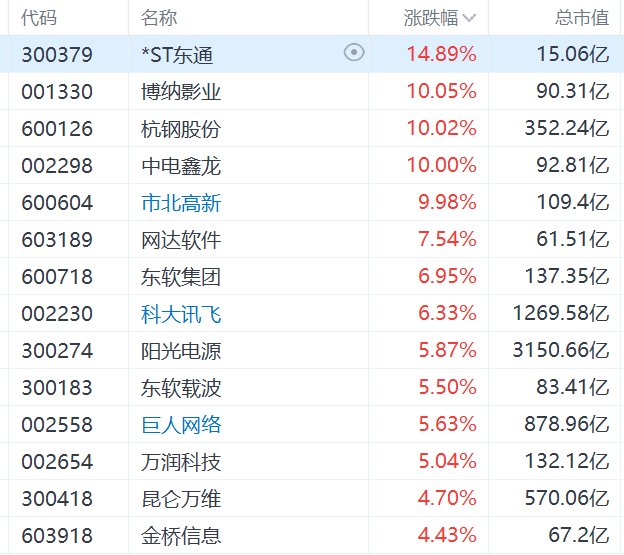
阿里云概念午后异动 杭钢股份直线涨停
Xin Lang Cai Jing· 2025-09-24 05:36
Group 1 - Alibaba Cloud concept saw localized fluctuations in the afternoon, with Hangzhou Steel Holdings experiencing a sharp rise and hitting the daily limit [1] - Other companies such as Hongjing Technology, Zhejiang University Network New, Data Port, and Jinqiao Information also saw rapid increases [1]
算力租赁板块局部拉升,杭钢股份触及涨停
Xin Lang Cai Jing· 2025-09-24 05:27
Group 1 - The computing power leasing sector experienced a partial surge, with Hangzhou Steel reaching the daily limit increase [1] - Hongjing Technology rose over 5%, indicating positive market sentiment in the sector [1] - Other companies such as Yuke Technology, Unisplendour, and CloudWalk Technology also saw gains, reflecting a broader trend in the computing power leasing market [1]
钢铁行业点评报告:稳增长工作方案发布钢铁受益于反内卷加速
Zhong Guo Yin He Zheng Quan· 2025-09-23 11:19
Investment Rating - The report maintains a "Recommended" investment rating for the steel industry [1]. Core Insights - The "Steel Industry Stable Growth Work Plan (2025-2026)" has been released, aiming for an average annual growth of around 4% in the industry's added value over the next two years. This plan emphasizes "stabilizing growth and preventing internal competition," guiding structural adjustments and high-quality development in the steel sector [12][14]. - The report highlights the acceleration of digital transformation in the steel industry, with significant investments in AI and digital technologies by leading companies, indicating a shift towards data-driven operations [27][28]. Summary by Sections 1. Review of 2021 Steel Supply-Side Capacity Regulation - In 2021, China's crude steel production fell to 1.035 billion tons, a year-on-year decrease of approximately 2.8%, due to stringent capacity control measures aimed at achieving carbon neutrality goals [4][8]. - The profitability of the steel industry improved significantly, with total profits in the black metal smelting and rolling processing industry reaching 424.09 billion yuan, a year-on-year increase of 72.1% [9][10]. 2. Stable Growth Work Plan Released, Leaders Benefit from Production Regulation - The "Stable Growth Work Plan" sets a target for the steel industry's added value to grow by about 4% annually from 2025 to 2026, focusing on economic stability and balanced market supply and demand [12][14]. - The plan emphasizes precise control of capacity and production, promoting industry transformation and upgrading, which will benefit leading steel companies [15][16]. 3. Accelerated Digital Transformation, AI + Steel Gaining Momentum - The digital transformation in the steel industry is expected to significantly enhance overall digital levels by 2026, with a focus on integrating new information technologies [19][20]. - Leading companies like Baosteel and Shougang are actively pushing forward their AI and digital transformation initiatives, with Baosteel planning to implement over 300 AI application scenarios by 2025 [27][28]. 4. Investment Recommendations - The report suggests focusing on leading companies such as Shougang, Hebei Steel, and CITIC Special Steel, as they are expected to benefit from the ongoing capacity regulation and industry transformation [31].
稳增长工作方案发布,钢铁受益于反内卷加速 | 投研报告
Zhong Guo Neng Yuan Wang· 2025-09-23 03:19
Core Viewpoint - The recent report from China Galaxy highlights the "precise control of capacity and output" and "industry transformation and upgrading" as key development directions for the steel industry in the context of ongoing supply-side reforms [1][3]. Summary by Sections Industry Overview - In 2021, China's steel production faced significant supply-side capacity control measures, leading to a historic year-on-year decline in crude steel output by approximately 2.8%, reaching 1.035 billion tons [2]. - The combination of strong demand and strict production controls resulted in domestic steel prices rising sharply, maintaining historical highs, and the total profit for the black metal smelting and rolling industry reached 424.09 billion yuan, a year-on-year increase of 72.1% [2]. Policy Developments - The "Steel Industry Steady Growth Work Plan (2025-2026)" was jointly issued by multiple government departments, setting an average annual growth target of around 4% for the steel industry's added value over the next two years [3]. - The plan emphasizes "steady growth and prevention of internal competition," providing a clear path for structural adjustment and high-quality development in the steel sector [3]. Digital Transformation - The work plan focuses on industry upgrades, advocating for increased effective investment, modernization of processes and equipment, and accelerated digital transformation [4]. - By 2026, the steel industry aims to significantly enhance its digitalization level, integrating new information technologies deeply into the steel industry, transitioning from isolated applications to a comprehensive digital development approach [4]. Investment Recommendations - The report suggests that in the context of ongoing supply-side reforms, the steel industry's capacity will continue to concentrate on high-quality leading companies, with a focus on industry leaders and performance improvements [5]. - Recommended companies for investment include Shougang Group, Hebei Iron and Steel Group, and CITIC Special Steel [5].


利好来了,重磅发布!
Zheng Quan Shi Bao· 2025-09-22 15:13
Core Viewpoint - The steel industry is set to benefit from a significant policy initiative aimed at stabilizing growth and promoting high-quality development, with a target of approximately 4% annual growth in value added over the next two years [1][2]. Group 1: Policy Framework - The "Steel Industry Stabilization Growth Work Plan (2025-2026)" was jointly issued by five government departments, focusing on structural adjustments and high-quality development [2][3]. - The plan emphasizes a problem-oriented and goal-oriented approach, proposing 10 specific measures across five key areas [2][3]. Group 2: Key Measures - The plan includes precise control of production capacity and output, with a focus on supporting advanced enterprises and phasing out inefficient capacity [2][3]. - It promotes the development of low-carbon steelmaking processes, such as electric arc furnaces and hydrogen metallurgy, through differentiated support for capacity replacement [2][3]. - The plan mandates that by the end of 2025, over 80% of steel production capacity must complete ultra-low emission transformations [6]. Group 3: Industry Management and Innovation - Steel enterprises will be classified and managed in tiers, encouraging resource allocation towards leading companies [3]. - The plan aims to enhance the supply of high-end products by fostering collaboration among steel companies, upstream and downstream enterprises, and research institutions [3][4]. Group 4: Investment and Digital Transformation - The plan calls for the modernization of equipment and the promotion of digital transformation within the industry, including the establishment of evaluation standards for digitalization [4][7]. - It encourages the adoption of advanced technologies and the development of intelligent manufacturing processes [4][7]. Group 5: Monitoring and Support - The plan outlines organizational, policy, and operational support measures to ensure the effective implementation of the growth strategy [7]. - Continuous monitoring and capacity warning mechanisms will be established to maintain industry stability [7]. Group 6: Market Outlook - Analysts predict a gradual recovery in steel demand as seasonal changes occur, with a potential reduction in inventory levels [7]. - The industry is expected to enter a performance cycle focused on profitability, driven by increased production restrictions and a shift towards high-quality development [7].
钢铁行业反内卷“扶优劣汰”,头部钢企有望迎价值重估
Di Yi Cai Jing· 2025-09-22 10:53
Core Viewpoint - The steel industry is accelerating its "anti-involution" efforts, with a focus on capacity reduction and optimization, as outlined in the "Steel Industry Stabilization Growth Work Plan (2025-2026)" issued by multiple government departments [1][2] Group 1: Industry Goals and Measures - The main goal of the plan is to achieve an average annual growth of about 4% in the steel industry's added value from 2025 to 2026 while prohibiting new capacity and implementing production cuts [1][2] - The plan emphasizes enhancing supply-demand adaptability through five key measures: strengthening industry management, promoting technological innovation, expanding effective investment, increasing market demand, and deepening open cooperation [2][3] Group 2: Current Industry Challenges - The steel industry is facing significant downward pressure due to a prolonged demand decline influenced by the real estate and infrastructure sectors, leading to an oversupply of crude steel [2][4] - The net asset return rate for the ordinary steel sector was only 0.93% in the first half of 2025, marking a historical low since 2010 [2] Group 3: Financial Performance and Market Reaction - The steel sector's revenue decreased by approximately 10% year-on-year in the first half of the year, with many companies reporting losses [5] - The average price-to-book ratio (PB) for the ordinary steel sector is currently at 0.74, significantly lower than peaks in 2017 and 2021, indicating a historical low valuation [5][6] - Following the announcement of the new plan, there has been a notable increase in stock prices for several steel companies, with some experiencing gains of over 5% [1][6] Group 4: Future Outlook - Analysts suggest that the focus on capacity reduction and the shift towards high-value, low-carbon, and intelligent production methods may lead to a recovery in profitability and valuation for leading steel companies [3][4] - The market is expected to closely monitor the implementation of production cuts and the resulting effects on the industry [6]



普钢板块9月22日跌0.13%,首钢股份领跌,主力资金净流出6919.41万元
Zheng Xing Xing Ye Ri Bao· 2025-09-22 08:40
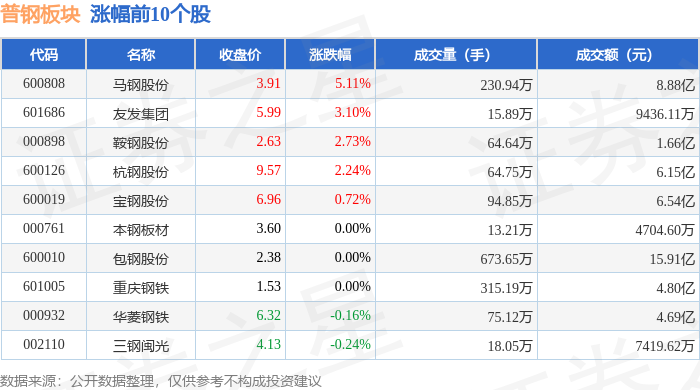
Market Overview - On September 22, the general steel sector experienced a slight decline of 0.13%, with Shougang Corporation leading the losses [1] - The Shanghai Composite Index closed at 3828.58, up 0.22%, while the Shenzhen Component Index closed at 13157.97, up 0.67% [1] Individual Stock Performance - Major gainers included: - Maanshan Iron & Steel Co., Ltd. (600808) with a closing price of 3.91, up 5.11% and a trading volume of 2.3094 million shares [1] - Youfa Group (601686) closed at 5.99, up 3.10% with a trading volume of 158,900 shares [1] - Ansteel Group Corporation (000898) closed at 2.63, up 2.73% with a trading volume of 646,400 shares [1] - Major losers included: - Shougang Corporation (6560000) closed at 4.18, down 8.73% with a trading volume of 1.9927 million shares [2] - Bayi Iron & Steel Group (600581) closed at 4.37, down 3.96% with a trading volume of 703,700 shares [2] - New Steel Co., Ltd. (600782) closed at 4.10, down 2.38% with a trading volume of 549,600 shares [2] Capital Flow Analysis - The steel sector saw a net outflow of 69.1941 million yuan from institutional investors, while retail investors contributed a net inflow of 74.8744 million yuan [2] - Notable capital flows included: - Maanshan Iron & Steel Co., Ltd. saw a net outflow of 74.4429 million yuan from institutional investors [3] - Chongqing Iron & Steel (601005) had a net inflow of 55.7782 million yuan from institutional investors [3] - Shougang Corporation experienced a net outflow of 22.8932 million yuan from retail investors [3]
利好来了!刚刚,重磅发布!
券商中国· 2025-09-22 05:57
Core Viewpoint - The steel industry is set to benefit from a significant policy initiative aimed at stabilizing growth and promoting high-quality development, with a target of approximately 4% annual growth in value added over the next two years [1][2]. Summary by Sections Policy Framework - The "Steel Industry Stabilization and Growth Work Plan (2025-2026)" was jointly issued by five government departments, focusing on structural adjustments and high-quality development [2][3]. - The plan emphasizes "stabilizing growth and preventing internal competition," outlining a clear implementation path for the steel industry [2]. Key Measures - The plan includes 10 specific measures across five areas, focusing on governance, supply optimization, transformation promotion, consumption expansion, and cooperation enhancement [2][3]. - It advocates for precise control of production capacity and output, with a push for differentiated support for low-carbon steel production methods [2][3]. Industry Management - Steel enterprises will undergo graded management based on compliance, with a focus on resource allocation towards leading companies [3]. - The plan aims to enhance the supply of high-end products by fostering collaboration among steel companies, upstream and downstream partners, and research institutions [3][4]. Investment and Upgrading - The plan promotes the modernization of equipment and processes, including the replacement of outdated facilities and the adoption of advanced technologies [4][5]. - Digital transformation is highlighted as a key area, with initiatives to assess and enhance the digital capabilities of the steel industry [4]. Environmental Goals - By the end of 2025, over 80% of steel production capacity is expected to complete ultra-low emission transformations [5]. - The plan underscores the importance of eliminating outdated production equipment to meet environmental standards [5]. Support and Monitoring - The plan outlines three areas of support: organizational collaboration, policy backing, and operational monitoring to ensure the effective implementation of the proposed measures [6]. - Market dynamics are expected to improve, with a gradual recovery in steel demand and a reduction in inventory levels [6]. Long-term Outlook - The steel industry is anticipated to experience increased concentration and a shift towards high-quality development, benefiting companies with advantageous product structures and cost efficiencies [6]. - The industry is positioned to enter a performance cycle focused on profitability, driven by stricter production limits and enhanced competitive advantages for leading firms [6].