OPPO

Search documents
国内最大规模!福蓉科技拟投资5.6亿元在崇州市建设新材料项目
Sou Hu Cai Jing· 2026-01-30 09:26
Group 1 - The core point of the article is that Furong Technology plans to raise up to 300 million yuan through a simplified procedure for a specific audience to fund its green low-carbon aluminum alloy new materials project in Chongzhou City [1] - The company intends to invest 563.85 million yuan in constructing the project, which includes building two workshops, a 25-ton electric melting production line, and four electric extrusion production lines, along with supporting systems [1] - The project aims to produce 40,000 tons of aluminum alloy round ingots and 24,100 tons of aluminum alloy new materials annually, while also upgrading existing production lines to enhance efficiency and sustainability [1] Group 2 - The project will utilize the most advanced international equipment and technology, positioning it as one of the largest green environmental aluminum alloy round ingot production projects in China, setting a benchmark for aluminum melting and casting technology [2] - The initiative replaces natural gas with clean electricity, aligning with national energy-saving and emission-reduction goals, showcasing the company's commitment to social responsibility and positively impacting the industry [2] - Furong Technology is a specialized manufacturer in the aluminum structural components for consumer electronics, supplying major global brands such as Apple, Samsung, Google, Huawei, Xiaomi, VIVO, and OPPO, while also expanding into the new energy and automotive aluminum profile sectors [2]

2026,手机业进入轻资产生存时代
Feng Huang Wang· 2026-01-30 07:59
Core Insights - The smartphone market is entering a phase of intense competition, with the youngest player, Honor, showing potential for growth amidst a challenging environment [1][21] - The Chinese smartphone market is characterized by a fragile balance among the top six players, with market shares fluctuating around 15% [2][4] Market Dynamics - The competition is becoming increasingly fierce, with every percentage point of market share requiring significant resource investment [4] - Honor's global smartphone shipments are projected to exceed 71 million units in 2025, marking a 9% year-on-year growth [4][9] Competitive Positioning - Honor, as the youngest and only single-brand player among the top six, demonstrates unique resilience in a competitive landscape [5] - The company is avoiding the pitfalls of heavy asset models by maintaining a lean organizational structure and flexible channel strategies, allowing for greater financial agility [6][12] Strategic Focus - Honor is strategically positioned in the mid-to-high-end market segment, focusing on the $300-$499 price range to avoid price wars in the sub-$200 category [9] - The brand is actively pursuing high-end market opportunities, evidenced by successful product launches like the Magic8 Pro Air and the RSR Porsche Design model [11] Global Expansion - Honor's overseas market share is set to surpass 50% in 2025, with significant growth in Latin America and the Middle East and Africa [9][14] - The company is transitioning from a broad market approach to a more focused strategy, emphasizing key regions and building a structured growth framework [14][20] Leadership and Strategy - Under the leadership of CEO Li Jian, Honor has implemented a clear strategy focusing on youthfulness, high-end positioning, and globalization [21] - The company has successfully restructured its competitive capabilities, positioning itself as a significant player in the global market within five years of independence [21]

OPPO 折叠屏技术被苹果研究,全球销量逆势增长
Xin Lang Cai Jing· 2026-01-30 06:15
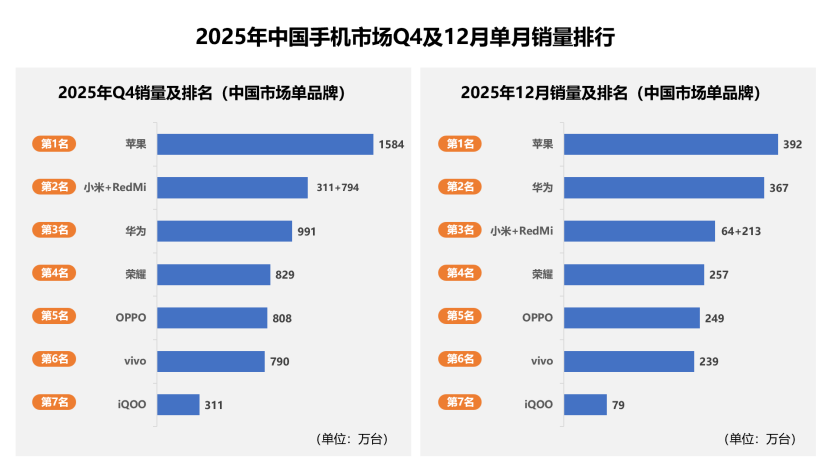
Group 1 - Apple is accelerating the development of its first foldable iPhone by purchasing OPPO's flagship foldable model, Find N5, for disassembly and research, highlighting OPPO's technological leadership in the foldable screen sector [1] - OPPO's global smartphone sales have shown strong growth, with a 7.6% year-on-year increase in Q4 2025, and a notable 10.2% growth in the Chinese market, making it the top performer in the Android segment [4] - OPPO's total sales, including OnePlus and Realme, are projected to exceed 190 million units in 2025, ranking third globally, driven by precise positioning and innovation investments in high and mid-high-end markets [4] Group 2 - The upcoming foldable iPhone is expected to feature a Samsung panel with an external screen of approximately 5.5 inches and an internal screen of about 7.8 inches, with a phased release starting in September 2026 and a price range of $2000 to $2500, facing some mass production challenges [3] - IDC indicates that the high-end market is currently the core battleground for industry innovation, and OPPO's combination of technological leadership and market recognition positions it well for future competition in the foldable screen arena [4]

第一波存储涨价的手机受害者出现了
Di Yi Cai Jing· 2026-01-30 04:36
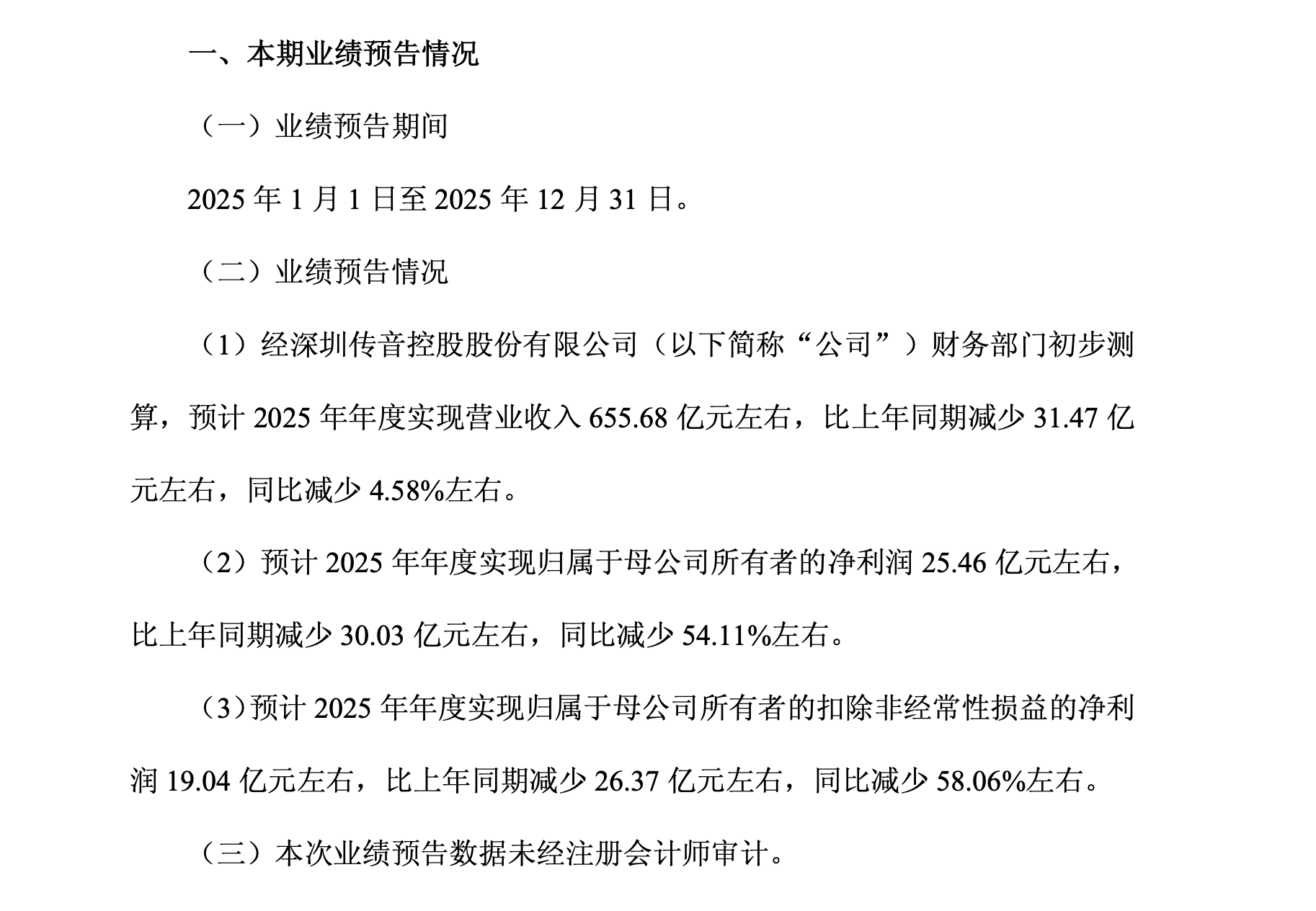
Core Viewpoint - The global storage chip prices are rising, significantly impacting smartphone manufacturers, with Transsion Holdings reporting a notable decline in revenue and profit due to increased component costs [3][5]. Company Summary - Transsion Holdings expects a revenue of approximately 65.568 billion yuan for 2025, a year-on-year decrease of about 4.6%, and a net profit of around 2.546 billion yuan, down 54.11% year-on-year, marking the first time the company has experienced such a significant profit drop since its listing [3][5]. - The company attributes the decline to rising supply chain costs, particularly for storage components, which have negatively affected product costs and gross margins [3][5]. - As of January 30, Transsion's stock price was 57.79 yuan, down 4.50%, reflecting a 44% decline from its one-year high [3][5]. Industry Summary - In the first three quarters of the previous year, Transsion's net profit fell by 44.97%, indicating a trend of increasing revenue without corresponding profit growth [5]. - Other smartphone manufacturers, such as Xiaomi and realme, have also reported challenges in fully passing on the increased costs of storage components to consumers [5][6]. - UBS forecasts that by Q4 2026, the cost of memory in the BOM (Bill of Materials) for mid-range smartphones will rise to 34%, up from 22% in Q4 2024 and 27% in Q4 2025, with an expected increase of about $16 per unit, representing a 37% rise [6]. - Counterpoint Research predicts that the increase in DRAM prices will raise BOM costs for smartphones across all price segments, with low, mid, and high-end models seeing increases of approximately 25%, 15%, and 10%, respectively, and further increases of 10% to 15% expected by Q2 2026 [6][7]. - The anticipated rise in component costs is expected to lead to a 2.1% decline in global smartphone shipments in 2026, particularly affecting lower-priced models where price adjustment options are limited [7].


Omdia:小米2025年出货1.654亿部,全球第三
Feng Huang Wang· 2026-01-30 04:23
Core Insights - The report from Omdia indicates that Xiaomi is projected to ship 165.4 million units in 2025, maintaining its position as the third-largest smartphone manufacturer globally, despite a 2% decrease from 168.6 million units in 2024 [1] Group 1: Shipment Forecast - Xiaomi's shipment volume for Q4 2025 is expected to be 37.8 million units, which represents an 11% decline compared to 42.7 million units in Q4 2024 [1] - The decline in shipments is attributed to weak demand for entry-level models and significant contraction in key markets [1] Group 2: Market Share - In 2025, the global smartphone market share for the top ten manufacturers is projected as follows: Apple 19%, Samsung 19%, Xiaomi 13%, Vivo 8%, OPPO 8%, Transsion 8%, Honor 6%, Lenovo 5%, Huawei 4%, and Realme 3% [1] Group 3: Cost Impact - The report notes that rising costs of key components and memory have begun to suppress shipment expectations for 2026 [1]


Omdia:2025年OPPO出货1.007亿部,全球第五
Feng Huang Wang· 2026-01-30 04:20
2025年全球智能手机前十大厂商市场份额排名:苹果19%、三星19%、小米13%、vivo8%、OPPO8%、 传音8%、荣耀6%、联想5%、华为4%、realme3%。 2025年第四季度,OPPO出货量2680万部,相较于2024年第四季度的2460万部,同比增长9%。 报告称,随着realme自2026年并入OPPO后,OPPO体系将更为庞大,有望取得更高排名。 凤凰网科技讯1月30日,根据市场研究机构Omdia最新报告,2025年OPPO出货量达1.007亿部,同比下 降3%,全球排名第五。 ...
传音预警利润腰斩,第一波存储涨价的手机受害者出现了
Di Yi Cai Jing· 2026-01-30 04:07
受存储涨价影响,千元机市场阵营开始失守。 全球存储芯片价格持续走高,智能手机厂商开始率先感受到成本涨价带来的"寒意"。 1月29日晚,深圳传音控股股份有限公司(688036.SH)发布2025年年度业绩预告,预计全年实现营业收入约655.68亿元,同比下降约4.6%;归属于母公司股 东的净利润约25.46亿元,同比大幅下降54.11%。这也是该公司上市以来首次出现净利润"腰斩"。 传音在公告中称,受供应链成本上升影响,存储等元器件价格上涨较多,对产品成本和毛利率造成一定影响,导致报告期内公司整体毛利率出现下滑态势, 叠加销售费用和研发投入增加,拖累了整体盈利表现。截至30日午间收盘,传音控股股价为57.79元,跌4.50%,距近一年高点,跌幅达到44%。 在分析机构看来,与高端机型相比,存储成本上涨对千元机等中低端产品的冲击更为直接。由于产品售价和利润空间有限,存储等核心元器件成本在整机物 料成本中的占比上升,会迅速侵蚀厂商的盈利能力。 瑞银在去年年底发布的一份行业报告中测算,到2026年第四季度,内存成本在中低端智能手机BOM(物料清单)中的占比预计将升至34%,明显高于2024 年第四季度的22%和202 ...
Omdia:苹果手机2025年出货超2.4亿部创新高,vivo首次跻身全球第四
Feng Huang Wang· 2026-01-30 03:15
Group 1 - Apple achieved a record annual shipment of 240.6 million iPhones in 2025, marking a 7% year-on-year increase and maintaining its position as the global leader for the third consecutive year [5] - In Q4, Apple set a new quarterly shipment record, with a 26% year-on-year growth in the Chinese mainland market, driven primarily by demand for the iPhone 17 series [5] Group 2 - Xiaomi shipped 165.4 million units in 2025, retaining its position as the third-largest global smartphone manufacturer, although its Q4 shipments declined by 2% [6] - Vivo entered the global top four for the first time with shipments of 105.3 million units, reflecting a 4% year-on-year growth [6] - OPPO shipped 100.7 million units, experiencing a 3% year-on-year decline, but returned to growth in Q4 due to new product launches [6] Group 3 - The report indicates that rising costs of key components and memory chips at the end of the year have begun to suppress shipment expectations for 2026 [6] Group 4 - In 2025, the market share of the top ten global smartphone manufacturers was as follows: Apple 19%, Samsung 19%, Xiaomi 13%, Vivo 8%, OPPO 8%, Transsion 8%, Honor 6%, Lenovo 5%, Huawei 4%, and Realme 3% [7]

如何看NAS的AI应用场景
2026-01-30 03:11
Summary of NAS and AI Applications Industry Overview - The discussion revolves around the development and deployment of AI applications on NAS (Network Attached Storage) devices, particularly in relation to Cloudbot and its integration with consumer-grade NAS systems [1][2][3]. Key Points and Arguments AI Application Deployment - NAS devices are becoming ideal platforms for deploying Cloudbot, with developers able to install toolkits and connect to AI APIs easily. The main challenge lies in the cost of deploying models locally versus in the cloud, with local deployment being cheaper [1][2]. - Consumer-grade NAS configurations are a bottleneck for local deployment, as low-end processors can only support small-scale models, affecting accuracy and response speed. High-end NAS with dedicated GPUs offer better performance but still lag behind Mac mini in terms of overall capability [1][3][4]. Hardware and Software Developments - AI NAS hardware focuses on high performance, large storage capacity, and substantial memory. Software capabilities have evolved from basic file management to advanced features like AI photo editing, video stitching, and subtitle generation [1][9]. - Several manufacturers, including Ugreen, OPPO, and ZTE, are actively promoting AI NAS development by launching hardware and software solutions to enhance user experience [1][11]. Market Dynamics - The rising prices of memory and solid-state drives (SSDs) have significantly impacted the market, causing delays in product launches from companies like Xiaomi. This price surge is attributed to market speculation and supply shortages, with expectations of price relief post-2026 [3][13]. - The primary user groups for AI NAS include home users (especially families) and small studios, with a significant portion of Ugreen's customer base being family-oriented [14][24]. Competitive Landscape - The competitive landscape features both emerging and traditional manufacturers. New entrants like Ugreen and JiKong are advancing quickly in AI technology, while established brands like Synology and QNAP are slower to adapt [15][16]. - The cost structure of NAS products shows that hardware accounts for 50-60% of the total price, with memory and CPU being significant components. Recent price hikes in storage have affected overall costs [23]. Future Trends and Opportunities - The future of NAS may include expanded use cases, such as replacing NVRs for surveillance and integrating with IoT devices for smart home applications. This could enhance productivity and data management capabilities [17][25]. - Local storage solutions are preferred for privacy and cost reasons, as cloud services can be expensive and raise privacy concerns [18][19]. - New entrants in the NAS market need strong technical capabilities and a robust ecosystem to compete effectively, with innovation being crucial for capturing market share [20]. Challenges and Considerations - While computers can perform similar tasks, NAS devices offer advantages in continuous operation and scalability, making them more suitable for certain applications [21]. - NAS devices provide unique features such as multiple network interfaces and virtualization support, which are essential for business applications [22]. Conclusion - The integration of AI with NAS technology presents significant opportunities for enhancing user experience and expanding market applications. However, challenges such as hardware limitations, market dynamics, and competitive pressures must be navigated to fully realize this potential.
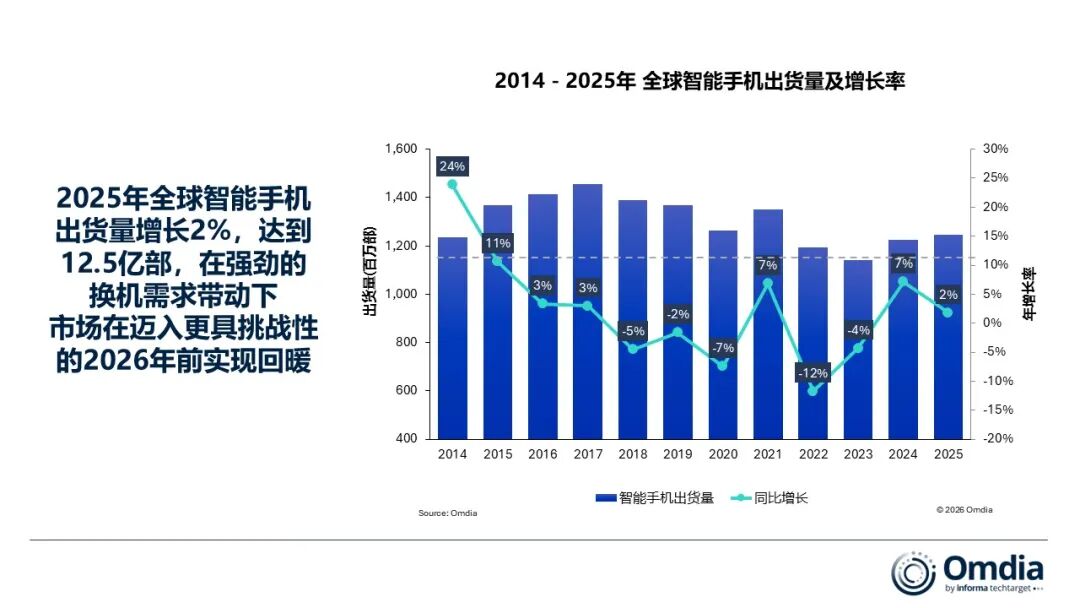
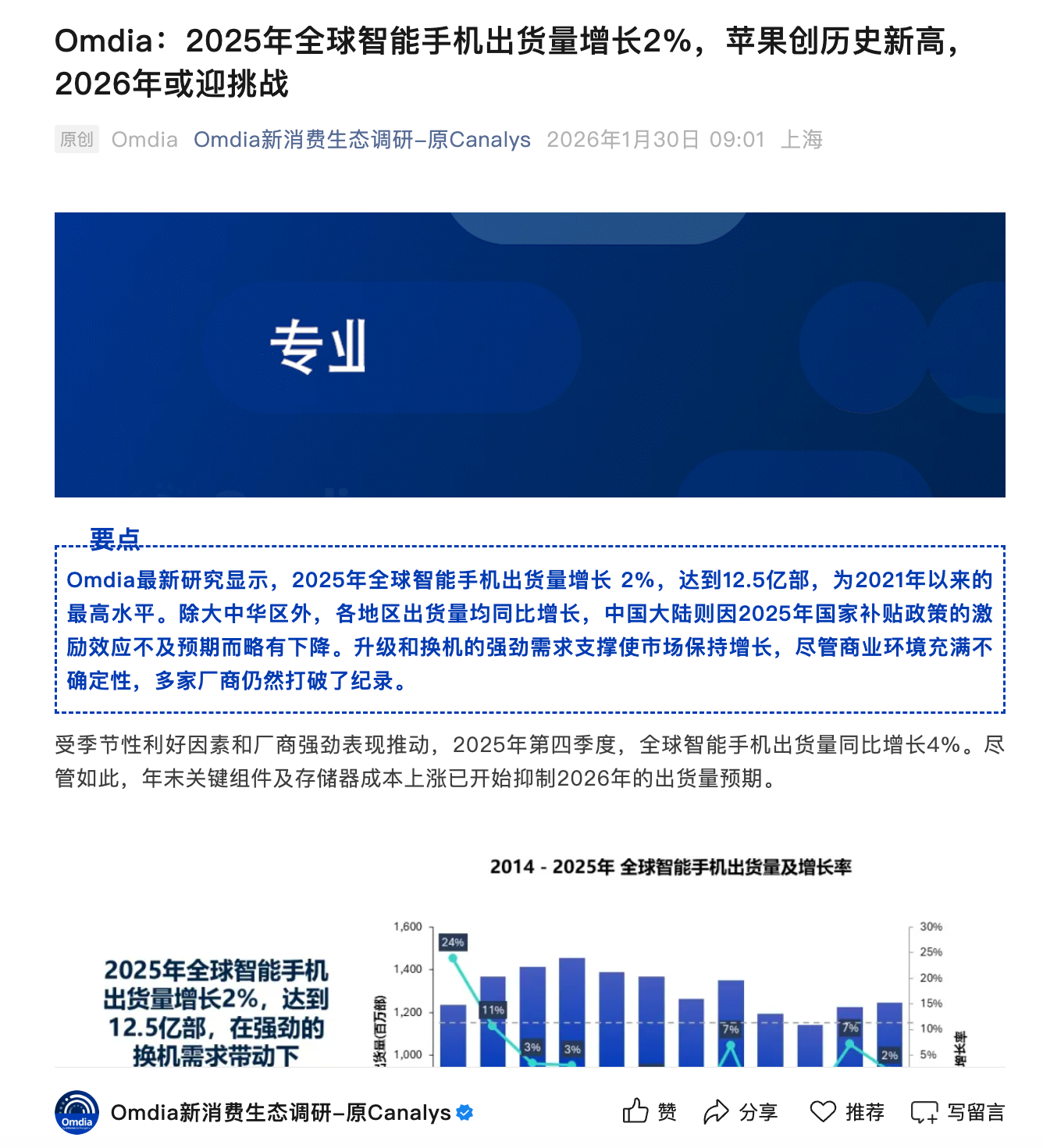
Omdia:2025年全球智能手机出货量增长2% 达到12.5亿部
Zhi Tong Cai Jing· 2026-01-30 01:41
Core Insights - Global smartphone shipments are projected to grow by 2% in 2025, reaching 1.25 billion units, marking the highest level since 2021, with all regions except Greater China experiencing year-on-year growth [1] - The fourth quarter of 2025 saw a 4% year-on-year increase in global smartphone shipments, driven by seasonal factors and strong vendor performance, although rising costs of key components began to suppress expectations for 2026 [1] Group 1: Company Performance - Apple achieved a record annual shipment of 240.6 million iPhones in 2025, a 7% increase year-on-year, maintaining its position as the largest smartphone manufacturer for the third consecutive year [4] - Samsung rebounded in 2025 with a 7% year-on-year increase in shipments, closing the year with a strong fourth quarter, driven by resilient demand for flagship models and a recovery in the entry-level market [4] - Xiaomi defended its top three position despite a 2% decline in fourth-quarter shipments, impacted by weak entry-level demand and significant market contraction [5] Group 2: Market Dynamics - Vivo entered the fourth position for the first time, with a 4% year-on-year increase in shipments to 10.53 million units, supported by success in the Indian market and stable domestic performance [5] - OPPO ranked fifth, with annual shipments of 10.07 million units, experiencing a 3% year-on-year decline, but returning to growth in the fourth quarter with the launch of new models [5] - Despite challenges, several manufacturers outside the top five maintained positive growth, with Honor and Lenovo achieving year-on-year increases of 11% and 6%, respectively [5] Group 3: Future Outlook - Concerns for 2026 are emerging due to escalating supply-side pressures on DRAM, NAND, and other semiconductors, which may compress profit margins and force price adjustments [8] - Companies must effectively manage supply chain pressures and strengthen long-term partnerships to mitigate the impact of rising costs on consumer demand [8] - The focus for manufacturers will shift towards profitability and exploring alternative revenue sources, with a strategic opportunity to capture upgrade demand and ensure market share sustainability [11]