
晶澳科技

Search documents
安泰科:硅片厂商挺价意愿强烈 单晶硅片价格继续上涨
Zhi Tong Cai Jing· 2026-01-08 13:40
Core Insights - The price of silicon wafers has continued to rise due to price support from silicon wafer manufacturers, downstream demand, and cost support from raw materials [1][2] Price Trends - N-type G10L monocrystalline silicon wafer (182*183.75mm/130μm) average transaction price is 1.31 yuan/piece, up 9.17% compared to the previous period - N-type G12R monocrystalline silicon wafer (182*210mm/130μm) average transaction price is 1.42 yuan/piece, up 8.40% compared to the previous period - N-type G12 monocrystalline silicon wafer (210*210mm/130μm) average transaction price is 1.66 yuan/piece, up 9.21% compared to the previous period [1][3] Market Dynamics - Downstream battery prices have significantly increased, with mainstream battery prices ranging from 0.37 to 0.39 yuan/W, up 18.75% compared to the previous period, while module prices remain stable at 0.66 to 0.68 yuan/W [1] - The supply side has seen a significant reduction in silicon wafer production, with December output at 47.7 GW, down 14.2% from November [2] - The overall operating rate in the industry remains stable, with major integrated companies operating at 50%-70% capacity [2] Price Stability and Future Outlook - Despite strong price increase intentions from silicon wafer manufacturers, the terminal component prices have not followed the upward trend, and battery manufacturers are planning to reduce production to alleviate supply-demand pressure, making it difficult for silicon wafer prices to maintain an upward trend in the short term [2]

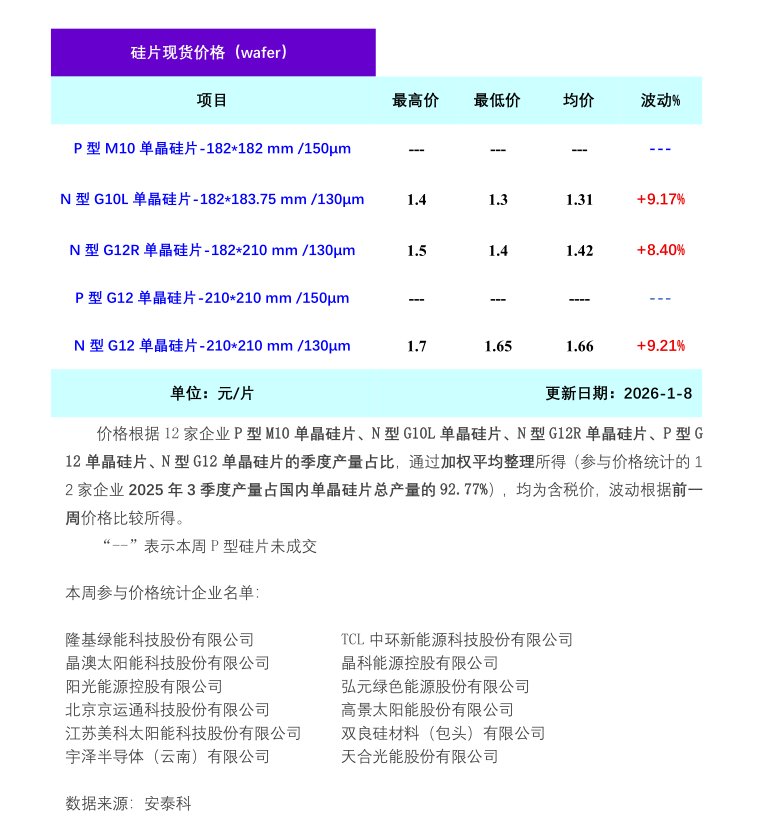
【安泰科】单晶硅片周评-市场情绪积极 硅片价格继续上行(2026年1月8日)
中国有色金属工业协会硅业分会· 2026-01-08 13:22
Group 1 - The core viewpoint of the article indicates that silicon wafer prices continue to rise due to strong demand from downstream battery manufacturers and cost support from raw materials [1][2] - The average transaction price for N-type G10L monocrystalline silicon wafers is 1.31 yuan per piece, up 9.17% compared to the previous period; N-type G12R wafers are priced at 1.42 yuan, up 8.40%; and N-type G12 wafers at 1.66 yuan, up 9.21% [1][3] - The average mainstream price for battery cells is between 0.37-0.39 yuan/W, reflecting an 18.75% increase, while module prices remain stable at 0.66-0.68 yuan/W [1] Group 2 - Silicon wafer production decreased significantly in December, with a total output of 47.7 GW, down 14.2% from November, leading to reduced inventory levels [2] - The operating rates of major silicon wafer manufacturers are stable, with two leading companies operating at 50% and 48%, while integrated companies operate between 50%-70% [2] - Despite the strong pricing intentions from silicon wafer manufacturers, the terminal component prices have not followed the upward trend, and battery cell manufacturers are planning to reduce production to alleviate supply-demand pressure [2]
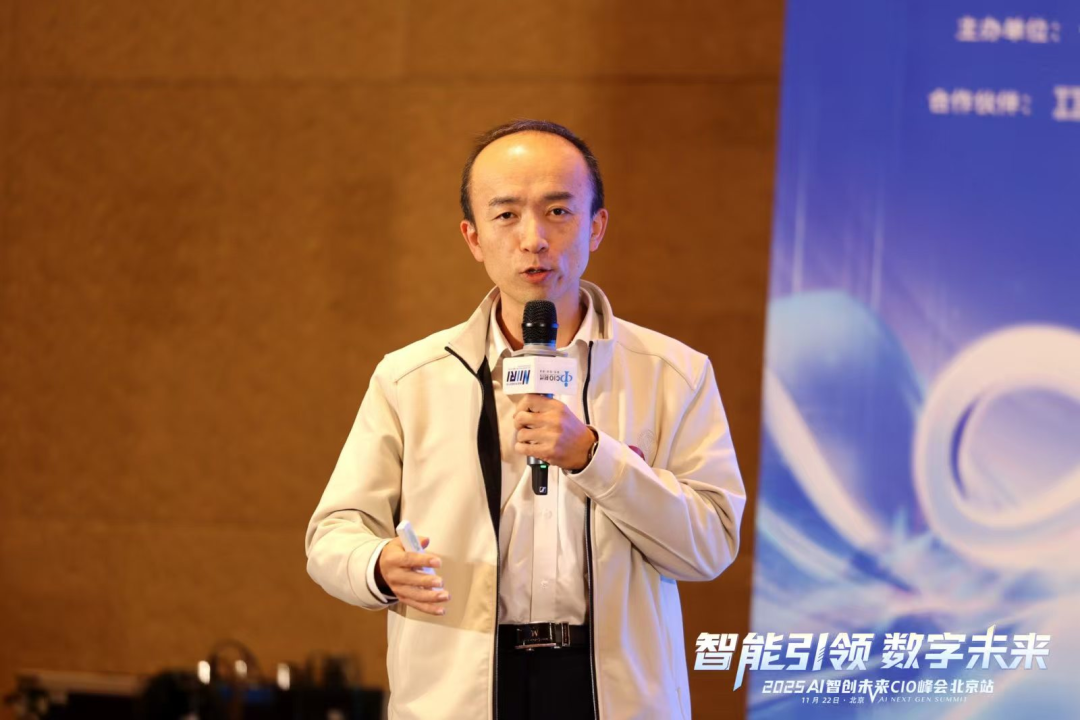
晶澳太阳能科技数字化总监张毅柱:在变革中破局,以数字强营销
Xin Lang Cai Jing· 2026-01-08 11:43
Core Insights - The conference "Smart Leadership, Digital Future | 2025 AI Intelligent Future CIO Summit" was recently held in Beijing, featuring a presentation by Zhang Yizhu, Digital Director of JA Solar Technology Co., Ltd., on "Marketing Digital Transformation Guided by Business Change" [1][13] Industry Context - The photovoltaic industry is undergoing significant changes, facing challenges such as price declines and intensified market competition, leading to a consensus on the need for "transformation" and "change" [4][16] - The market has shifted from a seller's market, characterized by "producing as much as possible," to a buyer's market, necessitating a change in marketing strategies to focus on demand-driven production [4][16] Marketing Digital Transformation Strategy - JA Solar emphasizes a step-by-step approach to marketing digital transformation, advocating for quick wins through opportunity management, production-sales collaboration, customer management, and risk warning systems [3][15] - The company recognizes the urgency of marketing transformation, driven by the need for market insight, precise customer management, and improved collaboration efficiency [5][17] Implementation Framework - The core logic of JA Solar's digital transformation is that "digitalization serves business needs, not the other way around," focusing first on identifying business pain points and setting clear transformation goals [6][18] - The transformation is structured around a dual support system of "architecture + culture," ensuring that digital functions align with specific business scenarios and fostering a culture of proactive participation among employees [6][18] Phased Approach to Transformation - The transformation is divided into five phases, each focusing on a core objective to ensure visible results and build confidence [19][20] - Phase 1: Online opportunity management, improving monitoring efficiency by over 60% [20] - Phase 2: Digital production-sales collaboration, enhancing supply chain response speed by 40% [20] - Phase 3: Precise customer management through a customer classification model [20] - Phase 4: Intelligent risk warning systems, improving contract risk identification accuracy by 80% [20] - Phase 5: Long-term customer management plans to foster win-win partnerships [21] Key Takeaways for Transformation - Successful transformation requires leadership commitment, with the chairman leading the initiative and establishing a cross-departmental change management committee [10][22] - Process optimization must precede digitalization, ensuring that workflows are efficient before being digitized [10][22] - Employees must perceive tangible benefits from the transformation to reduce resistance and foster motivation [10][22] Future Directions - JA Solar aims to enhance "full-link intelligent collaboration" in marketing, leveraging AI to analyze customer interactions and synchronize global market data for informed decision-making [11][23] - The company views marketing digital transformation as an ongoing process rather than a one-time project, striving to maintain a competitive edge in the evolving photovoltaic industry [11][23] Conclusion - JA Solar's marketing digital transformation serves as a valuable example for the industry, emphasizing the importance of aligning business needs with digital tools and fostering a supportive culture to navigate changes effectively [12][24]


太平洋证券:光伏行业反内卷加速供需重塑 重视新技术、新场景
Zhi Tong Cai Jing· 2026-01-08 02:55
Core Viewpoint - The photovoltaic industry is expected to accelerate supply-demand restructuring driven by the "anti-involution" trend, leading to gradual profit recovery by 2026 [1] Group 1: Supply-Demand Restructuring - The "anti-involution" spirit is deeply penetrating the photovoltaic industry, with main chain prices recovering from the top down, and auxiliary material leading companies showing significant profit recovery by Q3 2025 [1] - The rapid development of energy storage, alongside the implementation of grid parity for solar storage in key markets like China, the US, and Europe, is expected to alleviate the impact of increased photovoltaic installations on the grid [1] - The long-term demand outlook is optimistic due to rising computing power needs and breakthroughs in core photovoltaic technologies for space stations, which will open new application scenarios [1] Group 2: Technology Iteration and Profit Recovery - The penetration rate of low-silver and silver-free technologies is expected to rise quickly, with leading companies likely to recover profits faster than the industry average due to rapid cost reduction in component production [2] - The introduction of low-silver solutions by JinkoSolar and silver-free technologies by LONGi Green Energy is highlighted as key developments in this technology iteration [2] Group 3: Auxiliary Material Companies - Auxiliary material companies are expected to accelerate profit recovery through diversified business layouts, as the pressure on the photovoltaic main chain has been ongoing for over three years [3] - Leading companies in auxiliary materials are preparing for a second growth phase, with non-photovoltaic business proportions expected to increase, contributing to revenue and profit reversals [3] Group 4: Beneficiary Analysis - Companies leading in low-silver and silver-free technology iterations, such as LONGi Green Energy, JinkoSolar, Aiko Solar, and Tongwei Co., are expected to benefit from cost advantages [4] - Companies actively integrating energy storage with photovoltaic operations, like Trina Solar, JinkoSolar, LONGi Green Energy, and JA Solar, are likely to see profit recovery [4] - Leading companies in supporting facilities, such as DKE Holdings, Juhua Materials, and Foster, are expected to continue profit recovery through new technology breakthroughs and business expansions [4]




晶澳科技涨2.02%,成交额2.04亿元,主力资金净流入1648.34万元
Xin Lang Cai Jing· 2026-01-08 02:29
Core Viewpoint - JinkoSolar Technology Co., Ltd. has experienced fluctuations in stock performance and significant changes in financial metrics, indicating potential investment opportunities and challenges in the solar energy sector. Group 1: Stock Performance - On January 8, JinkoSolar's stock rose by 2.02%, reaching 12.11 CNY per share, with a trading volume of 204 million CNY and a turnover rate of 0.52%, resulting in a total market capitalization of 40.08 billion CNY [1] - Year-to-date, the stock price has increased by 5.76%, with a 4.04% rise over the last five trading days, a 5.67% increase over the last 20 days, but a decline of 12.63% over the last 60 days [1] Group 2: Financial Performance - For the period from January to September 2025, JinkoSolar reported a revenue of 36.809 billion CNY, a year-on-year decrease of 32.27%, and a net profit attributable to shareholders of -3.553 billion CNY, reflecting a significant year-on-year decline of 633.54% [2] - Cumulatively, JinkoSolar has distributed 3.055 billion CNY in dividends since its A-share listing, with 2.415 billion CNY distributed over the past three years [3] Group 3: Shareholder Structure - As of September 30, 2025, the number of shareholders for JinkoSolar was 147,800, a decrease of 17.24% from the previous period, while the average number of circulating shares per person increased by 20.84% to 22,370 shares [2] - Among the top ten circulating shareholders, Hong Kong Central Clearing Limited holds 214 million shares, a decrease of 7.3649 million shares from the previous period, while other notable shareholders have seen varying changes in their holdings [3]
山西证券研究早观点-20260108
Shanxi Securities· 2026-01-08 01:11
Market Trends - The domestic market indices showed slight fluctuations, with the Shanghai Composite Index closing at 4,085.77, up by 0.05%, while the CSI 300 Index fell by 0.29% to 4,776.67 [4]. Industry Commentary: Communication - The communication industry outperformed in 2025, with a cumulative increase of 84.8%, ranking second among major sectors. Key segments included optical modules, liquid cooling, optical fibers, and satellite communications, with respective increases of 357.2%, 221.4%, 188.9%, and 160.2% [6]. - For 2026, the focus will be on overseas optical communications, domestic computing power, and commercial aerospace, which are expected to present high-low trading opportunities driven by event catalysts [6]. - The demand for 800G optical modules is projected to reach approximately 45 million units in 2026, doubling from 2025, with significant contributions from NV and ASIC [6]. Industry Commentary: Coal - The coal industry is expected to reverse the trend of internal competition, with a focus on controlling supply and improving profitability. The anticipated coal price for 2026 is around 720 RMB/ton, maintaining a tight balance [10]. - The report suggests that the "反内卷" (anti-involution) strategy will help stabilize coal prices and improve profitability, with a projected recovery in performance for the fourth quarter [10]. Industry Commentary: Photovoltaics - The price of polysilicon has increased, with average prices for dense materials rising to 54.0 RMB/kg, a 3.8% increase from the previous week. The total production of polysilicon in 2025 is estimated at 131.9 million tons, a decrease of 28.4% year-on-year [12]. - The average price of N-type battery cells has risen by 2.6% to 0.39 RMB/W, reflecting a response to inventory pressures and demand softness [14]. - The report highlights key companies to watch in the photovoltaic sector, including 隆基绿能 (LONGi Green Energy) and 晶澳科技 (JA Solar Technology) [14].
晶澳科技:公司不存在逾期担保
Zheng Quan Ri Bao Wang· 2026-01-07 13:45
Core Viewpoint - Jingao Technology (002459) announced a guarantee balance of RMB 60.04 billion as of December 31, 2025, which represents 215.22% of the audited net assets attributable to shareholders for the fiscal year 2024 [1] Group 1 - The guarantee amount provided for subsidiaries within the consolidated financial statements is RMB 56.91 billion [1] - The guarantee amount provided for companies outside the consolidated financial statements is RMB 3.13 billion [1] - The company has no overdue guarantees, no guarantees involved in litigation, and no losses due to guarantees resulting in adverse judgments [1]
晶澳科技:JAM66D50-650高功率组件是公司晶澳新量产的DeepBlue 5.0产品
Zheng Quan Ri Bao Wang· 2026-01-07 11:44
证券日报网讯 1月7日,晶澳科技(002459)在互动平台回答投资者提问时表示,JAM66D50-650高功率 组件是公司晶澳新量产的DeepBlue5.0产品。该系列组件最大功率可达670W,量产组件效率最高达 24.8%,在当前主流大尺寸n型组件中处于领先水平。DeepBlue5.0的设计逻辑聚焦于"全生命周期发电收 益最大化"和"系统端综合成本最优",该产品在电池技术、组件设计和制造工艺上实现了多项关键突 破,其中Bycium+5.0n型钝化接触电池技术、更高密度封装与先进互联技术、高双面率等技术的升级为 DeepBlue5.0的更新迭代提供了坚实的基础。 ...
反内卷加速供需重塑,重视新技术、新场景
Tai Ping Yang Zheng Quan· 2026-01-07 10:46
Group 1 - The "anti-involution" trend is reshaping supply and demand in the photovoltaic industry, with price recovery expected as the market stabilizes. The introduction of energy storage at parity in key markets is accelerating, alleviating pressure on the grid from rapid increases in photovoltaic installations. The long-term demand outlook is optimistic due to rising computing power needs and breakthroughs in photovoltaic technology for space applications [2][12][14]. Group 2 - The penetration of low-silver and silver-free technologies is expected to increase rapidly, with leading companies likely to recover profitability faster than the industry average. The rise in silver prices is driving the adoption of these technologies, which are crucial for cost reduction [3][38][43]. Group 3 - The auxiliary material sector, under pressure for over three years, is expected to see a recovery in profitability as companies diversify their business models. Leading firms are preparing for a second growth phase, which will enhance their revenue streams [4][63]. Group 4 - Beneficiary analysis indicates that companies leading in low-silver and silver-free technology, such as Longi Green Energy and JinkoSolar, are well-positioned to benefit from cost advantages. Companies actively investing in energy storage, like Trina Solar and JA Solar, are also expected to see early recovery in profitability [5][73]. Group 5 - Global demand for photovoltaic installations is projected to grow, with an estimated 600 GW and 610 GW of new installations in 2025 and 2026, respectively. However, growth rates may slow due to market saturation in core regions like China and Europe [8][14]. Group 6 - The supply side is experiencing overcapacity, with significant production increases expected in silicon materials and components. The "anti-involution" movement is leading to reduced capital expenditures, which may help manage supply effectively [12][30]. Group 7 - The photovoltaic industry is witnessing a shift towards new technologies and applications, such as space photovoltaics and perovskite solar cells, which are expected to expand market opportunities significantly [49][54].


晶澳科技(002459) - 关于2025年度公司提供担保的进展公告
2026-01-07 09:15
| | | 证券代码:002459 证券简称:晶澳科技 公告编号:2026-003 债券代码:127089 债券简称:晶澳转债 晶澳太阳能科技股份有限公司 关于 2025 年度公司提供担保的进展公告 一、合并报表范围内担保情况概述 1、担保额度审批 晶澳太阳能科技股份有限公司(以下简称"公司")于2024年12月10日召开 第六届董事会第三十一次会议、2024年12月30日召开2024年第三次临时股东大会, 审议通过了《关于2025年度公司与下属公司担保额度预计的议案》,同意公司为 合并报表范围内下属公司提供担保、下属公司之间互相担保、下属公司为公司提 供担保,2025年度新增担保额度总计不超过人民币880亿元,其中向资产负债率 为70%以上的担保对象的新增担保额度为不超过568亿元,向资产负债率为70% 以下的担保对象的新增担保额度为不超过312亿元。担保范围包括但不限于申请 融资业务发生的融资类担保(包括贷款、银行承兑汇票、外汇衍生品交易、信用 证、保函等业务)以及日常经营发生的履约类担保。担保种类包括一般保证、连 带责任保证、抵押、质押等。在上述额度范围内,公司及下属公司因业务需要办 理上述担保范围内业 ...