
Arm Holdings plc

Search documents
Arm Holdings Stock is Down 43%. It’s an Underrated Play on Physical AI
Yahoo Finance· 2026-01-20 15:31
Group 1: AI and Semiconductor Industry Trends - The tech and AI trade has become more volatile, with semiconductor stocks, particularly memory chip makers and semiconductor equipment, experiencing significant growth recently [2] - The emergence of a new class of high-tech leaders is noted as the AI revolution enters its fourth year, with the "Magnificent Seven" stocks showing varied performance [2] - The AI landscape has evolved since the introduction of ChatGPT over three years ago, with expectations for more significant advancements in 2026, particularly in agentic AI and robotics [3] Group 2: Arm Holdings Performance and Strategy - Arm Holdings' stock has declined approximately 43% from its peak, raising concerns about potential further drops below $100 per share due to analyst downgrades related to overvaluation [6][7] - The company has launched a physical AI division and restructured its focus towards humanoid robots and autonomous vehicles, indicating a strategic shift in its business model [7] - Investor concerns have been heightened by Softbank's margin loan backed by Arm shares, which could lead to forced selling during market downturns [7]

RT-Thread熊谱翔:开源是国产操作系统构建生态的最佳路径
Guan Cha Zhe Wang· 2026-01-20 14:11
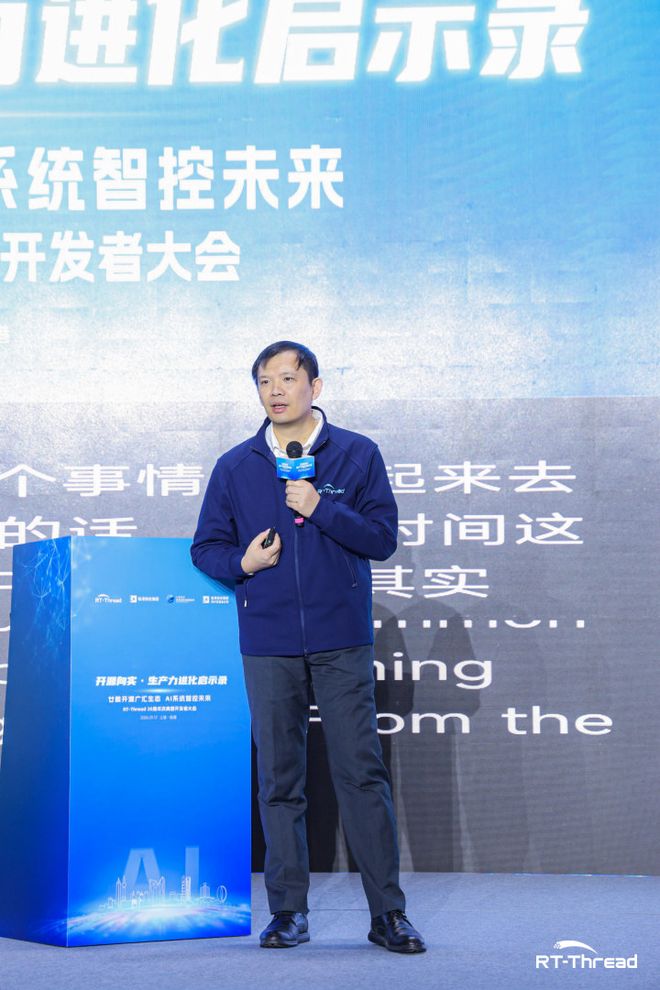
近日,"开源向实·生产力进化启示录"全球峰会暨RT-Thread睿赛德二十周年开发者大会在沪举行。大会 汇聚政府领导、中国工程院院士、国内外知名企业代表、全球核心开发者、技术管理者共话开源如何重 构生产关系,促进生产力发展变革,吸引来自芯片、工业、汽车、机器人、能源、通信等多个领域上千 名产业代表参加。 本次大会启幕之时,恰逢上海将开源体系建设升维为城市核心战略、冲刺"国际开源高地"的关键窗口 期。深耕开源二十载的RT-Thread睿赛德,以自身积淀的全球影响力锚定这一命题:本次大会不仅具象 化其技术生态的繁荣样态与产业纵深,更以基础软件领域的自主实践,彰显中国正从开源规则的追随 者,向全球生态主导者跃迁的硬核底气与坚定决心。 开源力量汇聚全球智慧,推动生产力进化 真正的基础软件价值,不仅在于版本更新的速度,而在于能否经受十年、二十年的时间考验,被开发者 和产业持续使用与验证。大会主论坛上,RT-Thread睿赛德创始人&CEO熊谱翔发表了主题演讲《开源 筑基 质效跃迁:RT-Thread的'从零到亿'》,系统回顾了RT-Thread睿赛德自2006年诞生以来的关键演进 节点。二十年来,RT-Thread睿赛 ...

Jim Cramer on Arm Holdings: “I Would Hold It”
Yahoo Finance· 2026-01-19 13:29
Group 1 - Arm Holdings plc (NASDAQ:ARM) has experienced a significant decline in stock price, prompting discussions about whether to hold, sell, or buy more shares [1][2] - The stock has seen a 23% loss over the past year, raising concerns about its performance despite the positive assessment of CEO Rene Haas [2] - There is speculation that the decline may be linked to a high price-to-earnings multiple and potential selling of SoftBank's stake in the company [1] Group 2 - Arm Holdings designs and licenses CPU architectures, system IP, and software for various applications, including automotive, computing, consumer, and IoT [2] - Despite the current challenges, there is a belief that certain AI stocks may present better investment opportunities with higher upside potential and lower downside risk [2]
Arm (ARM) Downgraded by BofA on Smartphone and Royalty Headwinds
Yahoo Finance· 2026-01-17 17:56
Group 1 - Arm Holdings plc (NASDAQ:ARM) has been downgraded from Buy to Neutral by BofA Securities, with a price target reduction from $145 to $120 ahead of its Q3 fiscal year 2026 results on February 4 [1] - The downgrade is attributed to near-term challenges in the smartphone market, including rising memory costs, increased reliance on SoftBank for licensing, and a slowdown in royalty revenue, which currently accounts for only about 10% of total royalties [1][3] - Global smartphone shipments are expected to decline at a low single-digit rate year-over-year, influenced by higher memory costs and supply constraints, which will negatively impact Arm's Client business that generates over 50% of royalty revenue [2][3] Group 2 - Revenue for Arm is projected to slow down, particularly in royalties and licensing, with a potential decline of 5% year-over-year in FY26 if excluding SoftBank, which now constitutes 25-30% of total licensing revenue [3] - Despite the short-term challenges, Arm's long-term potential in the data center market remains favorable, with opportunities in server content and new silicon/chiplet developments [2][3]
Micron Celebrates Official Groundbreaking at New York Megafab Site
Globenewswire· 2026-01-16 13:30
Core Insights - Micron Technology, Inc. is breaking ground on a $100 billion memory manufacturing complex in Onondaga County, New York, which will be the largest semiconductor facility in the U.S. and create 50,000 jobs [1][3][5] Group 1: Project Overview - The New York project represents the largest private investment in the state's history and aims to meet the increasing demands of AI systems and devices [3][5] - Production at the new facility is expected to start in 2030, with ramp-up throughout the decade [6] Group 2: Economic Impact - The project is part of Micron's broader $200 billion expansion plan in the U.S., which includes additional fabs in Idaho and Virginia, and aims to produce 40% of its DRAM in the U.S., generating approximately 90,000 jobs [5] - Micron plans to invest $250 million in workforce development and community initiatives through a $500 million community investment framework [4] Group 3: Industry Support - Key industry leaders, including executives from NVIDIA, Google Cloud, Apple, Microsoft, and others, have expressed strong support for Micron's investment, highlighting its importance for the U.S. semiconductor supply chain and AI infrastructure [7][8][9][10][11][12] - The groundbreaking event was attended by various government officials, emphasizing bipartisan support for the project and its potential to revitalize the local economy [2][13][16] Group 4: Government and Community Response - New York Governor Kathy Hochul and Senate Democratic Leader Chuck Schumer highlighted the project's significance for economic development and job creation in the region [15][16] - Local officials, including Onondaga County Executive Ryan McMahon, expressed excitement about the transformative potential of the project for the community [17]

RISC-V+GPU,SiFive重磅宣布
半导体芯闻· 2026-01-16 10:27
Core Viewpoint - SiFive, a leading company in the RISC-V space, is now supporting NVIDIA's proprietary NVLink Fusion interconnect technology, raising questions about the viability of its competitor UALink technology [1][2]. Group 1: SiFive and NVLink Fusion - SiFive designs CPU cores and processors based on the RISC-V instruction set architecture (ISA), applicable in various scenarios from edge computing to data centers, and licenses its designs to customers [1]. - The announcement indicates that SiFive's designs will now include support for NVLink, which allows NVIDIA's customers to abstract an entire CPU and GPU as a unified accelerator, providing up to 3.6 TB/s of inter-chip bandwidth [1][2]. - SiFive's CEO, Patrick Little, stated that the adoption of NVLink Fusion reflects a shift in the industry towards heterogeneous, collaborative design systems, where open CPU architectures and advanced interconnect technologies define the future of AI data center computing [2]. Group 2: Industry Support and Developments - Major companies such as Intel, Arm, and Qualcomm are fully supporting NVLink Fusion, with Intel planning to release client systems that connect its CPU chips with NVIDIA's GPU chips using this technology [2]. - NVIDIA supports two configurations of NVLink Fusion: one that combines partner CPUs with NVIDIA GPUs, and another that allows customers to integrate NVIDIA's Grace or Vera CPUs with their custom XPU or AI accelerators [2]. - SiFive is focused on helping its customers build custom CPUs using its cores and reference designs for SoCs integrated with NVIDIA CPUs [3]. Group 3: UALink Technology Challenges - UALink was initially envisioned as an open alternative to NVLink, supported by numerous companies including Intel, AMD, Amazon, Meta, Microsoft, and Arm; however, establishing the standard has proven difficult [4]. - The lack of UALink switches has forced AMD to transmit the protocol through standard Ethernet tunnels, complicating the implementation [4]. - Broadcom, once a strong supporter of UALink, is now promoting its own interconnect architecture called Scale Up Ethernet (SUE) [4].


花旗:英特尔迎来AI芯片代工“窗口期”,美光因DRAM涨价放缓移出观察名单
Jin Rong Jie· 2026-01-16 06:28
Group 1: Intel - Citigroup upgraded Intel's rating from "Sell" to "Neutral" with a target price set at $50 [2] - The upgrade is based on Intel's potential benefits from the tight advanced packaging capacity situation at TSMC [2] - Analyst Atif Malik noted that Intel has a unique opportunity to attract foundry customers with government support [2] - Intel is expected to benefit from improved yields in its 18A - P/14A processes, particularly in AI-specific integrated circuits [2] - Despite positive factors, Intel is still facing challenges, including potential market share loss to AMD and Arm, and a weak PC market that may lead to rising memory prices [2] Group 2: Micron Technology - Micron Technology has been removed from the U.S. focus watchlist due to expected slowing pricing momentum for DRAM in Q2 compared to Q1 [3] - Malik explained that Micron's stock price typically aligns with quarterly price trends [3] - Strong demand in the AI sector and limited foundry capacity are expected to maintain supply-demand balance for memory until 2026/27 [3]

花旗:英特尔(INTC.US)迎来AI芯片代工“窗口期”,美光(MU.US)因DRAM涨价放缓移出观察名单
Zhi Tong Cai Jing· 2026-01-16 06:17
Group 1: Intel - Citigroup upgraded Intel's rating from "Sell" to "Neutral" with a target price set at $50, citing benefits from TSMC's advanced packaging capacity constraints [2] - Analyst Atif Malik noted that Intel has a unique opportunity to attract foundry wafer customers with government support [2] - Intel is expected to benefit from improved yields in its 18A-P/14A processes, particularly in the backend, leading to positive effects from AI-specific integrated circuits [2] - Despite positive factors, Intel is still facing challenges, including potential market share loss to AMD and Arm, and a weak personal computer market that may lead to rising memory prices [2] Group 2: Micron Technology - Micron Technology has been removed from the U.S. focus watch list due to expected slowing pricing momentum for DRAM in Q2 compared to Q1 [3] - Micron's stock price typically aligns with quarterly price trends, according to Malik [3] - The supply-demand balance for memory is expected to remain stable until 2026/27, driven by limited foundry capacity and strong demand in the AI sector [3]
AI芯片高景气延续!RBC预测:三年内规模有望突破5500亿美元
智通财经网· 2026-01-16 02:17
Group 1 - The core viewpoint of the article is that semiconductor revenue from AI applications is expected to grow significantly, from $220 billion in 2025 to over $550 billion by 2028, according to RBC Capital Markets [1] - Current market supply is tight, with enterprise order delivery cycles extended to 18 months, which clarifies the industry's outlook [1] - Infrastructure bottlenecks may delay some projects, but this could smooth out the spending cycle in the AI sector rather than being a negative factor [1] Group 2 - RBC Capital Markets has initiated coverage on several semiconductor companies, giving them an "outperform" rating, including Nvidia, Micron Technology, Marvell Technology, Arm, Astera Labs, ASML, Applied Materials, Lam Research, and Lattice Semiconductor [1] - For companies like Broadcom, AMD, Intel, KLA, SanDisk, Qualcomm, Skyworks, and Silicon Labs, RBC has assigned a "market perform" rating [2] Group 3 - High Bandwidth Memory (HBM) demand is expected to be a core growth driver, potentially reducing the cyclical volatility of the memory market [3] - AI workloads are shifting towards reinforcement learning and distributed inference, which require high memory performance [3] - The upcoming HBM4 iteration is anticipated to be beneficial, with average prices expected to increase by 30-50% [3] - The demand for high-capacity server memory (DIMM) and solid-state drives (NAND eSSD) is also driven by the explosion of generative AI [3] - Despite high memory prices potentially impacting demand in the PC and smartphone markets, the memory industry is expected to remain in a supply-demand imbalance until 2027 [3] - Capital expenditures in the wafer fabrication equipment (WFE) sector are projected to maintain strong growth over the next two years [3] - Technological trends such as backside power delivery, advanced packaging, and three-dimensional structures are expected to drive at least high single-digit growth in the wafer fabrication equipment market over the next two years [3]


今夜,科技股暴涨
Zhong Guo Ji Jin Bao· 2026-01-15 22:44
Group 1: Market Performance - US stock market saw significant gains on January 15, with technology stocks, particularly semiconductor companies, leading the rally. The Dow Jones increased by 0.65%, the Nasdaq Composite rose by 0.79%, and the S&P 500 gained 0.61% [1] - The semiconductor sector's strength was driven by TSMC's latest earnings report, which showed a 35% year-over-year profit increase, boosting investor confidence in AI themes [1][12] - TSMC's stock surged over 6%, reaching a historic high with a market capitalization exceeding $1.8 trillion, surpassing Broadcom to become the sixth largest company in the US stock market [1] Group 2: Individual Stock Movements - Notable stock movements included Sandisk Corporation up by 7.07%, AMD up by 6.11%, TSMC up by 5.99%, ASML up by 5.61%, Micron Technology up by 3.24%, and Broadcom up by 2.82% [2] - The Philadelphia Semiconductor Index experienced a significant increase of 3% [1] Group 3: Economic Indicators - The market is also reacting to macroeconomic data, with the US labor market showing resilience. Initial jobless claims unexpectedly fell to 198,000, the lowest since November, indicating that layoffs have not significantly increased at the start of the year [12] - New York state manufacturing activity is expanding, and the US dollar is strengthening [12] Group 4: Oil Market Reaction - International oil prices plummeted following President Trump's comments that alleviated market fears regarding potential military action against Iran [14][16] - Trump's statement was interpreted as a signal that the US might delay any military response, impacting Brent crude prices, which remain above last week's low of $60 per barrel [16]

