
海螺水泥

Search documents
水泥股涨幅居前 全国累计水泥产量同比下降 机构看好行业供给自律共识强化
Zhi Tong Cai Jing· 2026-01-22 06:48
消息面上,国家统计局数据显示,2025年,全国累计水泥产量16.93亿吨,同比下降6.9%,降幅与1-11 月持平,较去年同期收窄2.6个百分点,产量为2010年以来同期最低水平。12月份,全国单月水泥产量 1.44亿吨,环比和同比均下降6.6%。 水泥股涨幅居前,截至发稿,中国建材(03323)涨5.82%,报5.27港元;金隅集团(601992)(02009)涨 5%,报0.84港元;海螺水泥(600585)(00914)涨4.6%,报24.1港元;华润建材科技(01313)涨4.35%,报 1.68港元。 东吴证券指出,水泥行业供给侧主动调节的力度和持续性有望维持。该行判断2026年在龙头引领下供给 自律共识强化,行业错峰力度不断增强,提供盈利底部支撑,但需求不稳的背景下,行业供需需要频繁 再平衡,制约行业盈利弹性。若实物需求企稳改善,水泥旺季价格弹性可观。该行认为2026年行业盈利 环比2025年下半年有望呈现震荡中改善的态势,部分基建重点项目需求增量较大的省份景气有望明显领 先全国整体水平。 ...
港股异动 | 水泥股涨幅居前 全国累计水泥产量同比下降 机构看好行业供给自律共识强化
智通财经网· 2026-01-22 06:46
消息面上,国家统计局数据显示,2025年,全国累计水泥产量16.93亿吨,同比下降6.9%,降幅与1-11 月持平,较去年同期收窄2.6个百分点,产量为2010年以来同期最低水平。12月份,全国单月水泥产量 1.44亿吨,环比和同比均下降6.6%。 东吴证券指出,水泥行业供给侧主动调节的力度和持续性有望维持。该行判断2026年在龙头引领下供给 自律共识强化,行业错峰力度不断增强,提供盈利底部支撑,但需求不稳的背景下,行业供需需要频繁 再平衡,制约行业盈利弹性。若实物需求企稳改善,水泥旺季价格弹性可观。该行认为2026年行业盈利 环比2025年下半年有望呈现震荡中改善的态势,部分基建重点项目需求增量较大的省份景气有望明显领 先全国整体水平。 智通财经APP获悉,水泥股涨幅居前,截至发稿,中国建材(03323)涨5.82%,报5.27港元;金隅集团 (02009)涨5%,报0.84港元;海螺水泥(00914)涨4.6%,报24.1港元;华润建材科技(01313)涨4.35%,报 1.68港元。 ...
海螺水泥:公司积极推动落实市值管理的各项举措
Zheng Quan Ri Bao· 2026-01-21 13:13
(文章来源:证券日报) 证券日报网讯 1月21日,海螺水泥在互动平台回答投资者提问时表示,公司股价波动受宏观经济、行业 和市场形势等多种复杂因素综合影响。公司将围绕已制定的《市值管理制度》,积极推动落实市值管理 的各项举措,持续提升经营发展质量,不断增强公司的内在投资价值。 ...
建材行业点评:量变累积,建材行业复苏可期
Shenwan Hongyuan Securities· 2026-01-21 10:41
Investment Rating - The report maintains a positive outlook on the building materials industry, indicating a "Look Forward" investment rating [3][4]. Core Insights - The real estate sector has experienced a downturn for five consecutive years, but there are emerging positive signals that warrant attention. The building materials industry has faced pressures such as declining demand, credit risk expansion, cost disturbances, and intensified competition [4][5]. - Over the past five years, the industry has undergone significant capacity clearance, with a cumulative decline of 38% in waterproof materials production from 2021 to 2024. In contrast, the top three companies in this sector have seen a revenue decline of only 20.9%, indicating a rapid increase in industry concentration [4][5]. - Strategic transformations have been completed by several leading building materials companies, enhancing their competitive positions and adapting to market changes. Companies like Dongfang Yuhong and Keshun have successfully restructured their channels and expanded into new markets [6]. - There is an anticipated surge in renovation demand due to the aging housing stock, with a significant portion of homes being over 20 years old. The report predicts that by 2025, second-hand housing transactions will account for 70% of the market, which will likely stimulate renovation activities [7][9]. - Policy adjustments have been noted, with government signals indicating support for the real estate sector, including tax incentives for housing transactions. This is expected to positively influence market sentiment and investment in the building materials sector [9]. Summary by Sections Industry Overview - The building materials industry has faced five years of challenges, but recent developments suggest a potential recovery. The report emphasizes the importance of viewing the industry from a long-term perspective [4][5]. Capacity and Production - The report highlights a significant reduction in production capacity across various segments, including a 38% decline in waterproof materials and a 1.6 billion ton reduction in cement capacity, which has alleviated supply pressures [4][5]. Strategic Transformations - Notable companies have successfully navigated strategic transformations, with improvements in asset quality and revenue growth. For instance, Dongfang Yuhong has seen a substantial increase in retail business revenue [6]. Demand Dynamics - The report anticipates a shift in demand dynamics, particularly in the renovation market, driven by an aging housing stock and changing consumer preferences. This is expected to lead to increased demand for building materials [7]. Policy Environment - Recent policy changes are viewed as supportive of the real estate market, with indications of government backing for housing transactions and urban renewal initiatives [9]. Investment Recommendations - The report suggests focusing on core consumer building materials stocks, particularly those positioned to benefit from anticipated increases in construction activity and renovation demand [9].


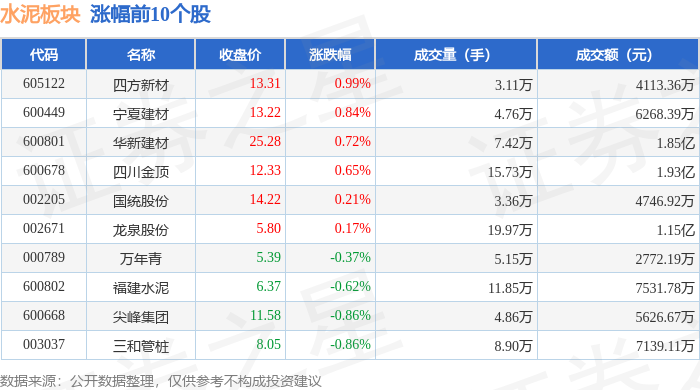
水泥板块1月21日跌1.1%,西部建设领跌,主力资金净流出2152.29万元
Zheng Xing Xing Ye Ri Bao· 2026-01-21 08:54
Group 1 - The cement sector experienced a decline of 1.1% on January 21, with Western Construction leading the drop [1] - The Shanghai Composite Index closed at 4116.94, up 0.08%, while the Shenzhen Component Index closed at 14255.12, up 0.7% [1] - Key stocks in the cement sector showed varied performance, with Sifang New Material rising by 0.99% and Wan Nian Qing falling by 0.37% [1] Group 2 - Western Construction saw a significant drop of 4.78%, with a trading volume of 335,700 shares and a transaction value of 202 million yuan [2] - The cement sector's main funds experienced a net outflow of 21.52 million yuan, while retail funds saw a net outflow of 14.97 million yuan [2] - Major stocks like Conch Cement had a net inflow of 83.13 million yuan from main funds, despite a net outflow from retail investors [3]


双碳下建筑建材行业机会
2026-01-21 02:57
Summary of Key Points from Conference Call Industry Overview - The conference call focuses on the construction and building materials industry in China, particularly in the context of carbon neutrality initiatives and the impact of carbon emission trading policies on the cement sector [1][2][3]. Core Insights and Arguments - **Green Energy and Engineering Companies**: Companies like China Electric Power Construction and China Energy Engineering are positioned to benefit from increased investment in the power grid and growing demand for technological upgrades from downstream clients [1][3]. - **Cement Industry Leaders**: Major cement companies, such as Conch Cement, are expected to benefit from investments in energy-saving and carbon reduction technologies, as well as policies aimed at reducing excess capacity [1][3]. - **Emerging Coal Chemical Sector**: The emerging coal chemical industry is seen as having significant growth potential, especially given the strategic importance of oil security in China. Companies like China Chemical and Donghua Technology are expected to benefit from this trend [1][4][5]. - **Carbon Emission Trading Market**: The national carbon emission trading market is experiencing a trend of increasing prices. Companies failing to meet advanced standards will incur additional production costs due to the need to purchase carbon credits [1][6]. - **Cost Impact of Carbon Credits**: By the end of 2025, the price of carbon credits is expected to reach 80 RMB per ton, with initial cost impacts on cement companies being relatively limited, estimated at less than 3 RMB per ton of clinker [1][8]. Additional Important Insights - **Policy Implementation Timeline**: Policies to limit overproduction in the cement industry are set to be implemented in Q1 2026, presenting a favorable time for investment as the competitive landscape is expected to be reshaped through long-term adjustments [2][11]. - **Market Performance Drivers**: The current strong performance of the construction and building materials sector is attributed to low valuations and catalysts such as increased investment in the power grid and rising demand for technological upgrades from clients [7]. - **Long-term Effects of Carbon Policies**: The carbon quota policy is a long-term process that will gradually lead to the exit of outdated production capacity. The implementation of short-term measures will create opportunities for industry consolidation starting in Q1 2026 [12][13]. - **Valuation and Investment Timing**: The cement industry is currently at a historical valuation low, making it an attractive investment opportunity. Companies like Conch Cement and others are trading below book value, indicating potential for price appreciation [11]. Conclusion - The construction and building materials industry in China is poised for significant changes driven by carbon neutrality policies and market dynamics. Key players in the green energy and cement sectors are well-positioned to capitalize on these trends, making this an opportune time for investment.

十五五-的降碳路径与机遇解读
2026-01-21 02:57
Summary of Key Points from the Conference Call Industry Overview - The focus is on China's carbon emission control system, which includes quotas, Green Certificates, and China Certified Emission Reduction (CCER) [1][3][4]. Core Insights and Arguments - **Carbon Emission Control System**: The system aims to constrain carbon-emitting enterprises, promote green electricity development, and compensate for carbon reduction projects. Key industries currently included are steel, cement, and aluminum smelting, with plans to cover chemical, coking, and paper industries by the end of 2027 [1][3]. - **Quota Management**: The baseline values for quotas are set below equilibrium values, creating pressure for carbon reduction. The government will adjust these values based on actual conditions [1][4]. - **Carbon Price Trends**: The downward trend in carbon prices is a result of government policies providing companies with a buffer to adapt. The annual carbon reduction pressure is estimated at -0.5% [5]. - **Green Certificate Market**: Future plans include linking Green Certificates to corresponding carbon reduction amounts, allowing companies to offset emissions through purchases. Current low prices are due to a two-year validity period, but future policy clarity may stabilize prices [6]. - **Expansion of Quota Management**: The quota expansion plan is gradually progressing, with additional sectors like petrochemicals, civil aviation, and paper expected to be included [7]. - **CCER Issuance Conditions**: Projects must demonstrate significant carbon reduction effects and align with national strategic development to qualify for CCER. Examples include renewable energy projects and infrastructure improvements [8]. Additional Important Insights - **Investment Directions in Environmental Sector**: Key areas include waste incineration, non-electric green energy, and recycling of metals and plastics. Companies like Huanlan Environment and Weiming Environmental are expected to benefit from these trends [10][11][12]. - **Challenges and Opportunities in Steel Industry**: The steel sector, responsible for about 10% of total emissions, faces challenges in reducing carbon intensity due to process limitations. However, production control strategies present opportunities for emission reductions [16][17]. - **Opportunities in Light Industry**: The paper industry can leverage carbon trading through fast-growing forests, with companies like Yueyang Forest Paper leading in carbon credit transactions [18][19]. - **Building Industry's Role in Carbon Reduction**: The construction sector must adopt energy-saving technologies and focus on design optimization to reduce emissions effectively [20]. - **Future Policy Impacts on Cement Industry**: The cement sector, which contributes significantly to carbon emissions, will face stricter regulations and potential production cuts, impacting pricing dynamics [21][22]. - **Advantages of Specific Sub-industries**: Companies that provide energy-efficient materials, such as Luoyang Energy Saving, are positioned to benefit from the overall carbon reduction trend [23]. - **Impact of Dual Control Policies on New Energy**: The dual control policies are expected to accelerate the energy structure transformation, benefiting sectors like wind and solar energy, and enhancing the demand for related technologies [24].
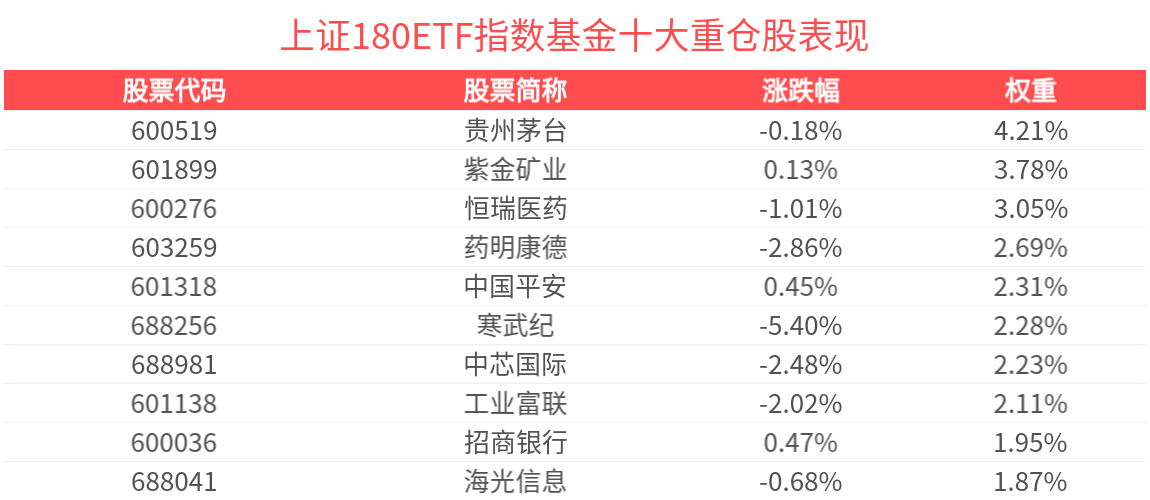
上证180指数上涨0.08%,上证180ETF指数基金(530280)实现4连涨
Sou Hu Cai Jing· 2026-01-21 01:55
Core Viewpoint - The Shanghai 180 ETF Index Fund closely tracks the Shanghai 180 Index, which reflects the overall performance of 180 large-cap and liquid stocks in the Shanghai securities market [2] Group 1: Index Performance - As of January 20, 2026, the Shanghai 180 Index rose by 0.08%, with notable increases in constituent stocks such as China Chemical (+10.01%), China Power Construction (+7.02%), and Hengli Petrochemical (+6.62%) [1] - The Shanghai 180 ETF Index Fund achieved a four-day consecutive increase, with the latest price reported at 1.26 yuan [1] - The fund's average daily trading volume over the past year was 256.26 million yuan, with a turnover rate of 0.11% on January 20, 2026 [1] Group 2: Fund Metrics - The fund's Sharpe ratio since inception is 2.13, indicating a favorable risk-adjusted return [1] - The maximum drawdown for the fund year-to-date is 1.30%, with a relative benchmark drawdown of 0.06% [1] - The management fee for the fund is 0.15%, and the custody fee is 0.05% [1] Group 3: Top Holdings - As of December 31, 2025, the top ten weighted stocks in the Shanghai 180 Index account for 25.29% of the index, including Kweichow Moutai, Zijin Mining, and China Ping An [2] - The top ten stocks by weight are Kweichow Moutai (4.21%), Zijin Mining (3.78%), and China Ping An (2.31%), among others [3]






海螺水泥股东将股票存入凯基证券亚洲 存仓市值26.2亿港元
智通财经网· 2026-01-21 00:59
智通财经APP获悉,香港联交所最新资料显示,1月20日,海螺水泥(00914)股东将股票存入凯基证券亚洲,存仓市值26.2亿港元,占比8.86%。 1月14日,Invesco Asset Management Limited增持海螺水泥(00914)190.75万股,每股作价23.0824港元,总金额约为4402.97万港元。增持后最新持股数目为 9274.6万股,最新持股比例为7.13%。 ...
海螺水泥(00914)股东将股票存入凯基证券亚洲 存仓市值26.2亿港元
智通财经网· 2026-01-21 00:47
Group 1 - On January 20, 2023, shareholders of Conch Cement (00914) deposited stocks into KGI Securities Asia, with a market value of HKD 2.62 billion, accounting for 8.86% [1] - On January 14, 2023, Invesco Asset Management Limited increased its stake in Conch Cement by acquiring 1.9075 million shares at a price of HKD 23.0824 per share, totaling approximately HKD 44.0297 million [1] - Following the acquisition, Invesco's total shareholding in Conch Cement rose to 92.746 million shares, representing a holding percentage of 7.13% [1]