
三生国健

Search documents
三生制药拟分拆脱发治疗领域附属公司蔓迪国际赴港上市
Xin Jing Bao· 2025-11-25 12:05
Core Viewpoint - Recently, 3SBio announced the proposal to spin off its subsidiary Mandi International for independent listing on the Hong Kong Stock Exchange, with 3SBio holding 87.16% of Mandi's shares, and after the spin-off, 3SBio will not retain any interests in Mandi [1][5] Group 1: Company Overview - Mandi International was established in 1997 as Zhejiang Wansheng Pharmaceutical Co., Ltd., and launched China's first 5% minoxidil product in 2001, filling a gap in the domestic hair loss treatment market [1][2] - Mandi International's revenue is primarily dependent on the Mandi product series, which includes 5% minoxidil solutions and shampoos, contributing over 90% of its revenue [3][4] Group 2: Market Potential - The hair health management market in China has expanded from 19.8 billion yuan in 2018 to an estimated 52.7 billion yuan in 2024, with a projected compound annual growth rate (CAGR) of 11.3% from 2024 to 2035 [2] - Over 339 million people in China are affected by hair loss, with more than 60% of them under the age of 35 [2] Group 3: Financial Performance - Mandi International's revenue from 2022 to 2024 is projected to grow from 982 million yuan to 1.455 billion yuan, with a CAGR of 21.7%, and net profits are expected to rise from 202 million yuan to 390 million yuan [3] - In the first half of 2025, Mandi International achieved revenue of 743 million yuan, a year-on-year increase of approximately 20.2% [3] Group 4: Product Development - Mandi International launched the second-generation minoxidil product, Mandi 5% minoxidil foam, which saw rapid sales growth, generating 307 million yuan in 2024 and 283 million yuan in the first half of 2025 [4] - The company has a pipeline of products under development, including treatments for acne, obesity, and vitiligo, although these contribute less to current revenue [4] Group 5: Strategic Rationale for Spin-off - The spin-off is expected to provide multiple commercial benefits, including enhanced value transparency, independent financing platforms, and optimized management responsibilities, which will improve decision-making and market responsiveness [5]
脱发“90后”,撑起一个IPO:蔓迪国际正式向港交所主板递交上市申请
Zhong Guo Ji Jin Bao· 2025-11-25 07:58
Core Insights - A hair loss treatment product from Mandi International, a subsidiary of Sangfor Pharmaceutical, is set to go public on the Hong Kong Stock Exchange, potentially marking the third IPO for the Liu family [1] - Mandi International holds a significant 57% market share in China's hair loss medication market, driven by its flagship product, Mandi® Minoxidil [1][4] - Despite strong financial performance, Mandi International faces challenges such as product concentration, reduced R&D investment, and increasing competition [1][7] Financial Performance - Mandi International's revenue projections for 2022 to 2024 are 982 million RMB, 1.228 billion RMB, and 1.455 billion RMB, with net profits of 202 million RMB, 441 million RMB, and 309 million RMB respectively [2] - In the first half of 2025, the company reported revenue of 743 million RMB, a 20.2% increase year-on-year, and a net profit of 174 million RMB, up 64.1% [2] - The gross margin for the company has remained high, with figures of 80.3%, 82.0%, 82.7%, and 81.1% from 2022 to 2025 [3] Product Structure - Over 90% of Mandi International's revenue comes from the Mandi® product line, with the core product Mandi® 5% Minoxidil accounting for 91.3% and 91.6% of revenue in 2022 and 2023 respectively [4] - The company is expanding its product line to include other skin care products and is developing a long-acting GLP-1 receptor agonist for weight management, currently in Phase III clinical trials [6] R&D and Marketing - Mandi International's R&D expenses saw a significant drop from 92.2 million RMB in 2024 to 19.5 million RMB in the first half of 2025, raising concerns about its innovation capabilities [7] - In contrast, sales expenses have increased, reaching 374 million RMB in the first half of 2025, which is over 50% of total revenue [9] Market Competition - The hair loss treatment market is becoming increasingly competitive, with major players like Merck and Johnson & Johnson entering the space [12] - Mandi International's core patents are set to expire in 2028, which could lead to a surge in generic products and price competition [12] - The number of registered hair loss shampoos in China has exceeded 400, indicating a crowded market [12] Industry Trends - The global hair loss medication market is projected to reach $2.11 billion in 2024 and $3.175 billion by 2031, with a CAGR of 6.1% [12] - The rising interest in consumer healthcare and the potential for high-margin, self-purchased products are attracting capital market attention [13]

脱发“90后”,撑起一个IPO!
中国基金报· 2025-11-25 07:28
Core Viewpoint - A hair loss treatment product from Mandi International, a subsidiary of 3SBio, is expected to lead to a third IPO for the Liu family, amidst a growing hair loss crisis in China, where over 330 million people are affected, with more than 60% under the age of 35 [2][4]. Financial Performance - Mandi International reported impressive financial data, with revenues projected to reach RMB 9.82 billion, RMB 12.28 billion, and RMB 14.55 billion from 2022 to 2024, and net profits of RMB 2.02 billion, RMB 4.41 billion, and RMB 3.09 billion respectively [6]. - In the first half of 2025, the company achieved revenue of RMB 7.43 billion, a year-on-year increase of 20.2%, and a net profit of RMB 1.74 billion, up 64.1% [6]. Product Concentration - Over 90% of Mandi International's revenue comes from the Mandi® product series, with the core product, Mandi® 5% Minoxidil solution, accounting for 91.3% and 91.6% of revenue in 2022 and 2023 respectively [7][8]. R&D and Marketing Expenditure - Despite strong performance, Mandi International's R&D spending saw a significant drop from RMB 9.22 million in 2024 to RMB 1.95 million in the first half of 2025, raising concerns about its innovation capabilities [11]. - Sales expenses have increased significantly, with over 50% of revenue in the first half of 2025 allocated to sales costs, indicating rising customer acquisition costs in a competitive market [13][14]. Market Competition - The hair loss treatment market is becoming increasingly competitive, with major players like Merck and Johnson & Johnson entering the space. The global market for hair loss treatment is projected to reach USD 2.11 billion in 2024, growing at a CAGR of 6.1% [18]. - Mandi International faces potential risks as some of its core patents are set to expire in 2028, which could lead to a flood of generic products and price wars [18]. Industry Trends - The rising incidence of hair loss among younger demographics is transforming "hair health" into a significant consumer pharmaceutical category, attracting capital market interest [19]. - The company's ability to innovate and diversify its product pipeline will be crucial for its future growth potential, especially in a market that has shown clear demand [19].

“美政府想减少对华供应链依赖,药商和患者却可能愈发依赖中国药”
Guan Cha Zhe Wang· 2025-11-25 06:36
Core Insights - The Chinese pharmaceutical industry is at a pivotal moment for global expansion, with rapid advancements in new drug development, clinical trials, and international collaborations [1] - Despite the U.S. efforts to reduce reliance on Chinese supply chains, American manufacturers and patients may increasingly depend on Chinese innovations [2] Group 1: Industry Growth and Innovation - China has become the second-largest innovator in drug development globally, conducting about one-third of global clinical trials last year, up from just 5% a decade ago [1] - The stock prices of Chinese biotech companies have surged by 110% this year, more than three times that of their U.S. counterparts [1] - Major Western pharmaceutical companies are facing a "patent cliff," with over $300 billion in revenue-generating drugs losing patent protection by 2030, leading them to seek potential drug molecules from China [1] Group 2: Strategic Collaborations - Significant collaborations between U.S. and Chinese companies are emerging, such as Pfizer's agreement with a Chinese biotech firm for a potential $1.25 billion deal for an experimental cancer drug [3] - In another instance, GlaxoSmithKline partnered with a Chinese company for a $500 million deal, highlighting the increasing importance of Chinese firms in the global pharmaceutical landscape [3][5] Group 3: Regulatory and Developmental Advancements - The Chinese pharmaceutical industry has undergone significant reforms, including streamlined approval processes and alignment with international regulatory standards, resulting in a dramatic increase in new drug approvals [5] - The time required for clinical trial approvals has decreased from 501 days to 87 days, with the number of new treatment approvals rising from 11 in 2015 to an expected 93 by 2024, 42% of which are domestically developed [5] Group 4: Market Dynamics and Challenges - Despite being the second-largest pharmaceutical market, China faces challenges in profitability, with prescription drug sales projected at $125 billion in 2023, only one-sixth of the U.S. market [9] - The majority of sales still come from generic drugs, with new drugs accounting for only one-fifth of sales, although this is expected to rise to one-third by 2028 [9] Group 5: Global Market Aspirations - Chinese companies are increasingly targeting overseas markets, often through licensing agreements with Western firms, and are exploring new business models to enhance their market presence [10] - The valuation of Chinese biotech firms is significantly lower than their U.S. counterparts, making them attractive to Western investors [10] - The rise of Chinese pharmaceutical companies could lead to more affordable therapies, particularly benefiting patients in underdeveloped countries [10]
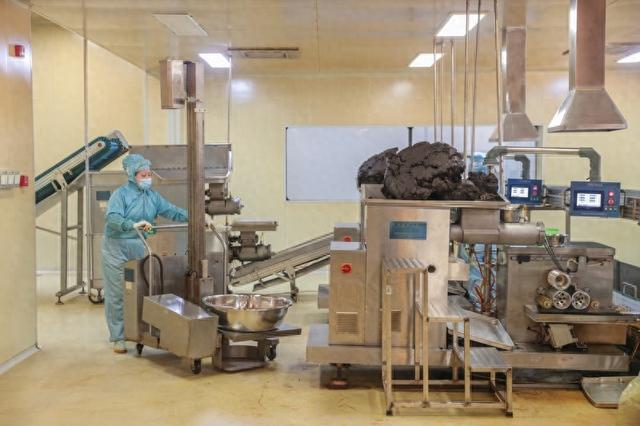
“头秃” 焦虑撑起一个IPO,沈阳“药二代”的第三家上市公司来了
Xin Lang Cai Jing· 2025-11-25 03:02
Core Insights - The article highlights the significant growth potential in the hair loss treatment market, particularly through the upcoming IPO of Mandi International, a subsidiary of Sangfor Pharmaceutical, which is set to capitalize on the booming demand for hair restoration products [1][20]. Market Overview - The hair loss market in China is experiencing explosive growth, with the number of affected individuals exceeding 339 million by 2024, translating to one in four people suffering from hair loss, predominantly among the younger demographic [4]. - The hair health management market is projected to grow from 52.7 billion RMB in 2024 to 171.4 billion RMB by 2035, with a compound annual growth rate (CAGR) of 11.3% [4]. Company Performance - Mandi International holds a 57% market share in the hair loss medication sector, with revenue expected to grow from 982 million RMB in 2022 to 1.455 billion RMB in 2024, reflecting a CAGR of 21.7% [1][12]. - The company's flagship product, Minoxidil, has seen a decline in sales, while the newly launched Minoxidil foam is driving growth, achieving sales of 283 million RMB in the first half of 2025, a 338% increase year-on-year [6][8]. Financial Metrics - Mandi's gross profit margin remains high, consistently above 80%, with net profits rising from 202 million RMB in 2022 to 390 million RMB in 2024 [9][12]. - The company has distributed 1.42 billion RMB in dividends to shareholders from 2022 to mid-2025, indicating strong cash flow management despite a decrease in asset value [20]. Competitive Landscape - Mandi International is facing increasing competition in the hair loss treatment market, with a need to diversify its product offerings beyond hair restoration to maintain growth [8][9]. - The company is also exploring new markets in skin health and weight management, although these segments are still in early development stages [9]. Family Business Background - The Lou family, founders of Sangfor Pharmaceutical, have established a significant presence in the capital markets with three listed companies, including Mandi International, which represents a strategic shift towards consumer healthcare [20][21]. - The family's wealth has been recognized, ranking them among the top in the biopharmaceutical sector, with a net worth of 15 billion RMB as of October 2025 [22][23].


150亿沈阳医药家族,冲击第三个IPO
2 1 Shi Ji Jing Ji Bao Dao· 2025-11-24 04:35
Core Viewpoint - Mandis International has submitted an IPO application to the Hong Kong Stock Exchange, with Huatai International as the sole sponsor, indicating a significant move in the hair loss treatment market in China [1][2]. Company Overview - Mandis International's minoxidil-based hair loss treatment products have ranked first in retail sales for ten consecutive years, holding a market share of 57% [2]. - The company reported a revenue of 743 million yuan in the first half of the year, representing a nearly 20% year-on-year growth, with a net profit of 174 million yuan [2]. - Mandis International was spun off from 3SBio, led by the prominent pharmaceutical figure Lou Jing, who is expected to achieve his third IPO [2][24]. Market Potential - The hair loss treatment market is experiencing significant growth, with over 339 million people in China suffering from hair loss issues, and more than 60% of them being under 35 years old [3]. - Approximately one in four individuals in China faces hair loss challenges [3]. Product Development - Mandis has been proactive in the minoxidil product market, launching the first 5% minoxidil solution in China in 2001 and continuously developing various product specifications [5]. - The company introduced the second-generation minoxidil foam product in 2024, which is the first and only domestically approved product of its kind in China [5]. - The foam product is priced at 198 yuan per bottle and has sold over 700,000 units, ranking first in Tmall's hair growth liquid sales [5][9]. Sales Performance - In the first half of the year, Mandis' sales reached approximately 681 million yuan, a 24% year-on-year increase, accounting for 98.8% of 3SBio's sales in the hair loss sector [12]. - The company's products have achieved a compound annual growth rate of 21.9% from 2022 to 2024 [12]. Distribution Channels - Mandis employs a dual-channel strategy, with online sales contributing 74% of its revenue in the first half of the year [10]. - The products are distributed to over 2,000 medical institutions and approximately 190,000 retail pharmacies across various cities in China [11]. Future Expansion - Lou Jing aims to expand Mandis' product line into skin health and weight management, recognizing significant market potential in these areas [20]. - The company is developing a range of early-stage assets, including treatments for acne and obesity-related metabolic syndromes [22]. IPO and Financial Strategy - The IPO is expected to enhance Mandis' research capabilities, digital operations, marketing, and brand development [25]. - Prior to the IPO, Mandis International was 87.16% owned by 3SBio, with Lou Jing and his wife being the controlling shareholders [24].
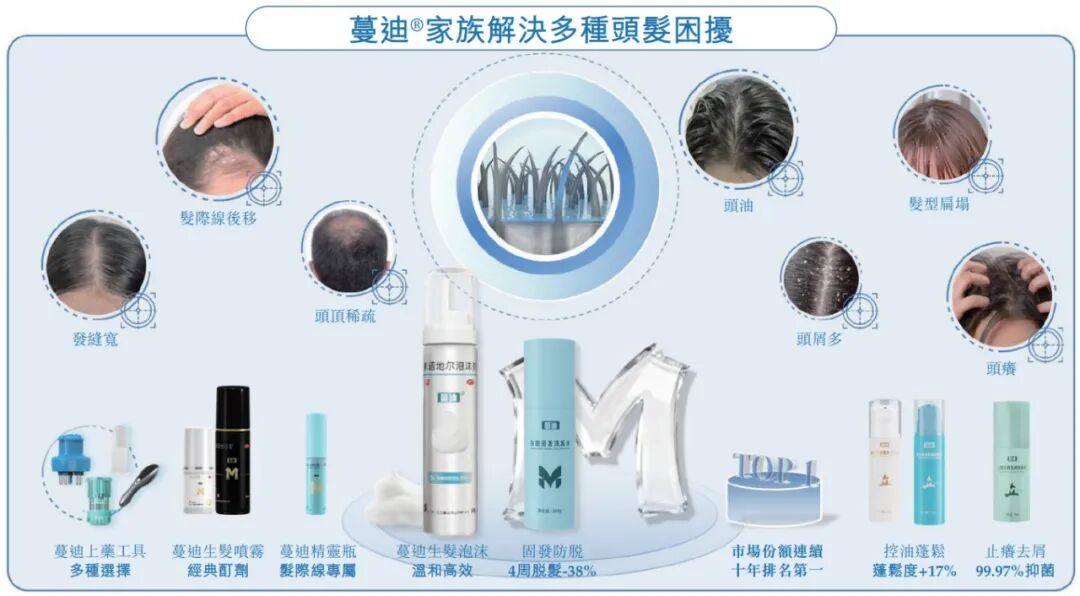
“H拆A”之后,创新药龙头拟再“H拆H”
Shang Hai Zheng Quan Bao· 2025-11-21 11:18
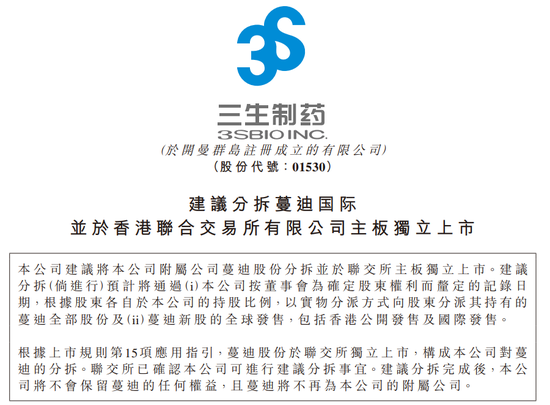
Core Viewpoint - The company, 3SBio, plans to spin off its subsidiary Mandi International for an independent listing on the Hong Kong Stock Exchange, with the goal of enhancing shareholder value and allowing investors to focus on the distinct value of Mandi International [1][10]. Group 1: Company Overview - Mandi International specializes in the hair health sector within the skin health industry, leading the market in hair loss treatment products [3]. - The company has a strong market presence, with its Minoxidil-based products holding a market share of 57% and 71% in the hair loss medication market for 2024 [4]. Group 2: Financial Performance - Mandi International's revenue is heavily reliant on its flagship product, contributing over 90% of total revenue from 2022 to 2024, with the 5% Minoxidil solution accounting for 91.3%, 91.6%, and 68.8% of the product series revenue in those years [5][6]. - Sales revenue for the 5% Minoxidil solution is projected to decline from approximately 1.11 billion RMB in 2023 to about 991 million RMB in 2024, indicating a significant drop [6][7]. - Total revenue growth rates for Mandi International are showing signs of fatigue, with 2023 and 2024 growth rates at 25.1% and 18.5%, respectively, and a 20.2% growth rate for the first half of 2024 [7]. Group 3: Market Challenges - The company faces challenges with a decreasing number of distributors, which has dropped from 173 in 2022 to 106 in 2024, impacting sales generated through distributors [8][9]. - The introduction of a second-generation product, the 5% Minoxidil foam, has shown promising growth, with sales reaching 283 million RMB in the first half of 2024, up from 65 million RMB in the same period the previous year [7]. Group 4: Spin-off Details - The spin-off of Mandi International is expected to allow existing shareholders to retain their interests in both Mandi International and 3SBio's remaining business operations, enhancing clarity in valuation for investors [10]. - This is not the first spin-off for 3SBio, as it previously spun off 3SBio Guojian for a listing on the STAR Market in 2020, which has since seen significant stock price appreciation [11][15].
三生国健跌2.04%,成交额1.24亿元,主力资金净流入200.37万元
Xin Lang Cai Jing· 2025-11-21 02:46
11月21日,三生国健盘中下跌2.04%,截至10:23,报64.28元/股,成交1.24亿元,换手率0.31%,总市值 396.47亿元。 资金流向方面,主力资金净流入200.37万元,特大单买入951.74万元,占比7.70%,卖出511.46万元,占 比4.14%;大单买入2717.60万元,占比21.98%,卖出2957.52万元,占比23.92%。 三生国健今年以来股价涨201.83%,近5个交易日跌11.18%,近20日涨17.31%,近60日涨20.86%。 今年以来三生国健已经7次登上龙虎榜,最近一次登上龙虎榜为11月3日。 三生国健所属申万行业为:医药生物-生物制品-其他生物制品。所属概念板块包括:生物医药、融资融 券、增持回购、中盘、抗癌药物等。 截至9月30日,三生国健股东户数1.12万,较上期减少12.77%;人均流通股55060股,较上期增加 14.64%。2025年1月-9月,三生国健实现营业收入11.16亿元,同比增长18.80%;归母净利润3.99亿元, 同比增长71.15%。 分红方面,三生国健A股上市后累计派现1.27亿元。 机构持仓方面,截止2025年9月30日,三生国健 ...
生物制品板块11月18日跌0.98%,禾元生物领跌,主力资金净流出9.81亿元
Zheng Xing Xing Ye Ri Bao· 2025-11-18 08:15
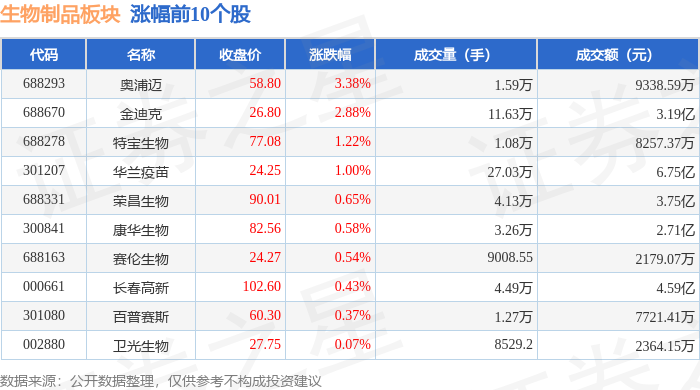
Core Insights - The biopharmaceutical sector experienced a decline of 0.98% on November 18, with He Yuan Bio leading the drop [1] - The Shanghai Composite Index closed at 3939.81, down 0.81%, while the Shenzhen Component Index closed at 13080.49, down 0.92% [1] Stock Performance Summary - Notable gainers included: - Aopu Mai (688293) with a closing price of 58.80, up 3.38% on a trading volume of 15,900 shares and a transaction value of 93.39 million [1] - Jin Hu Ke (688670) at 26.80, up 2.88% with a volume of 116,300 shares and a transaction value of 319 million [1] - Te Bao Bio (688278) at 77.08, up 1.22% with a volume of 10,800 shares and a transaction value of 82.57 million [1] - Notable decliners included: - Bu Yuan Bio (688765) at 79.95, down 3.89% with a volume of 56,800 shares and a transaction value of 458 million [2] - San Sheng Guo Jian (688336) at 67.60, down 3.87% with a volume of 68,100 shares and a transaction value of 469 million [2] - Wo Wu Bio (300357) at 31.77, down 3.23% with a volume of 77,900 shares and a transaction value of 250 million [2] Capital Flow Analysis - The biopharmaceutical sector saw a net outflow of 981 million from institutional investors, while retail investors contributed a net inflow of 819 million [2] - Key stocks with significant capital flow included: - Hua Lan Vaccine (301207) with a net inflow of 48.51 million from institutional investors [3] - Rong Chang Bio (688331) with a net inflow of 23.62 million from institutional investors [3] - Jin Ke (688670) with a net inflow of 5.53 million from institutional investors [3]


三生国健跌2.02%,成交额1.28亿元,主力资金净流入386.90万元
Xin Lang Cai Jing· 2025-11-18 02:20
Core Viewpoint - The stock price of Sangfor Technologies has shown significant growth this year, with a notable increase in trading activity and financial performance [2][3]. Group 1: Stock Performance - Sangfor Technologies' stock price has increased by 223.52% year-to-date, with a 7.22% rise in the last five trading days, 12.90% in the last 20 days, and 24.24% in the last 60 days [2]. - As of November 18, the stock was trading at 68.90 CNY per share, with a market capitalization of 42.497 billion CNY [1]. Group 2: Financial Performance - For the period from January to September 2025, Sangfor Technologies reported a revenue of 1.116 billion CNY, representing a year-on-year growth of 18.80%, and a net profit attributable to shareholders of 399 million CNY, which is a 71.15% increase year-on-year [2]. - The company has distributed a total of 127 million CNY in dividends since its A-share listing [3]. Group 3: Shareholder Information - As of September 30, 2025, the number of shareholders for Sangfor Technologies was 11,200, a decrease of 12.77% from the previous period, with an average of 55,060 circulating shares per shareholder, an increase of 14.64% [2]. - The top ten circulating shareholders include notable funds, with ICBC Frontier Medical Stock A and China Europe Medical Health Mixed A increasing their holdings [3].