Lumentum Holdings Inc.

Search documents
春节AI综述-大模型-CPO与光纤光缆
2026-02-24 14:15
Summary of Key Points from Conference Call Industry Overview - The conference call primarily discusses the **AI**, **CPU**, and **optical fiber communication** industries, highlighting the performance of companies like **Lumentum**, **长飞 (Changfei)**, and **亨通 (Hengtong)** during the 2026 Spring Festival period [1][2]. Core Insights and Arguments - **AI and Agent Technology**: The application of Agent technology is driving demand for personal terminal devices, with significant updates from major players like **字节跳动 (ByteDance)** and **阿里巴巴 (Alibaba)**, as well as overseas models like **GPT-3.1** and **Cloud 4.6** [2]. - **CPU Market Performance**: Companies in the CPU sector, particularly **Lumentum**, have shown strong performance despite challenges in the market, with expectations for rationality as new product launches approach [2]. - **Optical Fiber Communication Growth**: Companies like **长飞** and **亨通** are benefiting from domestic infrastructure projects and global division of labor, with high-end product exports contributing to growth potential [1][2]. - **CPO Technology Impact**: CPO technology has a limited impact on power consumption reduction (2%-4%), and the stability of AI infrastructure is deemed crucial for large capital expenditure projects [7][8]. - **NPU Adoption**: The NPU (Network Processing Unit) solution is expected to gain traction, potentially increasing shipment volumes significantly by 2027 [9]. Emerging Trends - **Cabinet Market Dynamics**: The optical communication field is seeing a shift towards low-power, high-efficiency optical interconnection solutions, with CPU and NPU becoming mainstream choices [3]. - **Silicon Photonics Development**: Companies like **新易盛 (NewEase)** are advancing in silicon photonics, with the potential for large-scale production of core components [11][12]. - **Challenges in Silicon-Based Technology**: The industry faces challenges related to light emission, heat control, and signal modulation, necessitating collaboration across the supply chain [13]. Market Opportunities - The optical communication market is viewed as a growth opportunity for both established and emerging companies, with various regions (Mainland China, Taiwan, North America) having unique advantages [5]. - A-share companies in the optical communication sector are considered to have investment value, particularly in the context of an expanding market [6]. Additional Insights - **AI Application Penetration**: Currently, only about 0.01% of the population is paying for AI services, but this is expected to grow rapidly with advancements in model capabilities [16]. - **User Behavior Changes**: There is a notable shift in user behavior from app engagement to API interactions via agents, leading to increased uncertainty in software ecosystems [17]. - **Domestic Inference Computing Limitations**: Domestic inference computing is currently insufficient to meet the demand for agent overflow, highlighting a need for improved infrastructure [19]. - **Future AI Trends**: The proliferation of personal agents is anticipated to lead to exponential growth in token consumption and hardware demand, particularly for GPUs [20][21].
未知机构:202602231146广发海外电子通信-20260224
未知机构· 2026-02-24 04:15
Summary of Conference Call Notes Company and Industry - **Company**: Lumentum (Ticker: LITE) - **Industry**: Electronic Communication, specifically focusing on AI-driven technologies and laser solutions Core Points and Arguments - **Investment Rating and Target Price**: Lumentum maintains a "Buy" rating with an increased target price of $765, indicating strong confidence in the company's future performance [1] - **Key Year**: 2027 is identified as a pivotal year for Lumentum, driven by the acceleration of NPO/CPO adoption within the AI Scale Up architecture [1] - **Revenue Projections**: - Total revenue from Scale Up/Out NPO/CPO lasers is expected to reach approximately $1.3 billion in 2026, $5 billion in 2027, and $17 billion in 2028, representing 3%, 9%, and 20% of total revenue respectively [1] - Long-term revenue opportunities from RubinUltra and future platforms are projected to exceed $1 billion annually, with sales ramp-up expected to begin by the end of 2027 [2] - **Earnings Per Share (EPS) Estimates**: FY26E and FY27E EPS estimates have been raised to $8 and $16 respectively, with CY2026 and CY2027 EPS estimates at $12 and $22 [2] - **CPO Switches**: The ramp-up of Scale Out CPO switches is anticipated, with Nvidia outlining its roadmap for Scale Out CPO, including the launch of Quantum-X in the second half of 2025 and Spectrum-X in the second half of 2026 [2] - **Market Penetration**: The expected shipment volume for Scale Out CPO is projected to reach 20,000 units in 2026 and 80,000 units in 2027, with a low overall penetration rate [3] - **Laser Value Contribution**: Each CPO unit is estimated to correspond to a laser value of approximately $5,000, contributing an expected revenue of $1.3 million in 2026 and $2.7 million in 2027 [3] - **Future Growth Drivers**: The transition to OIO architecture is expected to drive additional laser demand, creating structural growth opportunities for Lumentum in the long term [3] Other Important Content - **Structural Gross Margin**: Higher structural gross margins are expected to further strengthen Lumentum's positioning in next-generation AI interconnect architectures [2] - **Long-term Revenue Opportunities**: The adoption of NPO/CPO in RubinUltra and subsequent platforms is anticipated to represent significant long-term revenue opportunities, with expected shipments of 700,000 units in 2027 and 5 million units in 2028, generating approximately $2.3 billion and $13 billion in revenue respectively [3]

CPO,终于要来了?
Ge Long Hui· 2026-02-24 03:44
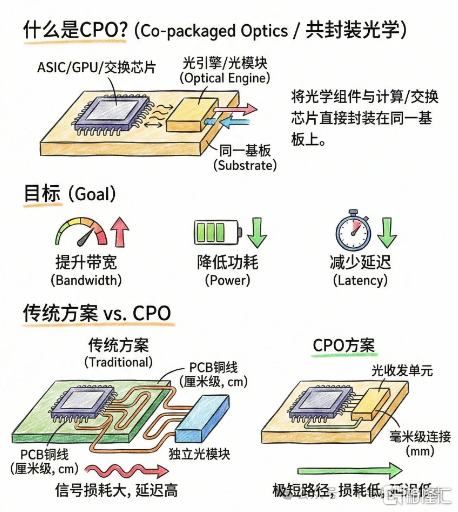
Core Insights - The semiconductor industry is witnessing a shift from chip manufacturing processes to the efficiency of inter-chip connections, driven by the exponential growth of AI model parameters [1] - Co-Packaged Optics (CPO) has emerged as a critical focus in the industry, transitioning from a laboratory concept to a commercial reality [2] Industry Trends - CPO integrates high-speed optical engines/modules with switch chips using advanced packaging technologies, aiming to address the limitations of traditional pluggable optical modules [2] - CPO technology can reduce power consumption by over 40%, increase bandwidth by three times, and decrease latency by 50%, making it suitable for AI training clusters and large-scale data centers [5] - The global Datacom CPO market is projected to grow from under $70 million in 2024 to $8 billion by 2030, with a compound annual growth rate exceeding 120% [5] Company Performance - Lumentum reported a revenue of $665.5 million for Q2 FY26, exceeding market expectations and reflecting a 65% year-over-year increase, driven by strong demand in AI and cloud computing [9] - Coherent's Q2 FY26 revenue reached $1.686 billion, a 17% increase year-over-year, with data center and communication sectors being the main growth drivers [16] - Tower Semiconductor announced a record revenue of $440 million for Q4 FY25, with significant investments in silicon photonics to increase production capacity [24] Demand and Supply Dynamics - Lumentum's management indicated a clear demand surge for CPO, with a significant order for high-power laser devices expected to generate substantial revenue in 2027 [11] - Coherent secured a large CPO order from a leading AI data center client, highlighting the strong market demand for CPO solutions [20] - Tower Semiconductor's silicon photonics capacity is largely pre-booked by clients, indicating a robust demand outlook [25] Future Outlook - CPO is expected to transition from a focus on horizontal scaling (Scale-Out) to vertical scaling (Scale-Up), with significant market potential as it begins to replace copper cables [29] - The industry anticipates that CPO will become a core component of AI infrastructure, with a projected market potential in the hundreds of billions [33] - Despite current technological and market challenges, the CPO sector is poised for significant growth, driven by advancements in technology and increasing demand from AI applications [34]




未知机构:TMTB日终总结核心围绕Citrini抛售展开分析了科技板块的大幅波动背后-20260224
未知机构· 2026-02-24 02:30
Summary of TMTB Conference Call Industry Overview - The conference call focused on the technology sector, particularly the impact of the Citrini sell-off on market dynamics and valuations within the internet and software segments [1][2]. Core Market Performance - The Nasdaq 100 ETF (QQQs) declined by 1.22%, with the internet and software sectors being heavily affected, while the semiconductor sector outperformed the market [1]. - The Citrini article amplified existing valuation concerns in the tech sector, acting as a catalyst for the sell-off rather than introducing new market issues [1]. Key Points on Sell-off Reasons - Investors are no longer willing to accept high valuations for internet and software stocks, leading to significant declines in individual stocks such as SHOP (-7%), MDB (-12%), and DDOG (-11%) [2]. - The valuation assessments do not account for heavy stock-based compensation (SBC) in software companies, with some firms showing no profitability under GAAP standards, exacerbating the sell-off [2]. - The development of AI technology has sparked both excitement and fear among investors, with potential benefits for AI semiconductors but negative implications for internet and software companies [2]. - Citrini's article suggested that AI advancements could lead to a structural crisis, impacting global payment and consumer finance systems, which heightened market fears [2]. Market Judgments - The era of high valuations for internet and software stocks is likely over, with a long-term "valuation fog" expected to persist [3]. - In the short term, the market may stabilize, but individual stock differentiation will increase, leading to a focus on selective stock strategies [3]. - The development of the digital world, while driven by AI, will be slowed by organizational inertia and human habits, preventing rapid disruption of existing structures [3]. Sector and Stock Differentiation - Significant declines were noted in various sectors, including gig economy stocks (DASH, UBER), alternative asset management (APO, BX), Indian IT services, SaaS software, and payment/consumer finance (MA, V, AXP) [4]. - IBM saw a 15% drop due to competition from Anthropic's Claude Code tool, which threatens its high-margin consulting business [4]. - Conversely, the optical communications sector showed strong performance, with companies like LITE, CIEN, and GLW benefiting from accelerated capital expenditures in AI data centers [4]. - BE rose by 8% nearing new highs, while NBIS and SNDK increased by 3% due to upcoming catalysts [4]. Sector Performance Breakdown - In the TMT sector, telecommunications led with a 1.4% increase, while internet, payment, business services, and software sectors fell by over 3.8% [5]. - Within the AI sub-sector, new cloud providers/miners (2.7%) and optical communications (0.9%) performed well, while AI software stocks dropped by 6.5% [5]. - Market factors indicated that TMT momentum pairs led with a 4.0% increase, while factors related to long-term profitability and GARP software saw significant declines [5].
Forget Nvidia, This Is the Stock to Buy For the AI Boom's Next Leg Up
247Wallst· 2026-02-23 19:45
Core Viewpoint - Lumentum Holdings is positioned as a key beneficiary in the AI boom, particularly in the optics sector, with significant revenue growth driven by cloud and AI demand [1]. Company Performance - Lumentum reported Q2 revenue of $665.5 million, reflecting a 65.5% year-over-year increase, with over 60% of revenue derived from cloud and AI segments [1]. - The company projects Q3 revenue guidance between $780 million and $830 million, indicating over 85% year-over-year growth [1]. - GAAP net income for Q2 was $78.2 million, or $0.89 per diluted share [1]. Industry Trends - A report from JPMorgan Chase indicates a multi-year upcycle in the optics sector, with hyperscaler spending expected to reach approximately $533 billion by 2026 [1]. - The 800G and higher-speed datacom market is anticipated to grow at over 40% annually through 2030, potentially reaching $44 billion [1]. - Supply shortages in key materials like indium phosphide lasers are expected to persist into 2027, allowing suppliers to increase prices by 10% or more starting in early 2026 [1]. Technological Advancements - Emerging technologies such as co-packaged optics and optical circuit switching are set to drive growth in the optics market, with co-packaged optics expected to add $10 billion in market value by 2030 [1]. - Lumentum's expertise in high-speed optical components positions it well to capitalize on these advancements [1]. Strategic Positioning - Lumentum's vertical integration, enhanced by its acquisition of CloudLight, allows for improved margins and supply control [1]. - The company aims for $100 million in quarterly optical circuit switch revenue by December [1]. - Partnerships with hyperscalers position Lumentum for sustained demand, with analysts raising price targets to $350 based on growth opportunities [1].

COHR Appears Expensive to Its Industry: Is AI Premium Warranted?
ZACKS· 2026-02-23 17:20
Core Insights - Coherent Corp. (COHR) is trading at a forward 12-month price-to-earnings ratio of 37.86X, significantly higher than the industry average of 22.26X, indicating a premium valuation despite strong operational performance [1][7] - In Q2 of fiscal 2026, COHR's non-GAAP EPS increased by 35.8% year-over-year to $1.29, outpacing the 17.5% revenue growth, showcasing substantial operating leverage [1][7] - The company has a book-to-bill ratio exceeding 4X in its data center segment, reflecting strong demand and visibility for future growth, particularly linked to AI infrastructure spending [3][7] Valuation Metrics - COHR's forward 12-month price-to-sales ratio stands at 5.83X, well above the industry's 2.57X, attributed to over 70% of revenue coming from the Datacenter & Communications segment [3] - The company's total debt to total capital ratio improved to 27.4% in Q2 of fiscal 2026, down from 41.1% in the same quarter last year, indicating effective balance sheet management [4] - Despite high valuation multiples, the strong margins and backlog suggest that the AI premium is justified by operational efficiency rather than speculation [5] Competitive Positioning - Compared to major competitors, Coherent is trading at a lower valuation; IPG Photonics is at 70.02X and Lumentum at 56.33X forward 12-month price-to-earnings [6] - Over the past six months, COHR's stock has surged by 174.2%, outperforming the industry which saw a 2.2% decline, although it lagged behind Lumentum's 441% increase [9] Earnings Estimates - The Zacks Consensus Estimate for COHR's earnings for fiscal 2026 and 2027 has risen by 5.5% and 13.1%, respectively, over the past 60 days [12] - COHR currently holds a Zacks Rank 2 (Buy), indicating positive market sentiment towards the stock [12]

5 AI-Infrastructure Giants to Buy for 2026 on Massive Data Center Boom
ZACKS· 2026-02-23 15:01
Industry Overview - The artificial intelligence (AI) sector, bolstered by the rapid growth of cloud computing and data centers, is experiencing a robust demand scenario, particularly for AI-powered data center capacity to manage and store vast amounts of data [1] - The "magnificent 7" stocks are set to invest $650 billion in 2026 for AI infrastructure development, representing a significant 71.1% year-over-year increase in capital spending on the AI ecosystem [2] Company Insights Amphenol Corp. (APH) - Amphenol holds a Zacks Rank 2 and benefits from a diversified business model, commanding an estimated 33% market share in AI-powered data center interconnects [7] - The company is experiencing triple-digit organic growth in its IT datacom segment, driven by high-speed and power interconnect products [8] - Amphenol's expected revenue and earnings growth rates for the current year are 34.9% and 29.3%, respectively, with a 1.9% improvement in the earnings consensus estimate over the last 30 days [12] Western Digital Corp. (WDC) - Western Digital, with a Zacks Rank 1, is witnessing strong demand for high-capacity hard disk drives (HDD) amid intensified cloud and AI demand [13] - The company is collaborating closely with hyperscale customers to deliver reliable, high-capacity storage solutions, with an expected revenue growth rate of -6.3% and earnings growth rate of 81.7% for the current year [16] Vertiv Holdings Co. (VRT) - Vertiv, holding a Zacks Rank 2, benefits from a diverse product portfolio and is strategically expanding capacity to support AI-enabled pipelines [17] - The company has a partnership with NVIDIA to co-develop an 800-volt DC power architecture, ensuring its infrastructure solutions remain relevant as power requirements scale [19] - Vertiv's expected revenue and earnings growth rates for the current year are 34% and 46.9%, respectively, with a 15.3% improvement in the earnings consensus estimate over the last 30 days [20] Lumentum Holdings Inc. (LITE) - Lumentum, with a Zacks Rank 1, designs and manufactures optical technologies essential for AI and cloud computing, experiencing significant revenue growth driven by demand for AI infrastructure connectivity solutions [21][22] - The company has a strong collaboration with NVIDIA for developing silicon photonics, positioning it as a key supplier to hyperscale customers [23] - Lumentum's expected revenue and earnings growth rates for the current year are 76.7% and over 100%, respectively, with a 34.6% improvement in the earnings consensus estimate over the last 30 days [24] EMCOR Group Inc. (EME) - EMCOR, holding a Zacks Rank 2, is a leading provider of critical infrastructure to AI-powered data centers, focusing on electrical infrastructure and cooling systems [25] - The company is gaining traction in the data center construction market, which is contributing to its expanding remaining performance obligations (RPOs) [26] - EMCOR's expected revenue and earnings growth rates for the current year are 5.4% and 8.6%, respectively, with a slight improvement in the earnings consensus estimate over the last 30 days [28]




Want to Invest in Small-Cap Stocks? Check Out These Two Top ETFs
Yahoo Finance· 2026-02-22 16:20
Core Insights - The State Street SPDR Portfolio S&P 600 Small Cap ETF (SPSM) and the Schwab U.S. Small-Cap ETF (SCHA) provide diversified exposure to U.S. small-cap stocks but differ in their index tracking and methodologies [1][2] Group 1: Cost and Size Comparison - SPSM has a lower expense ratio of 0.03% compared to SCHA's 0.04% [3] - As of February 20, 2026, SPSM's one-year total return is 18.4%, while SCHA's is 22.3% [3] - SPSM offers a higher dividend yield of 1.5% compared to SCHA's 1.2% [3] - SPSM has an AUM of $14.8 billion, while SCHA has $20.8 billion [3] Group 2: Performance and Risk Comparison - Over five years, SPSM's maximum drawdown is (27.94%), while SCHA's is (30.79%) [5] - The growth of $1,000 over five years is $1,244 for SPSM and $1,223 for SCHA [5] Group 3: Portfolio Composition - SCHA tracks a broad small-cap index with 1,724 stocks, emphasizing diversification across sectors such as financial services (17.9%), industrials (17.2%), and healthcare (15.8%) [6] - SPSM covers 607 stocks with sector tilts towards industrials (18.1%), financial services (18%), and consumer discretionary (14%) [7] - SCHA's largest holding is Sandisk Corp at 2%, while SPSM's top holdings are less than 1% each [6][7]
光互联的市场图谱
傅里叶的猫· 2026-02-21 14:13
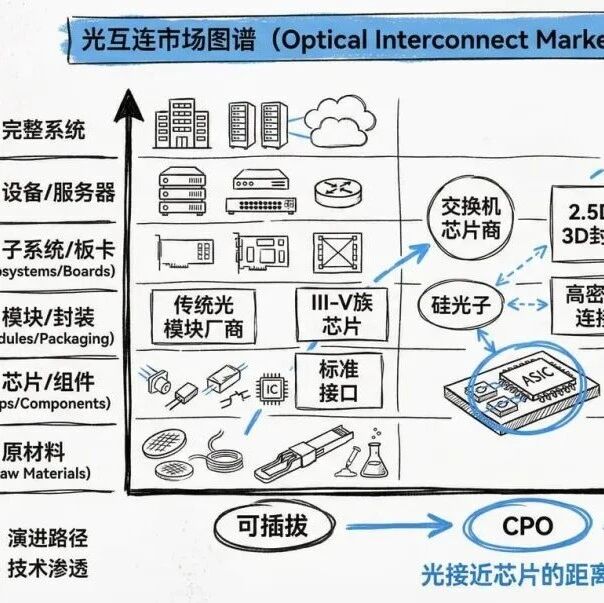
Core Insights - The article discusses the evolution of optical interconnect technology, highlighting three key structural patterns in the market: vertical integration vs. specialization, the scarcity of light generation, and the rise of SiPho foundries [5][6][10]. Group 1: Market Structure - Vertical integration offers structural advantages during technological transitions, as companies that can design across multiple layers can optimize the entire tech stack [9]. - Companies like Broadcom exemplify vertical integration, appearing across multiple layers of the value chain, while most others focus on specific segments [8]. - The semiconductor industry has historically shown that such advantages may not be permanent, as standardization can lead to the emergence of fabless models [9]. Group 2: Scarcity of Light Generation - The difficulty of producing light sources (Layer 1 and Layer 0) is highlighted, with InP and GaAs materials requiring specialized technology and equipment [12][13]. - Companies capable of mass-producing high-performance InP lasers are few, creating a concentrated market [13][14]. Group 3: Rise of SiPho Foundries - Layer 2, which focuses on SiPho foundries, is gaining attention as traditional semiconductor manufacturers like TSMC and GlobalFoundries enter the photonics space [17]. - TSMC's potential to optimize both AI chips and optical interconnects within the same ecosystem could disrupt existing vertical integration advantages [17]. Group 4: Layer Analysis - Layer 0 involves substrate supply, with companies like AXT benefiting from increased demand for III-V substrates, although geopolitical risks exist due to production in China [21][22]. - Layer 1 is dominated by Coherent and Lumentum, both of which manufacture InP lasers and are expanding production amid high demand [24][25]. - Layer 2 focuses on SiPho foundries, with companies like GlobalFoundries and TSMC leading in manufacturing photonic integrated circuits [27][29]. - Layer 3, represented by DSPs, faces potential obsolescence as CPO technology advances, with companies like Broadcom and Marvell adapting to this shift [33][36]. - Layer 4 sees companies like Innolight and Eoptolink currently leading in the pluggable module market, but their positions may be challenged as the industry shifts towards CPO [40][42]. Group 5: Future Signals - Key indicators to watch include pJ/bit energy consumption metrics, which reflect technological advancements and efficiency [56]. - The ongoing standardization efforts, such as OIF and UCIe, will shape the future market landscape and influence competitive dynamics [57][59]. - Recent mergers and acquisitions signal strategic directions in the industry, with notable deals like Marvell's acquisition of Celestial AI [60][62]. - The choices made by major cloud service providers like Google and AWS regarding their technology partnerships will ultimately determine market trajectories [63][64].
美股异动 | 光通信概念股涨跌不一 Lumentum(LITE.US)涨逾3%
智通财经网· 2026-02-20 15:09
Group 1 - The optical communication sector showed mixed performance on Friday, with Lumentum (LITE.US) rising over 3% and Coherent (COHR.US) increasing by more than 4% [1] - Credo Technology (CRDO.US) experienced a decline of nearly 2%, while Lumen Technologies (LUMN.US) and Astera Labs (ALAB.US) both fell by over 1% [1]