
Nu Holdings Ltd.

Search documents
Prediction: These Could Be the Best-Performing Bank Stocks Through 2030
Yahoo Finance· 2026-02-16 12:25
Core Insights - Bank stocks are not typically associated with high growth, but fintech integration is changing this narrative, with companies like Nu Holdings and SoFi Technologies outperforming traditional bank stocks and major indices over the past three years [1][2] Group 1: Nu Holdings - Nu Holdings is an all-digital bank based in Brazil, transforming financial management across Brazil, Mexico, and Colombia, previously facing high barriers to access for affluent and lower-income customers [4] - The company has achieved explosive growth, capturing over 60% of Brazil's adult population on its platform, onboarding approximately 1 million new members monthly, and has significant monetization potential as many customers use NuBank alongside other banks [5][6] - There remains substantial growth potential in Mexico and Colombia, with current customer penetration at 14% and 10% of the adult population respectively, and management is exploring new markets, including a recent application for a banking charter in the U.S. [6] Group 2: SoFi Technologies - SoFi operates in the U.S. with a focus on lending and is expanding into blockchain-based products, aiming to become a top-10 financial institution in the U.S. [7] - The company reported a record addition of 1 million new customers in Q4 2025, marking a 35% year-over-year increase, bringing the total to nearly 13.7 million, indicating a strong growth trajectory [7]


Maverick Capital Ltd.四季度建仓做多谷歌C、应用材料




Ge Long Hui A P P· 2026-02-13 22:56
Core Insights - Maverick Capital Ltd. established long positions in Google C, Applied Materials, Boston Scientific, Visa, and Camden Property during the fourth quarter [1] - The firm increased its holdings in TSMC, NVIDIA, GFL Environment, and Carvana [1] - Maverick Capital completely exited positions in Kenvue, US Bancorp, AMD, Danaher, and Insmed [1] - The company reduced its stakes in Nubank, Disney, Merit Medical, Acadia Health, and Sherwin-Williams [1] - The firm maintains significant positions in NVIDIA, Microsoft, Amazon, TSMC, and Google C [1]
Nu Holdings (NU) Receives Approval to Set up a New National Bank in the US
Yahoo Finance· 2026-02-13 10:19
Core Insights - Nu Holdings Ltd. has received conditional approval from the Office of the Comptroller of the Currency (OCC) to establish a new national bank named Nubank, marking a significant step towards entering the US market [1][2] - Nubank currently serves 127 million customers primarily in Latin America and aims to introduce its app-based banking model to American consumers [2] - Susquehanna has upgraded Nu Holdings' price target from $19 to $22, maintaining a Buy rating, citing the company's global expansion strategy as a key growth driver for 2026 [4] Company Overview - Nu Holdings Ltd. operates a digital banking platform across Brazil, Mexico, Colombia, the Cayman Islands, and the US, offering a range of services including spending, transactional, savings & investing, borrowing, and protection solutions [5] - The company's founder and CEO, David Vélez, emphasized that the approval is not just an operational expansion but a chance to validate the digital-first, customer-centric model as the future of financial services globally [2]
ClearBridge Emerging Markets Strategy Q4 2025 Commentary (Mutual Fund:MCEIX)
Seeking Alpha· 2026-02-12 15:15
Market and Performance Overview - Emerging markets advanced 4.7% in Q4 2025, finishing as one of the best-performing global equity asset classes, with the MSCI Emerging Markets Index rising 33.6% for the year, outperforming the MSCI EAFE Index (+31.2%) and the U.S. S&P 500 Index (+17.9%) [2] - Performance in Q4 was led by Korea and Taiwan, with Korean equities soaring 27.3% driven by a 50% gain in the IT sector, while Taiwanese stocks climbed 10.4% due to AI-related momentum [3] Sector Performance - The IT sector gained 16.4%, bolstered by AI-related stocks, while the materials sector advanced 11.6% as gold prices rose over 10% and copper prices hit record highs [6] - Energy, financials, and industrials sectors outperformed the index, while consumer discretionary, communication services, health care, and real estate underperformed [6] Company Highlights - SK Hynix saw its shares soar over 80% in Q4 and nearly tripled for the year due to increased demand for DRAM and NAND memory, particularly for AI workloads [7] - Samsung Electronics also experienced strong performance, benefiting from memory shortages that enhanced pricing power [7] - Taiwan Semiconductor, a leading manufacturer of high-end chips for Nvidia, significantly outperformed the benchmark [7] Regional Contributions - Significant contributors included China's Sieyuan Electric and Korea's HD Hyundai Electric, supporting AI data center buildouts [10] - Capitec Bank in South Africa delivered strong financial results, while Titan, an Indian jewelry retailer, showed encouraging performance despite India's overall underperformance [10] Detractors - Alibaba and Tencent surrendered gains due to a broader rotation out of China, while Contemporary Amperex Technology also faced declines [11] - MercadoLibre remained weak amid competition concerns in Brazil, and Apollo Hospitals detracted due to its large portfolio weight in a lagging Indian market [12] Portfolio Positioning - The strategy added four new positions, including Raia Drogasil and Nu Holdings in Brazil, while exiting positions in B3 S.A. and Proya Cosmetics [13][14][17] - Upgraded exposure in Indonesia by replacing PT Bank Rakyat Indonesia with PT Bank Central Asia, which has a strong deposit franchise [15] Outlook - The emerging market recovery is viewed as being in its early stages, with appealing valuations and supportive macroeconomic drivers [18] - Anticipated increased foreign investments into EM equities, driven by lower valuations and stronger economic growth [19] - The Chinese economy shows signs of increased stability, with improved trade relations and a more optimistic outlook [20] - Emerging markets offer opportunities in world-class companies with technological innovation, particularly in sectors like industrial automation, e-commerce, and fintech [21] - India remains a focus due to its large population and status as the fastest-growing major global economy, despite challenges faced in 2025 [22] Portfolio Highlights - The ClearBridge Emerging Market Strategy outperformed its benchmark in Q4, with gains across five of the nine sectors invested [23] - Stock selection in IT and industrials sectors contributed positively, while communication services and an underweight in materials detracted from performance [24] - Leading contributors included SK Hynix, Samsung Electronics, and Capitec Bank, while Tencent, Alibaba, and MercadoLibre were primary detractors [25]






The CEO of Nu Holdings Ltd. (NU) Strengthens Control as Nubank Pushes Global Expansion
Yahoo Finance· 2026-02-12 14:10
Core Insights - Nu Holdings Ltd. (NYSE:NU) is recognized as one of the top digital currency and payments stocks to invest in currently [1] Group 1: Company Overview - Nu Holdings Ltd. operates as a holding company providing a range of digital banking services, including business accounts, rewards, investments, personal loans, credit cards, insurance, and mobile payments [4] Group 2: Expansion Plans - CEO David Velez is focused on expanding Nubank, a leading financial firm in Latin America, to a global clientele exceeding 127 million, which includes nearly 60% of Brazil's adult population [2] - The company is pursuing a US expansion strategy, referred to as "Act Three," aiming to secure a complete banking license before broadening its service offerings [3] - In 2024, Nubank invested $250 million in Tyme Group to explore growth opportunities in Asia and Africa, in addition to the US market [3] Group 3: Financial Performance - In the third quarter, Nu Holdings reported a return on equity of 31%, outperforming Itau Unibanco's 23.3% [2] - The company's shares are currently valued higher than those of traditional banks, indicating strong market confidence [2] Group 4: Control and Governance - David Velez holds super-voting shares that provide him with control over approximately 75% of the voting power within the company [2]
The Bank Charter Boom Is Creating Very Different Kinds of Banks
PYMNTS.com· 2026-02-10 19:51
Core Insights - The trend of FinTechs and platforms pursuing bank charters indicates a shift towards greater regulatory compliance and long-term accountability, trading speed for control and durability [1][4][18] - The landscape of banking is evolving, with various types of charters offering different powers and regulatory frameworks, making it essential for institutions to understand these distinctions [5][11] Group 1: Types of Bank Charters - Not all bank charters are equal; they differ significantly in terms of operational capabilities, supervision, scalability, and risk management [3][11] - National bank charters, granted by the Office of the Comptroller of the Currency (OCC), allow institutions to operate nationwide under a single federal supervisor, enabling them to take deposits and make loans [13] - State-chartered banks are supervised by state regulators and can be more attuned to local markets, offering a different balance of oversight [14] Group 2: Emerging Trends and Developments - The recent acquisition of the FinTech platform Step by YouTube star MrBeast highlights the growing interest in banking platforms, although it was clarified that Step is not a traditional bank [4] - The approval of new de novo charter applications indicates a resurgence in the banking sector, with over two dozen applications filed recently [4][18] - The merger of Fifth Third Bancorp and Comerica, creating a bank with approximately $294 billion in assets, signifies a competitive reshaping among regional banks [19] Group 3: Regulatory Landscape - Industrial loan companies (ILCs) allow commercial firms to own banks, providing a pathway for FinTechs and retailers to integrate financial services into their platforms [17] - Special-purpose banks focus on specific services like trust or custody, allowing for tailored compliance and operational strategies [16] - The regulatory environment is complex, with different charters subject to varying statutes and privileges, which can impact operational strategies and governance [11][22]


边加谷歌边减英伟达!百年巨头柏基披露去年四季度大动作
Ge Long Hui· 2026-02-10 03:42
Summary of Key Points Core Viewpoint - Baillie Gifford's total holdings value decreased to $120.34 billion in Q4 2025, down approximately 10.8% from $135 billion in Q3 2025, primarily due to a net selling strategy and some growth stocks experiencing high-level corrections [1][2]. Group 1: Portfolio Adjustments - Nvidia remains the largest holding despite a 5.76% reduction in shares, accounting for 6.80% of the portfolio [3]. - Mercado Libre saw a 4.95% increase in holdings, raising its share to 5.83%, solidifying its position as a cornerstone of the portfolio [3]. - The top five holdings also include Amazon, Shopify, and Sea Ltd, with the top ten holdings comprising 43.4% of the total portfolio [4]. Group 2: Notable Transactions - Significant reductions were made in Amazon, Shopify, Meta, and Cloudflare, while Google saw a notable increase in holdings by 166%, reflecting a strategic shift towards AI capabilities [5][6]. - Baillie Gifford's investment in Google is valued at approximately $1.7 billion post-increase [6]. Group 3: Investment Philosophy and Trends - The investment team emphasizes the importance of adapting to the AI wave, suggesting that companies must pivot quickly to meet new market demands [9][10][12]. - The transition to AI is viewed as a new paradigm shift, with potential for significant growth opportunities as new companies emerge [14][15]. - The focus is on both "AI core" companies and those using AI as a tool to enhance existing services [21][24]. Group 4: Insights on China and Platform Companies - The sentiment in China has shifted, with a recognition of the country's potential to foster visionary entrepreneurs, particularly in the battery sector where CATL holds a significant market share [25][26]. - Platform companies are highlighted for their ability to create value through network effects and adaptability, requiring a long-term investment perspective [28]. Group 5: Non-Public Company Investments - Baillie Gifford has committed over £6 billion to non-public companies since 2012, recognizing the increasing duration of private company ownership before IPOs [31][32]. - The firm holds significant stakes in companies like SpaceX and ByteDance, which have shown substantial revenue growth compared to public market indices [33]. Group 6: Portfolio Construction Approach - The investment strategy is bottom-up, focusing on global transformations rather than specific trends or technologies [34]. - The portfolio includes a diverse range of companies across various sectors, with ongoing adjustments to capitalize on emerging growth opportunities [38].


边加谷歌边减英伟达!百年巨头柏基披露去年四季度大动作,背后有套AI “冰山模型”
聪明投资者· 2026-02-10 03:33
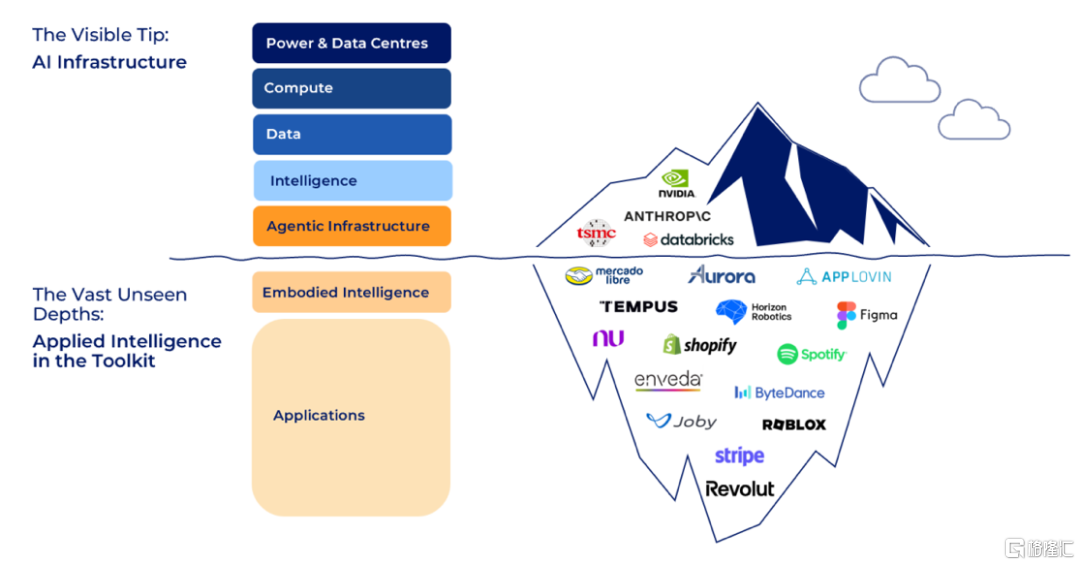
Core Viewpoint - Baillie Gifford's total holdings value decreased to $120.34 billion in Q4 2025, down approximately 10.8% from $135 billion in Q3 2025, primarily due to a net selling strategy and high valuations of growth stocks [2][3]. Group 1: Portfolio Adjustments - Nvidia remains the largest holding at 6.80%, despite a 5.76% reduction in shares for the second consecutive quarter [4]. - Mercado Libre saw a 4.95% increase in holdings, raising its portfolio share to 5.83%, solidifying its position as a key asset [4]. - The top five holdings include Amazon, Shopify, and Sea Ltd, with the top ten holdings accounting for 43.4% of the portfolio [5]. Group 2: Notable Transactions - Significant reductions were made in Amazon, Shopify, Meta, and Cloudflare, while Google saw a notable increase in holdings by 166%, reflecting a strategic shift towards AI capabilities [6]. - Baillie Gifford's investment in Google is estimated at around $1.7 billion post-increase, indicating a focus on AI custom chips and cost advantages in large-scale computing [7]. Group 3: AI Investment Insights - The investment team emphasizes the importance of early engagement in AI trends, suggesting that companies must pivot quickly to new business models once product-market fit is established [10][12]. - The transition to an "intelligent paradigm" is viewed as the next major shift in technology, with AI expected to create new growth opportunities and large companies [13][14]. - Current AI applications are primarily in personal assistant chatbots and programming tools, with companies like Anthropic experiencing rapid growth [15][16]. Group 4: Chinese Market Perspectives - The sentiment in the Chinese market has shifted, with a recognition of the potential for visionary entrepreneurs and rapid technological advancements [24]. - Baillie Gifford holds a significant stake in CATL, which commands 40% of the global battery market, indicating confidence in the future of battery technology beyond electric vehicles [25]. - Despite geopolitical risks, the firm sees potential in select Chinese companies that remain undervalued [27]. Group 5: Non-Public Company Investments - Since 2012, Baillie Gifford has committed over £6 billion to non-public companies, recognizing the increasing time companies remain private before IPO [30]. - The non-public market has expanded significantly, with over 1,500 companies valued at over $1 billion, representing a total market cap exceeding $5 trillion [32]. - Investments in non-public companies like SpaceX and ByteDance are seen as essential for capturing growth opportunities that may be missed in public markets [33]. Group 6: Portfolio Construction Strategy - The portfolio is constructed from the bottom up, avoiding single bets on specific countries or trends, focusing instead on global transformations [36][37]. - The firm is actively reallocating capital towards disruptive growth opportunities, including increased investments in companies like CATL and Chinese consumer platforms [42].
Baron Financials ETF Q4 2025 Quarterly Letter (BCFN)
Seeking Alpha· 2026-02-09 16:20
Core Insights - The Baron Financials ETF experienced a decline of 2.22% in the fourth quarter of 2025, underperforming the FactSet Global FinTech Index, which fell by 7.19%, but slightly trailing the MSCI USA Financials Index, which gained 2.07% [2][3][7] - Since its inception on December 31, 2019, the Fund has achieved an annualized return of 10.21%, outperforming the FinTech Index's 2.55% but lagging behind the Financials Index's 11.97% [2][3] Performance Overview - In the fourth quarter, the Fund's performance was driven by favorable stock selection within Information Services and an overweighting in Tech-Enabled Financials, while underexposure to banks negatively impacted relative performance [7][8] - The Fund's average weighting in banks was only 6%, which cost nearly 2 percentage points of relative performance against the Financials Index, where banks had a 38% weighting and were the top-performing industry [7][8] Sector Analysis - The Fund's holdings are segmented into various industries, with Capital Markets representing 31.7%, Information Services at 20.7%, and Payments at 17.4% as of December 31, 2025 [20][23] - The Fund has a significant overweight in Information Services and Capital Markets compared to the Financials Index, while being underweight in Banks and Insurance [20][21] Key Contributors and Detractors - Top contributors to the Fund's performance included Fair Isaac Corporation, S&P Global Inc., and Jack Henry & Associates, with Fair Isaac contributing 0.37% to returns due to strong quarterly results and positive fiscal guidance [12][13][14] - Major detractors included Robinhood Markets, which fell 0.93% due to a decline in customer engagement and cryptocurrency trading volumes, and MercadoLibre, which faced competitive pressures and margin concerns [16][17] Recent Activity - The Fund made significant net purchases in Morgan Stanley, Capital One Financial Corporation, and The Charles Schwab Corporation, focusing on firms with strong growth prospects and diversified revenue streams [25][31] - The Fund trimmed positions in Guidewire Software and Interactive Brokers to manage exposure to the volatile software sector and to fund purchases with better expected returns [32][33] Market Outlook - The macroeconomic environment is viewed as generally healthy, with stable credit trends and a low unemployment rate of 4.4% as of December 2025, supporting growth in the financial sector [34][35] - The Fund anticipates continued growth driven by favorable fiscal policies and easing monetary conditions, with expectations for two rate cuts in the upcoming year [35][36]
