
WeWork

Search documents
孙正义撤了,上次这么干,抱着黄仁勋痛哭
华尔街见闻· 2025-11-12 10:12
Core Viewpoint - SoftBank founder Masayoshi Son has made a significant move by liquidating all of SoftBank's $5.8 billion stake in Nvidia to reinvest in the AI sector, including a planned $30 billion investment in OpenAI and participation in a $1 trillion AI manufacturing center project in Arizona [1][3]. Group 1: Nvidia Stake Sale - SoftBank sold all 32.1 million shares of Nvidia at an exit price of approximately $181.58 per share, which is only 14% lower than Nvidia's historical peak of $212.19 [2]. - Despite analysts suggesting that this move should not be interpreted as a negative stance towards Nvidia, the stock price still fell nearly 3% following the announcement [3]. Group 2: Historical Context of Investment Style - Son's investment history is characterized by extreme bets, including a significant loss of $70 billion during the internet bubble burst and a legendary investment of $20 million in Alibaba that grew to $150 billion by 2020 [7][9]. - The previous complete exit from Nvidia in 2019 resulted in a substantial loss, as SoftBank sold shares worth $3.6 billion that are now valued at over $150 billion [3][19]. Group 3: Market Reactions and Implications - The decision to fully liquidate the Nvidia stake raises questions in the market about whether Son has identified risks that others have overlooked [4][19]. - Son's history of extreme investment decisions creates uncertainty for investors, who can only rely on past performance as a guide [5][19]. Group 4: Future Aspirations - Son has been seeking another comeback in his career, and his actions suggest that when he does not push all his chips to the center of the table, it is often more surprising [20].



孙正义再次清仓英伟达,上一次教训“价值2500亿美元”
3 6 Ke· 2025-11-12 09:22
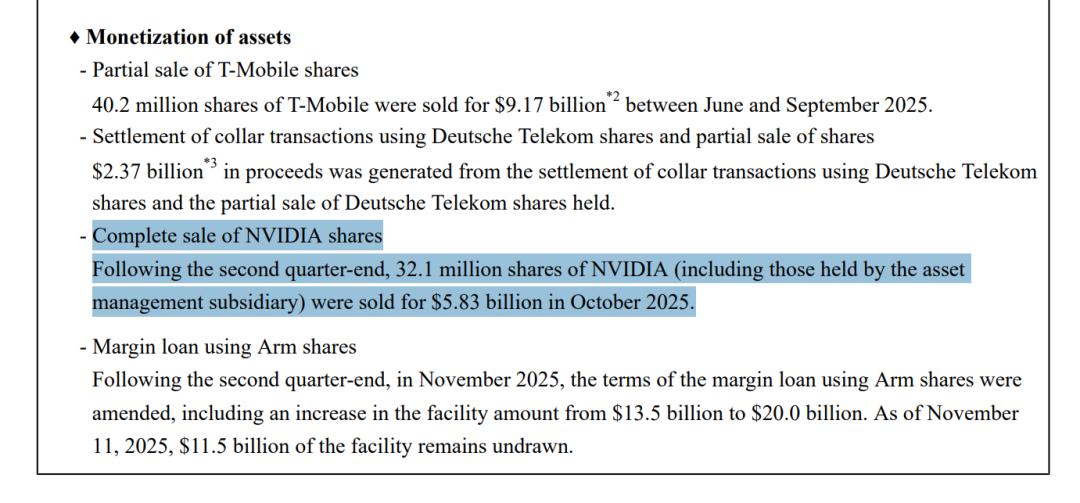
在第二季度结束后,于2025年10月出售了所持有的3210万股英伟达股份(包括其资产管理子公司持有的股份),套现58.3亿美元(当前约合人 民币415亿元)。 孙正义又让人看不懂了。 就在这个时间点,他清仓了英伟达,没错,是清仓。 随着软银二季度财报公布,财报里明晃晃提到—— 好家伙,要知道英伟达市值可是刚刚突破了历史性的"5万亿美元"大关,其潜力和价值估计没有人不清楚。 而且就算你说孙正义是瞅准了时机想卖个高价,但在AI时代,清仓这家被视为"AI基建核心"、"算力硬通货"的明星公司,仍不免让人心生疑问—— 孙正义是看到AI泡沫了吗? 毕竟上一次他减持英伟达,后来被老黄调侃损失了2500亿美元投资回报。 孙正义想什么呢? 孙正义辞别旧爱英伟达,All in新欢OpenAI 要想搞清孙正义究竟在想什么,不妨先来回答一个简单问题: 软银这次套现的钱,最终会流向哪里?答案其实已经清晰——OpenAI。 据软银首席财务官后藤芳光在财报说明会上透露,清仓之举正与公司和OpenAI之间的合作有关。 由于对OpenAI的投资规模较大,因此通过(出售股票)来筹集资金并加以运用。 具体来说,软银曾和OpenAI签订协议,承诺将 ...
孙正义再次清仓英伟达!上一次教训“价值2500亿美元”
量子位· 2025-11-12 08:01
Core Viewpoint - Masayoshi Son's decision to liquidate his entire stake in Nvidia raises questions about his investment strategy, particularly in the context of the AI boom and his shift towards OpenAI [2][6][31]. Group 1: Nvidia Stake Sale - SoftBank sold 32.1 million shares of Nvidia for $5.83 billion (approximately 41.5 billion RMB) after the end of Q2 2025 [3]. - Nvidia's market capitalization recently surpassed $5 trillion, indicating its significant value in the AI sector [5]. - This is not the first time Son has sold Nvidia shares; he previously liquidated his stake in 2019, which he later regretted as it cost him an estimated $250 billion in potential returns [28][25]. Group 2: Shift to OpenAI - The proceeds from the Nvidia sale are intended to fund SoftBank's substantial investment in OpenAI, with a commitment of up to $40 billion, of which $30 billion is expected to be invested [11][9]. - SoftBank's CFO confirmed that the liquidation aligns with the company's collaboration with OpenAI [8]. - The first tranche of $10 billion was completed in April 2025, with plans for further investments as OpenAI prepares for an IPO [11][20]. Group 3: Strategic Shift in AI Investment - Analysts suggest that Son's move to sell Nvidia is not an exit from AI but a strategic repositioning towards software and application layers, moving away from hardware [14][16]. - SoftBank's upcoming investments include acquiring Ampere for $6.5 billion and ABB's robotics business for $5.4 billion, indicating a focus on software and AI applications [17]. - The completion of OpenAI's restructuring paves the way for its IPO, which could yield significant returns for SoftBank [20][21].
CNBC Daily Open: SoftBank goes all in on OpenAI as 'Big Short' investor issues caution on AI firms
CNBC· 2025-11-12 07:30
Core Insights - SoftBank is selling its entire stake in Nvidia, having sold 32.1 million shares for $5.83 billion in October, but this decision is not driven by concerns over Nvidia's high valuations [1][2][4] Group 1: SoftBank's Stake Sale - The sale of Nvidia shares is significant, amounting to $5.83 billion, indicating a major financial maneuver by SoftBank [1] - The decision to sell is not related to concerns about AI valuations, as per a source familiar with the sale [4] Group 2: Market Reactions and Concerns - The sale could be interpreted as a sign of unease regarding Nvidia's high valuations, especially given SoftBank's previous investment history [2] - Michael Burry has raised concerns about major AI companies potentially understating depreciation of AI chips, which could artificially inflate earnings [3]


清仓英伟达震动市场,这是孙正义第二次这么干
Hua Er Jie Jian Wen· 2025-11-12 02:18
Core Insights - SoftBank founder Masayoshi Son has made a significant move by liquidating all of SoftBank's $5.8 billion stake in Nvidia to reinvest in the AI sector, including a planned $30 billion investment in OpenAI and participation in a $1 trillion AI manufacturing center project in Arizona [1][4] - The sale involved offloading 32.1 million shares of Nvidia at an exit price of approximately $181.58 per share, just 14% below Nvidia's historical peak of $212.19 [1] - This marks SoftBank's second complete exit from Nvidia, with the first exit in 2019 resulting in substantial losses, raising questions about whether Son perceives risks that others do not [1][5] Investment Style - Masayoshi Son's investment approach has been characterized by extreme bets, with a history of both significant gains and losses, including a $700 billion personal loss during the dot-com bubble and a legendary $20 million investment in Alibaba that grew to $150 billion by 2020 [2] - His willingness to seek large sums from investors, such as the $45 billion from Saudi Arabia for the Vision Fund, demonstrates a consistent strategy of aggressive capital raising [2] WeWork Experience - The investment in WeWork serves as a cautionary tale, where Son's high valuation of $47 billion led to a failed IPO and significant losses for SoftBank, totaling $11.5 billion in equity losses and an additional $2.2 billion in debt [3] Market Reactions - The recent liquidation of Nvidia shares has caused market speculation, with analysts suggesting that this move should not be interpreted as a negative stance towards Nvidia, yet it raises concerns about Son's insights into potential unseen risks [5]
CNBC Daily Open: SoftBank doubles down on AI amid warnings from 'Big Short' investor
CNBC· 2025-11-12 01:11
Core Insights - SoftBank is selling its entire stake in Nvidia, having sold 32.1 million shares for $5.83 billion in October, but this decision is not driven by concerns over Nvidia's high valuations [1][2][4] Group 1: SoftBank's Stake Sale - The sale of Nvidia shares is significant, amounting to $5.83 billion, indicating a major financial maneuver by SoftBank [1] - The decision to sell is not related to concerns about AI valuations, as per a source familiar with the sale [4] Group 2: Market Reactions and Concerns - The sale could be interpreted as a sign of unease regarding Nvidia's high valuations, especially given SoftBank's previous investment history [2] - Michael Burry has raised concerns about major AI companies potentially understating depreciation of AI chips, which could artificially inflate earnings [3]

孙正义,重回首富
投资界· 2025-11-05 01:50
Core Viewpoint - The article highlights the remarkable resurgence of Masayoshi Son, the founder of SoftBank, driven by significant investments in artificial intelligence (AI) and technology stocks, particularly Nvidia, which has led to a substantial increase in his personal wealth and SoftBank's market value [2][5][11]. Group 1: Financial Performance - SoftBank's market value reached approximately 38 trillion yen (about 1.7 trillion yuan), with a stock price surge from around 5,700 yen to 25,000 yen per share, marking an impressive increase [5]. - In the first quarter of the 2025-2026 fiscal year, SoftBank reported revenues of 1.82 trillion yen, a year-on-year growth of 7%, and a pre-tax profit of 689.94 billion yen, a significant increase of 205.7% [5]. - The Vision Fund's investment returns amounted to 726.84 billion yen, with a pre-tax profit of 451.39 billion yen, indicating a turnaround from previous losses [5]. Group 2: Investment Strategy - Son's aggressive investment strategy includes substantial stakes in Nvidia, Intel, and a $30 billion commitment to OpenAI, alongside a $5.375 billion acquisition of ABB's robotics business [3][10]. - SoftBank's investment in Nvidia increased in value from $1 billion to approximately $3 billion, with additional investments in TSMC and Oracle [5]. - Son's past missed opportunities with Nvidia, including selling all shares in 2019, highlight the volatility and risks associated with high-stakes investments [6]. Group 3: Future Outlook - Son aims for SoftBank to become the leading platform in the global AI sector over the next decade, predicting that AI will impact 5% to 10% of global GDP [11]. - The competition in AI is expected to be a comprehensive battle involving technology, products, and ecosystems, rather than a winner-takes-all scenario [11].
【锋行链盟】纳斯达克IPO破发核心要点
Sou Hu Cai Jing· 2025-10-16 16:18
Market Environment - Nasdaq's IPO underpricing is influenced by macroeconomic conditions, monetary policy, and investor risk appetite, which directly affect the funding support for new listings [2] - The Nasdaq index, while focused on tech stocks, is significantly impacted by overall market trends, including economic downturns and geopolitical conflicts, leading to a higher likelihood of IPO failures during such periods [2] Company Fundamentals - Companies listed on Nasdaq are primarily growth-oriented, particularly in sectors like technology, biotech, and renewable energy, but investors demand high certainty in short-term profitability and long-term competitiveness [2] - Basic flaws in a company's fundamentals can easily trigger IPO underpricing, especially if there are significant slowdowns in revenue growth or widening losses [2] Valuation Dynamics - The core issue of IPO underpricing often lies in the conflict between high valuations in the primary market and rational pricing in the secondary market [2] - Companies that have inflated valuations due to prior funding rounds may face significant challenges in the public market if they do not adjust their expectations before the IPO [4] Issuance Mechanism - The IPO pricing mechanism, typically determined by investment banks through book building, can amplify the risk of underpricing if the pricing deviates from market realities [2] - The "anchor effect" from recent comparable company valuations may fail if there are sudden market changes, leading to mispriced IPOs [4] Long-term Perspective - IPO underpricing does not necessarily indicate a company's failure; some quality firms may rebound as market conditions improve or as their fundamentals become more apparent [3] - Companies need to demonstrate improvements in fundamentals, such as revenue growth and reduced losses, to recover from initial underpricing [4] Key Risks - Companies in competitive sectors without unique advantages may be viewed as highly replaceable, increasing the risk of underpricing [2] - Specific events, such as clinical trial failures for biotech firms or regulatory issues for tech companies, can severely impact investor confidence and lead to significant stock price drops [2]

【锋行链盟】纳斯达克IPO发行定价流程及核心要点
Sou Hu Cai Jing· 2025-10-13 16:15
Group 1 - The core process of Nasdaq IPO pricing involves balancing the company's financing needs, investor risk-return expectations, and market liquidity to determine an acceptable issuance price [2] - The IPO pricing process is divided into five main stages: preparation, valuation and price range setting, roadshow and bookbuilding, pricing decision, and stock allocation and listing [2][7] Group 2 - The initial preparation stage includes selecting underwriters and conducting due diligence, which covers financial, business, and legal aspects to ensure transparency and mitigate risks [6] - Valuation analysis employs various methods such as discounted cash flow (DCF), comparable company analysis, and recent private funding rounds to establish an initial price range [6][7] Group 3 - The roadshow serves as a critical link between the company and investors, where management's ability to communicate effectively can influence investor confidence and demand [8] - Bookbuilding involves accurately collecting and processing investor orders to reflect true market demand, which informs the final pricing decision [9] Group 4 - Market conditions play a significant role in IPO pricing, with factors such as recent market performance, industry trends, and interest rates affecting investor sentiment and pricing strategies [10][13] - The Nasdaq emphasizes liquidity considerations, where companies with higher liquidity can command better pricing due to easier trading conditions [10] Group 5 - Adequate information disclosure is essential, as strict requirements ensure that investors have access to relevant financial data and risk factors, influencing their valuation adjustments [11] - Pre-IPO investors can impact the public offering price through their terms and the demand they generate, which can lead to price adjustments based on market conditions [12][14] Group 6 - The green shoe option allows underwriters to stabilize stock prices post-IPO by enabling them to sell additional shares if demand is high or buy back shares if prices fall [15] - Successful IPO pricing reflects a balance of company value and market demand, with outcomes ranging from meeting or exceeding initial price ranges to postponing or canceling offerings due to insufficient demand [16]
AI-driven accounting platform Trullion names new CEO
Yahoo Finance· 2025-10-07 11:01
Core Insights - Trullion has appointed Arthur "Artie" Minson as the new CEO, who has been an investor and advisor for over five years [1] - Isaac Heller has been named president and will focus on product development and partnerships in the audit and accounting sectors [2] - Trullion aims to enhance efficiency in finance, accounting, and auditing through its AI products [1][2] Company Leadership - Minson will oversee business operations including legal, finance, human resources, marketing, sales, customer success, and communications [2] - Heller will maintain his role as board chair while concentrating on new product development [2] Executive Background - Minson has a strong background, having served as president and co-CEO at WeWork, CFO at Time Warner Cable, and contributed to AOL's growth as CFO and COO [3] - His career began at EY, where he qualified as a CPA [3] Company Performance - Minson expressed excitement about leading Trullion during a phase of operational and financial acceleration, following the company's best quarterly performance in its history [4] - Since its inception in 2019, Trullion has developed a range of AI-powered accounting solutions and serves over 3,000 companies globally [4] Product Development - In May 2025, Trullion launched Trulli, an AI assistant designed to assist accountants with workflow automation, document analysis, and policy interpretation [5]