Snowflake Inc.

Search documents
A股策略周报20251221:迎接2026:告别单一叙事-20251221
SINOLINK SECURITIES· 2025-12-21 09:39
Market Dynamics - Since November, the correlation between the A-share (CSI 300) and U.S. stock market (S&P 500) has increased, with a 20-day rolling correlation exceeding 90%[3] - The average daily fluctuation of the CSI 300 has narrowed to the 39.7th percentile, while the S&P 500 is at the 33.7th percentile, indicating reduced volatility in both markets[12] Economic Indicators - The U.S. core CPI has decreased to 2.6%, the lowest in three and a half years, while the unemployment rate has risen to 4.6%[3] - Despite the rise in unemployment, the increase is primarily due to higher labor participation and temporary unemployment, not triggering the "Sam's Rule" threshold[15] AI Industry Insights - Recent trends show a divergence in the AI investment chain, with "broad AI" assets (copper, lithium, aluminum) outperforming core AI assets (computing chips, optical modules)[4] - There is a negative correlation between the stock price performance of AI core stocks and their capital expenditure as a percentage of revenue, indicating investor concerns over capital spending not translating into revenue growth[4] Domestic Demand Expansion - The Chinese government emphasizes expanding domestic demand, with a focus on increasing consumer spending and investment driven by income growth[5] - By 2025, measures will be taken to enhance secondary distribution, including raising minimum pension standards and implementing childcare subsidies[5] Future Investment Strategies - Investment strategies should focus on sectors benefiting from physical demand and domestic policy incentives, including industrial resources (copper, aluminum, lithium) and consumer sectors (airlines, hotels, food and beverage)[6] - The report suggests a dual focus on both physical demand and consumption policies as a more reliable investment approach leading into 2026[6]
OpenAI,65倍,8300亿美元
Ge Long Hui· 2025-12-20 11:39
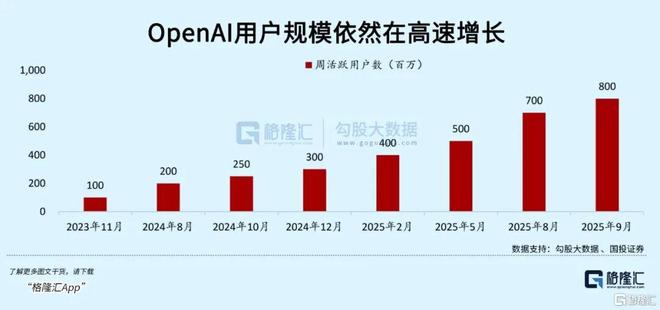
Core Viewpoint - OpenAI plans to raise $100 billion in a new funding round, potentially increasing its valuation to $830 billion, a significant jump from $500 billion just two days prior, highlighting the rapid escalation in perceived value within the AI sector [1][3]. Group 1: Valuation and Revenue Projections - If OpenAI achieves its target valuation of $830 billion, its price-to-sales ratio would be 65 times based on projected revenues of $12.7 billion in 2025 [2][3]. - OpenAI's revenue is expected to grow significantly, with estimates of $3.7 billion in 2024 and $12.7 billion in 2025, representing a 243% increase [6][7]. - The revenue structure includes substantial contributions from consumer subscriptions, enterprise services, and ecosystem commissions, with projections indicating that by 2029, revenues could reach $100 billion [7][8]. Group 2: Technological Advancements - OpenAI's competitive edge is attributed to its technological moat, particularly with the development of GPT-5, which utilizes a dual-track design for improved efficiency and cost reduction [3][11]. - The company is also working on "recursive self-improvement" technology, which could enhance model training efficiency by tenfold, necessitating a significant portion of the new funding [3][12]. Group 3: Financial Needs and Expenditures - OpenAI's projected costs for training advanced models are expected to soar into the tens of billions, driven by hardware and energy expenses, with estimates indicating a need for $100 billion in funding to support these initiatives [13][14]. - The company plans to invest heavily in building its own data centers to reduce reliance on external cloud services, with projected expenditures exceeding $450 billion from 2024 to 2030 [16][20]. Group 4: Market Dynamics and Competition - OpenAI faces intense competition for talent, necessitating substantial investments in employee compensation to retain top researchers amid offers from tech giants [20][21]. - The involvement of major investors, including SoftBank and Middle Eastern sovereign wealth funds, reflects a strategic interest in securing a foothold in the evolving AI landscape [25][26]. Group 5: Risks and Future Outlook - OpenAI's current business model is characterized by high cash burn rates, with projections indicating potential losses of $14 billion in 2026 and cumulative losses of $44 billion from 2023 to 2028 [23]. - The company's future hinges on successfully achieving AGI and significantly lowering inference costs; failure to do so could lead to a substantial market correction [27].

美国科技行业-第三季度业绩摘要:人工智能波动未改变软件投资逻辑-US Technology_ Q3 results summary_ AI volatility doesn‘t change the software playbook
2025-12-20 09:54
Summary of Key Points from the Conference Call Industry Overview - The conference call focuses on the **US Technology Equities** sector, particularly the **software and AI** landscape, highlighting the transition towards AI productization expected by **2026** [1][2]. Core Insights - **AI Productization Timeline**: 2026 is projected as the pivotal year for AI productization within enterprise software, moving from early-stage deployment to widespread enterprise integration [1][2]. - **Current AI Deployment Challenges**: Companies are still in the early stages of AI experimentation, facing challenges in hiring skilled talent and achieving meaningful results from initial projects [1][2]. - **Shift in Investment Focus**: There is a notable shift from hardware to software investments as companies begin embedding AI into their existing workflows, with significant advancements seen in companies like **Oracle, Microsoft, Salesforce, and ServiceNow** [1][2][5]. - **Monetization Visibility**: Vendors controlling structured enterprise processes are expected to have improved monetization visibility as AI becomes a value-added feature in their product suites [2]. Financial Performance Highlights - **Q3 Earnings Performance**: Most companies reported modest revenue beats but significant improvements in non-GAAP operating income and EPS, indicating early economic benefits from AI deployments [7][9]. - **Revenue Growth Constraints**: Despite increased interest in AI, enterprise budget expansions remain modest, limiting revenue growth [9]. - **Profitability Boost from AI**: AI-driven efficiencies are enhancing unit economics, leading to higher non-GAAP operating income and EPS, even without substantial revenue increases [9]. Company-Specific Insights - **Preferred AI Stocks**: The report identifies **Oracle (ORCL), Microsoft (MSFT), ServiceNow (NOW), and Salesforce (CRM)** as preferred stocks likely to benefit from their strategic positioning in the AI landscape by 2026 [2][5]. - **Earnings Revisions**: Companies like **Microsoft** and **Palantir** have seen significant upward revisions in revenue and EPS forecasts, reflecting strong AI-related demand [13][14]. - **CoreWeave's Performance**: CoreWeave reported revenue of **USD 1,365 million** for Q3, exceeding consensus but below estimates, with concerns about asset turnover and future guidance indicating potential revenue decline [18][19]. Market Dynamics - **AI Infrastructure Demand**: The demand for AI infrastructure and data workloads is solid, with companies like **Oracle and CoreWeave** aggressively scaling capacity [15]. - **Investor Sentiment**: There is a growing investor focus on how companies will deploy AI to solve business problems, with many still not fully recognizing the link between AI deployment and enterprise software [2]. Conclusion - The technology sector is on the brink of a significant transformation driven by AI, with 2026 expected to be a critical year for monetization and integration into enterprise workflows. Companies that are well-positioned in the software space are likely to capitalize on this trend, while challenges remain in the broader economic environment and enterprise budget constraints.


Snowflake (SNOW) Boosts FY2026 Guidance on Strong Enterprise Demand
Yahoo Finance· 2025-12-20 08:59
Snowflake Inc. (NYSE:SNOW) ranks among the best high growth stocks to buy now. Bernstein boosted its price target for Snowflake Inc. (NYSE:SNOW) to $237 from $221 on December 4 while retaining a Market Perform rating after the company’s third-quarter fiscal 2026 results. The cloud data company boosted its fiscal year 2026 guidance by roughly 1.5%, which was ahead of expectations, though consistent with past trends, and announced revenue that exceeded estimates by 3%. Meanwhile, strong consumption and ent ...
Dan Ives: 2026 will be key period to show next stage of AI trade from software and cyber
Youtube· 2025-12-19 21:59
Core Insights - 2026 is predicted to be a significant turning point in the AI revolution, particularly in software modernization and infrastructure buildout [1][2][3] - The technology sector is expected to rise by over 20% in 2026, with large-cap tech stocks potentially increasing by 30-40% [3][4] - An estimated $3-4 trillion will be spent on AI advancements over the next few years, indicating strong growth potential [4] Company-Specific Insights - Microsoft is anticipated to see a stock increase of 30-40% due to accelerated deals in Azure and overall strong performance in the cloud sector [6][7] - Oracle's recent selloff is viewed as overdone, with potential for the stock to reach $250, driven by its strong install base and AI-related growth [8][10] - Apple and Google are expected to announce a formal AI partnership around Gemini, which could significantly enhance their AI strategy and potentially increase Apple's stock value by $75 to $100 per share [12][14] Market Dynamics - The demand for AI solutions is currently outpacing supply at a ratio of 12 to 1 in the U.S., marking a significant shift in the competitive landscape [6] - The market is currently undervaluing the future growth potential of companies involved in AI, with expectations of growth accelerating from 17% to 45% in the coming years [10][11] - The AI revolution is still in its early stages, with significant opportunities for investment in companies like Microsoft, Oracle, and Nvidia, which have recently experienced stock price declines [11]

Jim Cramer Says Snowflake’s Decline Shows a Cohort Issue
Yahoo Finance· 2025-12-19 19:15
Snowflake Inc. (NYSE:SNOW) is one of the stocks Jim Cramer recently discussed. Noting that the stock has been down recently, a caller asked what was wrong with the stock, and Cramer replied: “Okay, what’s wrong with Snowflake is it’s in a cohort that’s going down, and it’s in baskets that are going down, and it’s considered to be AI, which is going down because everybody who’s saying, ooh, maybe there’s a bubble, the bubble popped, idiots. It popped at the end of October, and I’ve watched these stocks all ...
Earnings Calendar Preview: Defense Stock AAR, Coatings Firm AZZ Lead January Profit Parade
Investors· 2025-12-19 17:11
Group 1 - The earnings calendar is expected to be sparse until the end of the year, with notable reports from AAR Corp. on January 6 and AZZ Inc. on January 7 [5] - AZZ has received a Relative Strength Rating upgrade, indicating improved technical performance [5] - AAR Corp. has also achieved a Relative Strength Rating upgrade, hitting a key threshold [9] Group 2 - Oracle's stock has seen a significant increase following reports that TikTok has signed a deal to create a U.S. joint venture [6] - The stock market is experiencing a rebound, with Nasdaq leading the way, while Snowflake's outlook has caused a decline in its stock price [7] - Acuity Brands is highlighted as a strong performer, nearing a buy point, alongside Taiwan Semiconductor and other stocks [9]

Menlo Venture AI 调研:一年增长 3.2 倍,370 亿美元的企业级 AI 支出流向了哪?
海外独角兽· 2025-12-19 10:06
Core Insights - AI is experiencing unprecedented growth in enterprise software, with the market size increasing from $1.7 billion to $37 billion in just two years, representing a growth rate of approximately 3.2 times compared to last year's $11.5 billion [11][12] - The adoption rate of AI solutions is significantly higher than traditional SaaS, with 47% of AI transactions entering production compared to only 25% for traditional SaaS [20][24] - The spending on AI applications and infrastructure is projected to reach $19 billion and $18 billion respectively by 2025 [12] Group 1: Market Dynamics - The enterprise AI market has grown to occupy 6% of the global SaaS market, surpassing any historical software category growth [11] - AI-native startups have captured 63% of the market share in AI applications, while traditional giants still hold 56% in the infrastructure layer [29][35] - The healthcare sector accounted for nearly half of the vertical AI spending this year, totaling approximately $1.5 billion, a more than threefold increase from $450 million last year [46][48] Group 2: Spending Trends - In 2025, the total spending on generative AI is expected to reach $37 billion, with $19 billion allocated to AI applications and $18 billion to infrastructure [12][55] - The majority of AI spending is focused on applications that can quickly enhance productivity, with over half of enterprise AI spending directed towards AI applications [15][38] - The coding sector has emerged as a significant use case, with spending in this area expected to reach $4 billion by 2025, making it the largest segment within departmental AI [41][44] Group 3: Competitive Landscape - Anthropic has emerged as the leader in the enterprise LLM market, capturing approximately 40% of the spending, while OpenAI's share has decreased to 27% [63] - AI-native startups are outperforming traditional giants in several fast-growing application areas, demonstrating higher execution efficiency [29][30] - The PLG (Product-Led Growth) model is accelerating the adoption of AI products, with 27% of AI application spending coming from this model, compared to only 7% for traditional software [25][28] Group 4: Future Predictions - AI is expected to surpass human performance in everyday programming tasks, with continuous improvements in LLM capabilities [77] - The demand for explainability and governance in AI will become mainstream as the autonomy of agents increases [78] - There will be a shift towards edge computing for AI models, driven by needs for low latency and privacy [79]




BUILD 大会精华版正式上线!跟 Agentic AI 时代的开发者一起构建 | Q推荐
AI前线· 2025-12-19 03:07
Core Insights - Snowflake's BUILD event represents a significant platform for discussing cloud architecture, large-scale parallel computing, and data processing in the Data + AI field [3][4] - The introduction of BUILD in China signifies the integration of international technology with the local developer ecosystem, highlighting the importance of Chinese developers in global innovation [5] Group 1: Event Overview - The BUILD event is a tribute to the core developer activity of building, evolving into a leading platform for cloud and data discussions [3] - BUILD is not just a conference name; it symbolizes extreme performance and limitless scalability in the Data + AI sector [4] Group 2: Developer Empowerment - The event showcases practical cases from top global experts, focusing on topics like Agentic AI and multi-modal data processing, providing developers with insights from concept to prototype [7] - BUILD aims to accelerate the transition from development to production for Chinese developers, offering tailored solutions for various application scenarios [7] Group 3: Future Engagement - The upcoming BUILD 2025 event will further engage the Chinese technical community, providing insights into how Snowflake empowers business growth in the AI era [9] - Snowflake's AI data cloud is already utilized by 766 of the Fortune Global 2000 companies, indicating its significant role in helping businesses innovate and derive value from data [10]

Can C3.ai's IPD-Led Sales Reset Support a More Durable Growth Path?
ZACKS· 2025-12-18 15:35
Core Insights - C3.ai, Inc. is transitioning to a new phase of commercial execution, focusing on Initial Production Deployments (IPDs) as the main driver for sales reset [1] - The company is emphasizing smaller, high-impact deployments that demonstrate measurable economic value before scaling [1][5] - Management is tightening execution standards around IPDs to improve conversion outcomes and align deployments with economic objectives [3][10] IPD Activity and Strategy - In fiscal Q2 2026, C3.ai signed 20 new IPDs, including six generative AI IPDs, bringing the total to 394, with 269 currently active [2][9] - IPDs serve as a proving ground for customers to validate outcomes and build confidence for broader rollouts, as seen with major accounts like GSK, Dow, and Holcim [2] - The company is absorbing near-term margin pressure to enhance IPD execution and long-term conversions [9] Financial Implications - The shift to an IPD-led approach has led to moderated gross margins due to higher upfront costs and a heavier services component [4] - Management views this margin impact as a trade-off for prioritizing conversion quality and long-term customer value over immediate margin expansion [4] Competitive Landscape - C3.ai's IPD-centric approach contrasts with competitors like Palantir, which emphasizes rapid production deployments, and Snowflake, which focuses on consumption-based expansion [6][7][8] - C3.ai's strategy is positioned between these two, focusing on smaller deployments with explicit objectives to improve conversion quality and reduce execution risk [9][10] Stock Performance and Valuation - C3.ai shares have declined 21.5% over the past three months, compared to a 3.1% decline in the industry [11] - The company trades at a forward price-to-sales ratio of 6.03, significantly below the industry average of 16.47 [14] - The Zacks Consensus Estimate for fiscal 2026 earnings per share implies a year-over-year decline of 195.1%, although estimates have increased in the past 60 days [15]