
今世缘

Search documents
白酒深度汇报:当下我们如何看待白酒行业
2025-11-11 01:01
Summary of the Baijiu Industry Conference Call Industry Overview - The Baijiu industry is expected to reach a turning point around the second quarter of 2026, with stock prices typically responding ahead of fundamentals, indicating a current bottoming expectation for the sector, which presents good absolute return potential [1][4] - The industry has undergone six quarters of adjustment, likely to bottom out by the second quarter of 2026, with a subsequent recovery in income and stock prices anticipated [1][13][16] Key Insights and Arguments - The current market structure for Baijiu has significantly changed compared to the 2013-2016 cycle, with increased industry concentration and improved market management capabilities among leading companies [1][3][14] - The wholesale price of Moutai has dropped to 1,650 RMB, which is equivalent to 34 bottles purchasable with the annual income of urban residents, indicating sufficient economic capacity for high-end Baijiu consumption [1][11] - The Baijiu sector is currently under pressure but is expected to enter a phase of recovery as new products and channels contribute to growth, creating a resonance effect between alpha and beta returns [1][5] Future Trends - The Baijiu industry is projected to see a recovery in revenue growth by the second quarter of 2026, with a potential for excess returns compared to the CSI 300 index [13][16] - The rise of sauce-flavored Baijiu and its increasing penetration rate are noted as significant trends, despite recent adjustments in this segment [14][15] Investment Recommendations - Companies are categorized into three main development lines: 1. Those that meet family demand and have competitive advantages in regional markets, such as Jinwei and Gujing [17] 2. Large enterprises with strong brand positions and operational capabilities, like Luzhou Laojiao and Moutai [17] 3. Companies that innovate in products and channels, such as Shede and Li Du, which are exploring new growth points [17] Challenges and Opportunities - Current challenges include inventory buildup and downward pricing pressures across the industry, but a recovery in demand and normalization of inventory levels are expected to lead to a turning point in revenue stabilization [20] - The valuation of Baijiu companies is at historical lows, suggesting significant upside potential once the market recovers, particularly for high-end products that remain in demand [19][21] Conclusion - The Baijiu industry is in a transitional phase, with expectations of recovery and growth in the coming years. The current low valuations present a favorable long-term investment opportunity as the market stabilizes and consumer demand rebounds [19][20]




中信证券“3万亿”成笑话!茅台跌回1700元,900天库存压垮经销商
Sou Hu Cai Jing· 2025-11-10 23:03
Core Viewpoint - The Chinese liquor industry, particularly the baijiu sector, is experiencing a systemic crisis rather than a temporary fluctuation, indicating deep-rooted issues affecting the entire industry [2][24]. Industry Development - The baijiu market is witnessing a significant price collapse, with the wholesale price of Moutai dropping below 1700 yuan, a stark contrast to its previous status as a highly sought-after product [4][6]. - Approximately 60% of liquor companies are facing "price inversion," where selling prices are lower than wholesale prices, leading to severe financial strain on distributors [6][10]. - The stock performance of the baijiu sector has been poor, with many companies experiencing substantial declines in share prices, including a 40% drop for Moutai over four years [8][10]. Financial Performance - Recent quarterly reports reveal that nearly all listed liquor companies are experiencing negative growth, with some companies like Yanghe and Jiugui seeing revenue declines exceeding 30% [10][12]. - The average inventory turnover period for the industry has reached over 900 days, indicating severe overstock issues [21]. Consumer Behavior Changes - The baijiu industry has shifted towards a financial product mentality, prioritizing investment over consumption, which has alienated traditional consumers [13][15]. - Changes in consumer demographics, particularly the rise of younger generations (90s and 00s), have led to a decline in traditional consumption patterns associated with baijiu [19][23]. Future Outlook - The industry faces challenges in revitalization, requiring a shift back to the core value of baijiu as a consumable product rather than a speculative asset [24][28]. - Companies need to innovate and adapt to new consumer preferences, such as offering smaller, lower-alcohol products and engaging in modern marketing strategies to attract younger consumers [26][28].



A股酿酒板块走高,舍得酒业、会稽山涨停
Cai Jing Wang· 2025-11-10 20:37
Group 1 - The A-share liquor sector experienced a significant rise on November 10, with multiple companies reaching their daily limit up [1] - Shede Liquor and Kweichow Moutai both hit the daily limit, indicating strong investor interest [1] - Other notable performers included Gujing Gongjiu and Shanxi Fenjiu, both rising over 5%, while Yanjing Beer and Huichuan Beer saw increases of over 2% [1]


收评:尾盘拉升,再次站上4000点,释放重要信号!周二大盘可能这样走
Sou Hu Cai Jing· 2025-11-10 17:54
Core Viewpoint - The market is experiencing a structural shift, with funds moving from high-valuation technology growth sectors to lower-valuation, high-visibility consumer and cyclical sectors, indicating a change in institutional allocation focus for the fourth quarter [1][14]. Group 1: Consumer Sector - The consumer sector showed remarkable strength, with the liquor index surging 4.7%, marking the third-largest increase of the year, alongside strong performances in duty-free, department stores, and dairy sectors [2]. - The recovery in macroeconomic data, particularly the October CPI turning positive and exceeding market expectations, alleviated deflation concerns and signaled a rebound in consumer demand [2][3]. - Preliminary data from major e-commerce platforms during the Double Eleven shopping festival indicated significant year-on-year sales growth in categories like liquor, cosmetics, and home appliances, enhancing market sentiment towards liquor and duty-free industries [3]. - Regional liquor companies and leading duty-free operator China Duty Free Group outperformed high-end liquor brands, reflecting a focus on growth potential rather than brand premium in current consumer allocation strategies [4]. Group 2: Cyclical Sector - The cyclical sector also performed strongly, with significant gains in chemical, phosphate, and photovoltaic equipment sectors [5]. - Demand for new energy materials, particularly lithium iron phosphate and fluorinated chemicals, has notably increased due to global energy transition, leading to improved order visibility for leading companies [6]. - The photovoltaic industry chain has seen a recovery in production scheduling, with stable pricing for upstream silicon materials and components, attracting investor interest [7]. - The CRB commodity index has risen by 3.2% over the past two weeks, boosting confidence in the price recovery of metals and chemicals, which typically draws in more short-term and trend-following funds [8]. Group 3: Technology Growth Sector - The technology growth sector faced significant outflows, with AI, CPO, and humanoid robot sectors generally declining [10]. - A mismatch between valuations and earnings has emerged, as many high-growth sectors reported slowing net profit growth post-Q3 disclosures, leading to increased valuation pressure [11]. - Northbound funds and some public offerings have significantly reduced their exposure to technology sectors, shifting towards sectors with strong cash flow and short-term earnings certainty, such as liquor and chemicals [12]. - The previously overheated themes of artificial intelligence and robotics are experiencing a downturn due to a lack of new policies or technological breakthroughs, resulting in decreased investor interest [13]. Group 4: Market Dynamics and Investment Strategy - The collective strength of consumer and cyclical sectors reflects a broader trend of institutional reallocation, favoring low-valuation, stable cash flow industries as earnings expectations for technology growth sectors have not been met [14]. - The market's preference for "certainty over high elasticity" during a weak economic recovery phase suggests that the concentration of funds in consumer and cyclical sectors may continue for the next 2-4 weeks until new policies or industry catalysts emerge [19]. - Investment strategies should focus on identifying leading companies within the consumer recovery narrative and sectors showing marginal improvements in the new energy cycle, while being cautious with technology growth stocks until adjustments are complete [18].

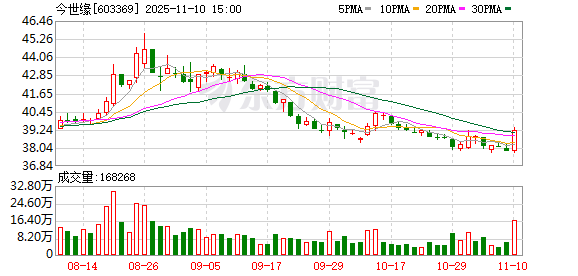
今世缘11月10日大宗交易成交221.07万元
Zheng Quan Shi Bao Wang· 2025-11-10 13:58
Group 1 - The core transaction on November 10 involved a block trade of 65,000 shares of Jinshiyuan, with a transaction value of 2.21 million yuan, at a price of 34.01 yuan, representing a discount of 13.28% compared to the closing price of the day [2][4] - In the last three months, Jinshiyuan has recorded a total of 9 block trades, amounting to 21.36 million yuan [3] - The closing price of Jinshiyuan on the day of the report was 39.22 yuan, reflecting an increase of 3.78%, with a daily turnover rate of 1.35% and a total trading volume of 651 million yuan [3] Group 2 - The latest margin financing balance for Jinshiyuan is 357 million yuan, showing a decrease of 7.70 million yuan over the past five days, which is a decline of 2.11% [4] - Two institutions have provided ratings for Jinshiyuan in the past five days, with the highest target price set at 51.00 yuan by Haitong International Securities [4] - Jinshiyuan was established on December 23, 1997, with a registered capital of 124.68 million yuan [4]
黎明前夕,曙光将至:白酒进入底部战略性布局期
Shenwan Hongyuan Securities· 2025-11-10 10:42
Investment Rating - The report maintains a strategic bullish outlook on the liquor industry, particularly on high-quality companies, indicating that it has entered a strategic allocation period [1]. Core Views - The liquor sector is expected to experience a fundamental turning point in Q3 2026, with a potential dual impact on valuation and performance by the end of 2026 and into 2027 if the fundamentals recover as anticipated [1][3]. - The report emphasizes the need for patience regarding the fundamentals and acknowledges that the performance of individual stocks will vary during this phase [1]. - Key recommended stocks include Luzhou Laojiao, Shanxi Fenjiu, Kweichow Moutai, and Wuliangye, with additional attention on Yingjia Gongjiu, Jinhui Jiu, Gujing Gongjiu, Jianshiyuan, and Yanghe Distillery [1]. Summary by Sections Fundamental Analysis - The liquor sector has accelerated its clearing process in Q3 2025, with expectations for a fundamental turning point in Q3 2026. The industry faced significant pressure in demand due to external structural disturbances, leading to a projected 20%-30% year-on-year decline in overall sales volume in Q3 2025, which is approximately 50% lower than Q3 2023 [3]. - High-end liquor prices have continued to decline as the market seeks a balance between volume and price [3]. Valuation Analysis - As of October 31, 2025, the liquor sector's absolute PE level stands at 18.7x, below the historical average of 27.6x since 2011. The relative PE ratio compared to the Shanghai Composite Index is 1.14x, also below the historical average of 2.01x [3]. - The report anticipates an increase in dividend rates for liquor companies, with many leading firms disclosing three-year dividend return plans, and most companies currently offering a dividend yield of over 3%, indicating long-term investment value [3]. Holdings Analysis - In Q3 2025, the liquor sector's holding proportion fell to 5.52%, reverting to levels seen in Q2 2017. This represents a decrease of 1.26 percentage points from the previous quarter, which is below the average since 2009 [3].
今世缘今日大宗交易折价成交6.5万股,成交额221.07万元
Xin Lang Cai Jing· 2025-11-10 09:35
Group 1 - The article highlights the launch of a new platform by Sina Finance, named "Wine Price Insider," which aims to provide real-time market prices for well-known liquor brands [1] - On November 10, a significant transaction involving Jiusiyuan occurred, with 65,000 shares traded at a price of 34.01 yuan, totaling 2.21 million yuan, which represents 0.34% of the total transaction volume for that day [1] - The transaction price of 34.01 yuan reflects a discount of 13.28% compared to the market closing price of 39.22 yuan [1] Group 2 - The trading data indicates that the transaction was executed by Huatai Securities, with the buying and selling departments involved in the trade [2] - The transaction volume of 65,000 shares suggests a notable interest in Jiusiyuan, potentially indicating market dynamics or investor sentiment [2]

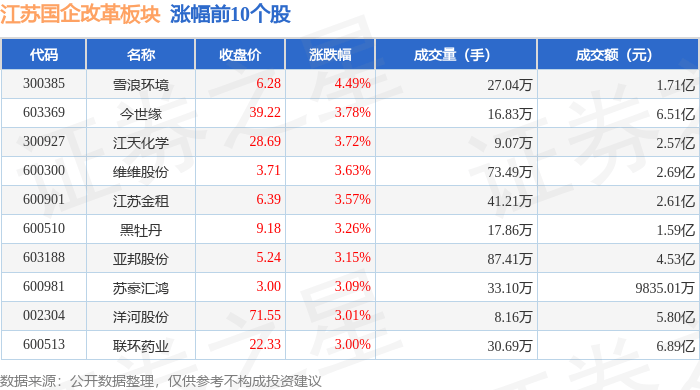
江苏国企改革板块11月10日涨1.09%,雪浪环境领涨,主力资金净流入9964.07万元


Sou Hu Cai Jing· 2025-11-10 09:05
Market Overview - On November 10, the Jiangsu state-owned enterprise reform sector rose by 1.09% compared to the previous trading day, with Xuelang Environment leading the gains [1] - The Shanghai Composite Index closed at 4018.6, up 0.53%, while the Shenzhen Component Index closed at 13427.61, up 0.18% [1] Stock Performance - Xuelang Environment (300385) closed at 6.28, with a gain of 4.49% and a trading volume of 270,400 shares, amounting to a transaction value of 171 million [1] - Jianshi Family (603369) closed at 39.22, up 3.78%, with a trading volume of 168,300 shares and a transaction value of 651 million [1] - Jiangtian Chemical (300927) closed at 28.69, up 3.72%, with a trading volume of 90,700 shares and a transaction value of 257 million [1] - Other notable stocks include Weivi Co. (600300) with a 3.63% increase and a transaction value of 269 million, and Jiangsu Jinzu (600901) with a 3.57% increase and a transaction value of 261 million [1] Capital Flow - The Jiangsu state-owned enterprise reform sector saw a net inflow of 99.64 million from main funds, while retail investors experienced a net outflow of 81.07 million [2] - The main funds showed a significant presence in stocks like Huatai Securities (601688) with a net inflow of 154 million, while retail investors withdrew from stocks like Xuelang Environment and Weivi Co. [3]
白酒进入底部战略性布局期:黎明前夕,曙光将至
Shenwan Hongyuan Securities· 2025-11-10 08:43
Investment Rating - The report maintains a "Positive" outlook on the liquor industry, indicating that it is entering a strategic allocation period as it approaches a bottom phase [2]. Core Insights - The liquor sector is expected to experience a fundamental turning point in Q3 2026, with a potential dual impact on valuation and performance by the end of 2026 and into 2027. This is based on historical performance patterns observed from 2012 to 2015, where stock price turning points preceded fundamental turning points [2]. - The report emphasizes the need for patience regarding the fundamental recovery and notes that individual company adjustments will vary, leading to differentiated stock performances during this period. It anticipates that the main contribution to stock price returns will come from valuation adjustments rather than earnings growth in the near term [2]. Summary by Sections Fundamental Analysis - The liquor sector has been experiencing a significant downturn since Q4 2024, with Q3 2025 showing accelerated declines. The industry is projected to face a 20%-30% year-on-year decline in sales volume in Q3 2025, with a 50% drop compared to Q3 2024. High-end liquor prices are also declining as the market seeks a balance between volume and price [4]. - Looking ahead, Q1 2026 is expected to continue facing double-digit sales volume declines, but stabilization is anticipated in Q2 2026, with a potential recovery in demand and pricing by Q3 2026 [4]. Valuation Analysis - As of October 31, 2025, the liquor sector's absolute PE ratio stands at 18.7x, significantly below the historical average of 27.6x since 2011. The relative PE ratio compared to the Shanghai Composite Index is 1.14x, also below the historical average of 2.01x. The report suggests that leading companies are expected to increase their dividend payout ratios, with most currently offering dividend yields above 3%, indicating long-term investment value [4]. Holdings Analysis - In Q3 2025, the liquor sector's holdings accounted for 5.52% of total fund investments, a decrease of 1.26 percentage points from previous quarters, returning to levels seen in Q2 2017. This indicates a significant reduction in fund exposure to the liquor sector compared to historical averages [4].
舍得酒业涨停!食品饮料ETF(159843)涨超3%,机构:珍惜当前白酒低位布局机会
2 1 Shi Ji Jing Ji Bao Dao· 2025-11-10 05:45
Group 1 - The technology sector experienced a pullback while the consumer sector saw a significant surge, with companies like Shede Spirits and Jiu Gui Jiu hitting their daily limit up [1] - The surge in the consumer sector is attributed to three main factors: the Ministry of Finance's report on continued fiscal policies to boost consumption, positive signals from the CPI data, and the upcoming closure of Hainan Island which is expected to accelerate economic development [1] - The leading companies in the food and beverage sector, such as Kweichow Moutai and Wuliangye, have reported their Q3 2025 earnings, indicating that the most challenging period for the liquor industry may be over [1] Group 2 - The Food and Beverage ETF (159843) tracks the Guozhen Food Index, which includes top stocks like Kweichow Moutai and Wuliangye, suggesting a focus on leading companies in the sector [2] - Analysts from CITIC Securities believe the food and beverage industry is gradually bottoming out, recommending to seize the current low valuation opportunities in the liquor sector [2] - According to China International Capital Corporation, the liquor industry is expected to see improvements in 2026, with a recovery phase beginning in the first half of next year, benefiting leading liquor companies with strong market share [2]
