民生证券

Search documents
国联民生迎新董事长 党委书记顾伟“一肩挑”
Zheng Quan Ri Bao Zhi Sheng· 2025-08-08 13:41
Group 1 - The core leadership team of Guolian Minsheng has officially been established, with Gu Wei taking on the role of Chairman, marking a significant step in the integration process of Guolian Securities and Minsheng Securities [1] - The integration process began with the public announcement of "Guolian Minsheng" on February 14, and substantial integration of business and personnel has been steadily progressing since then [1][2] - The recent appointment of Gu Wei is closely related to local policy directives, which stipulate that the roles of Party Secretary and Chairman in state-owned enterprises should be held by one individual, facilitating direct coordination between the Party and management [1][2] Group 2 - Gu Wei's career trajectory is deeply intertwined with the integration of Guolian Minsheng, having held various key positions that enable him to effectively manage the integration process [2][3] - The resignation of Ge Xiaobo from his roles as Chairman and other committee positions is noted, although he will continue to serve as Executive Director and President, allowing him to focus on business development [2][3] - The new executive team includes experienced professionals from both Guolian and Minsheng Securities, which is expected to stabilize the core team and promote cultural integration during the merger [4]

顾伟任国联民生证券董事长
Shang Hai Zheng Quan Bao· 2025-08-08 13:19
Core Viewpoint - The new leadership team of Guolian Minsheng Securities has been officially announced, with Gu Wei appointed as the chairman, marking a significant step in the integration of Guolian Securities and Minsheng Securities, which is seen as a successful case of market-oriented mergers in the Chinese securities industry [1][5]. Leadership Transition - Gu Wei, born in 1975 and with a strong background in local government and finance, is viewed as an ideal leader for Guolian Minsheng Securities due to his extensive experience and connections in the financial sector [3][4]. - Gu Wei's previous roles include significant positions in the Wuxi government, where he contributed to the development of the local financial ecosystem, leading to over 200 listed companies in Wuxi [4]. Integration and Strategy - The merger of Guolian and Minsheng Securities is characterized as a local government initiative to empower financial institutions and industry systems through state-owned capital [5]. - The leadership structure aims to balance state-owned enterprise governance with professional management, enhancing decision-making and operational efficiency [10]. Management Team Composition - The new executive team reflects a strategic balance between leaders from both Guolian and Minsheng, with a significant portion of the team coming from Minsheng Securities, ensuring stability and cultural integration during the merger [9][11]. - The appointments include experienced professionals in key positions, which is expected to facilitate the smooth integration of operations and business lines [12]. Performance and Growth - The merger has already shown significant synergies, with a projected net profit of 1.129 billion yuan for the first half of 2025, representing a year-on-year increase of approximately 1183% [12]. - The combined entity has established a strong market position, competing effectively with major players in the industry, and has seen substantial growth in its research business [13][14]. Future Outlook - The strategic vision includes a focus on industry integration, technological advancement, and wealth management, aiming to position Guolian Minsheng Securities as a leading investment bank [14].


慢牛已来,“旗手”蛰伏待涨!量能创纪录,国防军工人气飙升,"AI双子星"意外杀跌
Xin Lang Ji Jin· 2025-08-08 12:00
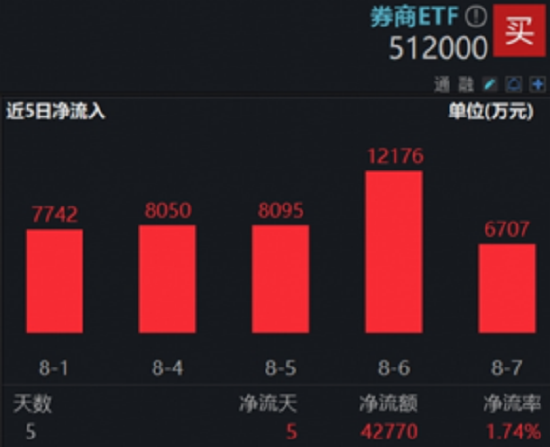
Market Overview - A-shares experienced a slight consolidation with major indices fluctuating around the water surface, and the Shanghai Composite Index reached a new high for the stage [1] - The total trading volume in the two markets was 1.71 trillion yuan, with over 2400 stocks rising [1] - The non-ferrous metals sector showed strong performance, while technology stocks, particularly in artificial intelligence, faced significant declines [1][14] Sector Performance - The defense and military sector demonstrated resilience, with the National Defense and Military ETF (512810) experiencing a slight decline of 0.14% but showing high popularity [1][5] - The National Defense and Military ETF recorded a weekly trading volume of 6.56 billion yuan, setting a new record since its launch in 2016 [5][8] - The brokerage sector has been relatively subdued, with the top brokerage ETF (512000) seeing a net inflow of over 4.2 billion yuan in the past five days, indicating continued investor interest despite its underperformance compared to the broader market [2][11][13] AI Sector Analysis - The AI sector faced a notable pullback, with the AI-focused ETF (589520) dropping 2.57% amid market corrections and profit-taking [14][16] - Concerns were raised regarding the performance of OpenAI's latest model, GPT-5, which did not meet high expectations, contributing to the sector's decline [17][18] - Despite short-term volatility, analysts suggest that the AI sector may still present investment opportunities due to ongoing developments in domestic AI technologies [18] Investment Sentiment - The overall sentiment in the A-share market appears to be bullish, with a consensus forming around a slow bull market supported by policy benefits, new capital inflows, and industrial upgrades [1][11] - The brokerage sector is expected to benefit from the recent policy initiatives aimed at enhancing the quality of public fund development, potentially attracting more capital [12][13] - Historical patterns suggest that the defense and military sector may see increased activity leading up to significant events, such as military parades, which could catalyze further investment interest [8]
国联民生高管阵容相亮,顾伟掌舵,三大看点聚焦新班子
Xin Lang Cai Jing· 2025-08-08 11:32
Core Viewpoint - The recent executive appointments at Guolian Minsheng Securities mark a significant step in the integration of the company, with a focus on enhancing business collaboration and market competitiveness [1][4][15]. Group 1: Executive Appointments - Guolian Minsheng Securities has established a new core leadership team consisting of 16 members, including Gu Wei as Chairman and Ge Xiaobo as President, aligning with industry expectations [3][5]. - The new appointments include Xiong Leiming as Executive Vice President and Zheng Liang, Hu Youwen as Vice Presidents, all of whom possess extensive experience in the securities industry [3][4]. - The leadership changes are part of a broader strategy to integrate Guolian and Minsheng Securities, emphasizing a market-oriented approach and leveraging the strengths of both entities [4][15]. Group 2: Integration Strategy - The integration process is characterized by a deep fusion of business chains, client resources, and professional capabilities, representing a shift in the securities industry from "scale expansion" to "quality enhancement" [4][15]. - The leadership adjustments are expected to provide strong support for business integration and development, promoting collaboration and enhancing market competitiveness [4][15]. - The integration aims to achieve the "1+1>2" goal by effectively utilizing the advantages of state-owned shareholders and the unique business characteristics of Minsheng Securities [4][15]. Group 3: Leadership Composition - The new executive team reflects a combination of "state-owned enterprise leaders and professional managers," which is a strategic move to enhance operational efficiency [6][12]. - The leadership structure includes a balance of executives from both Guolian and Minsheng, facilitating cultural integration and stability during the merger [10][11]. - The dual role of Gu Wei as both Party Secretary and Chairman is designed to streamline decision-making processes and ensure alignment between governance and business operations [12][14]. Group 4: Strategic Goals - Guolian Minsheng Securities aims to become a leading investment bank by 2035, with a clear focus on developing its core business lines, including wealth management and asset management [15][16]. - The company has set ambitious strategic goals, including the establishment of an industrial investment bank, technology investment bank, and wealth investment bank, to better serve the real economy [15][16]. - Recent performance indicators show a significant increase in net profit, with a reported net profit of 1.129 billion yuan, reflecting a year-on-year growth of approximately 1183% [16].

顾伟掌舵国联民生,新高管团队四大看点!
Jing Ji Guan Cha Wang· 2025-08-08 11:32
Core Insights - The new leadership team of Guolian Minsheng Securities has been officially announced, with Gu Wei taking on the roles of both Party Secretary and Chairman, indicating a significant consolidation of power within the company [1][3][4] - The integration of Guolian Group and Minsheng Securities marks a successful case of market-oriented mergers in the brokerage industry, driven by local government initiatives to empower financial institutions [2][3][8] - The strategic appointment of executives from both Guolian and Minsheng Securities aims to enhance operational efficiency and facilitate a smooth integration process, with a focus on leveraging the strengths of both entities [5][7][9] Company Developments - Guolian Group acquired a 30.3% stake in Minsheng Securities for 9.105 billion yuan, and subsequent approvals from regulatory bodies have paved the way for Gu Wei's leadership role [2][3] - The recent adjustments in the executive team, including the appointment of five senior executives from Minsheng Securities, signify a new phase in the integration process [2][5][7] - The leadership structure now features a blend of state-owned enterprise leaders and professional managers, which is expected to enhance decision-making and operational effectiveness [6][8] Financial Performance - Guolian Minsheng Securities reported a significant increase in net profit, achieving 1.129 billion yuan in the first half of 2025, a year-on-year increase of approximately 1183% [10][12] - The company is positioned to enhance its competitive edge in the investment banking sector, with a focus on wealth management, asset management, and derivative products [9][11] - The integration strategy aims to create a comprehensive financial service capability, targeting various sectors including technology finance, green finance, and digital finance [10][12] Market Position - The merger has established Guolian Minsheng Securities as a formidable player in the brokerage industry, competing with major firms like Guotai Junan and CITIC Securities [11] - The company aims to achieve a market share of 4.22% in research services, positioning itself among the top five in the industry [11] - The strategic vision includes a focus on regional development and industry specialization, with plans to enhance service offerings and operational capabilities [12]
国联民生迎新董事长,党委书记顾伟“一肩挑”
Xin Lang Zheng Quan· 2025-08-08 11:14
Core Viewpoint - The recent leadership changes at Guolian Minsheng Securities, including Gu Wei's appointment as both Chairman and Party Secretary, signify a new phase in the integration of Guolian and Minsheng, emphasizing the importance of local government support in the merger process [2][3][4]. Group 1: Leadership Changes - Gu Wei has been appointed as Chairman of Guolian Minsheng Securities, consolidating his roles as both Party Secretary and Chairman, which aligns with local government regulations [3][4]. - The leadership transition follows Guolian Group's acquisition of a 30.3% stake in Minsheng Securities for 9.105 billion yuan, marking a significant step in the integration process [2]. - The new executive team has been finalized, indicating a strategic alignment and effective integration of resources and management from both firms [2][4]. Group 2: Integration Strategy - The merger is seen as a model for market-oriented consolidation in the securities industry, with local government backing enhancing the capabilities of financial institutions [3][10]. - The integration aims to leverage the strengths of both Guolian and Minsheng, focusing on enhancing comprehensive financial services and achieving a synergistic effect of "1+1>2" [8][10]. - The strategic plan includes a focus on various financial sectors such as technology finance, green finance, and wealth management, aiming to establish a leading comprehensive state-owned enterprise group [8][11]. Group 3: Performance and Market Position - Guolian Minsheng Securities reported a significant increase in net profit, reaching 1.129 billion yuan, a year-on-year increase of approximately 1183%, indicating strong financial performance post-merger [10][11]. - The firm has positioned itself among the top players in the market, establishing a new competitive landscape alongside major firms like Guotai Junan and CITIC Securities [11][12]. - The integration has not only improved financial metrics but also enhanced the firm's capabilities in investment banking and research, contributing to a robust growth trajectory [11][12].
新发国债等债券利息收入恢复征收增值税
Zheng Quan Ri Bao· 2025-08-08 07:02
Core Viewpoint - The reintroduction of value-added tax (VAT) on interest income from newly issued government bonds and other bonds starting August 8 is expected to have a limited impact on the net profits of insurance companies, but it may influence their asset allocation strategies towards equities and other bond types [1][2][3]. Summary by Sections Impact on Insurance Companies - The new VAT policy will have a minor static impact on the net profits of insurance companies, estimated at around 1% [3]. - The policy will primarily affect the interest income from newly issued government bonds, while existing bonds will remain exempt from VAT until maturity [2][3]. Asset Allocation Changes - Despite the slight decrease in actual interest income, bonds will maintain their status as the "ballast" in insurance asset allocation, with a potential marginal increase in equity investments to enhance overall returns [4][5]. - Insurance companies are likely to increase their allocation to high-dividend stocks and may also consider growth stocks to manage short-term volatility and achieve better long-term returns [6]. Current Bond Allocation Trends - As of the end of Q1 this year, insurance funds had approximately 34.9 trillion yuan in total investments, with bond investments accounting for about 48.58% of this total, indicating a rising trend in bond allocation [2]. - The proportion of bond investments among life insurance companies reached 51.18%, reflecting a strong preference for bonds as a primary asset class [2]. Future Outlook - Analysts predict that insurance funds will continue to favor long-duration bonds, especially in a low-interest-rate environment, while also seeking to lock in tax-exempt returns from existing bonds [4][5]. - The overall investment yield for insurance companies is expected to improve as the macroeconomic environment stabilizes and capital markets recover [6].
新发国债等债券利息收入恢复征收增值税 对险资大类资产配置影响几何?
Zheng Quan Ri Bao· 2025-08-07 23:41
Core Viewpoint - The restoration of value-added tax (VAT) on interest income from newly issued government bonds and other bonds starting from August 8 is expected to have a limited static impact on the net profits of insurance companies, but it may influence their asset allocation strategies, potentially leading to an increased allocation in equity assets as a partial substitute for bonds [1][2][4]. Summary by Sections Policy Changes - As of August 8, 2023, interest income from newly issued government bonds, local government bonds, and financial bonds will be subject to VAT, while those issued before this date will remain exempt until maturity [2]. Impact on Insurance Companies - The overall impact on insurance companies' net profits is estimated to be around 1%, with some firms potentially adjusting their asset allocation towards higher-yielding assets or older bonds to mitigate the effects of the new tax policy [3][4]. - According to estimates from major insurance companies, the impact of the new policy on their net profits is projected to range from 0.26% to 1.77%, indicating a relatively minor effect [3]. Asset Allocation Trends - Despite the slight decrease in actual interest income, bonds will maintain their status as the "ballast" in insurance asset allocation. However, some insurance firms may increase their allocation to equity assets in response to the changing market conditions [4][5]. - Data shows that as of the end of Q1 2023, insurance funds had a bond investment balance of approximately 16.97 trillion yuan, accounting for about 48.58% of total investments, with life insurance companies having an even higher allocation of 51.18% [2]. Future Outlook - Analysts suggest that insurance funds will continue to focus on long-duration bonds, especially in a declining interest rate environment, while also considering high-dividend stocks to enhance overall investment returns [5]. - The potential for increased allocation to high-dividend stocks and growth stocks is anticipated as insurance companies seek to balance short-term volatility with long-term gains, especially as the macroeconomic environment stabilizes [5].
新发国债等债券利息收入恢复征收增值税 将对险资大类资产配置影响几何?
Zheng Quan Ri Bao· 2025-08-07 16:43
Core Viewpoint - The reintroduction of value-added tax (VAT) on interest income from newly issued government bonds, local government bonds, and financial bonds is expected to have a minimal impact on insurance companies' net profits, estimated at around 1% in the short term, while encouraging a shift towards high-dividend assets and older bonds for hedging purposes [1][3][4]. Summary by Sections Impact of VAT Reintroduction - The Ministry of Finance and the State Taxation Administration announced on August 1 that VAT will be reinstated on interest income from newly issued bonds starting August 8, while previously issued bonds will remain exempt until maturity [2]. - Insurance companies have significantly increased their bond allocations, with bond investments reaching approximately 16.97 trillion yuan, accounting for about 48.58% of total investment [2]. Quantitative Analysis - Research from Huayuan Securities indicates that the short-term impact on insurance companies' net profits from the VAT policy is around 1%, with potential for increased impact as the allocation to new bonds rises over time [3]. - Guojin Securities estimates the impact on the net profits of the five major listed insurance companies for 2024 to be between 0.26% and 1.77%, indicating a generally minor effect [3]. Asset Allocation Trends - Despite the slight decrease in actual interest income, bonds will maintain their status as the "ballast" in insurance asset allocation, although there may be a marginal increase in equity asset allocation to enhance overall investment returns [4][5]. - As of the end of the first quarter, insurance funds have continued to increase their bond allocations, with a notable rise in the proportion of bond investments compared to the end of the previous year [4]. Future Outlook - Analysts suggest that insurance funds will likely accelerate their allocation to long-duration bonds to lock in tax-exempt returns, while the scarcity of these bonds may lead to a premium, resulting in lower long-term bond yields and increased fair value [4]. - Insurance companies are expected to increase their holdings in high-dividend stocks and growth stocks to mitigate the pressure from the VAT reintroduction and declining long-term interest rates, aiming for better long-term returns [6].
中科信息:8月7日接受机构调研,南方基金、生命人寿等多家机构参与
Zheng Quan Zhi Xing· 2025-08-07 15:08
Core Viewpoint - Zhongke Information (300678) is focused on providing information technology solutions based on intelligent recognition and analysis technology, with applications in various sectors including government, tobacco, and oil and gas industries [2][5]. Group 1: Business Overview - The company primarily offers information technology solutions, including both software and hardware, with a focus on high-speed machine vision and intelligent analysis technology [2][5]. - Key application areas include smart governance, intelligent manufacturing, and smart health, with a strong emphasis on digital transformation across various industries [2][3]. - The company has a leading market position in providing digital solutions for major government meetings and is the only global supplier capable of offering detection technology for the entire lifecycle of banknote printing [2][3]. Group 2: Recent Developments - The artificial intelligence anesthesia robot, developed in collaboration with Sichuan University West China Hospital, has entered clinical trials after four years of research, demonstrating its capability in surgical anesthesia assistance [4]. - The intelligent loading robot and intelligent paving robot are currently in testing phases, with plans for industrial promotion in the future [4]. Group 3: Financial Performance - In Q1 2025, the company reported a main revenue of 53.1853 million yuan, a year-on-year decrease of 39.0%, and a net profit attributable to shareholders of 3.19 million yuan, down 57.96% [5]. - The company's debt ratio stands at 24.2%, with an investment income of 50.408 million yuan and a gross profit margin of 38.38% [5].