
浦发银行

Search documents
各银行在售高收益纯固收产品一览!合资理财子产品首次上榜
2 1 Shi Ji Jing Ji Bao Dao· 2026-02-02 09:13
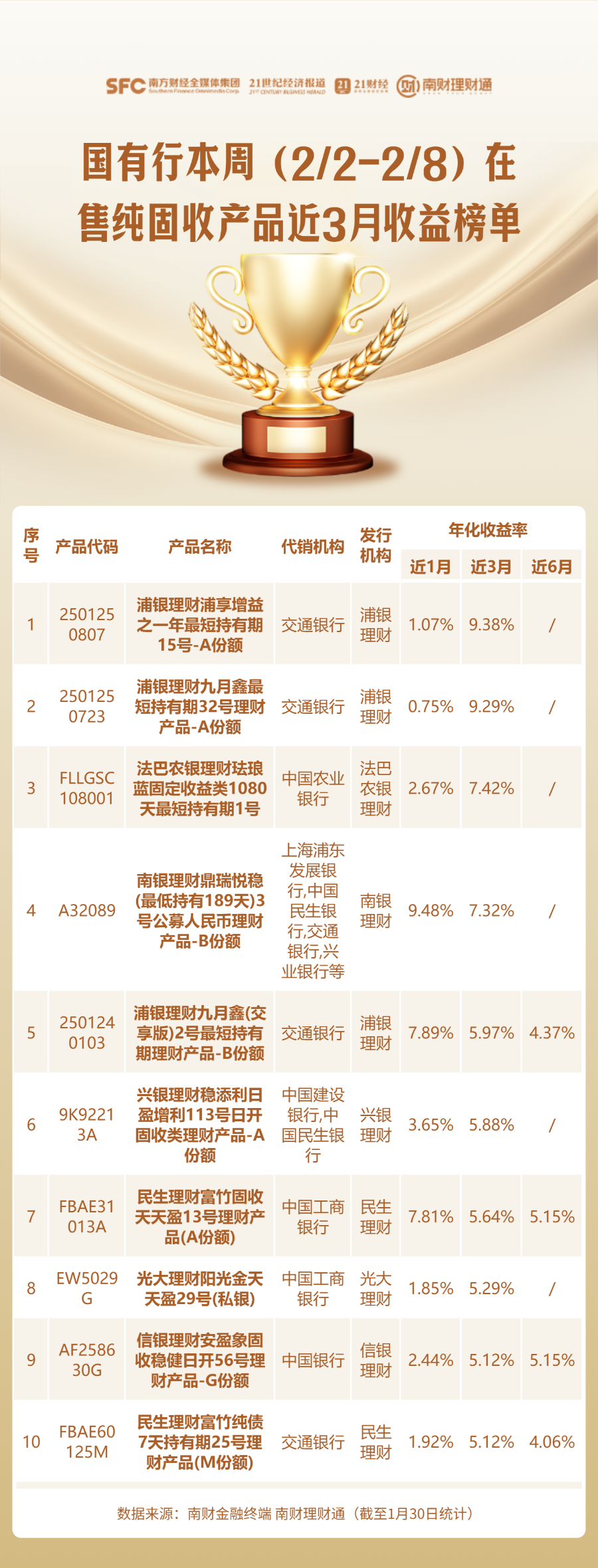
Core Insights - The report focuses on the performance of pure fixed-income products issued by wealth management companies, highlighting the best-performing products available for sale through various distribution channels [1][4] Group 1: Product Performance - The ranking of products is based on their annualized returns over the past month, three months, and six months, with a particular emphasis on the three-month annualized yield to reflect their performance amid recent market fluctuations [1] - A total of 28 distribution institutions are involved, including major banks such as Industrial and Commercial Bank of China, Bank of China, Agricultural Bank of China, and others [1] Group 2: Product Availability - The list of products is categorized as "available for sale," but actual availability may vary due to factors such as sold-out quotas or differences in product listings shown to different customers by banks [1] - Investors are advised to refer to the actual displays on the distribution bank's app for the most accurate information regarding product availability [1] Group 3: Data Source - The data presented in the report is sourced from the Nanfang Financial Terminal and Nanfang Wealth Management, with statistics as of January 30 [3][5]







银行“年终奖理财”卷疯,有人2万元定投黄金
Xin Lang Cai Jing· 2026-02-02 08:12
来源:时代财经APP 岁末更替之际,职场人期盼的2025年年终奖陆续到账,年终奖理财市场持续升温。 时代财经梳理发现,国有大行、股份行、城商行及理财子公司等金融机构,近期纷纷加码推出年终奖专 属产品与服务。其中,交银理财的 "新薪宝" 系列 1 元起购,部分产品成立以来年化达 4.91%;中信银 行深圳分行推 PR1-PR2 级产品,近三月年化最高 2.13%,叠加三重礼至高享 860.6 元权益;浦发银行马 年贺岁存单 1 万起投,3 年期年利率 1.75%;苏州银行自营及代销产品覆盖1.68%-12.32%不同收益区 间。 与此同时,低利率环境下,居民理财更趋理性,稳健优先、分层配置成主流,对确定性收益的追求愈发 凸显。 普益标准研究员付翘楚向时代财经表示,近期银行年终奖理财营销策略有两大变化:一是整合存款、理 财、基金等全品类金融产品,提供覆盖多场景的一站式综合资产配置方案;二是聚焦专业服务,不简单 罗列产品,而是基于客户风险偏好与资金用途,提供专属配置策略与投资逻辑。 机构争相布局:从"单品比拼"到"场景化配资产"转型 面对集中释放的年终奖理财需求,各类金融机构精准发力,不再局限于单一产品推销,而是聚 ...

祖名股份:为控股子公司贵州祖名豆制品有限公司提供4650.00万元担保
2 1 Shi Ji Jing Ji Bao Dao· 2026-02-02 07:54
Core Viewpoint - The company has signed a maximum guarantee contract with Shanghai Pudong Development Bank for its subsidiary, providing a guarantee for credit business up to RMB 46.5 million [1] Group 1 - The guarantee is for Guizhou Zunming Tofu Products Co., Ltd., a controlling subsidiary of the company [1] - The guarantee amount is within the approved limit of RMB 480 million from the 2024 annual shareholders' meeting [1] - The specific guarantee limit for Guizhou Zunming is RMB 50 million, leaving a remaining available limit of RMB 3.5 million after this guarantee [1]

卫星扎堆“上天”,银行风控卷出“新高度”
3 6 Ke· 2026-02-02 07:23
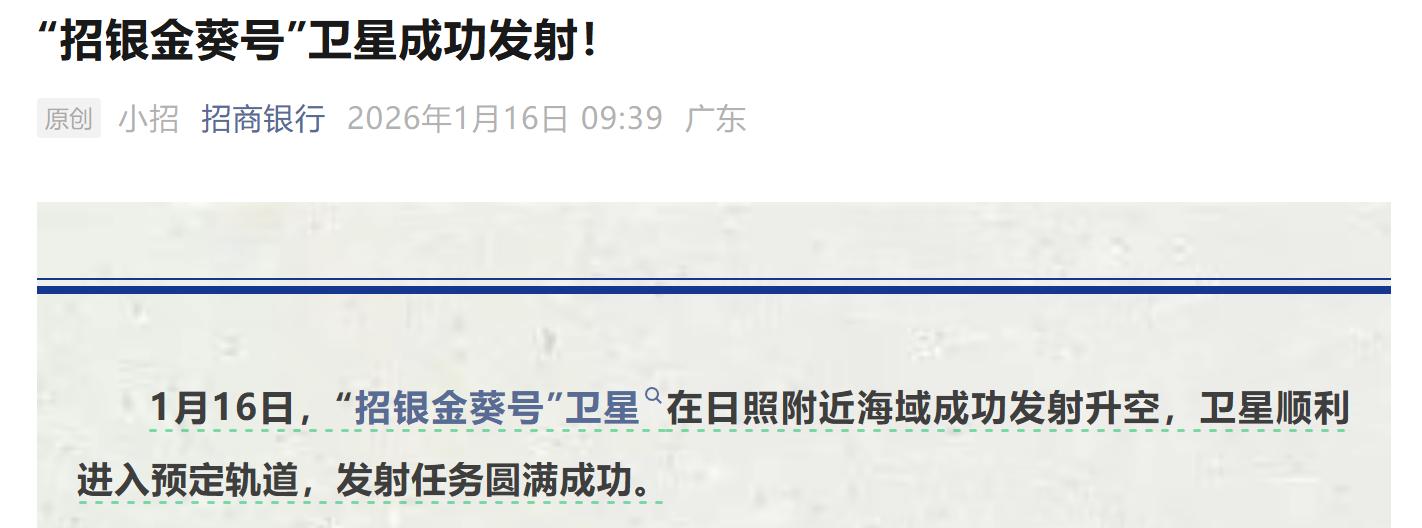
Core Viewpoint - The commercial aerospace sector is experiencing a surge in interest and investment, particularly from banks, driven by supportive policies and the potential for innovative applications of satellite technology in financial services [1][2][22]. Group 1: Policy and Industry Trends - Beijing has issued measures to promote the development and utilization of commercial satellite remote sensing data from 2026 to 2030, encouraging companies to build differentiated satellite constellations with clear commercial value and application prospects [1]. - Various industries, including traditional banking, are actively engaging in the commercial aerospace sector, with banks launching their own satellites [2][3]. Group 2: Bank Initiatives in Satellite Launches - On January 16, 2024, China Merchants Bank's "Zhaoyin Jinkui" and Shanghai Pudong Development Bank's "Pudong Digital" satellites were successfully launched [4]. - Both satellites are part of China's first global low-orbit satellite IoT constellation, "Tianqi Constellation" [5]. - The "Zhaoyin Jinkui" satellite is designed for high-precision monitoring of construction progress for first-hand mortgage properties, while the "Pudong Digital" satellite aims to enhance smart risk control and provide critical financial services during natural disasters [8]. Group 3: Evolution of Risk Control - The trend of banks launching satellites signifies a shift from traditional ground-based data reliance to a "heaven and earth collaboration" model for risk control [11][22]. - Satellite technology addresses the core pain point of information asymmetry in traditional risk management, providing banks with stable and objective data [13][14]. - For instance, the "Zhaoyin Jinkui" satellite can improve construction monitoring accuracy to over 95%, significantly enhancing post-loan inspection efficiency [14]. Group 4: Future Implications and Opportunities - The integration of satellite technology into banking operations not only enhances risk management but also opens new avenues for financing in the commercial aerospace sector, which has been traditionally challenging due to high barriers and lack of collateral [19][20]. - Banks' active participation in satellite launches may lead to deeper due diligence and value discovery in the commercial aerospace industry [20][21]. - The collective move of banks into the aerospace sector represents a critical leap in enhancing their core competitiveness and addressing inclusive finance challenges [22][23].

今年银行怎么干?12家银行年度工作会议高频词透露重要信息
Nan Fang Du Shi Bao· 2026-02-02 07:05
Core Insights - The banking industry is focusing on "digital transformation," "high-quality development," "risk prevention," and "artificial intelligence" as key themes for 2026, reflecting a shift towards more specialized and refined development paths [1][2][4] Group 1: Key Themes from Annual Meetings - "Digital transformation" and "risk prevention" are highlighted as primary focuses, with nine banks mentioning these themes in their annual meetings [4] - The term "high-quality development" appears frequently, indicating a collective industry goal towards sustainable growth [2][4] - "Cost reduction and efficiency enhancement" is emphasized by multiple banks, reflecting a strategic shift from scale expansion to more efficient operations in response to narrowing interest margins [6][7] Group 2: Specific Strategies and Initiatives - Banks are adopting "differentiated development" strategies to avoid internal competition, with seven banks mentioning this approach [6] - Several banks are actively working on reducing operational costs, with examples including the reduction of high-cost deposits and operational expenditures [7] - The concept of "investing in both tangible and human capital" is emerging, with two banks explicitly stating this in their annual meetings, indicating a shift in focus towards human capital and future value creation [8][9] Group 3: Risk Management and Performance - Banks are implementing comprehensive risk management systems, with proactive measures for early identification and handling of risks [4][5] - Some banks reported a decrease in non-performing loans, showcasing effective risk management practices [5] - Overall, banks are experiencing positive growth in revenue and net profit, indicating a recovery in performance amidst cost-cutting measures [7]

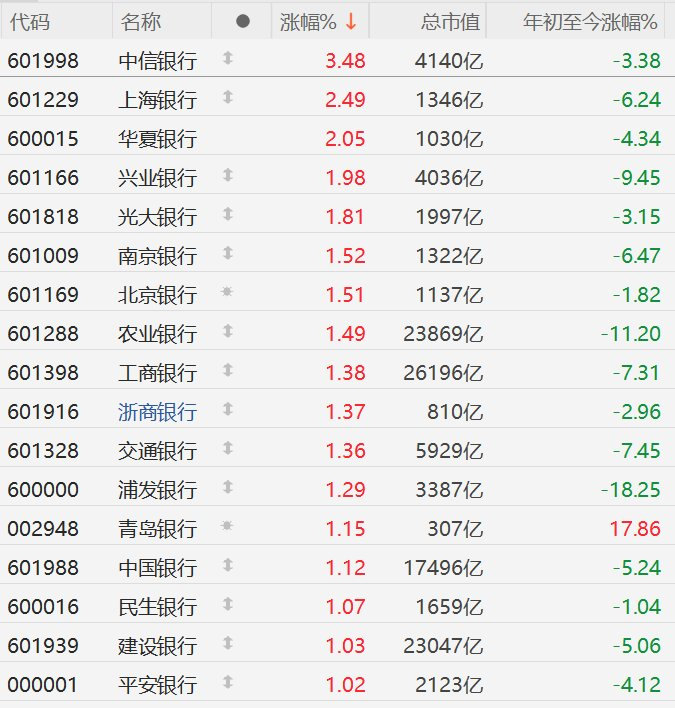
银行股逆势上涨,中信银行涨超3%
Ge Long Hui· 2026-02-02 03:57
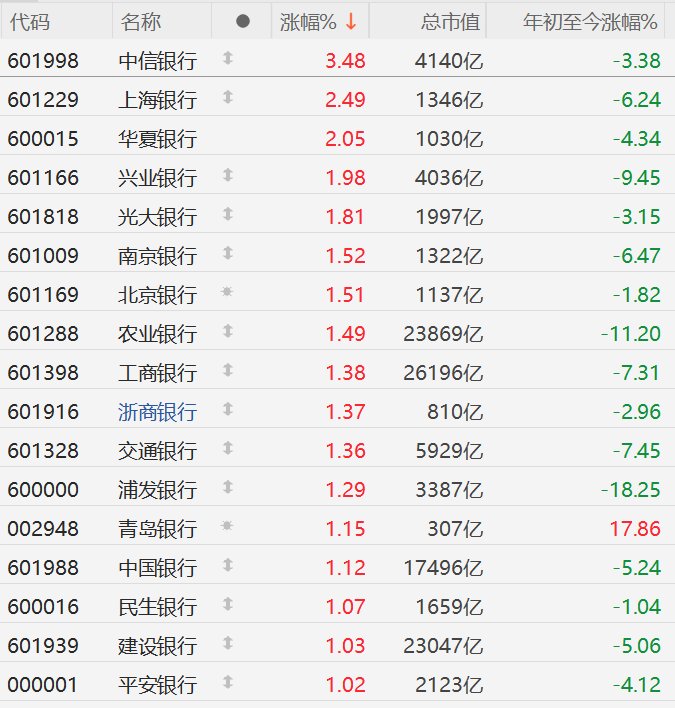
Core Viewpoint - The A-share market's banking sector experienced a counter-trend increase, with several banks showing significant gains despite overall market conditions [1]. Group 1: Stock Performance - CITIC Bank saw an increase of 3.48%, with a total market capitalization of 414 billion [2] - Shanghai Bank increased by 2.49%, with a market cap of 134.6 billion [2] - Huaxia Bank rose by 2.05%, with a market cap of 103 billion [2] - Other banks such as Industrial Bank, Everbright Bank, and Nanjing Bank also reported gains exceeding 1% [1][2] - Agricultural Bank, Industrial and Commercial Bank, and China Merchants Bank had market caps of 2386.9 billion, 2619.6 billion, and 2304.7 billion respectively, with slight increases [2] Group 2: Year-to-Date Performance - Year-to-date performance shows that most banks have negative returns, with CITIC Bank down 3.38% and Shanghai Bank down 6.24% [2] - Notably, Qingdao Bank has a positive year-to-date return of 17.86%, indicating strong performance relative to its peers [2] - Other banks like Agricultural Bank and Industrial Bank have year-to-date declines of 11.20% and 7.31% respectively [2]


A股银行股逆势上涨,中信银行涨超3%
Ge Long Hui A P P· 2026-02-02 03:54
Core Viewpoint - The A-share market has seen a rise in bank stocks, with several banks experiencing significant gains despite overall market trends [1] Group 1: Stock Performance - CITIC Bank increased by 3.48%, with a total market capitalization of 414 billion [2] - Shanghai Bank rose by 2.49%, with a market cap of 134.6 billion [2] - Huaxia Bank saw a gain of 2.05%, with a market value of 103 billion [2] - Industrial Bank increased by 1.98%, with a market cap of 403.6 billion [2] - Everbright Bank rose by 1.81%, with a total market capitalization of 199.7 billion [2] - Nanjing Bank increased by 1.52%, with a market cap of 132.2 billion [2] - Beijing Bank saw a rise of 1.51%, with a market value of 113.7 billion [2] - Agricultural Bank increased by 1.49%, with a market cap of 23,869 billion [2] - Industrial and Commercial Bank rose by 1.38%, with a market value of 26,196 billion [2] - Zhejiang Bank increased by 1.37%, with a market cap of 81 billion [2] - Bank of Communications rose by 1.36%, with a market value of 592.9 billion [2] - Shanghai Pudong Development Bank increased by 1.29%, with a market cap of 338.7 billion [2] - Qingdao Bank saw a rise of 1.15%, with a market value of 30.7 billion [2] - Bank of China increased by 1.12%, with a market cap of 17,496 billion [2] - Minsheng Bank rose by 1.07%, with a market value of 165.9 billion [2] - China Construction Bank increased by 1.03%, with a market cap of 23,047 billion [2] - Ping An Bank rose by 1.02%, with a market value of 212.3 billion [2] Group 2: Year-to-Date Performance - CITIC Bank has a year-to-date decline of 3.38% [2] - Shanghai Bank has decreased by 6.24% year-to-date [2] - Huaxia Bank has a year-to-date decline of 4.34% [2] - Industrial Bank has decreased by 9.45% year-to-date [2] - Everbright Bank has a year-to-date decline of 3.15% [2] - Nanjing Bank has decreased by 6.47% year-to-date [2] - Beijing Bank has a year-to-date decline of 1.82% [2] - Agricultural Bank has decreased by 11.20% year-to-date [2] - Industrial and Commercial Bank has a year-to-date decline of 7.31% [2] - Zhejiang Bank has decreased by 2.96% year-to-date [2] - Bank of Communications has a year-to-date decline of 7.45% [2] - Shanghai Pudong Development Bank has decreased by 18.25% year-to-date [2] - Qingdao Bank has increased by 17.86% year-to-date [2] - Bank of China has a year-to-date decline of 5.24% [2] - Minsheng Bank has decreased by 1.04% year-to-date [2] - China Construction Bank has a year-to-date decline of 5.06% [2] - Ping An Bank has decreased by 4.12% year-to-date [2]
信用债市场周观察:关注CRMW一级发行定价机会
Orient Securities· 2026-02-02 03:43
Report Industry Investment Rating - Not mentioned in the provided content Core Viewpoints of the Report - In the second half of 2025, CRMW products were issued intensively in conjunction with private enterprise science and technology innovation bonds, with obvious cost - reduction and credit - enhancement effects. Currently, there is little room for participation in the secondary market. It is recommended to focus on the pricing opportunities during the primary issuance of new products. The "underlying bond + CRMW" combination under the strong guarantee of large - scale national and joint - stock banks has valuation advantages, and institutions with stable liability ends such as proprietary trading can hold them until maturity [5]. - When classified by creation entities, special attention should be paid to CRMW created by joint - stock banks [5]. Summary According to Relevant Catalogs 1. Credit Bond Weekly Viewpoint: Focus on the Pricing Opportunities of CRMW Primary Issuance - CRMW is an important credit - enhancement product. In 2025, over a hundred CRMW were created by various institutions, a slight reduction from 2024. Nearly 40% of the protected underlying bonds were science and technology innovation bonds, and the protected issuers were mostly technology - based private enterprises. Commercial banks are the mainstream creation institutions, while securities companies have rarely participated since 2024, and guarantee companies such as Zhongyu Guarantee and Zhongzhai Zengxin have been active [9]. - It is difficult to participate in the secondary market of CRMW. The focus should be on the primary issuance, especially the CRMW created by joint - stock banks. The average maturity of recently issued underlying bonds is about 2 years, and the maturity considering the exercise right is generally no more than 3 years, which meets the preferences of mainstream institutions [15]. - By creation entity types: - State - owned banks: Since 2024, the frequency of state - owned banks creating CRMW has declined. The credit spread of the "CRMW + underlying bond" investment portfolio created by state - owned banks is generally low, with most spreads around 40bp since Q4 2025, and there is no excess return compared to mainstream urban investment/industrial bonds [15][17]. - Joint - stock banks: Banks such as China Zheshang Bank have created a relatively large number of CRMW. The credit spread of the "CRMW + underlying bond" investment portfolio is around 70bp, and the absolute return can exceed 2.4%, which is very attractive in a low - return environment. The higher return mainly comes from the higher coupon rate of the protected underlying bonds, and there is sufficient safety margin under the strong guarantee of CRMW [25]. - City commercial banks: Banks such as Dongguan Bank and Qingdao Bank are the main creation institutions. The returns of their "CRMW + underlying bond" portfolios are more differentiated, and the recent returns are mainly in the range of 2.1% - 2.2%, with limited attractiveness [25]. - Rural commercial banks: Only Shanghai Rural Commercial Bank participates, and the overall return of the portfolio is not high due to the strong credit quality of the credit - enhancement subject [25]. - Guarantee companies: Zhongyu Guarantee and Zhongzhai Zengxin have created a small number of CRMW in the past two years. The returns are scattered, and the "underlying bond + CRMW" portfolio has a slightly higher return due to weak liquidity, which is suitable for institutions with stable liability ends and high - risk preferences to hold until maturity [23][26]. - Secondary market opportunities are mainly concentrated in the "underlying bond + CRMW" portfolio with a maturity of less than 1 year. The primary market is the main way to participate, while the secondary market has weak liquidity. The short - term portfolio with a maturity of less than 1 year and a return of over 2.1% created by state - owned banks and strong joint - stock banks has cost - effectiveness [28]. 2. Credit Bond Weekly Review: The Enthusiasm for Medium - Term Bond Mining Continues 2.1 Negative Information Monitoring - There were no bond defaults, overdue payments, downgrades of issuer or bond ratings, or overseas rating downgrades during the week from January 26 to February 1, 2026. However, there were significant negative events for companies such as Sunshine City Group, Country Garden Real Estate Group, and Rongqiao Group [31][33]. 2.2 Primary Issuance: Net Financing Remains High, and Financing Costs Fluctuate Narrowly - The new issuance scale of credit bonds remained high, the maturity volume decreased, and the net financing remained high. From January 26 to February 1, 2026, the primary issuance of credit bonds was 307.4 billion yuan, a slight decrease from the previous period. The total repayment was 151.7 billion yuan, a 19% decrease from the previous period, and the net financing was 155.7 billion yuan [34]. - The number and scale of cancelled or postponed bond issuances remained at a low level. The financing costs of medium - and high - grade bonds fluctuated slightly. The average coupon rates of AAA and AA+ grades were 2.12% and 2.24% respectively, with a month - on - month increase of 9bp and a decrease of 7bp [35]. 2.3 Secondary Trading: Valuations Fluctuated Slightly, and 3 - year Bonds Outperformed Relatively - The valuations of credit bonds of various grades and maturities were mostly flat compared to the previous period, except for a 3bp decline in the 3 - year medium - and low - grade bonds. The risk - free interest rate fluctuated slightly, and the credit spreads were mostly flat. The term spreads of 3Y - 1Y and 5Y - 1Y of various grades almost all narrowed, with an average of about 2bp, and the AA - grade 3Y - 1Y narrowed by up to 4bp. The AA - AAA grade spread of the 3 - year bond narrowed by 4bp [37][40]. - The credit spreads of urban investment bonds in various provinces narrowed slightly, with an average narrowing of about 2bp, and the spreads in Heilongjiang and Yunnan narrowed the most. The credit spreads of industrial bonds fluctuated within ±1bp, significantly underperforming urban investment bonds, and the real estate sector widened by 3bp [42][43]. - The weekly turnover rate decreased by 0.18 percentage points to 1.85%. The issuers of the top - ten turnover bonds were mostly central and state - owned enterprises. The issuers of credit bonds with a discount of more than 10% in trading were mainly related to Country Garden, Vanke, and AVIC Industry Finance [45]. - The distribution of urban investment bonds with the largest narrowing or widening of spreads was scattered. Among industrial bonds, the top five issuers with widening spreads were mostly real - estate companies, including Times Holdings, Rongqiao, Yuzhou Hongtu, and Greenland [47][48].
银行“上星”拓展金融服务新空间
Jing Ji Ri Bao· 2026-02-01 22:01
Core Viewpoint - The successful launch of satellites by major Chinese banks marks a significant step in enhancing their financial services through advanced technology, particularly in risk management and data communication capabilities [1][2][3]. Group 1: Satellite Launches and Technology - China Merchants Bank launched the "Zhaoyin Jinkui" satellite, while Shanghai Pudong Development Bank launched the "Puyin Shuzhi" satellite, contributing to the formation of a low-orbit satellite communication matrix [1][2]. - The satellites are part of the "Tianqi Constellation," which aims to provide integrated IoT data communication services globally, enhancing capabilities in various sectors such as energy and agriculture [2]. Group 2: Risk Management and Financial Services - Satellite technology enhances banks' risk management capabilities by providing reliable financial information, thus addressing issues of information asymmetry [3]. - China Merchants Bank's self-developed risk management system utilizes high-resolution satellite imagery to monitor construction progress with over 95% accuracy, improving traditional post-loan inspection efficiency [3]. Group 3: Applications in Financial Services - Satellite technology can expand the coverage and precision of financial services, particularly in supply chain finance, rural finance, and green finance [4]. - Ping An Bank uses IoT devices monitored by satellites to track dairy cattle, addressing collateral issues and improving post-loan management [4]. Group 4: Resilience and Stability in Financial Infrastructure - Satellite communication technology helps banks maintain operations during ground communication disruptions, enhancing the resilience of financial infrastructure [5]. - China Merchants Bank is testing low-orbit satellite communication for disaster recovery systems, ensuring critical financial services can be quickly restored in extreme scenarios [5]. Group 5: Digital Transformation and Industry Impact - The satellite launches reflect the deepening digital transformation of the banking sector, enhancing communication systems and supporting the commercial satellite industry [6]. - Participation in the aerospace industry allows banks to improve their financial service capabilities in strategic areas while creating technological barriers [7]. Group 6: Challenges and Future Trends - While satellite technology offers unique advantages, it may lead to data monopolies and compliance risks, necessitating clear legal frameworks [7]. - The trend may result in a tiered ecosystem where major banks develop their satellite constellations, while smaller banks rely on data procurement from third-party services [7].

如何稳增长促转型?2026年银行业经营工作“划重点”
Shang Hai Zheng Quan Bao· 2026-02-01 18:15
2026年,银行经营工作怎么干?在低利率环境下,银行业如何稳增长、防风险、促转型,成为新一年经 营管理工作的核心命题。 近期,国有大行、股份行以及多家头部城商行、农商行相继召开2026年经营管理工作会议,聚焦服务实 体经济、优化业务结构、强化风险防控和推进数智化转型等重点任务,对全年经营工作"划重点"。 国有大行稳中求进服务实体是首位 从国有大行的2026年经营管理工作会议部署看,"稳中求进"仍是主基调,服务国家战略和实体经济被普 遍置于首要位置。 一方面,国有大行普遍将加大对重大战略、重点领域和薄弱环节的金融支持,围绕科技创新、普惠金融 等方向持续发力,做好金融稳定的"压舱石"。相关表述中,"专注主责主业""加大重点领域融资供给"为 高频词。 工商银行表示:突出主责主业,投资于物和投资于人紧密结合,加大贷款投放、债券投资力度,做深做 精"五篇大文章",全力服务"四稳";加力支持扩大内需、科技创新、中小微企业等重点领域,以及"十 五五"重大工程、重大项目;靠前服务"两重一薄",积极惠民生促消费,助力服务业扩能提质。 农业银行2026年将加大重点领域融资供给。坚持投资于物与投资于人紧密结合,持续加大"两重""两 ...