
科大讯飞

Search documents
国内首档纯AIGC教育动画 来自南京建邺高新区!
Yang Zi Wan Bao Wang· 2026-02-04 13:17
"宝贝快看,糖小豆又出新冒险啦!" 公司标杆项目《糖小豆奇妙夜》系国内首档纯AIGC教育动画,尚卫介绍,以系列行业AI中台与自研AI 内容生产体系为技术双核心,该项目成功跑通"内容生产-发行推广-商业变现"完整链条,原本需数十人 团队数月完成的场景搭建、角色渲染、镜头调度,如今由小型团队配合AI系统即可交付,成本直降, 同时作品画面风格高度统一,叙事节奏更为紧凑。目前,火焰山AI参与的该系列最新剧集《糖小豆之 星星工程队》即将上线。 近期国内首档纯AIGC教育动画《糖小豆奇妙夜》强势出圈!创造这个行业奇迹的不是什么行业巨头, 而是扎根在南京建邺高新区的一家本土企业火焰山(南京)人工智能科技有限公司。 作为一家人工智能企业,火焰山AI正试图以"技术+应用+人才"的生态闭环,重新定义视觉创作、行业 发展的边界。 火焰山AI创始人、董事长尚卫,这位曾深耕互联网与数字内容领域多年的连续创业者,在谈及为何选 择切入AI影像赛道时,语气坚定:"我们不是在追逐风口,而是在回应一个必然趋势——未来十年,所 有视觉内容都将被AI重构。" 从"工具革命"到"创作范式迁移" 尚卫对行业的观察始于一个朴素问题:当AI能以70%的成本 ...
2025年南京软件产业收入突破万亿元 创新驱动与生态赋能筑就高质量发展高地
Zheng Quan Ri Bao Wang· 2026-02-04 12:32
Core Insights - Nanjing has established itself as a leading software city in China, with software business revenue projected to reach 874 billion yuan in 2024, ranking first in Jiangsu province and fourth nationally [1] - The city aims to build a trillion-yuan software industry cluster by 2025, with a projected revenue of approximately 1,020 billion yuan, reflecting a year-on-year growth of 16.7% [1] Group 1: Technological Innovation - Nanjing focuses on key core technology breakthroughs to support high-quality industrial development, establishing national-level innovation platforms such as the Zijinshan Laboratory and the EDA Technology Innovation Center [2] - Local companies like Runhe Software are actively participating in the open-source HarmonyOS ecosystem, with 126 certified open-source HarmonyOS products, ranking second among Chinese cities [2] - The city has launched significant innovations, including the first domestic open-source intelligent robot operating system and the first "open-source Harmony + Loongson" personal computer [2] Group 2: Artificial Intelligence Development - Nanjing has initiated a special implementation plan to create Jiangsu's first AI ecological street, attracting 138 AI products [3] - In the previous year, Nanjing recorded 326 AI software investment projects, with 90 projects exceeding 100 million yuan in investment [3] - By 2025, Nanjing aims to add 29 new large models, bringing the total to 41, which accounts for 62% of Jiangsu's total [3] Group 3: Ecosystem and Project Development - Nanjing is building a comprehensive ecosystem that integrates policy, capital, projects, and enterprises to stimulate industrial growth [4] - The city has successfully attracted 327 AI software projects, exceeding its target of 200 projects for the year [4] - Notable projects include the establishment of the Dassault Systems Intelligent Manufacturing Headquarters and the BMW Global R&D Center in Nanjing [4] Group 4: Capital Empowerment and Future Plans - Nanjing is leveraging capital to support 27 fund demand projects totaling 1.245 billion yuan, facilitating the incubation of 48 technology achievements [5] - The city plans to continue implementing national strategies for AI and software industry development, aiming for higher quality and energy in the software sector [5] - Nanjing seeks to become the leading city in software intelligence in China, providing more quality investment opportunities for the capital market [5]
中美AI竞赛进入下半场,决胜点在哪?
Guan Cha Zhe Wang· 2026-02-04 06:59
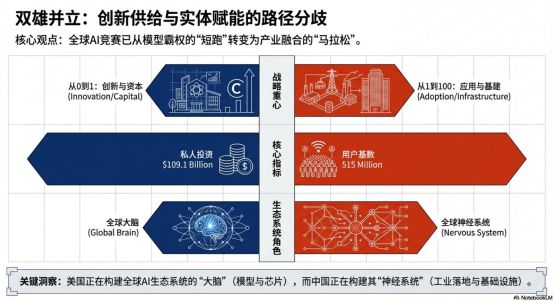
Core Insights - The current phase of the AI industry is shifting from a "technology parameter competition" to a focus on "application landing," emphasizing the creation of real value in sectors like healthcare, education, and government efficiency [1][2] - A "dual oligopoly" is emerging in the AI landscape, with the U.S. leading in foundational models and high-value software services, while China is advancing in large-scale applications and industrial empowerment [2][3] Group 1: U.S. and China's Competitive Landscape - The U.S. maintains an advantage in original innovation and high-value software services, while China is establishing barriers in large-scale applications and industrial empowerment [2][3] - Despite the U.S. leading in foundational model capabilities, China's models are proving to be cost-effective and competitive, closing the gap significantly in performance metrics [3][7] - The RAND Corporation's report indicates that the U.S. cannot solely rely on chip superiority to prevent Chinese models from reaching Tier-1 levels [3][6] Group 2: AI Application and Industrial Integration - China's AI applications are deeply integrated into core production processes, with a high adoption rate of 67% in manufacturing compared to the U.S.'s 34% [9][10] - Chinese companies are focusing on embedding cost-effective models into various smart hardware and industrial software, moving away from merely benchmarking against models like GPT-5 [9][10] - The integration of AI into industries such as steel and mining is transforming operational efficiency and safety, showcasing AI's role as a productivity tool rather than just a technological novelty [14][18] Group 3: Challenges and Opportunities - The transition of AI from theoretical applications to practical tools faces challenges, including unique industry scenarios, data accessibility, and the long value chain from technology validation to economic benefits [13] - Each industry challenge overcome can create unique competitive barriers, providing opportunities for China to build a robust AI ecosystem [13] - The development of domestic AI infrastructure, such as Huawei's CloudMatrix, is crucial for supporting complex AI applications and ensuring long-term operational stability [14][20]

腾讯、阿里再加码,二线AI大模型可以写悼词了
Sou Hu Cai Jing· 2026-02-04 06:37
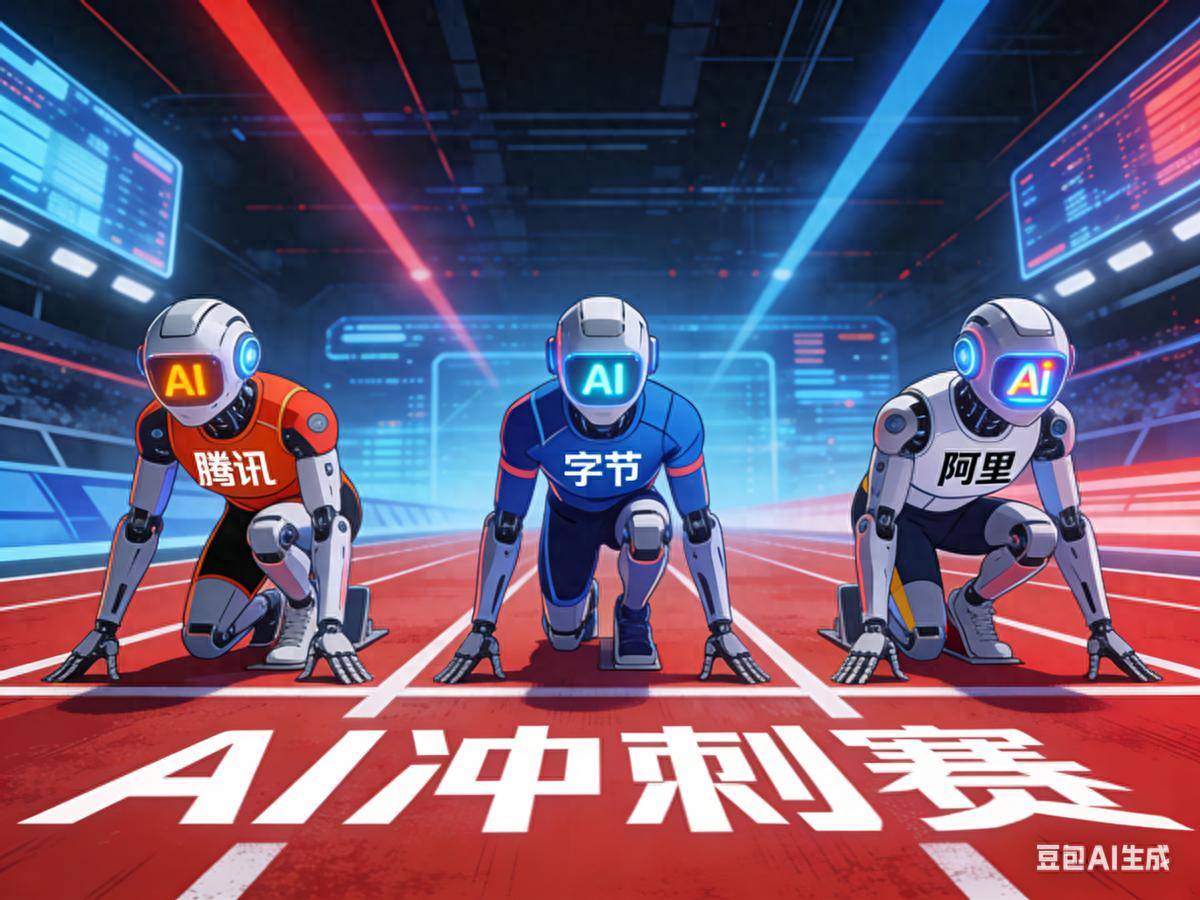
Core Insights - The technology industry is experiencing renewed excitement in early 2026, particularly around AI innovations from major players like Tencent and Alibaba [1][2][3] Group 1: AI Innovation and Industry Dynamics - The public appearances of Ma Huateng and Jack Ma discussing AI signal a critical phase in the AI innovation race, indicating a shift towards more aggressive experimentation [3][4] - Major companies are now more cautious about innovation, focusing on ROI and budget considerations, which has led to a decrease in risk-taking [5][6] - The need for influential voices to encourage innovation is emphasized, as companies may fear the risks associated with AI development [6][7] Group 2: Company Strategies and Developments - Alibaba's Qianwen AI initially aimed at internal technology trials before pivoting to consumer-facing applications, showcasing a strategic shift in its business model [9][10] - ByteDance's Doubao AI has emerged as a significant player, leveraging its existing app ecosystem to enhance its AI capabilities [13][14] - Tencent's new AI social product, Yuanbao, is seen as a strategic move to protect its core social media business while exploring new revenue streams [18][19] Group 3: Competitive Landscape and Market Challenges - The AI industry is entering a new phase of competition, with major players intensifying their efforts, potentially making it harder for mid-tier AI companies to survive [20][21] - Data indicates a significant number of AI-related companies are facing closure, highlighting the challenges for smaller players in the market [22] - The market is increasingly favoring large tech companies, which are better positioned to absorb costs and innovate, leaving independent AI firms at risk of being marginalized [32][40] Group 4: Future Outlook and Trends - The ongoing AI arms race is shifting from a focus on absolute performance to cost-effectiveness, which may impact the viability of smaller players [41][42] - The concept of an "AI slaughter line" suggests that many companies may not survive the competitive pressures of the evolving landscape [23][24] - The narrative of AI innovation continues to evolve, with the potential for new breakthroughs that could reshape the industry dynamics [43]
国泰海通:计算机年报业绩增长与下滑两极分化 行业呈现“两头大、中间小”特征
智通财经网· 2026-02-04 06:17
Group 1 - The core viewpoint indicates that the median data shows that the profit performance of computer companies in 2025 is expected to outperform revenue [1] - Among the 238 companies that released performance forecasts, only 70 provided revenue data, with a median revenue growth rate of 0.97%. In contrast, the median growth rate for net profit attributable to shareholders is 17.83%, and for non-recurring net profit, it is 28.68% [1] - Large-cap companies tend to lean towards the growth side in performance statistics, with stronger certainty in fourth-quarter performance [1] Group 2 - In 2025, over half of the computer industry performance forecasts are positive, indicating a polarization between growth and decline [2] - Among the 358 computer companies, 238 released performance forecasts, representing 66.5%. The distribution of expected net profit growth rates shows that 42.9% (103 companies) expect growth of over 30%, while 36.3% (87 companies) anticipate a decline of over 30% [2] - The high-growth and significant decline segments combined account for 79.2% of the companies, with 60% (142 companies) expecting growth and 40% (96 companies) expecting decline [2] Group 3 - Among companies with a net profit of approximately 100 million and above, significant performance differentiation is observed [3] - Companies with clear improvements in performance and expected year-on-year growth of over 30% include Tonghuashun, Daotong Technology, and iFLYTEK, among others [3] - Conversely, companies facing profit pressure with year-on-year declines include Bosi Software and Keyuan Wisdom, with the latter showing nearly 40% growth when excluding impairment losses [3]

AMD预计2027年AI年收入达数百亿,AI人工智能ETF(512930)备受关注
Xin Lang Cai Jing· 2026-02-04 05:24
Group 1 - The core viewpoint of the news highlights the performance of the AI sector, particularly focusing on the decline of certain stocks within the China Securities Artificial Intelligence Theme Index, with companies like Guanghuan Xinnet leading the drop at 9.57% [1] - AMD reported its Q4 2025 earnings, achieving revenue of $10.27 billion, a 34% year-over-year increase, surpassing market expectations of $9.65 billion. The adjusted earnings per share reached $1.53, up from $1.09 a year earlier, also exceeding the forecast of $1.32 [1] - AMD's CEO, Lisa Su, indicated a strong growth foundation, projecting a revenue growth rate of over 60% for the data center business in the next three to five years, and anticipated AI business sales to reach hundreds of billions by 2027 [1] Group 2 - According to Dongfang Securities, the demand for storage driven by AI is expected to continue growing, with significant changes anticipated in data center storage structures due to AI inference processes [2] - At CES 2026, NVIDIA introduced a memory storage platform for inference context, with SanDisk predicting an additional storage demand of 75-100 exabytes by 2027, potentially doubling by 2028 [2] - The AI Artificial Intelligence ETF closely tracks the China Securities Artificial Intelligence Theme Index, which selects 50 listed companies involved in providing foundational resources, technology, and application support for AI [2] Group 3 - As of January 30, 2026, the top ten weighted stocks in the China Securities Artificial Intelligence Theme Index accounted for 57.27% of the index, including companies like Zhongji Xuchuang and Hikvision [3] - The AI Artificial Intelligence ETF has various off-market connections, including multiple classes of the Ping An China Securities Artificial Intelligence Theme ETF [3]

开源AI智能体Clawdbot星标破13万,软件ETF(159852)一键掘金计算机软件行业机遇
Xin Lang Cai Jing· 2026-02-04 03:41
Group 1 - The core viewpoint of the news highlights the decline of the CSI Software Service Index by 2.64% as of February 4, 2026, with leading stocks such as Guanghuan New Network and others experiencing significant drops [1] - Clawdbot (OpenClaw), an open-source personal AI agent project, has rapidly gained over 136,000 stars on GitHub, marking it as one of the fastest-growing open-source projects at the beginning of 2026 [1] - Major domestic cloud service providers like Tencent Cloud, Alibaba Cloud, and UCloud have launched cloud-based deployment services for Clawdbot, indicating a shift in AI from being a "consultant" to becoming an embedded "digital employee" in workflows [1] Group 2 - Guotai Junan Securities anticipates that in 2026, AI applications will evolve from being merely usable to highly functional, with diverse business models emerging, positioning AI applications as a core theme in the AI industry market [1] - The top ten weighted stocks in the CSI Software Service Index as of January 30, 2026, include iFlytek, Kingsoft Office, and others, collectively accounting for 60.27% of the index [2] - Investors can also access AI software investment opportunities through the Software ETF (159852) and its linked fund (012620) [3]
国内外AI年报分析展望




2026-02-04 02:27
Summary of the Conference Call on AI Annual Report Analysis Industry Overview - The conference focused on the analysis and outlook of AI annual reports, particularly in the TMT (Technology, Media, and Telecommunications) sector, with a specific emphasis on domestic and international AI companies [1][2][4]. Key Points and Arguments General Market Sentiment - The period from October 31 to March is characterized as a performance vacuum, where the focus is on thematic investments rather than immediate earnings results [2][3]. - The spring market is expected to see a resurgence, with significant activity anticipated around March [3][4]. North American Companies - North American companies, particularly those involved in AI and cloud computing, have reported earnings that exceeded expectations, indicating strong capital expenditure in AI [4][6]. - Companies like Microsoft and Meta have shown robust spending on AI infrastructure, reflecting a positive outlook for the sector [4][6]. - Despite some domestic companies underperforming, their stock prices have rebounded, suggesting that market sentiment is more focused on thematic trends rather than immediate earnings [5][6]. Domestic AI Companies - Domestic AI companies are experiencing a supply-demand imbalance, with strong demand for AI-related products and services, despite some companies reporting earnings below expectations [6][7]. - The industry is characterized by a shortage of materials and components, which is driving prices up and creating a favorable environment for growth [6][7][10]. Future Growth Projections - There is a consensus that the growth trajectory for AI companies will continue to be strong, with expectations for significant growth in 2026 and beyond [8][9]. - Many companies are currently undervalued, trading at price-to-earnings (P/E) ratios between 15x to 20x, which presents a potential investment opportunity [8][9]. Specific Company Insights - Companies like Wan, Tianfu Communication, and others are highlighted for their potential despite recent earnings misses, as the overall industry outlook remains positive [4][6][7]. - The demand for GPUs and AI chips is expected to remain high, with domestic companies like Cambrian facing challenges but still showing potential for recovery [9][10]. Application and Innovation - The conference emphasized the importance of AI applications, particularly in gaming and media, with companies like Tencent and ByteDance leading the charge [14][15]. - The emergence of AI-driven applications is seen as a significant growth area, with expectations for increased investment and innovation in this space [14][15]. Regulatory and Market Concerns - There are concerns regarding potential regulatory impacts on the gaming industry, but these are largely viewed as unfounded and not likely to affect the overall market significantly [15][16]. - The market is currently experiencing volatility, but analysts suggest that this presents buying opportunities for fundamentally strong companies [21][22]. Additional Important Insights - The conference highlighted the importance of monitoring capital expenditure trends among major tech companies, as this will influence the demand for AI infrastructure and services [36][37]. - The potential for new technologies, such as diamond-based cooling materials for semiconductors, was discussed as a future growth area [24][25]. - Analysts recommend focusing on companies with strong fundamentals and growth potential, particularly in the AI and semiconductor sectors, as the market continues to evolve [22][23][39].
未知机构:当前全球大模型算法和应用迭代加快-20260204
未知机构· 2026-02-04 02:20
Summary of Key Points from the Conference Call Industry Overview - The global competition for traffic entry points in large model algorithms is intensifying, with significant developments in AI applications and algorithms expected in February 2026 [1][2][3]. Core Insights and Arguments - The rapid iteration of global large model algorithms and applications is highlighted, with notable updates from major companies such as Google integrating Gemini 3 technology into Chrome, enhancing multitasking and web browsing capabilities [1][2]. - Domestic companies like Alibaba, Kimi, and DeepSeek have also made significant announcements regarding their latest AI large models, indicating a competitive landscape in the AI sector [2]. - A strong investment opportunity in AI is anticipated for February 2026, driven by ongoing advancements in AI applications and computing power [3]. Investment Recommendations - Six main investment themes are suggested: 1. **AI Fundamental Large Models**: Recommended companies include iFlytek, Zhipu, MiniMax, Alibaba, and Tencent [3]. 2. **AI Programming**: Suggested companies are Zhuoyi Information, Puyuan Information, and SenseTime [3]. 3. **AI Enterprise Services**: Recommended firms include Dingjie Zhizhi, TaxFriend, Guangyun Technology, Hand Information, Saiyi Information, and Kingdee International [3]. 4. **AI Office Solutions**: Companies to watch are Hehe Information, Kingsoft Office, and Foxit Software [3]. 5. **AI Animation and Drama**: Suggested companies include Wanjing Technology and Kunlun Wanwei [3]. 6. **AI Computing Power**: A strong outlook for the entire AI computing power industry chain, including chips, servers, storage, optical modules, and PCBs, with recommended companies such as hgxx, hwj, Industrial Fulian, Inspur Information, Huqin Technology, Zhongji Xuchuang, Sega Technology, and Changxin Bochuang [3]. Additional Important Content - The launch of Tencent's AI application Yuanbao and its promotional activities indicates a strategic move to enhance user engagement during the festive season [2].
无人机巡飞、AI研新药、无人车上路数智生活照进现实
Chang Jiang Ri Bao· 2026-02-04 01:03
Group 1 - The core focus of the news is on Wuhan's development of a smart economy, emphasizing the integration of artificial intelligence and smart technologies into urban governance and industrial upgrades [1][2] - The city has implemented a public safety intelligence system that significantly reduces response times for crime-related incidents, showcasing the effectiveness of AI in urban safety management [1] - The "City Eye" low-altitude remote sensing monitoring system has been established as the first nationwide network covering a super-large city, enhancing urban governance from a flat to a three-dimensional and intelligent model [2] Group 2 - Companies and new research institutions in Wuhan are leveraging AI and data-driven approaches to achieve substantial growth, marking a shift in scientific research paradigms [3] - The city has seen advancements in autonomous driving, with significant policy iterations and the establishment of a comprehensive data set for autonomous vehicle development [3] - The integration of AI in the textile and apparel industry has led to improved supply chain efficiency and the creation of new business ecosystems that combine industry, AI, and cross-border trade [4]