
推理上下文内存存储平台

Search documents
AMD预计2027年AI年收入达数百亿,AI人工智能ETF(512930)备受关注
Xin Lang Cai Jing· 2026-02-04 05:24
Group 1 - The core viewpoint of the news highlights the performance of the AI sector, particularly focusing on the decline of certain stocks within the China Securities Artificial Intelligence Theme Index, with companies like Guanghuan Xinnet leading the drop at 9.57% [1] - AMD reported its Q4 2025 earnings, achieving revenue of $10.27 billion, a 34% year-over-year increase, surpassing market expectations of $9.65 billion. The adjusted earnings per share reached $1.53, up from $1.09 a year earlier, also exceeding the forecast of $1.32 [1] - AMD's CEO, Lisa Su, indicated a strong growth foundation, projecting a revenue growth rate of over 60% for the data center business in the next three to five years, and anticipated AI business sales to reach hundreds of billions by 2027 [1] Group 2 - According to Dongfang Securities, the demand for storage driven by AI is expected to continue growing, with significant changes anticipated in data center storage structures due to AI inference processes [2] - At CES 2026, NVIDIA introduced a memory storage platform for inference context, with SanDisk predicting an additional storage demand of 75-100 exabytes by 2027, potentially doubling by 2028 [2] - The AI Artificial Intelligence ETF closely tracks the China Securities Artificial Intelligence Theme Index, which selects 50 listed companies involved in providing foundational resources, technology, and application support for AI [2] Group 3 - As of January 30, 2026, the top ten weighted stocks in the China Securities Artificial Intelligence Theme Index accounted for 57.27% of the index, including companies like Zhongji Xuchuang and Hikvision [3] - The AI Artificial Intelligence ETF has various off-market connections, including multiple classes of the Ping An China Securities Artificial Intelligence Theme ETF [3]

沪指收出“十字星” 后期盯紧成交量
Sou Hu Cai Jing· 2026-01-07 14:16
Market Overview - A-shares experienced slight gains on January 7, with the Shanghai Composite Index achieving a 14-day consecutive rise, closing up 0.05% at 4085.77 points [1] - The Shenzhen Component Index rose 0.06% to 14030.56 points, while the ChiNext Index increased by 0.31% to 3329.69 points [1] - Total trading volume in the Shanghai and Shenzhen markets reached 288.18 billion yuan, an increase of 49.2 billion yuan compared to January 6 [1] Sector Performance - The electronic chemicals, coal, semiconductor, power equipment, minor metals, biopharmaceuticals, and power grid equipment sectors showed the most significant gains [1] - Conversely, the shipbuilding, education, securities, aerospace, and jewelry sectors experienced the largest declines [1] - On January 7, 2173 stocks rose, with 97 hitting the daily limit, while 3190 stocks fell, with 7 hitting the lower limit [1] Technical Analysis - The Shanghai Composite Index formed a "doji" candlestick pattern with a larger upper shadow than lower shadow, indicating significant selling pressure [3] - Future trading days will require close monitoring of trading volume; a surge above 3 trillion yuan may indicate substantial capital withdrawal, potentially leading to significant adjustments [3] - If trading volume begins to shrink, a minor adjustment is expected, but the extent of this adjustment is anticipated to be limited [3] Specific Stock Movements - Storage chips saw a significant rise at the market open, driven by NVIDIA's announcement of the new Vera Rubin AI platform, which is set to enhance training efficiency and reduce inference costs [2] - However, many strong stocks in the storage chip sector experienced a pullback, suggesting that some investors are taking profits [2] - The securities and oil sectors faced selling pressure, with the oil sector's decline attributed to fluctuations in international oil prices [2]
东方证券:英伟达推出推理上下文内存存储平台 AI存储需求持续扩张
智通财经网· 2026-01-07 07:38
Core Viewpoint - NVIDIA has launched a context memory storage platform at CES 2026, aimed at creating a new memory layer optimized for AI inference, bridging GPU memory and traditional storage [1][2]. Group 1: NVIDIA's New Platform - The context memory storage platform is a POD-level AI-native storage infrastructure designed to support long-term AI operations by optimizing data management and access [2]. - The platform includes hardware and software components such as BlueField-4 for data management, Spectrum-X Ethernet for high-performance networking, and various software tools to enhance system efficiency [2]. Group 2: Shift in AI Inference Bottlenecks - The bottleneck in AI inference is shifting from computation to context storage, necessitating a restructured AI storage architecture to handle increased context data from complex tasks [3]. - There is an anticipated significant growth in demand for storage chips as AI evolves from simple chatbots to intelligent collaborative agents requiring extensive context capacity [3]. Group 3: Domestic Storage Industry Opportunities - The ongoing shortage of storage capacity presents a historic opportunity for domestic storage manufacturers, especially as international competitors may face limitations in expanding production [4]. - Companies like Changxin Technology and Yangtze Memory Technologies are making strides in DRAM and NAND technologies, respectively, which could lead to substantial production increases following their IPOs [4]. Group 4: Related Companies - Key semiconductor equipment companies include Zhongwei Company, Jingzhida, and Beifang Huachuang, while notable packaging and testing firms are Deep Technology and Huicheng Shares [5][6]. - Companies involved in AI storage solutions and benefiting from storage technology iterations include Zhaoyi Innovation and Jiangbolong [6].


东方证券:英伟达(NVDA.US)推出推理上下文内存存储平台 AI存储需求持续扩张
智通财经网· 2026-01-07 07:37
Core Viewpoint - NVIDIA has introduced a context memory storage platform at CES 2026, aimed at creating a new memory layer optimized for AI inference, bridging GPU memory and traditional storage [1][2]. Group 1: NVIDIA's New Platform - The context memory storage platform is a POD-level AI-native storage infrastructure designed to support long-term AI operations by optimizing data access and management [2]. - The platform includes hardware and software components such as BlueField-4 for data management, Spectrum-X Ethernet for high-performance networking, and various software tools to enhance system efficiency [2]. Group 2: Shift in AI Inference Bottlenecks - The bottleneck in AI inference is shifting from computation to context storage, necessitating a restructured AI storage architecture to handle increased context data from complex tasks [3]. - There is an expectation that the demand for storage chips will grow significantly as AI evolves from simple chatbots to more complex collaborative entities requiring extensive context capacity [3]. Group 3: Domestic Storage Industry Opportunities - The ongoing supply-demand imbalance in storage, coupled with limited expansion from overseas storage giants, presents a historic opportunity for domestic storage manufacturers to increase their market share [4]. - Companies like Changxin Technology and Yangtze Memory Technologies are making significant advancements in DRAM and NAND technologies, respectively, which could lead to substantial production capacity increases post-IPO [4]. Group 4: Related Companies - Key domestic semiconductor equipment companies include Zhongwei Company, Jingzhida, and Beifang Huachuang, among others [5]. - Companies involved in packaging and testing include Deep Technology and Huicheng Shares [6]. - Firms focusing on AI storage solutions and benefiting from storage technology iterations include Zhaoyi Innovation and Lianyun Technology [6].
美股存储板块 SNDK 为何疯涨28%?道指冲刺“5万点”
3 6 Ke· 2026-01-07 03:54
Core Viewpoint - The U.S. stock market continues its strong momentum into the new year, with the S&P 500 and Dow Jones reaching all-time closing highs, indicating a shift of funds from leading AI giants to deeper sectors of the supply chain, particularly benefiting the semiconductor industry [1] Group 1: Market Performance - The Dow Jones increased by 0.99% to 49,462.08 points, crossing the significant psychological barrier of 49,000 points [1] - The S&P 500 also set a new record, rising by 0.62% to 6,944.82 points [1] Group 2: Storage Sector Surge - The storage sector in the U.S. stock market experienced explosive growth, with significant gains in major companies: SanDisk (SNDK) surged by 27.56%, Micron (MU) rose by 10.02%, Western Digital (WDC) increased by 16.77%, and Seagate (STX) climbed by 14% [3] Group 3: AI Storage Architecture - NVIDIA introduced the "Inference Context Memory Storage Platform" at CES 2026, marking a shift in AI architecture where inference becomes a complex system engineering challenge rather than solely reliant on GPUs [5] - The new architecture addresses the need for handling large-scale token processing, creating a "G3.5 flash layer" that integrates enterprise-grade NAND flash storage directly with GPU systems [7][9] Group 4: Valuation Reconstruction - The introduction of NVIDIA's platform provides a clear quantitative anchor for storage demand, allowing analysts to accurately calculate storage needs based on the number of GPU racks deployed, leading to a shift from traditional P/B valuation to PE premium for storage companies [10] Group 5: Supply Chain Dynamics - Structural growth pressures are impacting the supply chain, with expectations of continued DRAM price increases due to production constraints, projected to grow by 51% in revenue by 2026, while NAND revenue is expected to grow by 45% [11][13] - The average selling price (ASP) for DRAM is anticipated to rise by 33%, and for NAND by 26%, reflecting strong demand in the memory semiconductor industry [13] Group 6: Industry Outlook - Wall Street consensus indicates that the current "storage supercycle" will last at least until 2027, with top storage companies' total market value potentially approaching $1.5 trillion by 2027, representing over 50% upside from current levels [16] - Major tech companies like Google, Amazon, and Microsoft have placed unlimited orders with manufacturers like Micron, highlighting the critical role of storage solutions in the AI landscape [19]



黄仁勋在2026CES上的发言,创新和增量在哪里?|0106
Hu Xiu· 2026-01-06 16:24
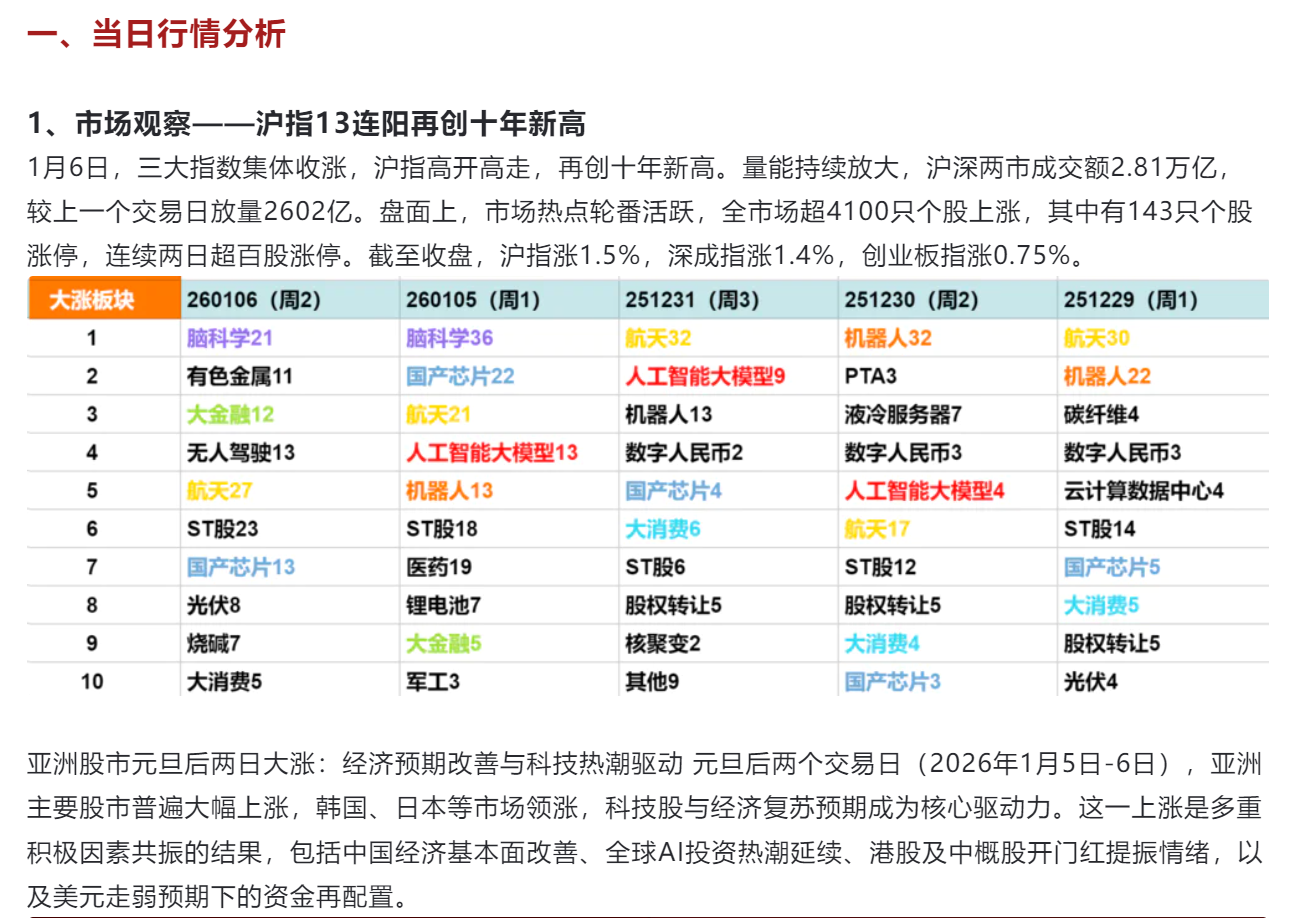
Market Overview - The Shanghai Composite Index achieved a 13-day consecutive rise, reaching a ten-year high on January 6, with a closing increase of 1.5% [1] - The total trading volume in the Shanghai and Shenzhen markets was 260.2 billion, indicating a significant increase in market activity [1] - Over 4,100 stocks in the market rose, with more than 100 stocks hitting the daily limit for two consecutive days [1] Sector Performance - Major sectors that saw significant gains included brain science, non-ferrous metals, and large financial institutions, with respective increases of 21, 11, and 12 stocks [2] - The technology sector, particularly AI and robotics, continued to drive market enthusiasm, with notable performances from companies like Samsung Electronics and TSMC [4][5] Global Market Trends - Asian stock markets experienced substantial gains post-New Year, driven by improved economic expectations and a surge in technology stocks [2] - The KOSPI index in South Korea rose by 5.65%, while Japan's Nikkei 225 increased by 4.33%, reflecting a broader regional trend of recovery [5] Investment Shifts - A significant amount of fixed-term deposits, approximately 32 trillion yuan, is set to mature in 2026, leading to a "deposit migration" phenomenon as investors seek higher returns [6] - Insurance products, particularly dividend insurance, are becoming attractive alternatives for low-risk investors, contributing to a surge in the insurance sector's stock prices [6] Policy Developments - A new policy encouraging large state-owned insurance companies to increase their investments in A-shares is expected to inject thousands of billions into the stock market annually [7] - This policy aims to channel a portion of new insurance premiums into the stock market, providing a crucial source of incremental capital [7] Technological Innovations - At CES 2026, advancements in AI and robotics were highlighted, including the introduction of a household humanoid robot named Neo, which signifies a new era in home automation [8] - The launch of a mass-producible all-solid-state battery by Donut Lab was announced, showcasing significant improvements in energy density and charging speed compared to traditional lithium-ion batteries [10] AI Developments - NVIDIA's CEO Huang Renxun announced breakthroughs in AI technology, emphasizing the transition from digital intelligence to physical AI, supported by new hardware architectures and memory storage solutions [11][12] - The introduction of the Rubin GPU, which significantly enhances processing capabilities and reduces inference costs, marks a pivotal advancement in AI computing [13][20] Industry Applications - The emergence of GPU-native databases is transforming data processing in AI applications, allowing for more efficient handling of high-concurrency requests [26][28] - Companies like Demingli are focusing on full-stack self-research capabilities, enhancing their competitive edge in the storage market through proprietary technology [30][33] Aerospace and Navigation - The company Hezhong Shizhuang is actively participating in the commercial aerospace sector, leveraging its high-precision positioning technology for rocket recovery and satellite applications [34][36] - Their self-developed chips and systems are crucial for providing real-time precise positioning in complex environments, enhancing the reliability of aerospace operations [36]
英伟达推出推理上下文内存存储平台,AI存储需求持续扩张
Orient Securities· 2026-01-06 14:13
Investment Rating - The report maintains a "Positive" investment rating for the electronic industry in China [5]. Core Insights - NVIDIA has launched a context memory storage platform for inference, indicating a continuous expansion in AI storage demand. This platform aims to create a new memory layer optimized for inference between GPU memory and traditional storage, supporting long-term AI operations [3][6]. - The bottleneck in AI inference is shifting from computation to context storage, leading to a significant growth in demand for storage chips. As AI models become more complex, the need for high-frequency data access will drive changes in storage architecture [6][7]. - The ongoing shortage of storage capacity presents historic opportunities for domestic storage manufacturers, especially as international competitors may have limited expansion capabilities. Domestic companies like Changxin Technology and Yangtze Memory Technologies are positioned to benefit from this trend [6][7]. Summary by Sections Investment Recommendations and Targets - The report highlights several investment targets in the semiconductor and storage sectors, including: - Semiconductor equipment companies: Zhongwei Company, Jingzhida, Jingyi Equipment, Weidao Nano, Tuojing Technology, and Northern Huachuang [3][7]. - Domestic packaging and testing companies: Deep Technology, Huicheng Co., and Tongfu Microelectronics [3][7]. - Logic chip manufacturers: Jinghe Integration [3][7]. - Companies focusing on edge AI storage solutions: Zhaoyi Innovation and Beijing Junzheng [3][7]. - Companies benefiting from storage technology iterations: Lianqi Technology and others [3][7]. - Domestic storage solution providers: Jiangbolong, Demingli, Baiwei Storage, and Lenovo Group [3][7].