
睿创微纳

Search documents
睿创微纳:公司是研发驱动型企业
Zheng Quan Ri Bao· 2025-11-10 13:41
Core Viewpoint - The company emphasizes its commitment to research and development (R&D) as a driver of competitiveness and long-term sustainable growth, rather than focusing on short-term profits [2] Group 1: R&D Commitment - The company is a research-driven enterprise with a comprehensive technology and product research, development, and innovation system in the fields of infrared, microwave, and laser multi-dimensional perception [2] - R&D investment has increased in line with the expansion of the company's business scale, driven by personnel growth, material consumption, and equipment depreciation [2] - The company plans future R&D investments based on strategic development needs and aims to continuously improve R&D efficiency while optimizing the R&D expense ratio [2]


睿创微纳:微波业务全链条布局,组件已大规模量产
Sou Hu Cai Jing· 2025-11-10 10:44
Core Insights - The company has a comprehensive layout in the microwave business, covering the entire supply chain from core chips to components, subsystems, and complete systems [1] - The component segment has achieved large-scale production, while chips, subsystems, and complete systems have been delivered in small batches [1] - The products are applicable in various fields including equipment construction, satellite communication, low-altitude applications, and smart vehicles [1]
公司问答丨睿创微纳:公司的微波业务从核心芯片到组件、子系统、整机全链条布局 组件环节的产品已实现大规模量产
Ge Long Hui A P P· 2025-11-10 09:49
Core Viewpoint - The company has successfully achieved mass production of its microwave components and is expanding its product offerings across various sectors, including satellite communication and smart vehicles [1] Company Summary - The company's microwave business encompasses a full chain layout from core chips to components, subsystems, and complete systems [1] - Mass production has been realized for the component segment, while chips, subsystems, and complete systems have achieved small batch deliveries [1] Industry Application - The products are applicable in multiple fields such as equipment construction, satellite communication, low-altitude economy, and smart vehicles [1]
公司问答丨睿创微纳:公司目前在手订单充足 产能利用率较高
Ge Long Hui A P P· 2025-11-10 09:12
Core Viewpoint - The company expresses optimism regarding future market demand and confirms sufficient orders and high production capacity utilization for the fourth quarter [1] Group 1 - The company currently has a sufficient backlog of orders [1] - The production capacity utilization rate is relatively high [1] - Market promotion for various products is progressing as expected [1] Group 2 - The company anticipates growth in fourth-quarter performance compared to the same period last year [1]
睿创微纳(688002.SH):产品可应用在装备建设、卫星通信、低空经济以及智能汽车等多个领域
Ge Long Hui· 2025-11-10 08:36
Core Viewpoint - Ruichuang Micro-Nano (688002.SH) has established a comprehensive layout in the microwave business, covering the entire chain from core chips to components, subsystems, and complete machines [1] Group 1: Business Development - The component segment of the company's products has achieved large-scale mass production [1] - Products in the chip, subsystem, and complete machine segments have achieved small-batch delivery [1] Group 2: Application Areas - The company's products can be applied in various fields, including equipment construction, satellite communication, low-altitude economy, and smart vehicles [1]
全球巨头竞逐太空算力新赛道,科创100指数ETF(588030)盘中交投活跃
Sou Hu Cai Jing· 2025-11-10 03:50
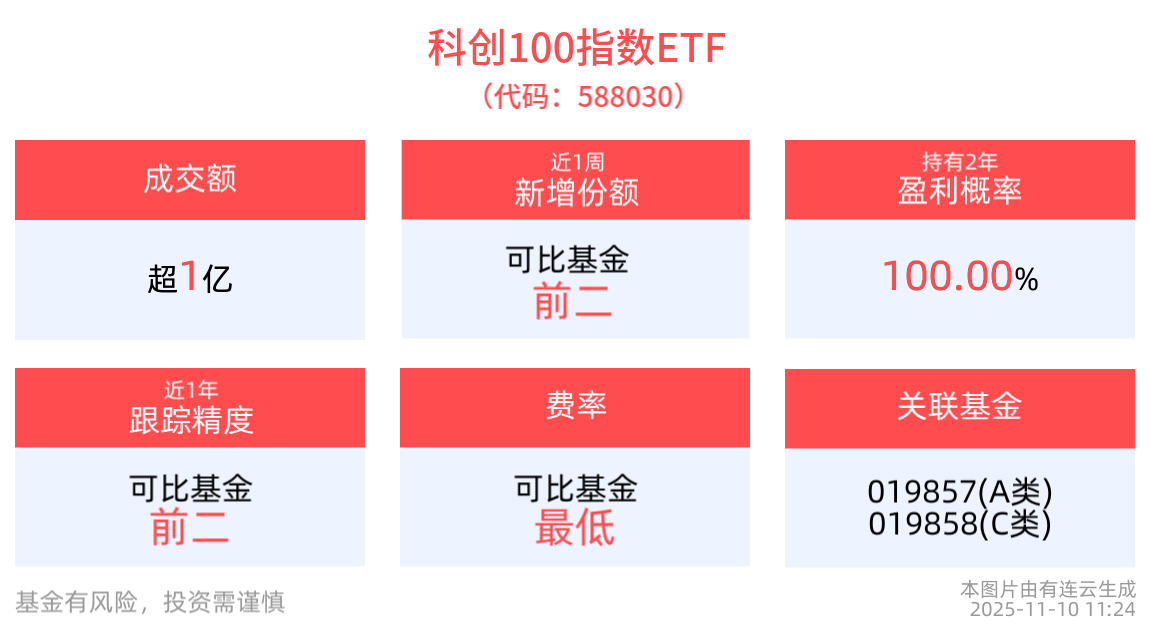
Group 1: Market Performance - The Shanghai Stock Exchange Sci-Tech Innovation Board 100 Index decreased by 1.87% as of November 10, 2025, with mixed performance among constituent stocks [3] - The top gainers included Baike Bio up 4.59%, Zhongke Xingtou up 3.92%, and Zhongxin Bo up 2.82%, while the largest decliners were Xiamen Tungsten down 8.26%, Guodun Quantum down 8.06%, and Huahong Semiconductor down 6.70% [3] - The Sci-Tech 100 Index ETF (588030) fell by 2.02%, with the latest price at 1.31 yuan, but has seen a cumulative increase of 20.11% over the past three months as of November 7, 2025 [3] Group 2: Liquidity and Trading Volume - The Sci-Tech 100 Index ETF had a turnover rate of 2.32% during the trading session, with a transaction volume of 133 million yuan [3] - Over the past year, the average daily trading volume of the ETF was 379 million yuan, ranking it first among comparable funds [3] Group 3: Space Computing Developments - Global tech giants are accelerating their investments in space computing, shifting AI competition from Earth to space, with Google launching Project Suncatcher and SpaceX building a space data center [4] - Chinese companies are also making rapid advancements, with Guoxing Aerospace's "Star Computing" plan and the upcoming launch of the "Tianlibo-10" satellite in 2026, which boasts a single satellite computing power exceeding 10 POPS [4] - Space computing is emerging as a solution to AI computing energy consumption and bandwidth bottlenecks, leveraging near-infinite solar energy supply and high energy efficiency [4] Group 4: Investment Recommendations - Minsheng Securities suggests that supernodes may become a mainstream technology under cluster expansion, enhancing the domestic computing ecosystem [5] - Key areas to focus on include domestic AI computing sectors such as chip design, advanced wafer manufacturing, and liquid cooling technologies [5] - The latest scale of the Sci-Tech 100 Index ETF reached 5.79 billion yuan, ranking it second among comparable funds, with a significant increase of 6 million shares over the past week [5] Group 5: Index Composition - As of October 31, 2025, the top ten weighted stocks in the Sci-Tech 100 Index accounted for 25.77% of the index, including Huahong Semiconductor and Guodun Quantum [6]
睿创微纳跌2.00%,成交额1.77亿元,主力资金净流出2635.21万元
Xin Lang Cai Jing· 2025-11-10 03:28
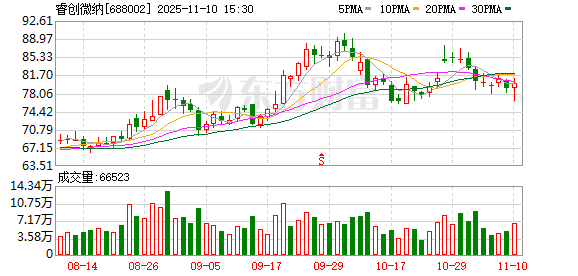
Core Viewpoint - The stock of Ruichuang Micro-Nano has experienced fluctuations, with a year-to-date increase of 65.23% but a recent decline in the last five and twenty trading days [1][2] Financial Performance - For the period from January to September 2025, Ruichuang Micro-Nano achieved a revenue of 4.086 billion yuan, representing a year-on-year growth of 29.72% [2] - The net profit attributable to shareholders for the same period was 707 million yuan, reflecting a year-on-year increase of 46.21% [2] Stock Market Activity - As of November 10, the stock price was 77.41 yuan per share, with a market capitalization of 35.627 billion yuan [1] - The trading volume was 177 million yuan, with a turnover rate of 0.49% [1] - There was a net outflow of 26.3521 million yuan in principal funds, with significant selling pressure observed [1] Shareholder Information - As of September 30, 2025, the number of shareholders increased by 4.51% to 14,400, while the average circulating shares per person decreased by 3.63% to 31,954 shares [2][3] - The top ten circulating shareholders include significant institutional investors, with notable changes in holdings among them [3] Business Overview - Ruichuang Micro-Nano specializes in the design and manufacturing of application-specific integrated circuits (ASICs), MEMS sensors, and infrared imaging products, with infrared thermal imaging and optoelectronic business accounting for 94.48% of its revenue [1] - The company is categorized under the defense and military electronics sector, with involvement in various concepts such as sensors and robotics [1]
MEMS,中国势不可挡
3 6 Ke· 2025-11-07 02:56
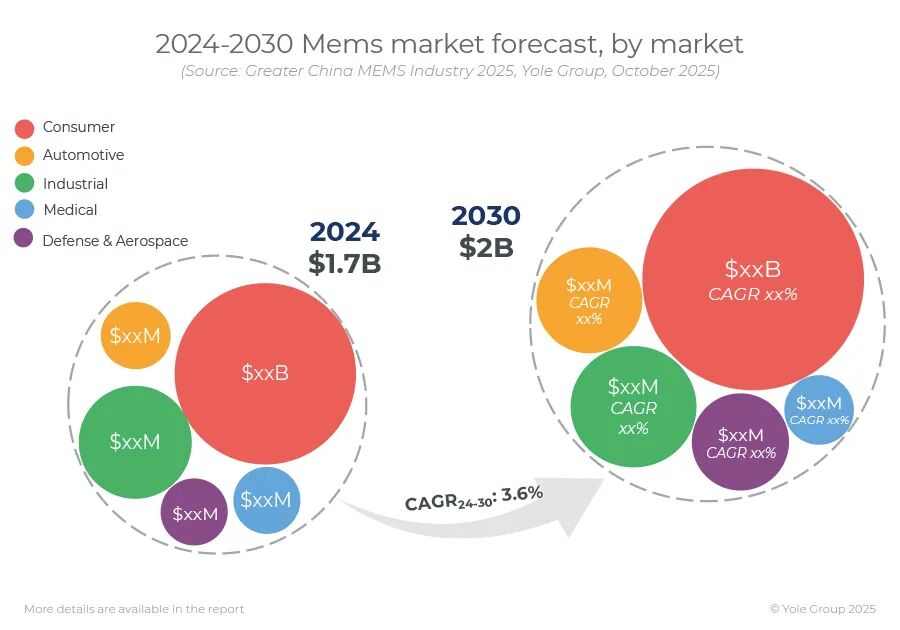
Core Insights - The MEMS industry in Greater China is projected to reach $1.7 billion in revenue in 2024, with a year-on-year growth of 8.4% and an estimated shipment of 5.4 billion units [1] - The market is expected to grow at a compound annual growth rate (CAGR) of 3.6% from 2024 to 2030, reaching $2 billion in revenue and 6.6 billion units sold by 2030 [1] - Chinese manufacturers are positioned to capitalize on this growth, particularly in the "AI + IoT + automotive electronics" wave [1] Market Dynamics - Consumer electronics remain the largest application segment for MEMS, with strong demand for inertial sensors, microphones, and pressure sensors in wearable devices like TWS headphones and smartwatches [3] - Major Chinese companies such as Silan Microelectronics, AAC Technologies, Goermicro, MiraMEMS, and MEMSensing are key players in the supply chain, leveraging performance, reliability, and cost advantages [3] - Goermicro is projected to achieve over 4.5 billion yuan in revenue in 2024, making it the largest smart sensor interaction solution provider in China [3] Revenue Growth - Silan Microelectronics reported a 10% increase in revenue for its MEMS sensor products in the first half of 2025, with a market share of 20%-30% in domestic smartphone brands [3] - AAC Technologies' sensor and semiconductor business revenue reached 608 million yuan in the first half of 2025, a 56.2% increase, driven by high signal-to-noise ratio microphones [4] - MEMSensing achieved a record revenue of 300 million yuan in the first half of 2025, a 47.82% increase, with significant upgrades in acoustic sensor technology [5] Industry Expansion - Chinese MEMS manufacturers are expanding into high-value sectors like automotive and industrial applications, with Silan Microelectronics developing high-precision inertial sensors for automotive use [6] - The automotive sector is seeing increased demand for MEMS microphones due to the rise of smart cockpits and voice control systems [6] - The industrial sector is leveraging MEMS accelerometers and microphones for equipment health monitoring, aligning with the cost and manufacturing flexibility of Chinese firms [7] Emerging Applications - The medical market is expected to be one of the fastest-growing segments for MEMS, particularly with the opening of the OTC hearing aid market in the U.S. and China [7] - MEMS technology is also being integrated into AI infrastructure, with demand for MEMS optical switches and micro-mirrors in optical communication systems [8] Device Maturity - The variety of MEMS devices includes inertial, acoustic, environmental, optical, medical, and energy-related types, with applications expanding beyond consumer electronics [9] - Chinese manufacturers have achieved near-complete domestic production of MEMS microphones, reaching international performance standards [10] Manufacturing Advancements - The MEMS foundry sector in Greater China is projected to grow by 14.3% in 2024, becoming a new growth engine for the industry [13] - Companies like Chipone Integrated Circuits and Huazhong University of Science and Technology are emerging as key players in MEMS wafer foundry [16][17] - The transition from 8-inch to 12-inch wafer production lines is underway, with Guangzhou Zengxin launching the first 12-inch MEMS sensor production line in China [18] Future Outlook - Chinese MEMS companies are expected to gain unprecedented development opportunities, benefiting from their position as a core manufacturing hub for consumer electronics, automotive, and industrial sectors [12] - The focus on manufacturing capabilities is shifting from "filling gaps" to "building advantages," enhancing China's bargaining power and technological influence in the global MEMS market [21]


MEMS,中国势不可挡
半导体行业观察· 2025-11-07 01:00
Core Viewpoint - The MEMS (Micro-Electro-Mechanical Systems) industry in the Greater China region is projected to reach a global revenue of $1.7 billion in 2024, with a year-on-year growth of 8.4%, driven by the convergence of AI, IoT, and automotive electronics [2]. Group 1: Market Dynamics - The MEMS market is expected to have a compound annual growth rate (CAGR) of 3.6% from 2024 to 2030, with sales reaching 6.6 billion units and revenue hitting $2 billion by 2030 [2]. - Consumer electronics remain the largest application segment, particularly in TWS earbuds, smartwatches, and AR glasses, where demand for inertial sensors, microphones, and pressure sensors is strong [4][5]. Group 2: Chinese Manufacturers' Role - Chinese companies such as Silan Microelectronics, AAC Technologies, Goermicro, MiraMEMS, and MEMSensing are becoming key drivers in the MEMS market, leveraging advantages in performance, reliability, and cost [5]. - The domestic MEMS microphone industry has achieved nearly complete localization, forming a complete ecosystem from wafer to packaging, with performance metrics approaching international standards [12]. Group 3: Technological Advancements - MEMS acoustic sensors are set to undergo significant upgrades in technical specifications, particularly in signal-to-noise ratio, creating new market opportunities [6]. - The automotive and industrial sectors are seeing increased demand for high-reliability MEMS products, with applications in safety-related systems and device health monitoring [7]. Group 4: Emerging Markets - The medical market is anticipated to be one of the fastest-growing segments for MEMS, especially with the opening of the OTC hearing aid market in the U.S. and China [8]. - The demand for MEMS in communication and AI infrastructure is also rising, driven by the surge in data traffic and AI training scales [8]. Group 5: Manufacturing and Supply Chain - The MEMS foundry sector in Greater China is expected to grow by 14.3% in 2024, with companies like Chipone, Silex, and Huazhong University of Science and Technology leading the charge [17]. - The transition from 8-inch to 12-inch wafer production lines is underway, which will significantly reduce costs and increase output [19][21]. Group 6: Future Outlook - Chinese MEMS companies are positioned to seize unprecedented growth opportunities, benefiting from their proximity to key markets and the ability to respond quickly to customer needs [14][15]. - The next decade will be crucial for achieving breakthroughs in high performance, intelligence, and system integration within the MEMS industry [24].

睿创微纳(688002):营收表现强劲,业绩如期兑现
Changjiang Securities· 2025-11-06 15:32
Investment Rating - The investment rating for the company is "Buy" and is maintained [8] Core Insights - The company reported strong revenue performance with a total revenue of 4.086 billion yuan for the first three quarters of 2025, representing a year-on-year growth of 29.72%. The net profit attributable to the parent company reached 707 million yuan, up 46.21% year-on-year, and the net profit excluding non-recurring items was 667 million yuan, reflecting a growth of 50.31% year-on-year [5][6] - In Q3 alone, the company achieved a revenue of 1.542 billion yuan, marking a year-on-year increase of 36.7% and a quarter-on-quarter increase of 9.59%. The net profit attributable to the parent company for Q3 was 356 million yuan, up 37.33% year-on-year and 73.38% quarter-on-quarter, while the net profit excluding non-recurring items was 338 million yuan, showing a year-on-year growth of 44.49% and a quarter-on-quarter growth of 72.68% [5][6] Financial Performance - The company maintained a high gross margin of 54.05% in Q3 2025, with a slight year-on-year decrease of 0.06 percentage points and a quarter-on-quarter decrease of 0.52 percentage points. The expense ratio decreased slightly to 29.33%, leading to a net profit margin increase of 2.48 percentage points to 21.38% [11] - The contract liabilities increased significantly to 320 million yuan at the end of Q3, up 95.75% from the beginning of the period, indicating strong future demand. The inventory balance reached a historical high of 2.121 billion yuan, reflecting the company's proactive preparation for ongoing demand release [11] Strategic Developments - The company has established a comprehensive capability across the entire industry chain from infrared chips, detectors, and mechanisms to complete machines, while also achieving a full-chain layout in the microwave field. This forms a technological closed loop [11] - The integration of AI technology is ongoing, with continuous improvements in core algorithms for intelligent detection and recognition, enhancing technical precision [11] Earnings Forecast - The company is expected to achieve net profits attributable to the parent company of 950 million yuan, 1.33 billion yuan, and 1.79 billion yuan for the years 2025 to 2027, with year-on-year growth rates of 66.3%, 40.5%, and 35.0% respectively. The corresponding price-to-earnings ratios are projected to be 39.2, 27.9, and 20.7 times [11]