
易方达基金

Search documents
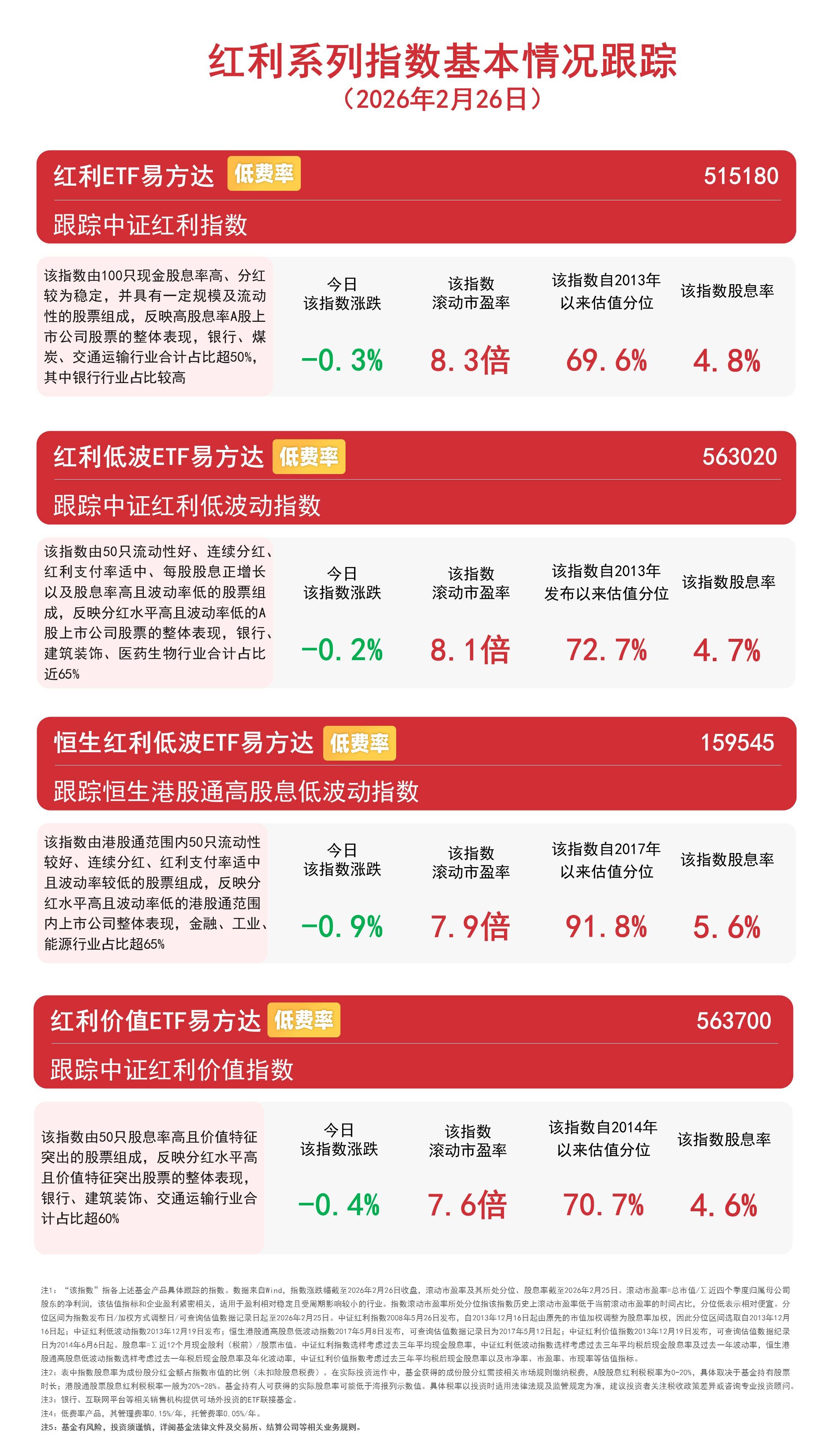
红利板块震荡调整,红利低波ETF易方达(563020)、恒生红利低波ETF易方达(159545)等产品受关注
Sou Hu Cai Jing· 2026-02-26 10:33
Group 1 - The core indices, including the China Securities Dividend Low Volatility Index and the Hang Seng High Dividend Low Volatility Index, experienced declines of 0.2%, 0.3%, 0.4%, and 0.9% respectively [1][5] - The E Fund's dividend low volatility ETFs, including the E Fund Dividend Low Volatility ETF (563020) and the E Fund Hang Seng Dividend Low Volatility ETF (159545), saw net inflows of 55 million yuan and 110 million yuan respectively over the first two trading days after the holiday [1] - E Fund is currently the only fund company that implements low fee rates for all its dividend ETFs, with a management fee rate of 0.15% per year for its various products [1] Group 2 - The China Securities Dividend Low Volatility Index consists of 50 stocks that are liquid, have a history of continuous dividends, moderate dividend payout ratios, positive growth in earnings per share, and low volatility, reflecting the overall performance of A-share listed companies with high dividend levels and low volatility [3] - The Hang Seng Dividend Low Volatility Index is composed of 50 stocks within the Hong Kong Stock Connect that are liquid, have continuous dividends, moderate dividend payout ratios, and low volatility, representing the overall performance of companies in this range [5]

基于BLACK-LITTERMAN模型融合资产择时与风格轮动的资产配置研究
Southwest Securities· 2026-02-26 10:30
202[Table_ReportInfo] 6 年 02 月 25 日 证券研究报告•金融工程专题报告 资产配置研究系列三 基于 BLACK-LITTERMAN 模型 融合资产择时与风格轮动的资产配置研究 在全球经济周期缩短、地缘政治冲突与技术革命叠加的背景下,市场"不确定性" 已成为投资管理的核心挑战,构建抗脆弱的组合是资本稳健增值的关键。传统均 值-方差模型(MVO)虽为资产配置基石,却因输入参数敏感性高、难以系统融合 主观观点而受限。Black-Litterman(BL)模型通过贝叶斯方法将市场均衡收益与 投资者观点结合,在量化严谨性中兼容主观判断,为机构资产配置提供新范式。 本文基于 BL模型原理,构建"战略+战术"双轮驱动的资产配置模型。战略端以 资产择时与回归分析生成资产收益后验分布,提升配置决策的前瞻性;战术端设 计 A股风格轮动策略,动态跟踪市场风格切换优化投资组合,增强 A股资产收益 表现。模型实现了长期战略配置与短期战术调整的有机结合,为大类资产配置提 供了系统性解决方案。 资产择时层 债券端立足经济基本面(经济增长、地产周期)与市场利率(质押回购、国债利 率)择时中债国债;商品端围绕黄金 ...
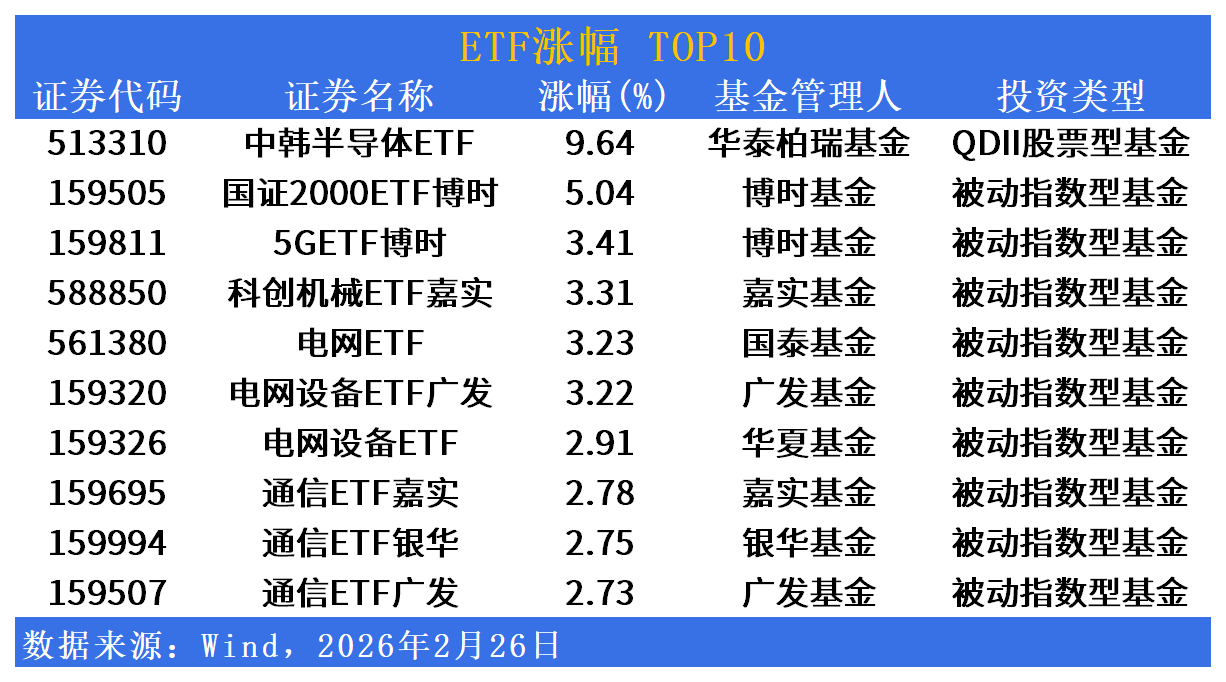
ETF市场日报 | 中韩半导体ETF暴涨9.64%,短融ETF成交破660亿
Sou Hu Cai Jing· 2026-02-26 08:15
Market Overview - A-shares showed mixed performance with the Shanghai Composite Index down 0.01%, Shenzhen Component Index up 0.19%, and ChiNext Index down 0.29% as of market close [1] - Total trading volume in Shanghai, Shenzhen, and Beijing reached 25,568 billion, an increase of 756 billion from the previous day [1] ETF Performance - The China-Korea Semiconductor ETF surged by 9.64%, leading the market, driven by the recovery in the semiconductor supply chain [2] - The National 2000 ETF rose by 5.04%, indicating a rebound in small-cap growth stocks [2] - The Electric Grid sector performed well, with the Electric Grid ETF up 3.23% and the Electric Grid Equipment ETFs rising by 3.22% and 2.91% respectively [2] Communication Sector - The communication sector also saw gains, with ETFs in this category rising between 2.73% and 2.78% [3] Declining Sectors - The pharmaceutical sector faced a broad retreat, with the Hang Seng Biotechnology ETF showing the largest decline at -3.89% [4] - Other related ETFs in the healthcare and biotechnology sectors also experienced significant drops, indicating a market shift from defensive sectors to technology growth [4] Trading Activity - The Short-term Bond ETF had a trading volume exceeding 66 billion, leading in activity among ETFs [5] - The top traded ETFs included the Short-term Bond ETF at 661.12 billion and the Silver Day Benefit ETF at 167.16 billion [5] Turnover Rates - Cross-border products showed high trading activity, with the Brazil ETF and China-Korea Semiconductor ETF having turnover rates of 171.99% and 125.76% respectively [6][7] - The National Debt ETF also maintained a strong turnover rate of 88.09%, indicating active trading in interest rate bonds and cross-border assets [7] New ETF Launch - A new Technology Growth ETF by Industrial Bank is set to launch on February 27, with a focus on hard technology and a multi-factor strategy targeting the top 50 securities in various tech sectors [8]
多元资产配置系列之二:低利率时代的FOF多元配置趋势与应用实践
Ping An Securities· 2026-02-26 07:05
1. Report Industry Investment Rating - The industry investment rating is "Stronger than the market" (It is expected that the industry index will outperform the market by more than 5% in the next 6 months) [109] 2. Core Viewpoints of the Report - In the low - interest - rate era, the demand for asset - allocation products is rising, and FOF is gradually moving towards multi - asset allocation strategies. The multi - asset allocation of FOF has shown different performance in different risk - level portfolios and has certain advantages compared with some traditional funds [3] - Different types of FOF managers have their own unique multi - asset allocation management styles, which can achieve relatively stable returns and risk control [3] 3. Summary According to the Directory 3.1 Background: Low - interest - rate Era FOF Multi - asset Allocation Breakthrough - **Macro Background**: The continuous decline in interest rates has increased the demand for asset - allocation products. In 2025, the scale of partial - debt hybrid FOF increased by 176%. Newly issued products strengthen the multi - asset allocation attribute through the explicit "multi - asset" label [3][6] - **Configuration Pattern**: More and more FOFs include gold, commodities, Hong Kong stock indexes, and global stock indexes in their benchmarks. As of the end of 2025, there were 160 FOF products with Hong Kong stock indexes, 19 with overseas stock indexes, and 73 with commodity (including gold) indexes in their performance comparison benchmarks. From the perspective of actual positions, FOFs cover nine major categories of assets outside of A - shares and domestic bonds [12][18] - **Configuration Process**: The industry's participation in multi - asset allocation has significantly increased, and multi - asset allocation has gradually become the consensus of FOF managers. As of the 2025 semi - annual report, the proportion of multi - asset allocation considering Hong Kong stocks reached 13.55%, and that without considering Hong Kong stocks reached 9.13% [19] - **Configuration Status**: Currently, FOF multi - asset allocation mainly participates with low positions, and it will take time to progress from "tactical trial" to "strategic standard" [23] 3.2 Assets: From Traditional Stocks and Bonds to All - type Investment Products - **Hong Kong Stock Funds**: Hong Kong stock assets are the preferred choice for FOF multi - asset allocation. Managers' positions are concentrated in Hong Kong stock technology index and dividend - type index strategies. ETFs have become the mainstream vehicle for FOF to allocate Hong Kong stocks [30] - **QDII Stock Funds**: The high - concentration holding of US stock broad - based ETFs shows that FOF funds aim to obtain the long - term beta of mature markets. There are also signs of diversification in regional allocation [35] - **QDII Hybrid Funds**: The configuration logic of active - management QDII funds is to capture the comparative advantages in the global industrial chain [36] - **QDII Bond Funds**: Asian US dollar bonds are the main objects of FOF overseas fixed - income allocation [41] - **Commodity Funds**: The allocation of gold assets shows high strategic consistency, and gold is the primary choice for FOF to diversify underlying asset types. Other commodity funds are also widely included [49] - **Market Neutral Funds**: Market neutral funds have low volatility and better drawdown control ability, which are important tools for smoothing the portfolio net value curve [50] - **Mutual Recognition Funds**: Hong Kong mutual recognition funds effectively fill the configuration gap when QDII quotas are scarce and are an important supplement for FOF to allocate overseas fixed - income assets [54] - **REITs**: REITs are gradually being included in the "fixed - income +" configuration category by FOF due to their mandatory dividend characteristics and physical attributes of underlying assets [60] 3.3 Performance: Incremental Contribution of Multi - asset Allocation - **Comparison with Traditional Stock - Bond FOF**: - **Robust FOF**: Since 2024, robust multi - asset FOF has shown higher cumulative returns and better risk - adjusted performance, with overall investment efficiency superior to traditional stock - bond FOF [65][68] - **Balanced FOF**: Since 2024, there has been no significant difference between balanced multi - asset FOF and traditional stock - bond FOF in terms of return performance and risk - adjusted indicators [71] - **Aggressive FOF**: Since 2024, aggressive multi - asset FOF has shown high synchronization with traditional stock - bond FOF, and multi - asset allocation has not formed a stable risk - return advantage at this risk level [74] - **Comparison with Other Funds**: - **Compared with Hybrid Secondary Bond Funds**: Robust multi - asset FOF has a higher return level per unit of risk than hybrid secondary bond funds, showing better risk - return efficiency [78] - **Compared with Flexible Allocation Funds**: Balanced and aggressive multi - asset FOF still shows certain risk - return efficiency advantages, but the advantage is relatively limited [82] 3.4 Case: Practical Atlas of High - performing Managers - **Tang Jun**: He adheres to the multi - asset allocation framework for a long time and clearly incorporates the timing of major asset classes. His robust products can control drawdowns and continuously accumulate excess returns [85][88] - **Cao Jianwen**: He gradually transitions from traditional stock - bond allocation to a multi - asset framework, expands the source of portfolio returns by introducing commodities and overseas assets, and strengthens the timing of risk assets. The performance of his products has improved marginally after the transformation [90][92] - **Li Xiaoyi**: His multi - asset framework focuses on steady - state diversification and long - term structural optimization. He switches from active to passive in traditional stocks and bonds and enriches the defensive layer configuration through low - volatility assets such as QDII bond funds, mutual recognition funds, and REITs [95][97] - **Lin Guohuai**: He constructs the portfolio with a multi - asset index as the core benchmark, practices global multi - asset allocation in the strategic level, and balances high - equity offensiveness and cross - market diversification [100][103]
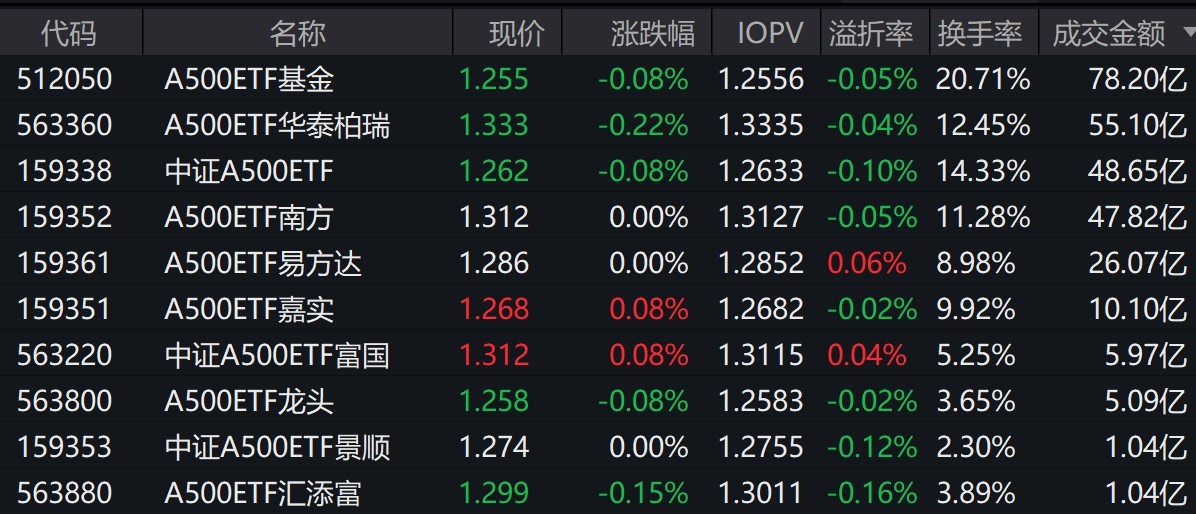
A股早盘走势分化,中证A500指数下跌0.06%,2只中证A500相关ETF成交额超55亿元
Mei Ri Jing Ji Xin Wen· 2026-02-26 06:18
| 代码 | 名称 | 现价 | IOPV 溢折率 换手率 涨跌幅 | 成交 | | --- | --- | --- | --- | --- | | 512050 | A500ETF基金 | 1.255 | -0.08% 1.2556 -0.05% 20.71% | | | 563360 | A500ETF华泰柏瑞 | 1.333 | -0.22% 1.3335 -0.04% 12.45% | | | 159338 | 中证A500ETF | 1.262 | -0.08% 1.2633 -0.10% 14.33% | 6 | | 159352 | A500ETF南方 | 1.312 | 0.00% 1.3127 -0.05% 11.28% | | | 159361 | A500ETF易方达 | 1.286 | 0.00% 1.2852 0.06% 8.98% | 2 | | 159351 | A500ETF嘉实 | 1.268 | 0.08% 1.2682 -0.02% 9.92% | | | 563220 | 中证A500ETF富国 | 1.312 | 0.08% 1.3115 0.04% 5.25% | ...
(场外)“红利+”投资,不止股息
Jin Rong Jie· 2026-02-26 05:37
Core Insights - The article discusses the evolution of dividend investing in the A-share market, highlighting the "Dividend+" product line from E Fund, which represents a three-tiered approach to dividend investment [1] Group 1: Dividend Investment Strategies - E Fund's "Dividend+" strategy transitions from a defensive "ballast" to a value-reassessed "scarce asset," and finally to a "growth dividend" driven by profit quality [1] - The E Fund CSI Dividend ETF Fund (A/C/Y: 009051/009052/022925) tracks the CSI Dividend Index, focusing on high-dividend sectors like banking and coal, with a dividend yield of 4.8%, serving as a "shock absorber" for investment volatility [1] - The E Fund National Value 100 ETF Fund (A/C: 025497/025498) tracks the National Value 100 Index, emphasizing undervalued value stocks, featuring a 4.8% dividend yield and a 10.6% return on equity, embodying both "dividend + value" [1] - The E Fund National Free Cash Flow ETF Fund (A/C: 024566/024567) follows the National Free Cash Flow Index, using "free cash flow" as a core selection criterion, which is essential for sustainable dividends and future expansion [1] Group 2: Essence of "Dividend+" - The essence of "Dividend+" lies in combining high dividends with considerations of profit quality and valuation safety margins, focusing on long-term value returns and enhancing the defensive and offensive capabilities of dividend investing [1]
(场外)为什么当下“红利+”策略越来越重要?
Jin Rong Jie· 2026-02-26 05:37
Core Viewpoint - The investment strategy of "Stable + Sustainable" is becoming a key theme for the year amid increasing market volatility and uncertainty, suggesting that a "Dividend +" strategy, which combines defensiveness and yield elasticity, may be a core choice for ordinary investors [1] Group 1: Investment Strategy - The "Dividend +" strategy evolves beyond traditional high-dividend frameworks to a comprehensive system that includes high dividends, low valuations, quality earnings, and value recovery, allowing for both offensive and defensive positioning in volatile markets [1] - Three ETFs under E Fund provide a complete "Dividend +" allocation tool, focusing on high-dividend, stable dividend-paying leading companies, with a notable emphasis on banking, coal, and transportation sectors [1] Group 2: Fund Performance - The E Fund National Value 100 ETF focuses on uncovering undervalued profit opportunities, with a high representation in financial and industrial sectors, suitable for capturing rebound trends after market stabilization [2] - The E Fund National Free Cash Flow ETF targets high-quality earnings, tracking the National Free Cash Flow Index, with a core advantage of a 12.4% return on equity, leaning towards technology growth and manufacturing sectors, and has recently outperformed the market [2] Group 3: Historical Data - From 2013 to present, the annualized return of the National Value 100 Index is 18.3%, the National Free Cash Flow Index is 19.0%, and the China Securities Dividend Index is 11.3%, all outperforming mainstream broad-based indices with higher Sharpe ratios, indicating better historical long-term returns for similar risk levels [2]
(场外)为什么这三只指数基金是“红利+”时代的工具优选?
Jin Rong Jie· 2026-02-26 05:37
Group 1 - The core viewpoint of the article emphasizes the advantages of E Fund's "Dividend+" index fund product line, which leads in index investment logic and features three main advantages [1] Group 2 - Advantage 1: Low fee rates, with E Fund's China Securities Dividend ETF linked fund and E Fund's National Securities Free Cash Flow ETF linked fund both having a management fee rate of 0.15% per year and a custody fee rate of 0.05% per year, the lowest in the market. A 0.2% fee rate difference over a 10-year period can reduce final returns by approximately 2%, making low fees an "invisible amplifier" for long-term returns [1] - Advantage 2: Scarcity, as E Fund's National Securities Value 100 ETF linked fund is the only product tracking the National Securities Value 100 index, providing investors with a precise tool for positioning when market styles shift towards value [1] - Advantage 3: Scale effect, with E Fund's China Securities Dividend ETF linked fund being the largest in terms of scale among similar index ETFs, reflecting market recognition [1] Group 3 - For investors, the key to choosing tools is finding a balance between "good strategies" and "good products" that suit their needs [2]
(场外)震荡市如何用“红利+”基金做配置?
Jin Rong Jie· 2026-02-26 05:37
风险提示:基金有风险,投资需谨慎。 来源:易方达基金 易方达国证价值100ETF联接基金(A/C:025497/025498)专注捕捉市场修复机会,作为市场唯一跟踪 国证价值100指数的ETF联接基金,聚焦低估值、高盈利的价值标的,在震荡反弹行情中具备更强弹 性。 易方达国证自由现金流ETF联接基金(A/C:024566/024567)牢牢把握高质量盈利主线,以12.4%的净 资产收益率为核心优势,聚焦盈利真实、现金流健康的优质企业,在震荡市中更受资金认可,为策略提 供长期成长动力。 三者搭配,形成了"防守+修复+成长"的完整闭环:下跌有支撑、反弹有弹性、长期有收益,真正做到 进可攻、退可守。既不用在波动中频繁操作,也不必担心踏空与被套,让投资在震荡市场中更稳、更从 容。 当下市场让不少投资者陷入两难:追涨怕高位被套,持币空仓又怕踏空行情,单一持仓波动大、拿不 住,成为普遍痛点。面对这样的市场环境,兼具防御性与进攻弹性的"红利+"策略,正是震荡市里既实 用、又稳健的配置答案。 震荡市的核心需求,是稳得住、有弹性、不踏空,而易方达三只"红利+"ETF联接基金恰好形成一套完 整的攻防策略,适配震荡格局: 易方达中 ...
(场外)为什么要买“红利+”基金?
Jin Rong Jie· 2026-02-26 05:37
投资大师巴菲特说:"投资的核心是买入优质资产,然后耐心等待。"红利资产凭借稳定的分红,向来是 优质资产的代名词。如今,我们对红利资产进行了策略扩充,迈入多维度聚合的"红利+"时代:在追求 高股息之外,进一步叠加了更强的安全边际与更扎实的盈利基本面考量。 1.稳定的股息回报:如易方达中证红利ETF联接基金(A/C/Y:009051/009052/022925)跟踪的中证红利 指数,拥有4.8%高股息率,提供持续可预期的分红回报。 2.合理的估值安全边际:如易方达国证价值100ETF联接基金(A/C:025497/025498)跟踪的国证价值 100指数,通过股息率、市盈率和自由现金流率三个价值维度综合选股,估值安全边际更强,有效降低 策略风险。 3.扎实的盈利质量:如易方达国证自由现金流ETF联接基金(A/C:024566/024567)跟踪的国证自由现 金流指数,12.4%的高净资产收益率,充分验证盈利的真实性与可持续性。 易方达中证红利ETF联接基金(A/C/Y:009051/009052/022925)、易方达国证价值100ETF联接基金 (A/C:025497/025498)、易方达国证自由现金流ETF ...