短融ETF海富通

Search documents
ETF跟踪研究:ETF市场周度更新-20260323
Yin He Zheng Quan· 2026-03-23 04:44
ETF Market Overview - As of March 23, 2026, the total number of ETFs in the market reached 2,310, with a total scale of 1,234.5 billion yuan and a weekly trading volume of 123.4 billion yuan. The number of newly added funds this week was 13 [1][3]. - Equity funds dominate the market, with thematic equity funds accounting for 30.6% of the total number, and their scale reaching 1,234.5 billion yuan, representing 60.1% of the total scale. Bond ETFs had the highest weekly trading volume, accounting for 25.3% [1][4]. Fund Inflow and Outflow - The inflow of funds last week was primarily concentrated in broad-based indices and bond ETFs, with the top inflow being the Short-term Bond ETF from Hai Fu Tong, which saw an inflow of 1.2 billion yuan. The latest scale of this fund is 12.3 billion yuan [5][6]. - In contrast, resource and chemical ETFs experienced significant outflows, with the chemical ETF seeing an outflow of 1.2 billion yuan, and the non-ferrous metal ETF experiencing an outflow of 1.1 billion yuan [7][8]. Industry Sector Fund Flow - Only the financial real estate and pharmaceutical sectors saw a slight net inflow of funds, with the financial real estate sector receiving 1.2 billion yuan and the pharmaceutical sector 0.3 billion yuan. Other sectors, including consumption and technology, experienced net outflows [13][14]. New ETF Listings - Last week, a total of 13 new ETFs were listed, all of which were equity funds covering various sectors, themes, and cross-border categories. The largest new listing was the Agricultural and Fishery ETF from Invesco, with a scale of 1.2 billion yuan [16][17]. Core Broad-based Index and ETF Performance - The performance of core broad-based indices showed significant divergence, with the ChiNext index rising against the trend, achieving a weekly return of 3.5%. In contrast, the CSI 300 index saw the largest weekly decline of 2.3% [18][19].
信用债ETF双周报(20260302-20260313):短融ETF交投活跃,持续获资金净流入-20260318
金融街证券· 2026-03-18 11:07
1. Report Industry Investment Rating No information about the industry investment rating is provided in the report. 2. Core Viewpoints of the Report The report analyzes the credit bond ETF market from multiple perspectives, including index market trends, ETF market trends, liquidity, scale, and risk - return. It indicates that the bond market is expected to be in a volatile state in March, with inflation expectations dominating bond pricing. It recommends a strategy of medium - short duration and high - coupon protection and suggests focusing on the Haifutong Urban Investment Bond ETF (511220.SH), the Haifutong Short - Term Financing ETF (511360.SH), and the Bosera Convertible Bond ETF (511380.SH) [7][64]. 3. Summary by Relevant Sections Index Market Trends - **Bond Index Market Trends**: Pure bond indexes rose slightly, and convertible bond indexes fell. The ChinaBond Financial Bond Index had the best performance in the past two weeks, with a 0.20% increase, while the ChinaBond Medium - and High - Grade Corporate Bond Spread Factor Net Price (Total Value) Index had the lowest increase, at 0.04%. Convertible bond indexes fluctuated downward, with the CSI Convertible Bond and Exchangeable Bond Index and the SSE Investment - Grade Convertible Bond and Exchangeable Bond Index falling by 3.07% and 2.67% respectively in the past two weeks [2][12]. - **Important Credit Bond Index Spread Situation**: The yields of credit bond indexes declined, and the spread trends showed less differentiation. Most credit bond index spreads widened, and credit bonds underperformed interest - rate bonds. The Shanghai Urban Investment Bond Index had the highest estimated yield (1.87%) and the highest spread (28.46bp) on March 13, 2026, while the ChinaBond Financial Bond Index had the lowest spread at 9.50bp [13]. Credit Bond ETF Market Trends - Pure bond ETFs generally rose, and convertible bond ETFs fell. Among the benchmark market - making bond ETFs, the average increase of Shenzhen Market - Making Credit Bonds was higher than that of Shanghai Market - Making Corporate Bonds. Among the science and technology innovation bond ETFs, the Invesco Science and Technology Innovation Bond ETF (159400.SZ) had the highest increase of 0.20%, and the Huaxia Science and Technology Innovation Bond ETF (159112.SZ) had the lowest increase of 0.06%. Among pure bond ETFs, the Dacheng Credit Bond ETF (159395.SZ) had the highest increase of 0.20%. The Bosera Convertible Bond ETF (511380.SH) and the Haifutong Convertible Bond ETF (511180.SH) fell by 3.38% and 2.67% respectively [3][19]. Credit Bond ETF Liquidity - The Haifutong Short - Term Financing ETF (511360.SH) was the most actively traded, with a trading volume of 586.87 billion yuan in the past two weeks, a month - on - month increase of 155.38%, an average daily trading volume of 58.687 billion yuan, and a high turnover rate of 747.23%. The total trading volume of science and technology innovation bond ETFs in the past two weeks was 1205.866 billion yuan, with an average daily trading volume of 120.587 billion yuan and an average turnover rate of 467.30%. The total trading volume of benchmark market - making bond ETFs in the past two weeks was 288.207 billion yuan, with an average daily trading volume of 28.821 billion yuan and an average turnover rate of 254.56%. The total trading volume of convertible bond ETFs in the past two weeks was 157.644 billion yuan, with an average daily trading volume of 15.764 billion yuan and an average turnover rate of 214.11% [4][25]. Credit Bond ETF Scale - The scales of different types of ETFs showed mixed trends. Short - term financing ETFs and urban investment bond ETFs continued to receive net capital inflows, while the scales of science and technology innovation bond ETFs and benchmark market - making bond ETFs continued to decline, and the scale of convertible bond ETFs began to decline. As of March 13, 2026, the scale of the Haifutong Short - Term Financing ETF (511360.SH) was 81.829 billion yuan, a month - on - month increase of 4.604 billion yuan; the scale of the Haifutong Urban Investment Bond ETF (511220.SH) was 33.887 billion yuan, a month - on - month increase of 2.530 billion yuan [4][36]. Credit Bond ETF Risk - Return Analysis - **Unit Net Value**: The unit net values of pure bond ETFs increased, while those of convertible bond ETFs decreased. By March 13, 2026, the unit net values of benchmark market - making bond ETFs exceeded 101 yuan, and those of science and technology innovation bond ETFs exceeded 100 yuan. The unit net value of the short - term financing ETF continued to rise steadily, exceeding 113 yuan, and the unit net value of the urban investment bond ETF rose slightly to 10.29 yuan. The unit net values of the Bosera Convertible Bond ETF (511380.SH) and the Haifutong Convertible Bond ETF (511180.SH) fell to 14.13 yuan and 12.98 yuan respectively in the past two weeks [42]. - **Income**: The coupon rates of component bonds were concentrated, and the urban investment ETF had the greatest coupon rate advantage. Most credit bond ETFs saw a decline in the weighted coupon rate of component bonds at the end of the period compared to the beginning. Convertible bond ETFs had the lowest coupon rates, with the weighted coupon rates of the Bosera Convertible Bond ETF (511380.SH) and the Haifutong Convertible Bond ETF (511180.SH) at 0.24% and 0.23% respectively. The Haifutong Short - Term Financing ETF (511360.SH) had a weighted coupon rate of 1.63%. The weighted coupon rate of benchmark market - making bond ETFs was higher than that of science and technology innovation bond ETFs. The Dacheng Credit Bond ETF (159395.SZ) in benchmark market - making credit bonds had the highest weighted coupon rate of 2.69%, and the Winwin Science and Technology Innovation Bond ETF (511150.SH) in science and technology innovation bond ETFs had the highest weighted coupon rate of 2.29%. The Haifutong Urban Investment Bond ETF (511220.SH) had the highest weighted coupon rate of 3.27%. In terms of capital gains, the weighted yields of pure bond ETFs increased at the end of the period compared to the beginning, and the capital gain income was positive [45]. - **Weighted Duration and Convexity**: Most credit bond ETFs reduced their durations, and the weighted durations of science and technology innovation bond ETFs were differentiated. Affected by inflation expectations, most credit bond ETFs reduced their durations. The China Merchants Science and Technology Innovation Bond ETF (551900.SH) had the longest weighted duration of 3.86, and the Haifutong Short - Term Financing ETF (511360.SH) had the shortest duration of 0.30. The Bosera Credit Bond ETF (159396.SH), the Haifutong Credit Bond ETF (511190.SH), the Southern Credit Bond ETF (511070.SH), and the Winwin Science and Technology Innovation Bond ETF (511150.SH) had significantly higher convexity than other ETFs, mainly due to their allocation of perpetual bonds, which increased the overall convexity. Considering both duration and convexity, the Haifutong Credit Bond ETF (511190.SH) and the Winwin Science and Technology Innovation Bond ETF (511150.SH) had strong anti - decline capabilities [50][51]. - **Credit Risk**: The overall credit risk of credit bond ETFs was low. The component bonds of science and technology innovation bond ETFs, benchmark market - making bond ETFs, the Haifutong Short - Term Financing ETF, and corporate bond ETFs were all rated AAA. On March 13, 2026, in the Haifutong Urban Investment Bond ETF, AAA - rated component bonds accounted for 40.50%, AA + - rated component bonds accounted for 42.70%, and AA - rated component bonds accounted for 16.80%. In the Bosera Convertible Bond ETF (511380.SH), component bonds rated AA - and below accounted for 58.38%, and in the Haifutong Convertible Bond ETF (511180.SH), AA - rated component bonds accounted for 64.04%. Although convertible bonds had low credit ratings, they had conversion options, so the default risk was still low [55]. - **Cost - Effectiveness**: The corporate bond ETF and the Haifutong Short - Term Financing ETF had the highest risk - return ratios. In terms of returns, the Invesco Science and Technology Innovation Bond ETF (159400.SZ) had the highest annualized interval return of 4.12%, and the Bosera Convertible Bond ETF (511380.SH) had the lowest annualized interval return of - 60.52%. In terms of drawdowns, the Bosera Convertible Bond ETF (511380.SH) and the Haifutong Convertible Bond ETF (511180.SH) had higher maximum drawdowns than pure credit bond ETFs due to the fluctuations in the returns of their underlying stocks. Among pure bond ETFs, the Bank of China Science and Technology Innovation Bond ETF (551060.SH) had the largest drawdown, but the overall drawdowns of pure bond ETFs were small. In terms of risk - return ratios, the Haifutong Short - Term Financing ETF (511220.SH) and the corporate bond ETF (511030.SH) had the highest cost - effectiveness in the past two weeks, with Sharpe ratios of 0.91 and 0.87 respectively and Calmar ratios of 0 and 497.88 respectively [58]. Investment Recommendations - Based on the economic fundamentals in February, which showed characteristics of contraction in manufacturing and non - manufacturing, rising inflation, stable social financing growth, and continued rebound and repair of industrial profits, and the tight balance of the capital market, it is expected that the bond market will be in a volatile state in March, with inflation expectations dominating bond pricing. It is recommended to adopt a strategy of medium - short duration and high - coupon protection in March. After comprehensively comparing the durations, convexities, and risk - return ratios of bond indexes and credit bond ETFs, it is recommended to focus on the Haifutong Urban Investment Bond ETF (511220.SH), the Haifutong Short - Term Financing ETF (511360.SH), and the Bosera Convertible Bond ETF (511380.SH) [64].
ETF生态周报:ETF市场整体综合面板-20260317
HWABAO SECURITIES· 2026-03-17 11:03
1. Report Industry Investment Rating No relevant content provided. 2. Core Viewpoints of the Report - The overall trend in the ETF market last week was that domestic equities generally declined, with high - valuation broad - based indices under pressure. Bonds provided a hedge, and sectors with defensive or resource attributes such as electricity were relatively dominant. There was a clear migration of funds from equity broad - based ETFs to gold, fixed - income, and some thematic ETFs, showing an obvious defensive tendency [22][23][33]. 3. Summary According to the Directory 3.1 Scale: Total Expansion and Structural Stratification (Market/Product/Institution) 3.1.1 Product Scale - As of March 13, 2026, the total number of ETFs in the whole market was 1,456, with a total scale of 52,528.30 billion yuan and 33,707.47 billion shares. Stock - type ETFs were the main force in terms of scale, with 1,131 funds, a scale of 30,551.01 billion yuan, and 21,147.17 billion shares. Compared with the previous week, the overall share increased by 400 million, but the scale decreased by 50.2 billion yuan. The number of stock - type ETFs remained unchanged, the share increased by 1.6 billion, but the scale decreased by 33.1 billion yuan [15][16]. 3.1.2 Institution Scale - Last week, the top 20 fund companies managed a total net asset value of 23 trillion yuan, accounting for 62% of the whole market, indicating significant industry concentration. E Fund and China Asset Management led in total scale with a more balanced structure. Tianhong was more focused on the money - market type. The scale fluctuations last week mainly came from the stock - type and ETF segments, with a "reduction" trend in the equity and ETF segments of the market, and more incremental funds concentrated in a few medium - sized institutions [18][19][20]. 3.2 Performance: Differentiated Gains and Losses and Valuation Positions 3.2.1 Major ETFs - Last week, the domestic equity market was generally weak, with broad - based indices generally retreating. The valuation quantiles of medium - and small - cap indices were at relatively high levels, indicating weakening market risk appetite. Structurally, there were obvious differences. The power ETF rose by 3.88%, showing defensive attributes, while the securities ETF fell by 1.68% due to systematic market adjustments rather than high valuations. Bonds strengthened slightly, and cross - border (QDII) ETFs were also weak, with the Hang Seng Tech Index ETF relatively resistant to decline and at a low historical valuation quantile [22][23]. 3.2.2 CITIC First - level Industry Index - Last week, industry performance showed obvious differentiation. Most industries had relatively high valuation quantiles but different trends. Strong industries were concentrated in the high - valuation range, while low - valuation sectors were generally weak [28]. 3.2.3 Representative ETF Products - As of March 13, 2026, in terms of scale, the Huatai - Peregrine SSE 300 ETF ranked first with 205.803 billion yuan. In terms of trading activity, bond - type ETFs were prominent, and in terms of valuation, some ETFs such as the military - leading ETF and the dividend ETF were at historical high levels, while the Hang Seng Tech ETF and the pharmaceutical ETF were at historical low levels, which were attractive for long - term investors [29]. 3.3 Funds: Sector Liquidity and Net Inflow Structure 3.3.1 Overall Market Overview: Scale and Net Redemption - As of March 13, 2026, the total scale of the whole - market ETFs reached 5.25 trillion yuan, slightly shrinking by 0.77 trillion yuan compared with the beginning of the year. The number of listed ETFs increased to 1,452, an increase of 52 compared with the beginning of the year. Stock - type ETFs were still the main force in scale, but their scale decreased by 0.78 trillion yuan compared with the beginning of the year. Commodity - type ETFs performed the best, with a significant increase of 109.841 billion yuan compared with the beginning of the year [36]. 3.3.2 Major Category of Funds: Stocks/Bonds/Commodities/Cross - border - Last week, funds generally showed a defensive tendency. Broad - based ETFs continued to have net outflows, while industry - thematic ETFs and commodity ETFs had net inflows. The SGE Gold 9999 had the largest net inflow, indicating a strong demand for hedging [4][32]. 3.3.3 Internal Equity: Broad - based vs. Industry/Theme vs. Strategy - As of March 13, 2026, the funds of major broad - based ETFs were generally weak, with continuous net outflows. Thematic ETFs and cyclical manufacturing ETFs were the main directions of fund inflows, while broad - based ETFs continued to be under pressure, indicating an obvious migration of existing funds from broad - based to thematic and cyclical directions [49]. 3.3.4 Top 20 Stock - type ETF Redemption Net Inflows - Last week, power and hedging assets were the main directions pursued by funds. The Grid Equipment ETF had the largest net inflow, followed by the Haifutong Short - term Financing ETF and the Free Cash Flow ETF. The Hang Seng Tech ETF did not appear in the top 10 list, indicating a weakening of short - term capital momentum for Hong Kong technology stocks [53]. 3.3.5 Leveraged Funds: Top 20 Net Margin Purchases and the Relationship with Redemption - Last week, the Bosera Convertible Bond ETF had the largest net margin purchase, followed by the Science and Technology Innovation 50 ETF and the E Fund Hong Kong Securities ETF. There were four typical relationships between margin trading and redemption, and the overall resonance of redemption and margin trading in the market was weak last week [55][56]. 3.4 ETF Trading Congestion 3.4.1 Changes in Trading Volume and Top 10 Turnover ETFs - As of March 13, 2026, the total trading volume of the ETF market was about 2.7 trillion yuan, with the increase mainly coming from bond - type ETFs, followed by stock - type ETFs. The trading volume of bond - type ETFs showed high turnover and high trading volume, and the trading congestion of bond - type ETFs was significantly differentiated. In stock - type ETFs, A500 - related ETFs were the most active in trading, and the trading of large - cap styles still dominated the market [60][63][66]. 3.5 Issuance Dynamics - Last week, the ETF issuance market declined. There were 66 funds being issued, a decrease of 14.29% compared with the previous week. 30 funds were established, an increase of 328.57% compared with the previous week, and 0 funds were listed, a decrease of 100% compared with the previous week. It is expected that 10 ETFs will be listed in the next two weeks, mainly stock - type, covering multiple themes. New products in some directions may be able to承接 existing capital enthusiasm, while the short - term trading activity of new products in some directions may be limited [76][78].
ETF市场日报 | 半导体设备板块回调居前,有色、稀土逆势领涨
Sou Hu Cai Jing· 2026-02-27 08:17
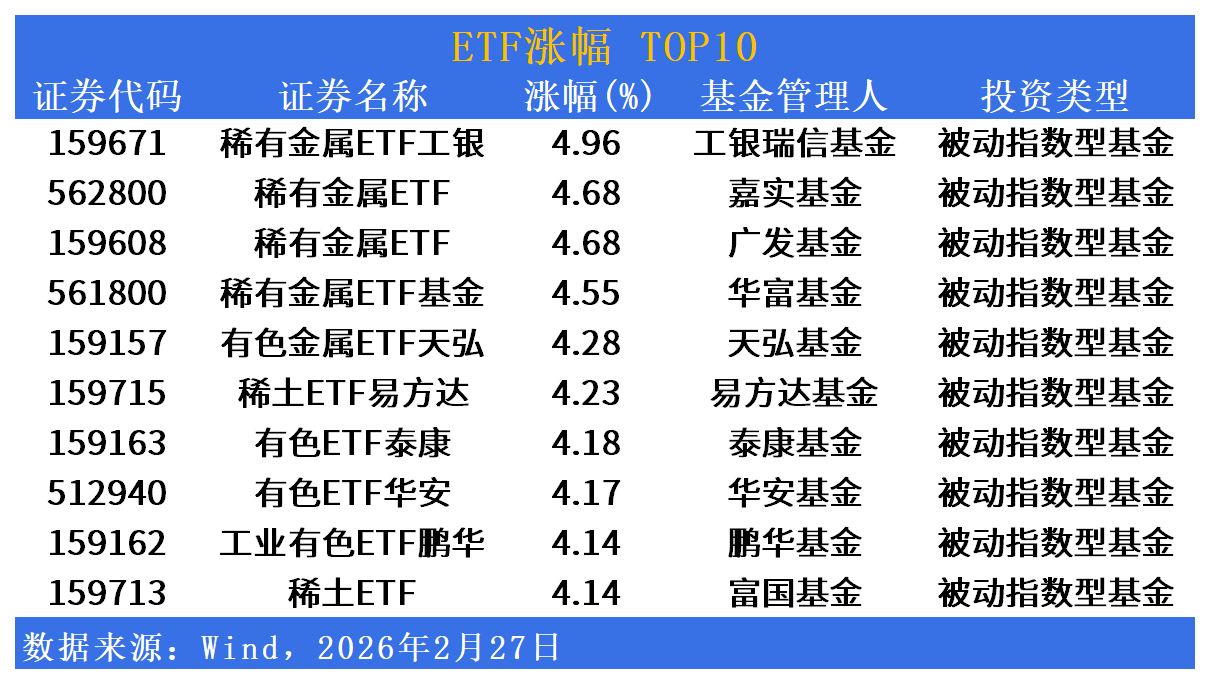
Market Overview - The A-share market showed mixed performance with the Shanghai Composite Index rising by 0.39%, while the Shenzhen Component Index fell by 0.06%, and the ChiNext Index decreased by 1.04% [1] - The total trading volume in the Shanghai, Shenzhen, and Beijing markets reached 2.51 trillion yuan, slightly down from the previous day [1] Sector Performance - The rare metals and rare earth sectors led the gains, with several ETFs in these categories rising over 4%, including the Rare Metals ETF from ICBC, which increased by 4.96% [2] - Other notable performers included the Rare Metals ETFs from Jiashi and Guangfa, both up by 4.68%, and the Rare Metals ETF Fund from Huafu, which rose by 4.55% [2] - The non-ferrous metals sector also saw significant increases, with the Non-Ferrous Metals ETF from Tianhong up by 4.28% and the Non-Ferrous ETF from Huashan rising by 4.17% [3] Declining Sectors - The semiconductor equipment sector experienced a notable pullback, with several ETFs in this category showing declines, including the Semiconductor Equipment ETF from Guotai, which fell by 2.16% [4] - The small-cap growth style, particularly in the ChiNext and National 2000 indices, faced pressure as funds rotated out of previously popular themes into cyclical resource sectors for safety [4] Trading Activity - The Short-term Bond ETF from Haifutong led trading activity with a turnover of 576.06 billion yuan, followed by the National Debt ETF from Huaxia at 168.25 billion yuan and the Sci-Tech Bond ETF from Nanfang at 137.24 billion yuan [5] - The turnover rates were high for bond ETFs, with the Sci-Tech Bond ETF from Nanfang achieving a turnover rate of 156.87%, indicating strong liquidity in this segment [6] ETF Issuance - Six new ETFs are set to launch, focusing on Hong Kong Stock Connect and Sci-Tech sectors, with fundraising starting on March 2, 2026 [8] - The Cash Flow ETF from Great Wall will track the National Index of Free Cash Flow, while the Engineering Machinery ETF from Penghua will follow the China Securities Engineering Machinery Theme Index [9] - Cross-border products include the Internet ETFs from ICBC and Xingye, which will track the China Securities Hong Kong Stock Connect Internet Index [9][10]

资金回流部分宽基ETF 市场主线向“盈利驱动”切换
Zhong Guo Zheng Quan Bao· 2026-02-26 20:28
Group 1 - The South Korea-China Semiconductor ETF (513310) surged by 9.64%, leading the market on February 26, with a premium rate of 21.10% and a turnover rate exceeding 125% [2][3] - The semiconductor equipment sector continues to rise, driven by a sustained "supply-demand imbalance" in the global storage industry, which is expected to maintain its upward trend until after 2027 [2] - The strong performance of the semiconductor design sector is attributed to Nvidia's impressive earnings report and the ongoing demand for AI computing power, alongside accelerated domestic industry development and supportive policies [2] Group 2 - The short-term bond ETF Hai Futong (511360) recorded a transaction volume exceeding 66 billion yuan, ranking first in the market [3] - Several A500 ETFs, including A500 ETF Fund (512050) and A500 ETF Huatai Baichuan (563360), saw significant trading volumes, indicating renewed investor interest in broad-based ETFs [3] - There was a notable net inflow into the Hang Seng Technology and Hong Kong internet-themed ETFs, suggesting a shift in investor sentiment despite market volatility [4] Group 3 - The market is expected to transition from valuation-driven logic to earnings-driven logic, with a focus on the quality of earnings, cash flow, and dividend capabilities of listed companies [5] - The dual focus on cyclical and technology sectors is emerging, with the performance of both sectors likely to depend on the verification of fundamental strengths [5][6] - In the context of economic recovery, the market is anticipated to maintain a volatile upward trend, favoring large and mid-cap blue-chip stocks [6]
资金回流部分宽基ETF市场主线向“盈利驱动”切换
Zhong Guo Zheng Quan Bao· 2026-02-26 20:28
Group 1 - The South Korea-China semiconductor ETF (513310) surged by 9.64%, leading the market, with a premium rate of 21.10% and a turnover rate exceeding 125% [1] - The semiconductor equipment sector continues to rise, driven by a sustained "supply-demand imbalance" in the global storage industry, which is expected to maintain its upward trend until after 2027 [1] - The strong performance of the semiconductor design sector is attributed to Nvidia's impressive earnings report and the confirmation of long-term resilience in AI computing demand, alongside accelerated domestic industry development and supportive policies [2] Group 2 - The short-term bond ETF (511360) recorded a transaction volume exceeding 66 billion yuan, ranking first in the market, while several A500 ETFs also saw significant trading volumes [2] - There has been a notable net inflow of funds into the Hang Seng Technology and Hong Kong internet-themed ETFs, indicating a reversal in market sentiment despite overall market fluctuations [3] - The market is expected to maintain a volatile upward trend, with large and mid-cap blue-chip stocks likely to outperform in the context of economic recovery [4]
ETF龙虎榜 | 大幅溢价!这只ETF逼近涨停
Zhong Guo Zheng Quan Bao· 2026-02-26 14:05
Group 1 - The core point of the news is the significant performance of various ETFs, particularly the South Korea-China Semiconductor ETF, which surged by 9.64%, leading the market with a premium rate of 21.10% and a turnover rate of 125.76% [1][5] - The short-term bond ETF, Hai Futong, recorded a transaction volume exceeding 66 billion yuan, making it the top ETF in the market for that day [4][6] - There was a notable inflow of funds into broad-based ETFs such as the CSI 500 ETF and the A500 ETFs, indicating a shift in market sentiment [5][7] Group 2 - The semiconductor equipment sector continues to rise, driven by strong demand for AI and a persistent supply-demand imbalance in the global storage industry, which is expected to last until at least 2027 [2][3] - The chip design sector saw a significant rally, attributed to Nvidia's impressive earnings report and ongoing domestic industry development supported by favorable policies [3] - Several ETFs related to power grids and communications also experienced notable gains, reflecting a broader market trend towards these sectors [1][2] Group 3 - The market is currently experiencing a shift from valuation-driven growth to earnings-driven performance, with an increasing focus on the quality of earnings, cash flow, and dividend capabilities of listed companies [8] - The investment strategy is suggested to adopt a phased approach or dollar-cost averaging to capture long-term opportunities amidst market volatility [8] - The market is expected to continue its upward trend, with mid-cap and large-cap blue-chip stocks likely to outperform in the context of economic recovery [8]
大幅溢价!这只ETF逼近涨停
Zhong Guo Zheng Quan Bao· 2026-02-26 12:45
Group 1 - The South Korea-China Semiconductor ETF (513310) surged by 9.64%, nearing the daily limit, leading the market ETFs with a premium rate of 21.10% and a turnover rate of 125.76% [1][4][8] - The Short-term Bond ETF (511360) recorded a transaction volume exceeding 66 billion yuan, ranking first among all market ETFs [2][8][9] - Several A500 ETFs, including A500 ETF Fund (512050) and A500 ETF Huatai (563360), saw significant trading volumes, indicating strong investor interest [2][8] Group 2 - The semiconductor equipment sector continues to rise, driven by a sustained "supply-demand imbalance" in the global storage industry, with expectations of continued growth until after 2027 [6] - The chip design sector experienced a significant rally, supported by strong performance from Nvidia and ongoing domestic industry development and policy support [6] - The film and insurance sectors faced declines, with the Hong Kong pharmaceutical sector experiencing substantial drops, as multiple Hong Kong pharmaceutical ETFs fell over 3% [6][7] Group 3 - Funds began to flow back into broad-based ETFs such as the CSI 500 ETF (510500) and the A500 ETF Southern (159352) on February 25, indicating a shift in investor sentiment [10] - The Hong Kong technology and internet-themed ETFs saw significant net inflows, suggesting a renewed interest in these sectors despite market volatility [10] - The market is expected to transition from "valuation-driven" to "earnings-driven" as investor focus shifts towards the quality of earnings and cash flow of listed companies [12]
ETF市场日报 | 中韩半导体ETF暴涨9.64%,短融ETF成交破660亿
Sou Hu Cai Jing· 2026-02-26 08:15
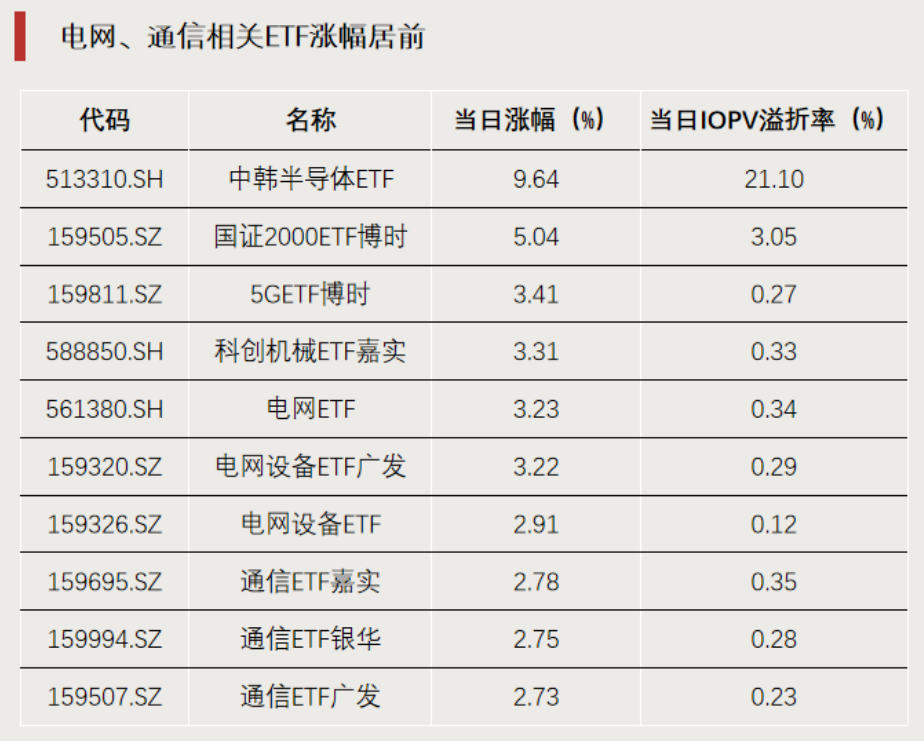
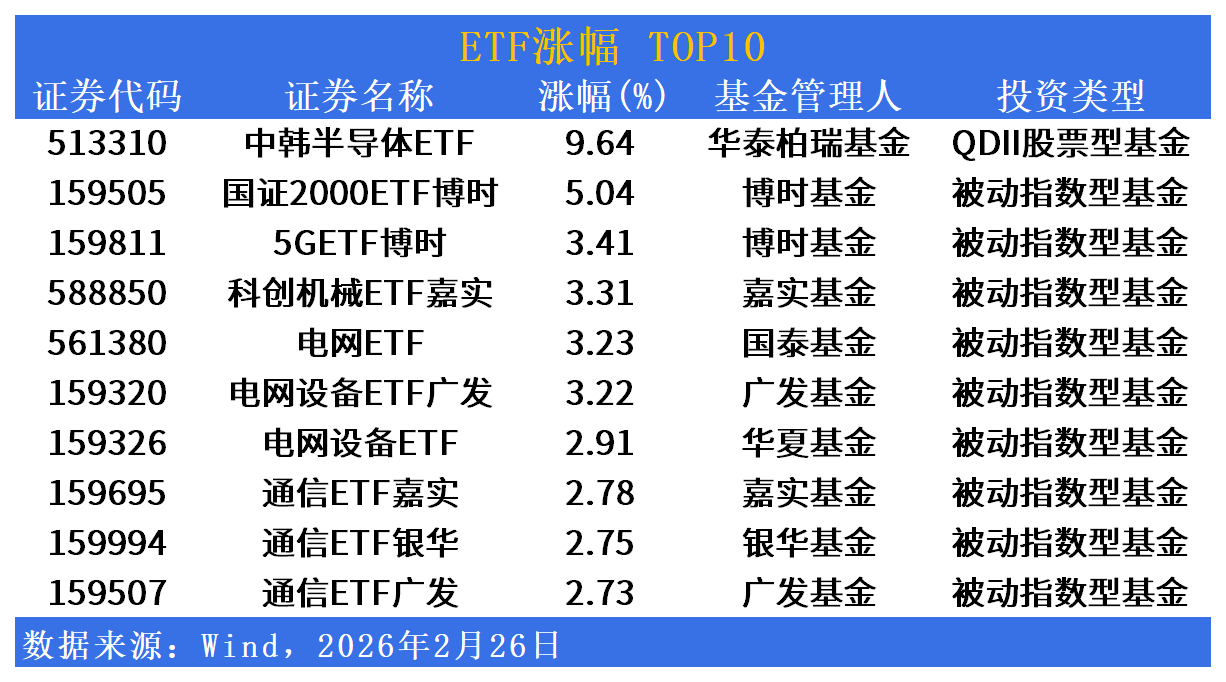
Market Overview - A-shares showed mixed performance with the Shanghai Composite Index down 0.01%, Shenzhen Component Index up 0.19%, and ChiNext Index down 0.29% as of market close [1] - Total trading volume in Shanghai, Shenzhen, and Beijing reached 25,568 billion, an increase of 756 billion from the previous day [1] ETF Performance - The China-Korea Semiconductor ETF surged by 9.64%, leading the market, driven by the recovery in the semiconductor supply chain [2] - The National 2000 ETF rose by 5.04%, indicating a rebound in small-cap growth stocks [2] - The Electric Grid sector performed well, with the Electric Grid ETF up 3.23% and the Electric Grid Equipment ETFs rising by 3.22% and 2.91% respectively [2] Communication Sector - The communication sector also saw gains, with ETFs in this category rising between 2.73% and 2.78% [3] Declining Sectors - The pharmaceutical sector faced a broad retreat, with the Hang Seng Biotechnology ETF showing the largest decline at -3.89% [4] - Other related ETFs in the healthcare and biotechnology sectors also experienced significant drops, indicating a market shift from defensive sectors to technology growth [4] Trading Activity - The Short-term Bond ETF had a trading volume exceeding 66 billion, leading in activity among ETFs [5] - The top traded ETFs included the Short-term Bond ETF at 661.12 billion and the Silver Day Benefit ETF at 167.16 billion [5] Turnover Rates - Cross-border products showed high trading activity, with the Brazil ETF and China-Korea Semiconductor ETF having turnover rates of 171.99% and 125.76% respectively [6][7] - The National Debt ETF also maintained a strong turnover rate of 88.09%, indicating active trading in interest rate bonds and cross-border assets [7] New ETF Launch - A new Technology Growth ETF by Industrial Bank is set to launch on February 27, with a focus on hard technology and a multi-factor strategy targeting the top 50 securities in various tech sectors [8]
56亿,加仓
3 6 Ke· 2026-02-25 09:42
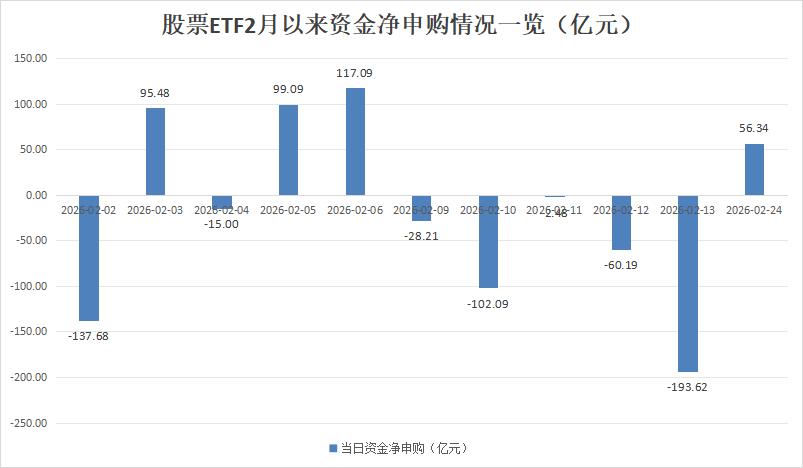
Group 1 - The stock ETF market experienced a significant net inflow of 56.34 billion yuan on February 24, reversing the trend of net outflows observed in the first five trading days of the year [1][2] - The A-share market opened higher and closed with the Shanghai Composite Index up by 0.87%, while the ChiNext Index saw a peak increase of over 2% [2] - The total scale of all stock ETFs reached 3.92 trillion yuan, with 1,339 stock ETFs in the market [2] Group 2 - The Hong Kong stock market ETFs led the net inflow, with 84.72 billion yuan, while broad-based ETFs saw a net outflow of 50.11 billion yuan [4] - ETFs tracking the Hang Seng Technology Index had the highest single-day net inflow of 46.59 billion yuan, while those tracking the CSI A500 Index faced a net outflow of 17.18 billion yuan [4] - Major fund companies like E Fund and Huaxia Fund reported significant net inflows in their ETFs, with E Fund's total ETF scale reaching 659.7 billion yuan [4][5] Group 3 - Specific ETFs such as the Hang Seng Technology Index ETF and the China Internet ETF saw net inflows of 16.53 billion yuan and 13.41 billion yuan, respectively [5][6] - The performance of the robotics and power grid equipment ETFs also attracted over 4 billion yuan in net inflows, indicating growing interest in these sectors [8] Group 4 - The market saw notable net outflows from broad-based ETFs, including the CSI 500 ETF and the media ETF, with the latter experiencing a net outflow of 4.46 billion yuan [9] - The short-term bond ETF faced the largest single-day net outflow of 11.54 billion yuan, reflecting a shift in investor sentiment towards riskier assets [9]