Alnylam

Search documents
Royalty Pharma Acquires Royalty Interest in Alnylam's AMVUTTRA for $310 Million from Blackstone Life Sciences
Globenewswire· 2025-11-04 12:15
Core Insights - Royalty Pharma has acquired a royalty interest in Alnylam's AMVUTTRA for $310 million from Blackstone Life Sciences, which is expected to enhance Royalty Pharma's portfolio significantly [1][3][4] - AMVUTTRA is an FDA-approved RNAi therapeutic for treating ATTR amyloidosis, a serious disease caused by misfolded proteins [2][3] - The acquisition includes a 1% royalty on worldwide net sales of AMVUTTRA, with sales projected to exceed $6 billion by 2028, following a strong sales performance of approximately $1 billion in 2024, representing a 74% year-over-year growth [3][4] Company Overview - Royalty Pharma is the largest buyer of biopharmaceutical royalties and funds innovation across the biopharmaceutical industry, collaborating with various entities from academic institutions to leading pharmaceutical companies [6] - The company has a diverse portfolio that includes royalties on over 35 commercial products, indicating a strong market presence [6] Market Context - AMVUTTRA addresses a growing market for ATTR-CM, with approximately 300,000 patients globally, of which only 20% are currently diagnosed, highlighting significant growth potential [3] - The transaction is expected to deliver returns consistent with Royalty Pharma's targets, despite potential competition from Alnylam's follow-on product, nucresiran [4]



Royalty Pharma Acquires Royalty Interest in Alnylam’s AMVUTTRA for $310 Million from Blackstone Life Sciences
Globenewswire· 2025-11-04 12:15
Core Insights - Royalty Pharma has acquired a royalty interest in Alnylam's AMVUTTRA for $310 million, which is expected to enhance its portfolio and capitalize on the growing market for ATTR amyloidosis treatments [1][3][4] Company Overview - Royalty Pharma is the largest buyer of biopharmaceutical royalties and funds innovation across the biopharmaceutical industry, collaborating with various entities from academic institutions to leading pharmaceutical companies [6] - The company has a diverse portfolio that includes royalties on over 35 commercial products, indicating a strong position in the market [6] Product Details - AMVUTTRA is an FDA-approved RNAi therapeutic for treating ATTR amyloidosis, a serious disease caused by misfolded proteins [2] - The product has shown significant commercial success, with sales reaching approximately $1 billion in 2024, representing a 74% year-over-year growth, and is projected to exceed $6 billion by 2028 [3] Transaction Specifics - The acquisition includes a 1% royalty on worldwide net sales of AMVUTTRA, with the royalty duration extending through March 2035 [4] - The transaction is expected to yield returns consistent with Royalty Pharma's targets for approved products, despite potential competition from Alnylam's follow-on product, nucresiran [4] Market Opportunity - There are approximately 30,000 hereditary ATTR amyloidosis with polyneuropathy (hATTR-PN) patients and over 300,000 ATTR cardiomyopathy (ATTR-CM) patients globally, with only 20% currently diagnosed, highlighting a significant market opportunity for AMVUTTRA [3]

透视瑞博生物赴港之旅:管线布局均衡丰富,具备“中国版Alnylam”稀缺特质
智通财经网· 2025-10-31 01:20
Core Insights - The article highlights the transformative potential of small nucleic acid drugs, moving from chronic medication to one-time treatments or long-term interventions, indicating a "blue ocean" market for these therapies [1] - The global small nucleic acid therapy market is projected to grow from $5.1 billion in 2024 to $18.6 billion by 2029, with a compound annual growth rate (CAGR) of 29.5%, and further to $49.4 billion by 2034, with a CAGR of 21.6% [1] - Suzhou Ribocure Biotechnology Co., Ltd. (Ribocure) is preparing for an IPO on the Hong Kong Stock Exchange, positioning itself as a key player in the small nucleic acid drug market [2] Company Overview - Ribocure, founded in 2007, is a major participant in the global small nucleic acid drug development space, particularly focusing on siRNA therapies [1][3] - The company has developed one of the largest siRNA drug pipelines globally, with seven self-developed drug assets currently in clinical trials targeting cardiovascular, metabolic, renal, and liver diseases, four of which are in Phase 2 trials [3][6] Product Pipeline - Ribocure's core product, RBD4059, is the world's first and fastest clinically developed siRNA drug for treating thrombotic diseases, which are a leading cause of death globally, claiming over 10 million lives annually [6] - RBD4059 selectively inhibits FXI to reduce thrombus formation risk without significantly increasing bleeding risk, offering a promising treatment option [6] - Other notable candidates include RBD5044 for hypertriglyceridemia and RBD7022 for hypercholesterolemia, both of which are in advanced clinical development stages [7] Market Positioning - Ribocure's product pipeline is well-balanced and focuses on major diseases with high market potential, including cardiovascular and metabolic disorders, which enhances its commercial prospects [7][8] - The company is building an integrated research, production, and sales capability to create a sustainable "innovation-profit" cycle, essential for long-term success in the biotech sector [8] Financial Performance - Ribocure's R&D expenditures from 2023 to mid-2025 are projected to total approximately 730 million yuan, reflecting its commitment to long-term innovation over short-term profits [8] - The company has successfully raised over 380 million yuan in recent financing rounds to support its clinical pipelines and technology development [9] - Revenue growth has been significant, with reported revenues of 440,000 yuan, 143 million yuan, and 103 million yuan from 2023 to mid-2025, alongside a notable reduction in losses [10] Strategic Collaborations - Ribocure has established strategic partnerships with several well-known pharmaceutical companies, enhancing its credibility and market valuation [9] - The company has received orphan drug designation for its product RBD1016, which is aimed at treating hepatitis D virus infections, facilitating its development and commercialization in the EU [9]
中信建投:小核酸药物产业实现多维突破 中国创新药企展现全球竞争力
智通财经网· 2025-10-30 23:48
Core Viewpoint - Small nucleic acid drugs are expected to become the third major category of drugs following small molecules and antibody drugs, driven by their ability to target traditionally undruggable targets and their long-lasting effects [1][2]. Group 1: Mechanism and Advantages - The mechanism of small nucleic acid drugs involves three main steps: endocytosis, endosomal escape, and gene silencing [2]. - Key factors for their effectiveness include receptor selection, optimization of delivery systems to enhance endosomal escape efficiency, and chemical modifications to improve stability [2]. - Compared to other drug types, small nucleic acid drugs offer advantages such as a rich target pool, strong specificity, and long-lasting effects [2]. Group 2: Industry Breakthroughs - The global small nucleic acid drug industry is achieving multi-dimensional breakthroughs, with drugs like Amvuttra and Leqvio showing significant potential, and Alnylam expected to achieve profitability this year [3]. - The years 2025-2026 are critical for validating new indications, with weight loss indications anticipated to reach proof of concept (POC) and CNS indications expected to begin exploration [3]. - Technological advancements include breakthroughs in extrahepatic delivery methods, with Avidity's AOC drug Del-zota showing promising efficacy and expected to be commercially available by 2026 [3]. Group 3: China's Competitive Edge - Chinese small nucleic acid drug companies are demonstrating global competitiveness, with an accelerated growth in research pipelines [4]. - Companies like Bosheng and Ruibo have established business development (BD) deals with multinational corporations (MNCs), highlighting China's competitive position [4]. - The focus of Chinese small nucleic acid drug pipelines has expanded from cardiovascular diseases and hepatitis B to include weight loss and CNS indications, with potential for first-in-class (FIC) and best-in-class (BIC) drugs [4].

BridgeBio(BBIO) - 2025 Q3 - Earnings Call Transcript
2025-10-29 21:32
Financial Data and Key Metrics Changes - Total revenues for Q3 2025 were $120.7 million, a significant increase from $2.7 million in the same period last year, primarily driven by $108.1 million in net product revenue from Atrobi [25][26]. - Total operating expenses increased to $259.3 million from $193.9 million year-over-year, with a notable rise in SG&A expenses by $68.8 million [26][27]. - The company ended Q3 with a strong cash position of $645.9 million, providing a solid cash runway for future operations [27]. Business Line Data and Key Metrics Changes - Atrobi generated $108.1 million in net product sales, with 5,259 unique patient prescriptions delivered to 1,355 unique healthcare providers [11][25]. - The company reported strong growth in the ATTR-CM market, with an increase in prescribing from both returning and new physicians [18][21]. Market Data and Key Metrics Changes - The ATTR-CM market continues to expand, with no signs of slowing down, contributing to a sustained growth runway for Atrobi [21]. - The company is seeing increased diagnosis rates for ATTR-CM, with expectations to reach closer to 250,000 diagnosed patients in the U.S. [39]. Company Strategy and Development Direction - The company aims for a market share of 30+% by volume in the coming years, focusing on the continued success of Atrobi and the upcoming launches of Encalirate and BBP-418 [6][11]. - The company is actively building infrastructure for global commercialization to ensure access to its therapies worldwide [24]. Management's Comments on Operating Environment and Future Outlook - Management expressed confidence in the ongoing success of Atrobi and the potential for strong market share growth, supported by positive clinical data from recent trials [6][11]. - The company is optimistic about the upcoming readouts for Infogratinib and the continued expansion of its pipeline [22][24]. Other Important Information - The company has a robust late-stage pipeline, with significant progress in R&D, including two recent positive phase 3 trial results [4][6]. - The company is focused on leveraging real-world evidence to support its market position and drive adoption of its therapies [16][78]. Q&A Session Summary Question: What is the percentage of new patient share for Atrobi? - Management estimates that the naive share is well in the 20s, with double-digit growth in overall prescriptions quarter-on-quarter [30][31]. Question: Can you elaborate on ATTR-CM diagnosis rates? - There has been robust growth in diagnosis rates, with ongoing education and excitement in the medical community about ATTR cardiomyopathy [39]. Question: Thoughts on Pfizer's 28-day free trial program? - Management views it positively as it encourages competition and emphasizes the importance of access for patients [44][46]. Question: How does the ex-US opportunity compare to the US market? - The ex-US opportunity is promising, with Bayer successfully commercializing in Europe, although pricing dynamics differ [50][52]. Question: Will there be a head-to-head study against Tafamidis? - Management believes that real-world evidence will be more impactful than a costly head-to-head study, as they already demonstrate superior efficacy [72][78]. Question: What differentiates Infogratinib in achondroplasia? - Infogratinib is expected to be more efficacious, safer, and more convenient due to its oral administration, addressing unmet needs in the market [83][86].

基因编辑疗法又一安全危机
3 6 Ke· 2025-10-28 23:29
Core Viewpoint - The gene editing sector experienced a significant setback following a severe liver injury incident in a patient treated with Intellia Therapeutics' NEX-z therapy, leading to a 42.23% drop in the company's stock price and a nearly 50% loss in market capitalization [1][2]. Group 1: Incident Details - A patient with a rare heart disease undergoing NEX-z treatment reported severe liver damage, prompting the suspension of two Phase III clinical trials [1][3]. - This incident marks the second occurrence of Grade 4 liver toxicity related to NEX-z this year, raising concerns about the safety of gene editing therapies [1][4]. - The first incident in May was asymptomatic and self-resolving, contrasting sharply with the current case, which required hospitalization [1][3]. Group 2: Market Impact - The safety concerns surrounding NEX-z have negatively affected the entire gene editing sector, causing stock declines in other companies such as Beam Therapeutics and Prime Medicine [1][4]. - Analysts had previously viewed the risk/reward balance of NEX-z favorably, but the recent events have led to increased scrutiny and skepticism regarding its safety profile [3][4]. Group 3: Market Potential and Competition - The market for ATTR-CM, the condition treated by NEX-z, is projected to exceed $11.2 billion by 2030, indicating significant commercial potential [2]. - Other treatments for ATTR-CM, such as Alnylam's Amvuttra, have shown strong sales growth, highlighting the competitive landscape and the urgency for Intellia to address safety concerns [8][9]. Group 4: Future Considerations - Intellia is collaborating with liver disease experts and regulatory bodies to investigate the recent adverse event and explore potential risk management strategies [6][7]. - The company faces financial pressure, with cash flow projected to last until 2027, making the resolution of these safety issues critical for its future [7][8].
一文简览之基因编辑
青侨阳光投资交流· 2025-10-15 08:19
Core Viewpoint - The article emphasizes the significance of gene editing technology as a revolutionary approach to curing genetic diseases, highlighting its potential to provide permanent solutions by directly correcting DNA sequences, unlike traditional therapies that only manage symptoms [3][4][5]. Group 1: Gene Editing Technology Overview - Gene editing is categorized into three generations: ZFN, TALEN, and CRISPR/Cas, with CRISPR/Cas representing a significant leap in efficiency and effectiveness [16][15]. - The CRISPR/Cas system utilizes RNA for target recognition, which simplifies the design and delivery process compared to previous methods [12][13]. - The article discusses the challenges of gene editing, particularly in identifying target sequences within vast genomic data, which has historically limited the technology's development [8][9]. Group 2: Current Market Landscape - The focus of investment in the biotech sector is shifting towards companies that leverage disruptive gene editing technologies, particularly those with proven products at the forefront of the market [5][18]. - Companies like CRISPR Therapeutics and Intellia are highlighted for their advancements in gene editing therapies, with CRISPR's products showing promising early commercial success [20][21]. - The article notes that the delivery of gene editing tools, especially to liver cells, has become more refined, with LNP (lipid nanoparticles) being a key method for effective delivery [21][23]. Group 3: Future Directions and Innovations - The emergence of base editing (BE) and prime editing (PE) technologies represents the next frontier in gene editing, offering more precise editing capabilities with reduced risks of off-target effects [31][36]. - Prime editing, in particular, is noted for its ability to perform complex edits without causing double-strand breaks, thus minimizing unintended genetic alterations [41][42]. - The article concludes with a forward-looking perspective on the potential for gene editing technologies to transform the biopharmaceutical industry, driven by ongoing innovations and the quest for effective treatments [45][46].

小核酸药物:从罕见病到常见病,治疗范式革命前夜
Haitong Securities International· 2025-10-13 15:00
Investment Rating - The report suggests a positive outlook for the oligonucleotide drug industry, indicating that it is on the verge of a therapeutic paradigm revolution, particularly in the treatment of common diseases [3]. Core Insights - The oligonucleotide drug market is approaching a critical point of explosion, with significant advancements in delivery technologies and therapeutic targets [3]. - The report highlights the potential for multiple innovative treatment paradigms for common liver diseases over the next five years, focusing on lipid-lowering, blood pressure reduction, and hepatitis B [3]. - The report emphasizes the importance of differentiated delivery technologies and the potential for business development (BD) opportunities in the industry [3]. Summary by Sections Industry Overview - The report revisits the previous assessment from January 2021, which predicted that oligonucleotide drugs would become the third major class of therapeutics after small molecules and monoclonal antibodies [3]. - It notes that the market has seen a significant increase in the number of approved siRNA/ASO drugs since 2022, addressing unmet medical needs [4]. Market Dynamics - The report identifies key players in the industry, including Alnylam, Arrowhead, and Ionis, and discusses their market capitalization changes from 2021 to 2025, highlighting Alnylam's significant growth due to successful drug launches [7]. - It mentions that the market for oligonucleotide drugs is expanding into common diseases, with Alnylam's drugs like Amvuttra and Inclisiran showing strong sales potential [20]. Technological Advancements - The report discusses advancements in delivery technologies, particularly the GalNAc conjugation platform, which has significantly improved the efficacy and safety of oligonucleotide drugs [41][42]. - It highlights the ongoing research into dual-target oligonucleotide drugs, which may become a new trend in the industry [36]. Competitive Landscape - The report outlines the competitive landscape, noting that multinational corporations (MNCs) are actively acquiring clinical-stage FIC drugs and exploring collaborations with biotech firms [3]. - It emphasizes the need for targeted delivery systems for different organs, indicating that the advancement and differentiation of delivery platforms will be crucial for the future success of oligonucleotide drug companies [26][27].



siRNA 药物行业深度报告:小核酸,大时代,靶向治疗新纪元
GUOTAI HAITONG SECURITIES· 2025-10-10 11:23
Investment Rating - The report rates the industry as "Overweight" [4] Core Insights - The siRNA drug industry is entering a new era with the maturation of technology platforms and the expansion of indications, focusing on the commercial value of siRNA drugs for common diseases [2][3] - siRNA drugs have transitioned from rare diseases to common diseases, showcasing strong target expansion capabilities, robust research and development extensibility, long-lasting effects, and low resistance [4][12] - The industry is witnessing a surge in business development (BD) transactions, particularly among multinational corporations (MNCs), indicating a vibrant market for siRNA technology [4][31] Summary by Sections 1. Dawn of a New Era for Small Nucleic Acid Drugs - Small nucleic acid drugs, including siRNA and ASO, are becoming a significant path for drug development, with a focus on their ability to regulate protein production [7] - The global approval of small nucleic acid drugs has reached 23, with siRNA drugs leading the way in rare disease applications [12][13] - Alnylam and other leading companies have demonstrated significant market capitalization differences due to their innovative drug development technologies [14][16] 2. Platform Characteristics and Focus on Indications - The siRNA drug industry is characterized by high barriers in modification and delivery, with a focus on breakthroughs in extrahepatic delivery systems [6][29] - The commercialization of siRNA drugs is accelerating, with multiple common diseases nearing market readiness [6][29] - The GalNAc delivery system has become the mainstream strategy for liver-targeted siRNA delivery, while breakthroughs in extrahepatic delivery are still needed [6][29] 3. Related Companies - Listed companies in the siRNA space include Yuyuan Pharmaceutical, Hengrui Medicine, and others, while unlisted companies include Bewang Pharmaceutical and others [4][12]

千亿市场潜力、有望成为第三大药物类型的小核酸药物 迎高速爆发期丨黄金眼
Quan Jing Wang· 2025-10-09 03:08
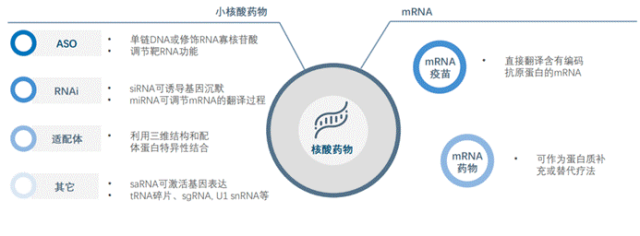
Core Insights - Small nucleic acid drugs are emerging as a potential third major class of therapeutics, alongside small molecules and antibody drugs, due to their unique advantages in development speed, efficacy, and safety [6][12]. Group 1: Overview of Small Nucleic Acid Drugs - Small nucleic acid drugs, including antisense oligonucleotides (ASO), small interfering RNA (siRNA), and microRNA (miRNA), are short-chain nucleic acids designed to intervene in gene expression for disease treatment [1][3]. - The development of small nucleic acid drugs has evolved since the 1970s, with significant breakthroughs occurring after 2014, leading to the successful market entry of several key products [3][4]. Group 2: Advantages of Small Nucleic Acid Drugs - Compared to traditional small molecule and antibody drugs, small nucleic acid drugs have shorter development cycles, lasting effects, higher success rates, and a lower likelihood of developing drug resistance [4][5]. - The success rate of small nucleic acid drugs from Phase I to Phase III trials is approximately 59.2%, which is five times higher than that of targeted drugs and overall pharmaceuticals [5]. Group 3: Market Progress and Investment Opportunities - The global small nucleic acid drug market is projected to grow from $2.7 billion in 2019 to $4.6 billion in 2023, with a compound annual growth rate (CAGR) of 14.3%, and is expected to reach $46.7 billion by 2033 [12]. - Several small nucleic acid drugs have been approved, with notable sales forecasts for 2024, including Nusinersen at $1.6 billion, Vutrisiran at $970 million (up 73% year-over-year), and Inclisiran at $750 million (up 112% year-over-year) [7][12]. Group 4: Pipeline and Regulatory Landscape - As of mid-2025, there are 22 approved small nucleic acid drugs globally, with the majority targeting genetic rare diseases [10]. - The Chinese market for RNA interference (RNAi) therapies is expected to grow significantly, with projections indicating a rise from approximately $4 million in 2022 to over $300 million by 2025 [14]. Group 5: Key Companies and Developments - Companies such as Yuyuan Pharmaceutical and Chengdu XianDao are actively involved in the development of small nucleic acid drugs, with multiple candidates in various clinical stages [18][20]. - Major multinational corporations (MNCs) are investing heavily in the small nucleic acid space, with significant collaborations and partnerships emerging in the industry [15][14].