Anysphere

Search documents
观察| AI创业,下一个机会在哪?
未可知人工智能研究院· 2025-11-14 03:02
Core Insights - The article discusses the current state of the AI industry, highlighting areas dominated by major players and identifying potential opportunities for new entrants in less competitive fields [2][16]. Group 1: Established "Dead Zones" - Three key areas are identified as having no entry points for new players: foundational models, AI-assisted programming, and customer support [3]. - In foundational models, six major companies dominate: Google, Anthropic, OpenAI, xAI, Meta, and Mistral, creating a significant barrier to entry due to high costs and established ecosystems [4]. - The AI programming sector is led by Anthropic's Claude Code and OpenAI's Codex, which together control over 60% of the market, making it difficult for smaller players to compete [5]. - The customer support AI market is characterized by a mix of professional and large-scale players, with established companies like Salesforce and HubSpot offering AI modules for free, further squeezing independent AI firms [6]. Group 2: Emerging "Hope Zones" - Four areas are identified as having potential for growth: financial technology, accounting, AI security, and physical intelligence [7]. - In financial technology, opportunities exist in anti-fraud systems and credit modeling for small and medium enterprises, leveraging alternative data sources [9][10]. - The accounting sector is undergoing a transformation, with a need for comprehensive AI solutions that can handle complex tasks, presenting opportunities for specialized firms [11][12]. - AI security is becoming increasingly critical, with a projected loss of over $50 billion in 2024 due to AI vulnerabilities, creating demand for proactive solutions [13]. - Physical intelligence, which integrates AI with real-world applications, is seen as a new frontier, with potential in robotics and drug development [14][15]. Conclusion - The article emphasizes the importance of finding niches within the AI landscape where smaller companies can thrive, rather than attempting to compete directly with established giants [16].


Cursor完成23亿美元D轮融资,投后估值293亿美元
Sou Hu Cai Jing· 2025-11-14 00:27
Core Insights - Cursor, a programming tool developed by Anysphere, has completed a Series D funding round of $2.3 billion, bringing its post-money valuation to $29.3 billion [1] - The funding round was led by new investor Coatue Management and existing investor Accel, with participation from Nvidia and Alphabet's Google [1] - This marks the third funding round for Anysphere in the past year, having raised over $3.305 billion in total [1] Funding Details - The Series D funding round raised $2.3 billion, increasing Anysphere's valuation to approximately ¥207.91 billion [1] - Prior to this, Cursor raised $105 million in a Series B round in December 2024, with a post-money valuation of $2.6 billion [1] - In the following six months, Cursor secured $900 million in a Series C round, raising its valuation to $9.9 billion [1] Company Focus - Cursor specializes in developing tools for autonomous code generation and completion [1] - The latest funding will be allocated towards research and development efforts [1]
全球首家,AI编程创企估值破2000亿,英伟达和谷歌抢投
3 6 Ke· 2025-11-14 00:11
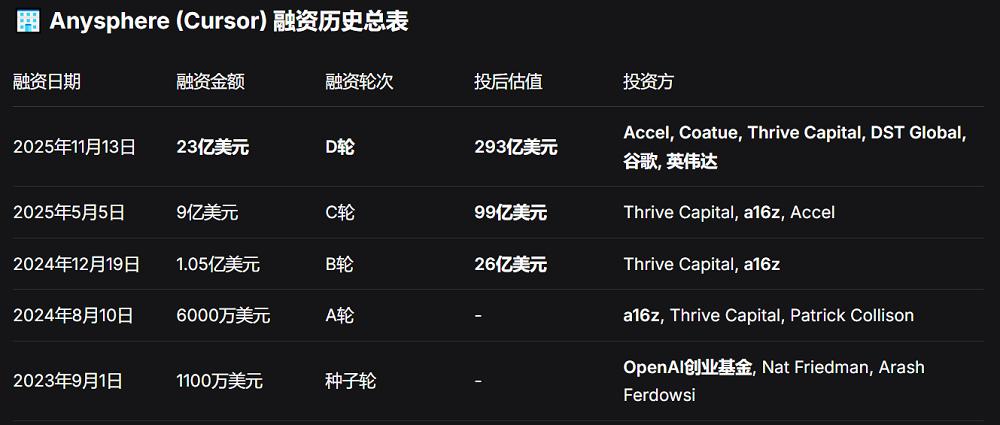
Core Insights - Anysphere's AI programming tool Cursor has completed a significant Series D funding round of $2.3 billion, achieving a post-money valuation of $29.3 billion, making it the first AI programming startup to surpass a valuation of 200 billion RMB [1][2] - The funding round included prominent investors such as Nvidia, Google, and top-tier fund Coatue, alongside existing investors like Accel, Thrive, a16z, and DST Global [1][2] - Over the past year, Anysphere has raised more than $3.3 billion, with its valuation increasing by approximately 1026% [1][2] Funding History - The funding history of Anysphere includes: - Series D: $2.3 billion on November 13, 2025, with a post-money valuation of $29.3 billion [2] - Series C: $900 million on May 5, 2025, with a post-money valuation of $9.9 billion [2] - Series B: $105 million on December 19, 2024, with a post-money valuation of $2.6 billion [2] - Series A: $60 million on August 10, 2024 [2] - Seed Round: $11 million on September 1, 2023 [2] Business Performance - Cursor's annual revenue has surpassed $1 billion, with millions of developers and many successful engineering organizations as clients [3] - The company has a team of over 300 engineers, researchers, designers, and operators, with plans for further expansion [3] Product Development - Cursor launched its first self-developed programming model, Composer, in late October, claiming it generates more code than any other large model globally [3][4] - The new funding will enable Cursor to invest further in research and development, aiming to enhance its self-developed models [4] Industry Context - The AI programming sector is witnessing a surge in companies developing their own models, including international players like Windsurf and Cognition, as well as domestic firms such as Alibaba's Qoder and ByteDance's Trae [4] - The unique advantage of these tools lies in their access to vast amounts of real user code and behavior data, which can be used to continuously optimize model performance [4]

这一年做 Agent 的公司,Coding 赚了钱,客服融了钱,你呢?
Founder Park· 2025-11-04 14:52
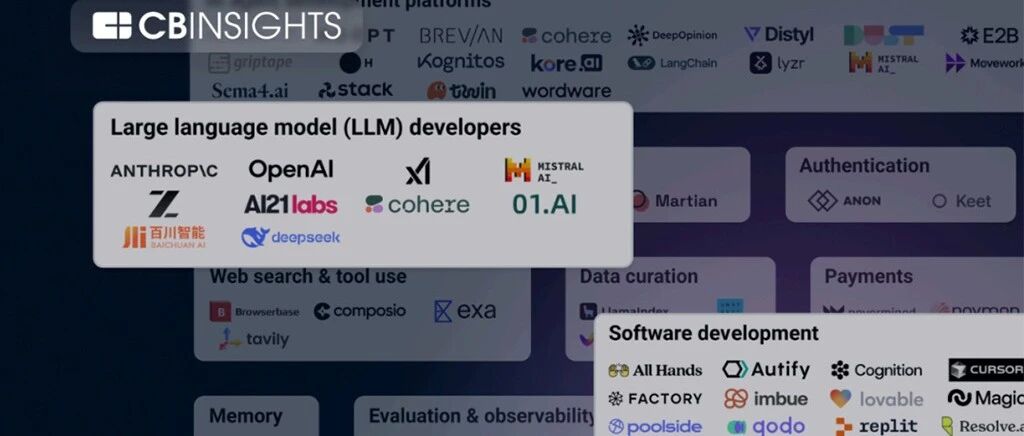
Core Insights - 2025 is expected to be the year of AI Agents, with nearly all AI products incorporating Agent functionalities [1] - The report by CB Insights titled "AI Agent Bible" provides a comprehensive overview of the Agent industry, highlighting over 170 promising AI Agent startups across 26 sub-sectors [2][3] Group 1: Key Observations - The report identifies several trends, including the rise of voice as the primary interaction method with AI, significant acquisition activity in the Agent space, and the increasing importance of payment infrastructure for Agent shopping [5][7][10] - High costs associated with AI reasoning are compressing profit margins, leading to a shift towards task-based pricing models [12][13][40] - The competition in the AI Agent market is intensifying, with a notable focus on general-purpose tools and specific applications in customer service and software development [18][22] Group 2: Market Dynamics - The report indicates that coding-related Agents are the most profitable, with an average revenue per employee of $1.4 million, while customer service Agents have a high valuation multiple of 219 times revenue [27][22] - The financial services and insurance sectors are particularly crowded, with a focus on specific workflows such as financial research and wealth management [23] - The report predicts that the next wave of vertical AI Agents will not only support operations but may also take on autonomous research functions [61] Group 3: Investment and Growth - In 2024, AI Agent startups attracted $3.8 billion in funding, nearly three times the total for 2023, indicating strong investor interest [45] - The report highlights the emergence of payment and voice AI as critical areas for future development, with significant investments and acquisitions occurring in these sectors [52][53] - Y Combinator's recent cohort shows a strong focus on Agentic AI solutions, with over half of the selected companies working on Agent technologies [55][59]
AI独角兽的商业化元年:新一代创业组织的崛起
3 6 Ke· 2025-10-29 12:10
Core Insights - As of 2025, the focus of AI venture capital is shifting from technology speculation to commercial viability, with AI unicorns demonstrating sustainable revenue models [2] - The emergence of AI Agents and "AI-native" unicorn business models is paving the way for new enterprise forms and entrepreneurial approaches [2] Investment Trends - The financing scale of global AI startups is experiencing exponential growth, with over half (57%) of the 54 companies valued at over $1 billion in 2025 being AI companies [3] - In the first half of 2025, AI industry financing exceeded the total for the entire year of 2024 [6] - Early AI investments focused on "AI + industry" empowerment, but by 2024, the investment logic shifted to pursuing new value that only AI can create [6] Unicorn Emergence - The rise of super unicorns is a direct reflection of concentrated AI investment, with four of the top ten global unicorns being AI companies [8] - These companies, such as OpenAI and Anthropic, are valued based on their mastery of computing power, algorithms, and models, indicating high market expectations for AGI potential [8] Revenue Growth - Currently, around 15 AI companies have an Annual Recurring Revenue (ARR) exceeding $100 million, with three surpassing $1 billion: OpenAI ($10 billion), Anthropic ($4 billion), and ScaleAI ($1.5 billion) [9] AI Agent Development - The AI industry is expanding its venture capital focus to platform and application layers, particularly AI Agents, which are creating disruptive products and experiences [10] - The number of companies in the AI Agent space has grown from about 300 to thousands within a year, integrating into various industry workflows [11] Business Model Evolution - AI services are transitioning from early software subscriptions to results-oriented payment models, allowing for better service to clients of varying sizes and needs [13] - AI Agents capable of executing high-value tasks will charge based on the quality of delivered results rather than usage time or user count [13] Market Dynamics - AI Agent startups raised $3.8 billion in 2024, nearly tripling the total from 2023, with major tech companies leading the development of general AI Agents [14] - Specialized startups are also finding opportunities by addressing specific technical challenges and pushing the boundaries of agent capabilities [14] Industry Applications - AI Agents are increasingly taking over repetitive tasks across various sectors, from invoicing to customer service, enhancing operational efficiency [16] - The software development sector is seeing significant advancements, with AI Agents evolving from code assistance to full-cycle software development [16] Future Outlook - The development of AI Agents is expected to lead to more autonomous systems that support dynamic decision-making, significantly lowering the capital requirements for startups [18] - The rise of AI Agents and digital employees is anticipated to democratize entrepreneurship, shifting the focus from technical backgrounds to problem-solving capabilities [19]


速递|ARR破5亿美元速度超Cursor,AI专家平台Mercor估值冲上100亿美元,融资3.5亿美元
Z Potentials· 2025-10-29 05:16
Core Insights - Mercor has successfully completed a $350 million financing round, raising its valuation to $10 billion [1] - The company initially started as an AI-driven recruitment platform but has pivoted to providing domain experts for AI model training [1][2] - Mercor's annual recurring revenue is projected to exceed $500 million, outpacing competitors [2] Financing and Valuation - Felicis Ventures led the previous $100 million Series B round at a $2 billion valuation and continues to lead the current round [1] - The company had previously set a target of $8 billion for its Series C round but has since increased it to $10 billion due to strong investor interest [1] Business Model and Operations - Mercor charges for talent recommendation and matching services based on hourly work from domain experts [1] - The company currently pays contractors over $1.5 million daily and has a talent pool of over 30,000 experts, with an average hourly income exceeding $85 [4] - The focus areas for Mercor include expanding its talent network, optimizing contractor-client matching systems, and developing new products for greater process automation [4] Market Context - The shift in partnerships among leading AI labs, such as OpenAI and Google DeepMind, has created opportunities for Mercor, especially after Scale AI lost significant contracts [2] - The rapid development of AI technology poses challenges in understanding the economic value of work, which Mercor aims to address [2]

明星AI编码助手涨价10倍惹怒开发者!CEO 回应:有人花千元薅了我们10多万,不挣钱不可持续
AI前线· 2025-10-19 05:33
Core Viewpoint - Augment Code has changed its pricing model from a message-based system to a usage-based system, leading to significant cost increases for users, with some reporting over a 10-fold increase in expenses [2][10][21]. Pricing Model Changes - The initial pricing model was based on the number of messages sent, with tiers allowing different message limits for free and paid users. The new model is based on a points system, where users receive a certain number of points to use for AI interactions [3][4][5]. - The previous pricing structure included a free version, a $50 developer version, a $100 professional version, and a $250 max version, which have now been replaced with a simpler model offering a $20 indie version and a $60 standard version [3][7]. User Reactions - Users have expressed dissatisfaction with the new pricing, feeling that they are being excluded after helping to optimize the system during its early stages. Some users have calculated their costs under the new model and found them to be prohibitively high [10][11][14]. - Complaints have arisen regarding the fairness of the new pricing model, as it does not accurately reflect the varying complexities of different AI tasks, leading to perceived inequities among users [15][16]. Industry Context - The CEO of Augment Code stated that the previous message-based pricing model was unsustainable and that usage-based pricing is becoming an industry standard, citing competitors like Zed and Replit [15][16]. - The shift in pricing reflects broader challenges in the AI coding assistant market, where companies face high operational costs and pressure to provide advanced AI capabilities while maintaining profitability [22][24][26]. Competitive Landscape - Augment Code claims a win rate of over 80% in the market, focusing on enterprise-level software engineers rather than casual developers. The company aims to differentiate itself through its context engine, which is designed to handle complex codebases [19][20]. - The competitive environment is intense, with many startups in the AI coding space struggling with profitability due to high costs associated with using large language models [22][24][26].

明星AI编码助手涨价10倍惹怒开发者!CEO 回应:有人花千元薅了我们10多万,不挣钱不可持续
Sou Hu Cai Jing· 2025-10-17 06:50
Core Insights - Augment Code has changed its pricing model from a message-based system to a usage-based system, leading to cost increases of over 10 times for some users [1][9][11] - The company claims the previous pricing model was unsustainable and does not accurately reflect the operational costs associated with AI usage [3][11] - The new pricing structure includes a points-based system where users receive credits based on their usage, with different tiers for individual and enterprise users [3][5][12] Pricing Changes - The initial pricing model allowed free users to send 50 messages per month, with paid tiers offering 600, 1500, and 4500 messages for $50, $100, and $250 respectively [1][7] - The new model offers a monthly fee of $20 for an indie version with 125 messages, and $60 for a standard version with unlimited chat and code completion [2][3][5] - Users have reported significant cost increases under the new model, with one user noting a conversion of 31 messages to 40,982 points, indicating a cost increase of over 10 times [9][12] User Reactions - Some users have expressed dissatisfaction with the new pricing, comparing it unfavorably to other tools and suggesting it may drive them away from the platform [2][10] - Concerns have been raised that the company may not have a substantial enterprise user base, as many organizations are hesitant to adopt such AI coding tools [10][12] - The CEO defended the pricing changes by stating that usage-based billing is becoming an industry standard and that the previous model was unfair and lacked transparency [11][12] Competitive Landscape - The AI coding assistant market is highly competitive, with companies like Zed, Replit, and Cursor also adjusting their pricing models [11][12] - Augment Code claims a win rate of over 80% in the market, focusing on enterprise-level software engineers rather than casual developers [13][14] - The industry faces challenges related to high operational costs associated with AI processing, which may impact profitability across various coding assistant startups [16][17]

“AI盛世”还是“AI泡沫”?10家AI独角兽,估值1年增长1万亿,VC一年投入超2000亿美元,利润为0
Hua Er Jie Jian Wen· 2025-10-16 12:39
Core Insights - The surge in AI investments has led to a dramatic increase in valuations of unprofitable AI startups, totaling nearly $1 trillion in the past year, marking the fastest wealth expansion in history [1] - U.S. venture capital (VC) investments in AI are projected to exceed $200 billion this year, significantly surpassing previous tech bubbles, indicating a strong market focus on AI [2] - The current investment climate is characterized by a "winner-takes-all" mentality, with expectations that only a few companies will dominate the market, reminiscent of the internet era [3] Investment Trends - The AI sector has attracted over $200 billion in VC funding this year, which is more than the $135 billion invested during the SaaS bubble in 2021 [2] - AI companies are experiencing inflated valuations, with some startups valued at 100 times their annual revenue, driven by a fear of missing out (FOMO) among investors [2] - The expectation is that while a significant amount of AI investment may be wasted, the technology could ultimately create tenfold value [3] Market Dynamics - The valuations of private AI companies are beginning to impact public markets, with major tech firms like AMD and NVIDIA seeing substantial market cap increases due to their associations with AI startups [3] - The competition among AI companies, particularly between OpenAI and tech giants like Microsoft and Google, is intensifying, leading to high operational costs and uncertain profitability timelines [4] - The current capital frenzy in AI resembles previous market bubbles, with valuations detached from actual earnings, raising concerns about the sustainability of this growth [5]


23岁,她融资5000万
3 6 Ke· 2025-10-15 09:40
Core Insights - The article highlights the entrepreneurial venture of Phoebe Gates, the youngest daughter of Bill Gates, who co-founded an AI shopping platform named Phia after graduating from Stanford University [1][5][6] - Phia aims to simplify the shopping experience by providing a one-click price comparison for consumers, leveraging AI technology [1][6] Company Overview - Phia has successfully completed a seed funding round, raising $8 million, with a post-money valuation of $32 million [3][8] - The funding round was led by KPCB, with participation from notable figures such as Kris Jenner, Sara Blakely, Michael Rubin, and Sheryl Sandberg [3][8] - The company has established partnerships with over 150 well-known e-commerce platforms, generating revenue through commissions on sales [6][8] Product Development - The initial product was a desktop extension for comparing second-hand goods, but the focus shifted to mobile development due to higher engagement on mobile devices [5][6] - The Phia app, launched in April, quickly gained traction, reaching the top 30 in the App Store shopping category within two days and accumulating over 500,000 users [6][8] Market Position and Future Plans - Phia's founders aim to position the platform as a leader in personalized shopping, with plans to enhance features like scheduling and personalized recommendations [8] - The next funding round is anticipated in Q3 2026, targeting $25-30 million to support international expansion and generative AI capabilities [8] Industry Trends - The article notes a growing trend of Gen Z entrepreneurs entering the startup scene, with several successful ventures emerging from this demographic [4][10] - Investment firms are increasingly focusing on young founders, recognizing their adaptability and innovative potential in the rapidly evolving AI landscape [11][12]