
OceanBase

Search documents
中国科技:弃内卷,出海去
3 6 Ke· 2025-10-23 08:33
Group 1 - The core viewpoint of the article highlights a significant shift in the growth focus of China's technology industry towards overseas markets due to intense domestic competition and market saturation [1][3][4] - The domestic market has transitioned from "incremental competition" to "stock competition," with companies facing resource depletion and rising costs in both ToB and ToC sectors [3][5] - The Chinese software market holds only 2%-3% of the global share, indicating a fragmented domestic market that limits growth potential [5][6] Group 2 - The article discusses the "double squeeze" faced by the Chinese technology market, characterized by a visible market ceiling and hidden internal competition, leading to a consensus that domestic growth is stalling [4][5] - The competition has devolved from "differentiated innovation" to "low-cost replication," particularly evident in the AI hardware and new energy vehicle sectors [6][9] - The article emphasizes the need for Chinese technology companies to adopt a systematic approach to overseas expansion, moving from "strategic alternatives" to "survival necessities" [3][8] Group 3 - Various sectors, including new energy vehicles and AI hardware, are exploring differentiated paths for overseas expansion, focusing on "global technology, local operations, and cultural empathy" [8][9] - Successful examples include Xiaopeng Motors collaborating with Volkswagen to develop standardized electric platforms, enhancing brand premium in Europe by 40% [9] - The article highlights the importance of localizing products and services to meet specific market needs, as demonstrated by companies like Keda Xunfei and Lenovo [15][24] Group 4 - The article outlines strategies for Chinese companies to navigate the complexities of the US-China trade war, including supply chain diversification and compliance with international regulations [25][26][27] - Companies are increasingly focusing on building a global compliance framework to mitigate risks associated with international operations [27][28] - The article predicts that overseas markets will become the primary battleground for Chinese technology companies, necessitating a shift from product competition to ecosystem competition [29][30] Group 5 - Emerging markets are expected to drive growth for Chinese technology companies, with significant opportunities in Southeast Asia, the Middle East, and Latin America [30][31] - The article stresses the importance of establishing international standards and building ecosystems to enhance competitiveness in global markets [31][32] - Companies must prioritize deep localization and global compliance to ensure survival and success in overseas markets [33][34]







全面拥抱全球化!OceanBase CEO,最新发声!
券商中国· 2025-10-22 05:30
Core Viewpoint - A group of Chinese companies with core technologies in cloud computing and distributed databases is beginning to seek a more significant role in international markets [1]. Group 1: OceanBase's Globalization Strategy - On October 22, Ant Group's domestic database company OceanBase announced an accelerated globalization strategy, launching the "GO GLOBAL GO Program" [2]. - CEO Yang Bing emphasized that globalization is a necessary path for OceanBase, stating that the company will continue to deepen its presence in the Chinese market while expanding overseas [3]. - OceanBase has already established a presence in key overseas markets, including Hong Kong, Macau, and Southeast Asia, and plans to enter the technologically advanced Japanese market by September 2025 [3]. Group 2: Challenges and Responses in Global Expansion - Yang Bing acknowledged the challenges of going global, including language and cultural differences, and the need to adapt quickly to new business environments [4]. - The challenges for technology companies in international markets include technical adaptability, market competition, and cultural and talent management [4]. - The "GO GLOBAL GO Program" includes organizational support and welfare guarantees to address employees' concerns about cultural adaptation, language communication, career development, and living costs [4]. Group 3: Broader Context of Chinese Technology Going Global - The global digitalization wave presents a vast market space for databases as a core component of IT infrastructure [5]. - OceanBase's accelerated globalization reflects a broader trend of Chinese technology companies, such as Alibaba Cloud, Tencent Cloud, and Huawei Cloud, expanding into international markets through local data centers and services [6]. - Unlike traditional manufacturing, technology exports carry higher added value and influence, potentially granting Chinese companies greater voice in global technology governance [6]. - The competition in the global technology market is fundamentally about ecosystems, requiring Chinese companies to navigate strong international competitors and complex geopolitical environments [6].

OceanBase CEO杨冰全员信:加速全球化布局,组建先锋团队
Sou Hu Cai Jing· 2025-10-22 05:25
Core Viewpoint - OceanBase is accelerating its globalization strategy with the launch of the "GO GLOBAL GO Program," aiming to become a global leader in database technology and represent advanced Chinese productivity [1][3][4]. Group 1: Globalization Strategy - The "GO GLOBAL GO Program" will select internal talent to form a pioneering team for global expansion, covering products, services, sales, and marketing [1][4]. - OceanBase has already established a presence in key markets such as Hong Kong, Macau, and Southeast Asia, and plans to enter the highly technical Japanese market by September 2025 [3][4]. - The company is currently in deep discussions with over 70 overseas clients, with 40 already signed and paying, spanning sectors like fintech, banking, and the broader internet [3][4]. Group 2: Employee Support and Development - The company will provide comprehensive support for employees going abroad, addressing concerns related to cultural adaptation, language communication, career development, and living costs [1][5]. - The initiative aims to create a win-win ecosystem for both the company and its employees, encouraging participation in the global expansion effort [4][5]. - Employees are invited to join the global pioneering team, with the company emphasizing the importance of understanding diverse market needs to build a sustainable technology ecosystem [3][4].
OceanBase CEO杨冰发布全员信:全面拥抱全球化
Xin Lang Ke Ji· 2025-10-22 04:03
Core Viewpoint - OceanBase is accelerating its globalization strategy with the launch of the "GO GLOBAL GO Program," aiming to become a global leader in database technology and represent advanced Chinese productivity [1][3][4]. Group 1: Globalization Strategy - The "GO GLOBAL GO Program" will select internal talent to form a pioneering team for global market expansion, focusing on product, service, sales, and marketing [1][4]. - OceanBase has already established a presence in key overseas markets, including Hong Kong, Macau, and Southeast Asia, and plans to enter the highly technical Japanese market by September 2025 [1][3]. - The company is currently in deep discussions with over 70 overseas clients, with 40 already signed and paying, spanning sectors such as fintech, banking, and the broader internet [1][3]. Group 2: Employee Engagement and Support - The company emphasizes the importance of understanding diverse market needs to build a sustainable technology ecosystem, encouraging employees to participate actively in the globalization efforts [2][4]. - OceanBase will provide comprehensive support for employees going abroad, addressing concerns related to cultural adaptation, language communication, career development, and living costs [1][5]. - The initiative is framed as not just a talent export plan but a strategic expedition that involves all employees in the company's global journey [4][5].
恒生电子张国强:证券业核心系统升级窗口期已至 金融科技业迎来发展新机遇
Shang Hai Zheng Quan Bao· 2025-10-09 18:39
Core Insights - The core viewpoint of the article emphasizes the necessity of upgrading core trading systems as a fundamental requirement for digital transformation in the securities industry [3][7] - The shift in client demands from basic availability to personalized, accurate, and timely services is driving this transformation [3][4] Digital Transformation Imperative - The securities industry is undergoing a profound change from a "transaction-centered" model to a "customer-centered" approach, making digital transformation crucial for service efficiency and core competitiveness [3][4] - Upgrading core trading systems is now a focal point for the industry, as traditional systems are increasingly inadequate to meet evolving client needs [4][5] Challenges with Traditional Systems - Traditional centralized architectures struggle to cope with the increasing business volume and diverse service models, leading to performance pressures [4][5] - The rapid growth of individual investors and trading frequency has pushed existing systems to their limits, necessitating a shift to more flexible and scalable solutions [4][5] Technological Innovations - The UF3.0 system from 恒生电子 employs a "dual-mode" architecture that combines stable and agile systems to enhance performance and reliability [5][6] - The system's design focuses on low-latency, high-concurrency capabilities, which are essential for modern trading environments [5][6] Collaboration and Innovation - 恒生电子 collaborates with various technology partners to innovate and adapt core trading systems, ensuring high security and control while reducing reliance on traditional foreign databases [6][7] - The establishment of innovation labs and industry alliances aims to explore and implement autonomous innovation practices across the entire technology stack [6][7] Opportunities for Financial Technology Firms - The ongoing digital transformation and core system upgrades present significant opportunities for financial technology companies to participate in the reshaping of the industry [7] - Regulatory support for distributed and open architecture systems further enhances the business prospects for local technology service providers [7]


一体化数据库成趋势,中小银行能否抓住AI转型新机遇?
Jing Ji Guan Cha Bao· 2025-09-13 04:53
Core Insights - The integration of databases is becoming a trend, and the ability of small and medium-sized banks to seize new opportunities for AI transformation is under scrutiny [2][10] - The report highlights the increasing concentration in the Chinese banking industry, with state-owned and joint-stock banks dominating approximately 80% of revenue and profit, which significantly squeezes the survival space for smaller banks [2][3] Industry Overview - The report indicates that the competitive landscape in the banking sector is intensifying, necessitating banks to enhance their core competitiveness [2] - A well-functioning, intelligent database system is crucial for banks to quickly launch new products and services, thereby improving customer satisfaction and standing out in a competitive market [2][3] Challenges and Opportunities for Small Banks - Small banks face unique challenges and opportunities in the AI era, including limited resources and weaker technological accumulation, but they also benefit from simpler business structures and shorter decision-making chains [3][10] - The report suggests that small banks should leverage their regional characteristics and agile insights to pursue differentiated and lean development paths [3][10] Database Transformation Trends - The banking industry is experiencing a shift from centralized to distributed and then to integrated database architectures, with integrated databases seen as a future core solution [4][10] - Integrated databases aim to solve 80% of problems by consolidating previously fragmented database functions, thus reducing system complexity and enhancing performance [4][5] Differences in Database Needs - Large banks prioritize high performance, scalability, security, and support for complex operations, while small banks focus on cost-effectiveness, ease of use, and low operational complexity [5] - Database providers need to understand these differences to offer customized solutions that meet the specific needs of banks of varying sizes [5] Implementation Challenges - Despite clear technological directions, small banks face significant challenges in database transformation, including issues with key business loads, real-time data analysis, and the practical application of AI [7][8] - The report identifies pain points in existing data infrastructure, such as scalability issues and insufficient real-time processing capabilities [7] Strategic Recommendations - The report recommends that banks establish clear transformation goals and plans, form strategic committees led by senior management, and create specialized project teams for effective implementation [8][9] - A multi-dimensional evaluation system for technology selection is advised, focusing on performance, disaster recovery, and operational complexity [8] Regional Disparities - The report notes a clear divergence in database transformation progress among different types of small banks, with city commercial banks advancing faster than rural commercial banks [9] - City commercial banks have a higher percentage planning to complete database upgrades within three years compared to rural banks, which often remain in pilot phases [9] Conclusion - The transformation of databases is not merely a technical replacement but a strategic pivot for small banks to reshape their competitiveness in the AI era [10] - Successful transformation relies on top-level design, organizational collaboration, talent development, and risk management, alongside technological choices [10]
2025零售数据底座创新大会召开
Zhong Guo Jing Ji Wang· 2025-09-01 09:25
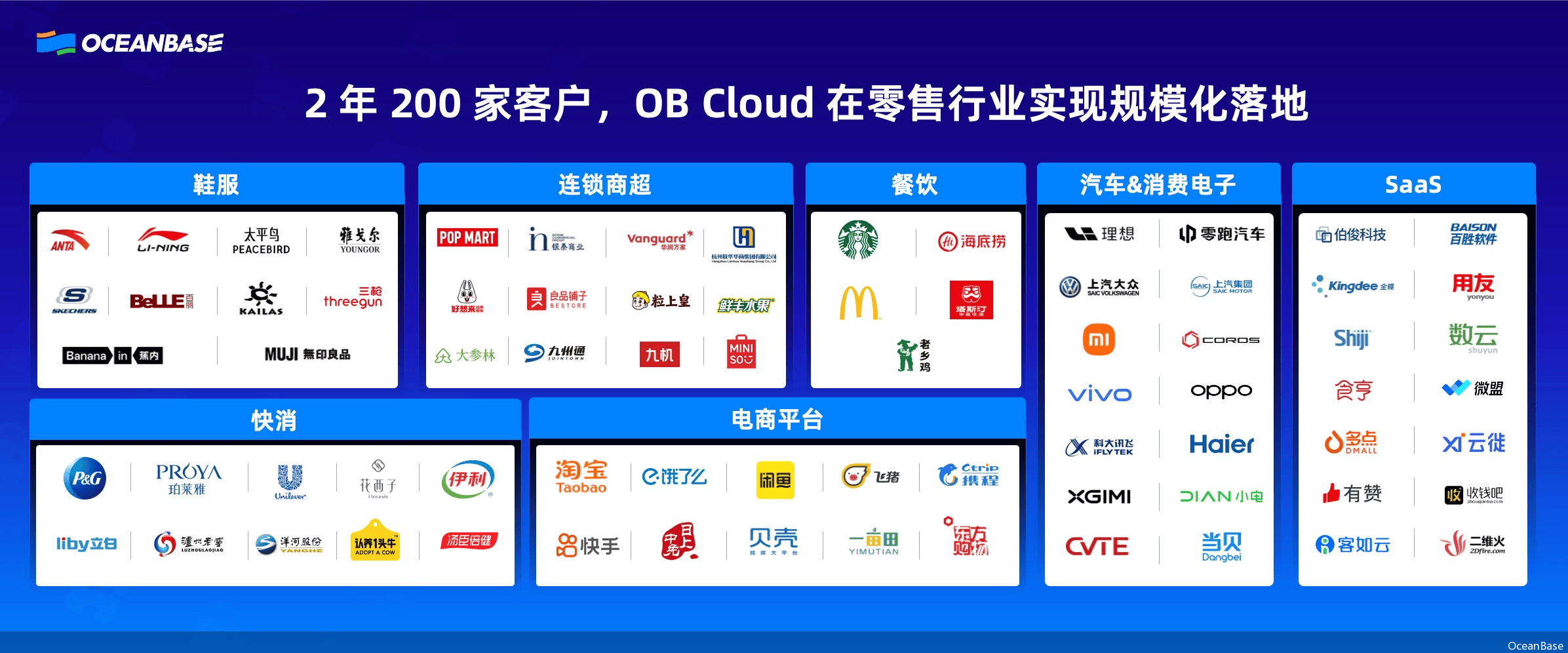
Group 1 - The demand for cloud databases has surged due to the need to handle massive amounts of unstructured data in generative AI applications [1][2] - OceanBase's cloud database product, OB Cloud, has served over 200 leading retail enterprises in various sectors, including apparel, food service, fast-moving consumer goods, and direct-to-consumer [1] - The retail industry is shifting from broad traffic operations to deep user value exploration, with over 90% of enterprises believing AI will significantly enhance productivity [1] Group 2 - OceanBase, founded in 2010, launched its integrated cloud database platform OB Cloud in 2022, aiming to assist various industries in transitioning to a digital intelligence era [2] - OB Cloud utilizes technologies like vector fusion queries to enable deep understanding of unstructured data such as images, videos, and text comments, facilitating features like image search and intelligent product recommendations [2] - The "Integrated Cloud Database White Paper" released at the conference emphasizes the transition of integrated cloud databases from "cost centers" to "growth engines," highlighting the need for companies to focus on six dimensions for technology selection [2]
OceanBase CEO杨冰:零售下一轮竞争,本质是“数据底座能力”的竞争
Sou Hu Cai Jing· 2025-08-29 15:44
Core Insights - The retail industry is undergoing a transformation where data infrastructure is shifting from a "cost center" to a "growth engine" [1] - Over 90% of enterprises believe that generative AI will enhance productivity, but traditional architectures face challenges such as data latency and system fragmentation [1][3] - A robust data foundation is essential for supporting real-time decision-making and AI applications in retail [4] Group 1: Industry Trends - Retail has moved from extensive traffic operations to deep user value exploration, with AI integrated across the entire supply chain [1] - The need for a data foundation that can handle "pulse-like surges" in traffic and serve as a "real-time decision engine" is critical [3][4] - The competition in retail is fundamentally about the capabilities of the data foundation, emphasizing the importance of ecosystem collaboration [5] Group 2: Technological Advancements - OceanBase's HTAP foundation has enabled companies like Haidilao to streamline their membership operations and achieve personalized recommendations [3] - The OB Cloud platform has reduced scaling time by 90% for companies like Pop Mart, allowing them to handle a hundredfold increase in traffic with high availability [3] - OB Cloud is focusing on deep integration of AI with databases, enhancing the understanding of unstructured data such as images and text [4] Group 3: Market Impact - OceanBase has served over 200 leading retail clients across various sectors, demonstrating the scalability of its solutions [4] - The global expansion of OB Cloud has reached over 50 regions, with a customer growth rate of 130%, showcasing the adaptability of Chinese technology [5] - The future of retail efficiency and innovation may be redefined as more companies adopt these transformative technologies [5]
OB Cloud两年服务200家零售企业,海底捞泡泡玛特等首选一体化架构
Guan Cha Zhe Wang· 2025-08-29 05:15
Core Insights - The retail industry is facing dual challenges of fluctuating traffic and AI transformation, necessitating a stable and efficient data foundation for success [1][3] - OceanBase Cloud (OB Cloud) aims to deepen its presence in the new retail sector by providing integrated cloud database solutions [1][4] Industry Trends - The retail sector is shifting from broad traffic operations to deep user value exploration, with over 90% of companies believing that generative AI will enhance productivity [3] - Traditional architectures face issues such as data latency and system fragmentation, hindering real-time decision-making and AI innovation [3] Company Developments - OB Cloud has developed four core capabilities to address retail challenges: integration of transaction and analysis, multi-model data fusion, vectorized query for AI applications, and multi-cloud native deployment [4] - The platform has demonstrated significant performance improvements, such as a 90% reduction in scaling time for high traffic scenarios and a 45% increase in real-time computing power for member systems [4][5] Case Studies - Haidilao utilized OB Cloud to manage high concurrency in its membership system, achieving stable operations that support over 80% of its total revenue [4][6] - The integration of OB Cloud in Haidilao's inventory system allows for real-time stock calculations and proactive decision-making, reducing response time from days to minutes [5] AI Integration - OB Cloud is focusing on deep integration of AI with databases, enhancing capabilities to understand unstructured data such as images and text [6] - The platform enables features like visual search and intelligent recommendation systems, improving customer experience and operational efficiency [6] Market Position - OB Cloud has served over 200 leading retail enterprises, including Li Ning and Haidilao, and is becoming a key infrastructure for the digital transformation of the retail industry [6][7] - The company has established a global presence across more than 50 regions, with a customer growth rate of 130% [7] Research Insights - A white paper released at the conference highlights the transition of integrated cloud databases from cost centers to growth engines, emphasizing the need for businesses to focus on architecture design and AI capabilities [7]

OceanBase发布《零售一体化云数据库白皮书》 破解“AI+零售”三大核心挑战
Jing Ji Guan Cha Wang· 2025-08-29 02:59
Core Insights - The first "2025 Retail Data Foundation Innovation Conference" was held in Shanghai, co-hosted by OceanBase, IT Dongfanghui, and EFCIO, where the "Integrated Cloud Database White Paper" was released, marking the first systematic exposition of integrated cloud database value in the retail industry [1] - The white paper emphasizes that in the era of "second-level decision-making" and "centimeter-level insights," integrated cloud databases are transitioning from being a "cost center" to a "growth engine" [1] - Retail enterprises are encouraged to focus on six dimensions for technology selection: architecture design, cost-effectiveness balance, high availability, IT integration capability, security compliance, and AI-native capabilities to establish a solid foundation for the new retail integrated data base in the AI era [1] Industry Challenges - The retail industry is facing dual challenges of pulse-like traffic shocks and AI transformation, necessitating a stable, efficient data foundation that supports AI applications as a key to success [2] - Over 90% of surveyed enterprises believe that generative AI will enhance productivity, yet traditional architectures suffer from data delays, system fragmentation, and resource redundancy, hindering real-time decision-making and AI innovation applications [2] - The retail sector's next competitive round is fundamentally about the capability of the data foundation, which requires a new generation of technology base that meets "full-time response, full-domain coverage, full-end adaptation, and full-staff collaboration" [2]