
罗氏

Search documents
观察| 5万亿AI烧钱狂欢,谁是“接盘侠”?
未可知人工智能研究院· 2025-11-12 03:02
Core Viewpoint - The article critiques the current AI infrastructure investment frenzy, highlighting the unsustainable nature of the spending and the potential for significant financial losses for investors. It draws parallels with historical investment bubbles, suggesting that the current situation may lead to similar outcomes if the market does not adjust to realistic revenue expectations. Group 1: AI Infrastructure Spending - Major US tech companies are projected to spend nearly $400 billion on AI infrastructure this year, with McKinsey forecasting a total of $5.2 trillion over the next five years, equivalent to India's annual GDP [5][11]. - The stock prices of major tech companies have surged, with the "Seven Giants" (including Apple and Microsoft) contributing to 75% of the S&P 500's gains since the launch of ChatGPT [11][12]. - Despite the hype, the current AI revenue is only $20 billion globally, indicating a need for a 100-fold increase to meet projected earnings by 2030 [7][9]. Group 2: Market Concentration and Risks - The "Seven Giants" now account for over 30% of the S&P 500, making the market highly dependent on their performance [11][12]. - AI spending has become a facade for the US economy, with half of the GDP growth this year attributed to these investments, raising concerns about sustainability [12][14]. - Historical patterns suggest that concentrated market speculation often leads to downturns, as seen in the internet and real estate bubbles [14][16]. Group 3: Capital Expenditure Trends - Companies that aggressively expand their asset bases tend to underperform, with data showing they earn 8.4% less annually than more conservative firms [17][20]. - The rapid depreciation of AI equipment exacerbates financial pressures, as companies must continually invest in new technology [21][24]. - The capital expenditure of the "Seven Giants" has increased from 4% to 15% of revenue since 2012, with some companies exceeding 21% [25][27]. Group 4: The Shift from Asset-Light to Asset-Heavy Models - The shift towards heavy asset investment has transformed these tech giants from "asset-light" to "asset-heavy" companies, leading to increased financial strain [25][30]. - Companies are now facing a "prisoner's dilemma," where they feel compelled to continue investing heavily in AI despite the risks of financial loss [30][31]. Group 5: Opportunities for Non-Investors - Historical trends indicate that the true beneficiaries of technological revolutions are often those who do not invest heavily in infrastructure but instead leverage existing technologies [31][32]. - Companies that utilize AI effectively without significant capital expenditure are positioned to benefit from the oversupply of AI infrastructure, leading to lower costs and increased efficiency [35][39]. - The article identifies two categories of AI beneficiaries: AI infrastructure builders and early AI adopters, with the latter showing significantly lower valuation premiums [33][39]. Group 6: Investment Strategies - Investors are advised to avoid high-capital expenditure AI stocks and focus on traditional companies that effectively utilize AI to enhance efficiency [40][44]. - The article emphasizes the importance of seeking undervalued AI stocks, particularly in sectors like finance, industry, and healthcare, which are less capital-intensive [44][45]. - The key takeaway is that successful investment in AI should focus on companies that can profit from AI without excessive spending on infrastructure [45][51].


上海低空经济独角兽,获3亿元融资 | 融资周报(2025年第41期)
Sou Hu Cai Jing· 2025-11-11 07:09
Financing Overview - A total of 19 financing events occurred in Shanghai this week, with 9 disclosing amounts totaling approximately 825.5 million yuan [3][6] - The number of financing events increased by 2 compared to the previous week, which had 17 events [3] - The majority of financing events took place in the Pudong New Area, with 8 events totaling 435 million yuan, followed by Minhang District with 6 events [3] Company Dynamics - Times Technology completed a 300 million yuan B++ round of financing on November 7, with investments from Huaying Capital, Junshan Capital, and PwC Capital [12][13] - Weitao Bio secured over 100 million yuan in angel round financing on November 5, led by Qiming Venture Partners, with participation from B Capital, Shunxi Fund, and Xingze Capital [14][15] - Juyue Testing completed nearly 100 million yuan in A+ round financing on November 6, led by Dongfang Jiafu, with participation from Guoxin Hongsheng and Tianbao Investment [16][17] - Yuesai Biotechnology completed nearly 100 million yuan in strategic financing on November 6, with investments from Shanghai Guotou Xiandao and Pudong Investment Holdings [18][19] Industry Focus - The healthcare sector saw the most financing events this week, with 5 occurrences, followed by integrated circuits with 4 [9][20] - The biopharmaceutical industry is a key focus in Shanghai, highlighted by the recent China International Import Expo where major companies showcased innovative products [20][21] - The Shanghai government has implemented policies to support the development of high-end medical devices, emphasizing the need for advancements in AI medical devices and diagnostic equipment [21]

跨国药企们,看上了这个“超级医药供应链”
Di Yi Cai Jing Zi Xun· 2025-11-11 06:55
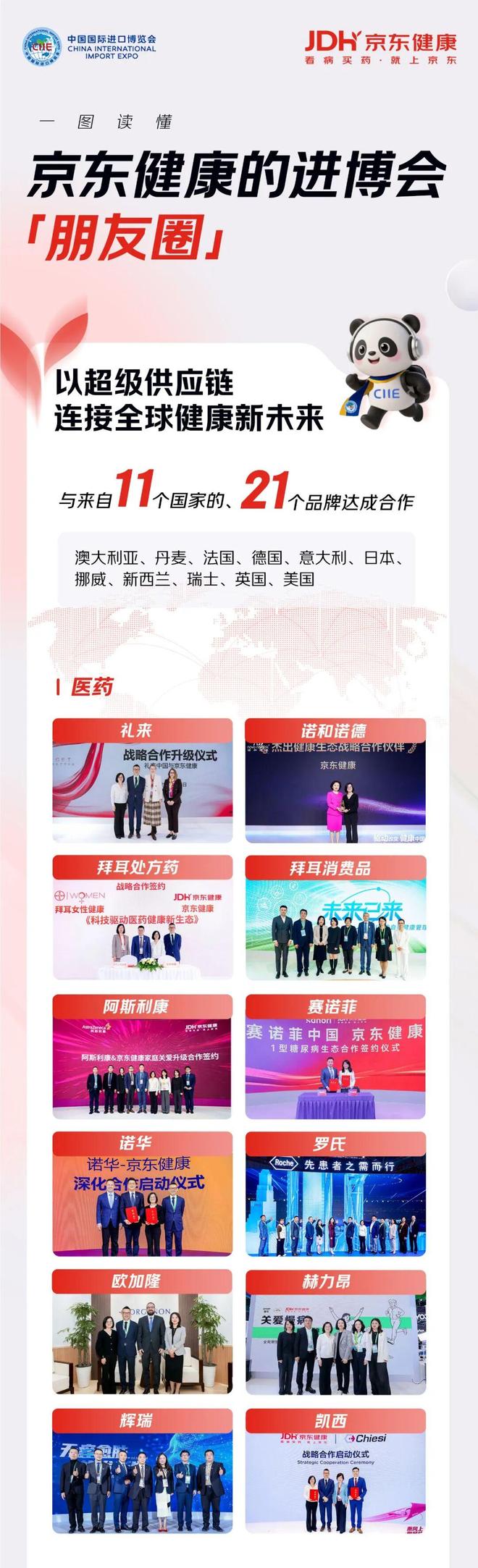
Core Insights - The eighth China International Import Expo saw JD Health establish partnerships with numerous multinational pharmaceutical companies and health brands, surpassing previous collaboration scales and focusing on top global pharmaceutical brands [1][2][3] - JD Health is leveraging its "super pharmaceutical supply chain" to empower companies and transition partnerships from simple channel cooperation to building a health ecosystem [1][3] Group 1: Strategic Collaborations - JD Health and Eli Lilly upgraded their strategic partnership during the expo, discussing future plans in diabetes care [2] - A strategic cooperation agreement was signed between JD Health and Kasey, focusing on disease education and chronic disease management [2][3] - JD Health is a key partner for Novo Nordisk, collaborating on a comprehensive service model for obesity and diabetes management [3] - Bayer and JD Health initiated a women's health literacy enhancement program, integrating medical resources and building a professional content library [3] - Sanofi and JD Health signed an ecological cooperation agreement to establish a Type 1 diabetes management center [3] Group 2: Market Dynamics - The outpatient market is becoming a critical battleground for pharmaceutical companies, shifting from a secondary option to a primary focus due to changes in patient consumption habits and healthcare policies [6][7] - JD Health is addressing the complexities of the outpatient market by offering a unified platform for pharmaceutical companies, reducing communication costs and enhancing operational efficiency [7] - The online pharmaceutical sales market is projected to grow, with JD Health leveraging over 200 million active users to enhance its digital marketing capabilities [8] Group 3: Internet Healthcare Transformation - The internet healthcare sector is reshaping patient treatment habits, with JD Health enhancing its services to meet evolving consumer health needs [10][11] - JD Health's internet hospital is facilitating a closed-loop service for flu prevention, allowing online consultations and prescription management [10] - The company is developing specialized healthcare services across various fields, providing a comprehensive approach to chronic disease management [11] Group 4: Future Outlook - The Chinese pharmaceutical retail market is expected to reach 501.9 billion yuan in 2024, with online sales growing faster than traditional retail [8] - JD Health aims to continue building an integrated healthcare service ecosystem, focusing on user-centered value creation and supply chain advantages [11]
跨国药企们,看上了这个“超级医药供应链”
第一财经· 2025-11-11 06:46
Core Insights - The article highlights the significant partnerships formed by JD Health at the China International Import Expo, emphasizing its role in connecting global pharmaceutical and healthcare brands with the Chinese market [1][3][37] - JD Health is leveraging its "super pharmaceutical supply chain" to empower multinational pharmaceutical companies and enhance the healthcare ecosystem in China [1][3] Partnerships and Collaborations - JD Health has established strategic collaborations with major pharmaceutical companies such as Eli Lilly, Bayer, and Sanofi, focusing on disease management and health education [3][4][5] - The partnership with Eli Lilly involves discussions on diabetes management and future cooperation plans [3] - JD Health and Bayer are launching a comprehensive women's health literacy program, integrating medical resources and online healthcare services [3][5] Market Dynamics - The article discusses the transformation of the Chinese pharmaceutical market, particularly the shift from hospital-based to outpatient and online channels, driven by healthcare reforms and changing patient behaviors [7][8] - JD Health is positioned to facilitate this transition by offering a streamlined platform for pharmaceutical companies to access both online and offline markets, reducing operational costs and improving efficiency [8][9] E-commerce Growth - The Chinese pharmaceutical retail market is projected to reach 501.9 billion yuan in 2024, with online sales growing at a faster rate than traditional retail [10] - JD Health's online platform has over 200 million active users, utilizing big data and AI to identify and reach potential customers effectively [9][10] Role of Internet Healthcare - Internet healthcare platforms are crucial in addressing the uneven distribution of medical resources in China, particularly in rural areas [12][13] - JD Health is enhancing its online healthcare services, providing a comprehensive approach to patient care, including online consultations and chronic disease management [13][14] Future Outlook - JD Health aims to continue developing its integrated healthcare service ecosystem, focusing on user-centered value creation and leveraging its supply chain advantages [14]
全球制药业洞察 | 惜败离场!诺和诺德为何竞逐管线重合的Metsera?
彭博Bloomberg· 2025-11-11 06:05
Core Viewpoint - The acquisition battle for the weight loss startup Metsera has concluded with Pfizer agreeing to acquire the company for $10 billion, while Novo Nordisk's participation raises questions about its confidence in its own weight loss drug pipeline [3][4]. Group 1: Acquisition Details - Pfizer's offer for Metsera was $100 per share, which is approximately 19% higher than Novo Nordisk's bid of $56.50 per share [6]. - The enterprise value of Pfizer's offer is $4.90 billion, while Novo Nordisk's is $6.00 billion, indicating a 22% difference in valuation [6]. - The acquisition is subject to antitrust review, which may pose significant challenges due to overlapping product pipelines [7]. Group 2: Product Pipeline Overlap - Both companies have overlapping products in their pipelines, particularly in GLP-1 receptor agonists, which raises concerns about Novo Nordisk's rationale for pursuing the acquisition [7][8]. - Novo Nordisk plans to submit its own GLP-1 drug, CagriSema, for approval in 2026, alongside several other drugs currently in development [7]. Group 3: Metsera's Drug Performance - Metsera's MET-097i demonstrated a 14.1% weight loss in the VESPER-1 trial, with a low treatment discontinuation rate of 2.9% [9][11]. - The drug's favorable tolerability profile and the absence of dose titration requirements may provide a competitive edge in the market [9]. - MET-233i, another drug from Metsera, showed an 8.4% weight loss in its Phase I trial, outperforming competitors like Roche's petrelintide [12].


TG Therapeutics Crumbles After Roche Unveils Its 'Unprecedented' Test Results
Investors· 2025-11-10 17:00
Core Insights - Roche's fenebrutinib demonstrated "unprecedented" test results for multiple sclerosis, impacting TG Therapeutics negatively [1][2] - Roche's stock increased by over 3% to $43.33, while TG Therapeutics' stock fell more than 5% to $30.53, reaching a two-month low [2] - Fenebrutinib showed significantly fewer relapses compared to teriflunomide in relapsing multiple sclerosis patients [3] - In primary progressive MS, fenebrutinib slowed disability progression comparably to Roche's Ocrevus, the only approved treatment for this condition [4] Roche's Competitive Position - Roche's fenebrutinib uses a different mechanism than TG Therapeutics' Briumvi, targeting BTK, which is involved in immune response to inflammation [7] - Roche's stock performance improved, gapping above its 50-day moving average following the news [7] TG Therapeutics' Market Performance - Briumvi's sales grew by at least double-digit percentages year-over-year, with a notable 84% increase to $152.9 million in Q3 [6] - Despite the sales growth, Briumvi still lags behind Ocrevus in overall sales [6] - TG Therapeutics maintains a strong IBD Digital Composite Rating of 97, ranking in the top 3% of stocks for performance [8]


Olema Pharmaceuticals (NasdaqGS:OLMA) FY Conference Transcript
2025-11-10 16:30
Summary of Olema Pharmaceuticals FY Conference Call Company Overview - **Company**: Olema Pharmaceuticals (NasdaqGS:OLMA) - **Event**: FY Conference on November 10, 2025 - **Key Speakers**: Shane Kovacs (CFO), Nazneen Doswalla (CMO) Industry and Product Focus - **Industry**: Oncology, specifically targeting metastatic breast cancer - **Key Product**: Palazestrant, an oral selective estrogen receptor degrader (SERD) Core Points and Arguments 1. **Palazestrant's Potential**: - Palazestrant is positioned as a next-generation endocrine therapy backbone for metastatic breast cancer, with ongoing pivotal trials expected to yield data in 2026 [4][13] - Recent data presented at ESMO showed a median progression-free survival (PFS) of over one year for the PALA-RIBO combination in a second-line setting, significantly outperforming current standards [5][6] 2. **Differentiation from Competitors**: - Palazestrant is a complete estrogen antagonist, unlike competitors like elacestrant and imlunestrant, which are partial agonists [7] - It offers over 10 times the plasma drug exposure compared to fulvestrant, which is administered via intramuscular injection [9] 3. **Clinical Trial Insights**: - The OPERA-01 trial (monotherapy) is enrolling well and is expected to read out in the second half of 2026 [13] - The OPERA-02 trial (first-line combination with Kisqali) has just begun enrollment, with significant investigator interest due to limited competition in this space [14][26] 4. **Market Opportunity**: - The U.S. market for frontline metastatic ESR1-positive HER2-negative breast cancer is estimated at 40,000 patients annually, with a potential peak sales opportunity of $5 billion if wild-type activity is confirmed [21][22] - If restricted to ESR1 mutant patients, the opportunity is still projected to be a couple of billion dollars annually [22] 5. **Collaboration with Novartis**: - Olema has a unique collaboration with Novartis for the OPERA-02 trial, which includes a supply agreement for Kisqali, allowing for a robust patient enrollment strategy [26][28] 6. **Future Development Plans**: - Olema is exploring combinations with Pfizer's abemaciclib, a selective CDK4 inhibitor, to stay competitive in the evolving market landscape [29] - The company is also developing a CDK2 inhibitor, with plans for combination studies with palazestrant [38] Important but Overlooked Content 1. **Regulatory Considerations**: - The FDA's feedback emphasizes the need to distinguish between ESR1 mutant and wild-type populations in clinical trial analyses [15][16] 2. **Financial Health**: - Olema reported $329 million in cash at the end of September 2025, with a runway extending into mid-2027, indicating a strong financial position to support ongoing trials and development [42] 3. **Market Dynamics**: - The success of Roche's upcoming giredestrant trial could influence market perceptions of the SERD class, but Olema believes their data positions them favorably regardless of that outcome [31][32] 4. **Long-term Strategy**: - Olema aims to leverage its intellectual property and exclusivity until the early 2040s to maximize sales and shareholder returns [36]

GLP-1之后,巨头卷向下一代减重药
第一财经· 2025-11-10 13:32
Core Insights - Pfizer won a dramatic bidding war against Novo Nordisk for the weight loss drug manufacturer Metsera, acquiring it for $10 billion, which includes a competitive amylin drug pipeline [3][4] - Amylin drugs mimic the action of the pancreatic hormone amylin, differing from currently marketed GLP-1 drugs, but both types suppress appetite and reduce food intake [3][4] - Analysts believe that the future combination of GLP-1 and amylin therapies could enhance weight loss efficiency and quality [4][5] Industry Developments - Major pharmaceutical companies, including Novo Nordisk, Eli Lilly, AbbVie, and Roche, are developing amylin-targeting weight loss drugs [4][6] - Eli Lilly's amylin therapy, eloralintide, showed positive results in a mid-stage study, indicating potential for further development [4][5] - Novo Nordisk presented data at the 2025 EASD annual meeting showing that its amylin drug cagrilintide led to an average weight loss of approximately 12.5 kg in obese or overweight patients [5][6] Competitive Landscape - Roche has partnered with Zealand Pharma to develop long-acting amylin drugs, indicating a collaborative approach in the industry [6] - Experts suggest that while direct comparisons between GLP-1 and amylin therapies are not yet possible, they may offer different benefits for various patient populations [6] - In China, several biopharmaceutical companies are also developing next-generation amylin-targeting weight loss therapies, with notable advancements from companies like Genscript and Xianju Pharmaceutical [6]


GLP-1之后,巨头卷向下一代减重药
Di Yi Cai Jing· 2025-11-10 12:46
Core Insights - Pfizer has acquired Metsera for $10 billion, which includes a competitive amylin drug pipeline, highlighting the intense competition in the weight loss drug market [1] - Amylin drugs mimic the action of the pancreatic hormone amylin, differing from GLP-1 drugs, but both aim to suppress appetite and reduce food intake [1] - Amylin receptor has been confirmed as an effective drug target, with amylin mimetics emerging as new therapies for obesity and diabetes [1] Group 1 - Major pharmaceutical companies, including Novo Nordisk, Eli Lilly, AbbVie, and Roche, are developing amylin-targeting weight loss drugs [2] - Eli Lilly's amylin therapy, eloralintide, showed positive results in a mid-stage study, helping obese or overweight patients lose over 20% of their weight in 48 weeks [2] - Novo Nordisk presented data on cagrilintide, showing an average weight loss of approximately 12.5 kg in a phase III trial for non-diabetic obese patients [2] Group 2 - Roche has partnered with Zealand Pharma to develop long-acting amylin drugs [3] - Experts suggest that while direct comparisons between GLP-1 and amylin therapies are not yet possible, they may offer different benefits for various patient populations [3] - Several domestic biopharmaceutical companies are also developing next-generation amylin-targeting weight loss therapies, with Gilead Sciences selecting ASC36 as a clinical candidate [3]
自免BTK抑制剂大爆发,没有悬念了
3 6 Ke· 2025-11-10 12:42
Core Insights - The self-immune BTK inhibitor Fenebrutinib from Roche has achieved significant milestones in clinical trials for relapsing multiple sclerosis (RMS) and primary progressive multiple sclerosis (PPMS) [1] - The success of Fenebrutinib is part of a broader trend in the self-immune BTK inhibitor market, with Sanofi and Novartis also gaining FDA approvals for their respective BTK inhibitors [2][3] Group 1: Roche's Fenebrutinib - Fenebrutinib has shown a significant reduction in annual relapse rates compared to Teriflunomide over a treatment period of at least 96 weeks [1] - The FENtrepid study comparing Fenebrutinib with the CD20 monoclonal antibody Ocrelizumab for PPMS also met its primary endpoint [1] - The complete data from these studies are yet to be published, and the drug's market approval is contingent on the results of the FENhance1 study expected in the first half of 2026 [1] Group 2: Competitive Landscape - Sanofi's Rilzabrutinib was the first BTK inhibitor approved by the FDA for treating immune thrombocytopenia (ITP), based on the LUNA phase III trial results showing 65% of patients achieving a platelet response [2] - Novartis' Remibrutinib received FDA approval for chronic spontaneous urticaria (CSU), marking it as the first BTK inhibitor approved for this indication [2][3] - The approval of these drugs indicates a significant advancement in the self-immune BTK inhibitor field, with Roche's success further solidifying the potential of BTK inhibitors in treating previously unaddressed conditions like RMS and PPMS [3] Group 3: Addressing Previous Concerns - Historically, there have been doubts regarding the efficacy of BTK inhibitors in treating autoimmune diseases due to their mechanism of action, which primarily inhibits new B cell generation without affecting existing pathological B cells [5][8] - Safety concerns have also been prominent, particularly regarding liver toxicity, which has led to clinical trial suspensions for some BTK inhibitors [6][7] - The recent approvals and positive trial results are expected to alleviate these concerns and validate the therapeutic potential of BTK inhibitors in the self-immune space [8] Group 4: Future Considerations - The self-immune BTK inhibitor market is becoming increasingly competitive, necessitating differentiation in molecular design and precise targeting of indications [9][10] - The success of Rilzabrutinib in ITP highlights the importance of focusing on diseases closely related to the BTK pathway for maximizing therapeutic efficacy [10] - The ongoing developments in this field suggest a dynamic landscape where both established and emerging players will continue to innovate and compete [10]

