国电南瑞

Search documents
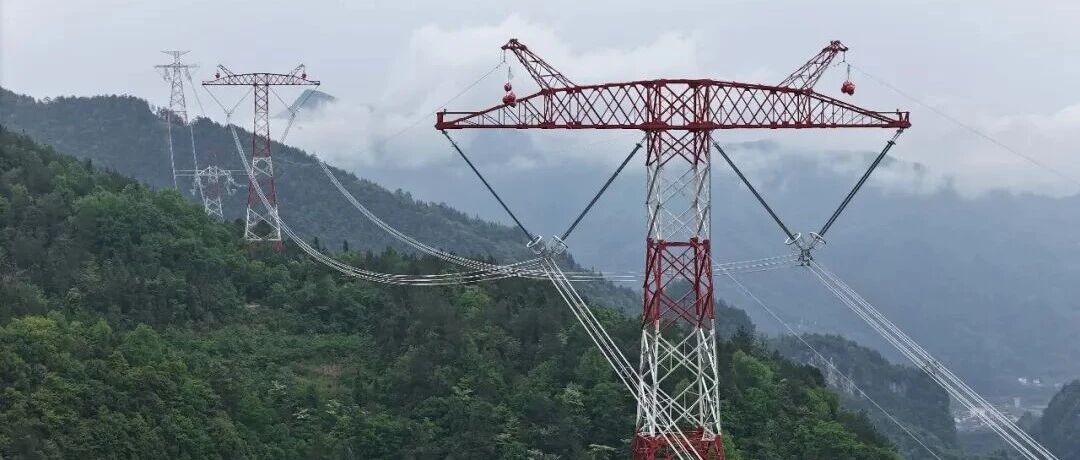
中国“西电东送”再添能源动脉 金上—湖北工程建成投运
Zhong Guo Xin Wen Wang· 2025-12-18 05:09
Core Viewpoint - The completion and operation of the Jinshang-Hubei ±800 kV UHVDC project is significant for promoting the cross-regional optimization of clean energy, facilitating the green and low-carbon transformation of energy, and enhancing national energy security [1][2] Group 1: Project Overview - The Jinshang-Hubei project is the first UHVDC project to penetrate deep into the Tibetan Plateau, starting from the upper reaches of the Jinsha River and passing through Tibet, Sichuan, Chongqing, and Hubei [1] - The project utilizes ±800 kV rated voltage and an 8 million kW rated capacity, with a transmission distance of nearly 1900 kilometers [1] - It is the world's first UHVDC project successfully applying site-level cascading technology at high altitudes [1] Group 2: Environmental Impact - The project is expected to deliver approximately 40 billion kWh of clean electricity annually, equivalent to replacing about 12 million tons of standard coal and reducing carbon dioxide emissions by approximately 30 million tons [1] Group 3: Strategic Importance - The Jinshang-Hubei project adds a new energy artery to the "West-to-East Power Transmission" initiative and is the second UHVDC project to bring external electricity into Hubei [2] - It will significantly enhance the mutual assistance of power supply and demand, promote resource optimization, and support the large-scale development of renewable energy [2] - The State Grid has built and put into operation 42 UHV projects, achieving a cross-regional transmission capacity of 370 million kW [2]

首条深入川藏高原腹地的特高压建成投运
中国能源报· 2025-12-18 03:49
Core Viewpoint - The completion and operation of the Jinshang-Hubei ±800 kV UHVDC project is a significant milestone for China's clean energy transition and energy security, facilitating the optimization of energy resources across regions and supporting the country's green low-carbon transformation [1][3]. Group 1: Project Overview - The Jinshang-Hubei project is the first UHVDC project to penetrate the Tibetan Plateau, with a transmission distance of nearly 1900 kilometers and a rated capacity of 8 million kilowatts [3][4]. - The project connects the clean energy resources from the upper reaches of the Jinsha River in Tibet and Sichuan to Hubei, enhancing the power supply and energy security in the region [3][6]. Group 2: Strategic Importance - This project serves as a crucial addition to the "West-to-East Power Transmission" strategy, significantly improving the ability to balance power supply and demand across regions [6][7]. - It supports the high-quality development of the central region and the construction of a new development pattern in China, providing robust power support for national strategies [6][7]. Group 3: Environmental Impact - The project is expected to deliver approximately 40 billion kilowatt-hours of clean electricity annually, replacing about 12 million tons of standard coal and reducing carbon dioxide emissions by around 30 million tons [7][8]. - It promotes the large-scale development and efficient utilization of renewable energy, contributing to the achievement of carbon reduction goals and the construction of an ecological civilization [7][8]. Group 4: Technological Innovations - The project introduces a pioneering site-separated cascading technology for UHVDC, enhancing operational flexibility and marking a significant breakthrough in high-altitude UHV technology [8][10]. - It has developed specialized equipment for high-altitude conditions and successfully implemented rapid circuit breakers that meet extreme environmental requirements, showcasing China's leadership in UHV transmission technology [8][10]. Group 5: Construction Challenges - The project faced significant challenges due to its high-altitude construction environment, including harsh weather, complex geology, and logistical difficulties [10][11]. - A comprehensive safety and ecological protection system was established to address these challenges, achieving a record of zero accidents during construction [10][11].

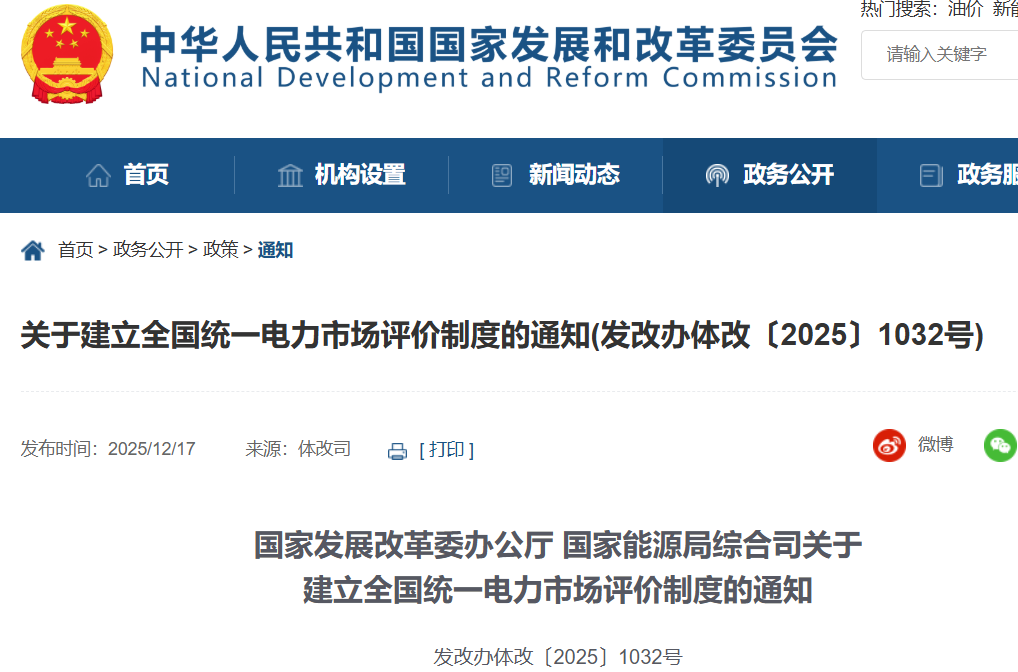
两部委:2026年起组织开展全国统一电力市场评价
Xin Lang Cai Jing· 2025-12-17 14:19
风电头条获悉,12月17日,国家发展改革委办公厅、国家能源局综合司发布关于建立全国统一电力市场评价制度的通知。 文件指出,全国统一电力市场评价工作应结合市场建设情况开展多维度综合评价,重点围绕电力市场运营效果、市场作用发挥、经营主体可持续 性发展、市场竞争充分度四个方面开展评价。 登录新浪财经APP 搜索【信披】查看更多考评等级 (来源:风电头条) 文件还指出,市场为储能、虚拟电厂等新业态提供发展空间,推动民营企业参与,带动相关产业链成长,促进就业和能源新质生产力提升。 市场竞争充分度评价方面,要求电力市场实现统一开放,经营主体有序竞争,对不当市场竞争、报价异常及市场力滥用行为能够有效约束,电力 市场信用机制健全,能够对市场失信行为进行惩戒。 此外,自2026年起组织开展全国统一电力市场评价,制定市场评价标准。鼓励各地因地制宜按需开展电力市场评价工作。鼓励市场运营机构充分 发挥自身优势,开展市场量化评价,及时发现并反馈电力市场建设运营相关问题。 公告如下: 以习近平新时代中国特色社会主义思想为指导,全面贯彻党的二十大和二十届历次全会精神,按照完善全国统一电力市场体系要求,围绕加快构 建新型电力系统的总体目标, ...
两部委:为储能、虚拟电厂等提供发展空间
Xin Lang Cai Jing· 2025-12-17 14:19
Core Viewpoint - The National Development and Reform Commission and the National Energy Administration have announced the establishment of a national unified electricity market evaluation system, set to begin in 2026, aimed at enhancing market efficiency and promoting the participation of private enterprises in the energy sector [1][19]. Group 1: Overall Requirements - The evaluation system is guided by Xi Jinping's thoughts and aims to create a scientific, systematic, and dynamic evaluation framework that balances safety, green transition, and economic efficiency [22]. - The evaluation will provide a decision-making basis for market construction and regulation, enhancing the optimization of electricity resource allocation [22]. Group 2: Evaluation Content - The evaluation will focus on four key areas: market operation effectiveness, market role performance, sustainable development of operating entities, and market competition adequacy [22]. Group 3: Market Operation Effectiveness Evaluation - A complete unified electricity market rule system will be established, ensuring coverage of various market types including long-term, spot, and ancillary services [23]. - A comprehensive technical standard system will be developed to meet current market needs and reflect advanced technologies [23]. - The evaluation will assess the efficiency of market operations, including member management, information disclosure, and transaction organization [23][25]. Group 4: Market Role Performance Evaluation - The evaluation will promote efficient circulation of electricity resources across regions, enhancing overall grid efficiency [26]. - Safety benefits will be ensured through coordinated operations of energy markets and capacity compensation mechanisms [26]. - Environmental benefits will be measured by the promotion of high-quality development and consumption of renewable energy [26]. - Economic benefits will be assessed through dynamic pricing mechanisms that optimize resource allocation and maintain reasonable electricity price fluctuations [26]. Group 5: Sustainable Development of Operating Entities Evaluation - The market mechanism will guide reasonable investment layouts, ensuring cost recovery and stable operations for electricity enterprises [27]. - The market will provide development space for new business models like energy storage and virtual power plants, fostering private sector participation and job creation [28]. - Market satisfaction among operating entities will be evaluated, focusing on their engagement and recognition of the market environment [29]. Group 6: Market Competition Adequacy Evaluation - The evaluation will ensure orderly competition among market participants and effective constraints on unfair practices [30]. - The market concentration index will be monitored to maintain a balance between supply-demand risks and price volatility [31]. Group 7: Evaluation Methods - A comprehensive evaluation indicator system will be established, reflecting practical market operations and allowing for dynamic adjustments [31]. - The evaluation will combine qualitative and quantitative analyses, as well as horizontal and vertical comparisons [31][32]. - Digital technologies will be leveraged to enhance the evaluation process and improve regulatory efficiency [33]. Group 8: Implementation and Application - The evaluation results will be compiled into reports for reference by government departments and market operators, facilitating analysis and improvement [34]. - The evaluation work will be organized by the National Development and Reform Commission and the National Energy Administration, with collaboration from various stakeholders [35].

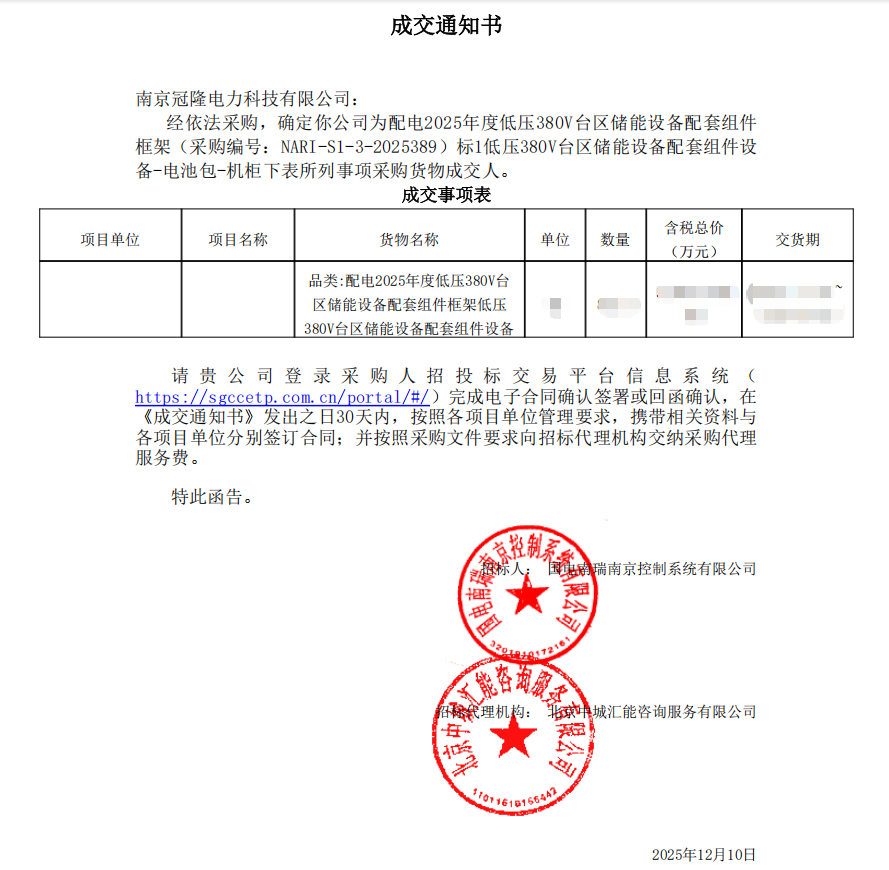
冠隆电力成功中标国电南瑞低压380V台区储能设备配套组件框架项目
Xin Lang Cai Jing· 2025-12-17 14:19
Core Insights - Nanjing Guandong Electric Power Technology Co., Ltd. has successfully won the bid for the low-voltage 380V energy storage equipment supporting components framework project for 2025, organized by State Grid Nanjing Control System Co., Ltd. [1][7] Company Overview - State Grid Nanjing Technology Co., Ltd. is the first listed company under the State Grid Corporation of China, focusing on intelligent energy and power solutions, covering four major sectors: grid automation, relay protection, power information communication, and hydropower environmental protection [5][11]. - The subsidiary, State Grid Nanjing Control System Co., Ltd., specializes in power system regulation technology and has significant industry influence in power distribution upgrades and energy transition [5][11]. Project Details - The bid includes three core products: LES-112W50 air-cooled energy storage system, LES-215L100 liquid-cooled energy storage system, and LES-261L130 liquid-cooled energy storage system [5][11]. - The systems are equipped with self-developed Power Conversion Systems (PCS) and have received full certification across European countries, demonstrating high efficiency and operational stability suitable for various scenarios, including low-voltage 380V energy storage [5][11]. Future Outlook - Guandong Electric Power aims to leverage its high-quality product matrix and professional energy solutions to empower the energy storage ecosystem and contribute to the green transition and sustainable development of the energy system [7][13].
引爆全球危机!美国停电时长暴涨80%,中国却早已布局47年
Sou Hu Cai Jing· 2025-12-17 13:42
Group 1 - The average power outage duration for U.S. users is projected to increase by 80% in 2024, reaching approximately 662.6 minutes, or nearly 11 hours, compared to the previous year [3][6] - In Virginia and Texas, the outage durations have increased by 228% and 176% respectively, with Texas experiencing a more than 700% increase compared to a decade ago [3][6] - The average retail electricity price in the U.S. is expected to rise by 13% from 2022 to 2025, with typical household electricity costs increasing from $1,683 to $1,902 annually [6][8] Group 2 - Nearly 80 million Americans are now forced to choose between paying electricity bills and other essential expenses, making electricity costs the second-largest energy expenditure after vehicle fuel [8][11] - The aging U.S. power grid is a significant issue, with an average service life of about 40 years and 70% of transformers exceeding their 25-year design life [8][11] - AI is projected to consume nearly 11.7% of U.S. electricity by 2030, up from 4% in 2023, with significant energy demands from data centers [11][13] Group 3 - The U.S. is facing challenges in power generation, with a rapid exit from coal, aging nuclear plants, and insufficient growth in renewable energy sources [13][21] - By 2030, the U.S. is expected to retire 94 GW of power generation capacity, while only adding 260 GW of new sources, leading to a dangerous gap in supply [13][21] - In contrast, China's power generation capacity has surged to 3.35 billion kilowatts by the end of 2024, a 58-fold increase since 1978 [21][26] Group 4 - China has implemented a systematic approach to power generation and distribution, including the "East Data West Computing" initiative, which directs data centers to energy-rich western regions [23][31] - The average electricity price in China is approximately $0.08 per kilowatt-hour, significantly lower than the U.S. average of $0.13 [26][31] - China's renewable energy capacity is projected to exceed 1.4 billion kilowatts by the end of 2024, with significant investments in wind and solar power [21][33] Group 5 - The differences in the energy landscape between the U.S. and China stem from varying development models and institutional designs, with the U.S. lacking a unified national energy strategy [26][31] - China's centralized planning allows for large-scale projects like ultra-high voltage transmission lines, while the U.S. struggles with fragmented state policies [31][35] - The U.S. faces inefficiencies in its power system due to outdated regulatory frameworks, while China has maintained continuous investment in modernizing its grid [35][41]

为储能等新业态提供发展空间!国家发展改革委、国家能源局建立全国统一电力市场评价制度
中关村储能产业技术联盟· 2025-12-17 11:47
Core Viewpoint - The establishment of a national unified electricity market evaluation system aims to enhance the efficiency and effectiveness of the electricity market, ensuring sustainable development and promoting competition among market participants [1][5][6]. Group 1: Overall Requirements - The evaluation system is guided by Xi Jinping's thoughts and aims to align with the goals of building a new power system, focusing on safety, green transformation, and economic efficiency [6]. - The evaluation will provide a scientific and systematic framework to assess the performance of the electricity market, supporting decision-making for market construction and regulation [6]. Group 2: Evaluation Content - The evaluation will focus on four main aspects: market operation effectiveness, market role performance, sustainable development of operating entities, and market competition adequacy [7]. Market Operation Effectiveness - The evaluation will assess the progress of market construction, including the establishment of a complete set of unified market rules and the coverage of various market types [8]. - It will also evaluate the technical standards and the operational foundation of the electricity market, ensuring efficient management and accurate information disclosure [9][10]. Market Role Performance - The evaluation will measure the efficiency of electricity factor circulation, the safety benefits of power supply, environmental benefits related to renewable energy, and the overall economic benefits of the electricity market [11][12]. Sustainable Development of Operating Entities - The evaluation will focus on the operational status of market entities, the cultivation of new business models like energy storage and virtual power plants, and the overall satisfaction of market participants [13][14]. Market Competition Adequacy - The evaluation will analyze the behavior of market participants, ensuring fair competition and monitoring market concentration levels to manage risks effectively [15][16]. Group 3: Evaluation Methods - A comprehensive evaluation indicator system will be established, combining qualitative and quantitative analysis methods to reflect the multi-dimensional aspects of the market [17][18]. - The evaluation will utilize digital technologies for real-time monitoring and enhance the predictive capabilities of market assessments [20][21]. Group 4: Implementation and Organization - The evaluation work will be organized by the National Development and Reform Commission and the National Energy Administration, with collaboration from various stakeholders [24]. - Local departments are expected to take responsibility for the evaluation, ensuring that the process is independent, professional, and comprehensive [24].

国家发展改革委办公厅 国家能源局综合司关于建立全国统一电力市场评价制度的通知
国家能源局· 2025-12-17 09:57
Core Viewpoint - The article outlines the establishment of a national unified electricity market evaluation system to enhance the efficiency and regulation of the electricity market in China, aligning with the country's broader economic and energy reform goals [3][4]. Group 1: Overall Requirements - The evaluation system aims to create a scientific, systematic, and dynamic framework that balances safety, green transformation, and economic efficiency, providing a basis for decision-making in market construction and regulation [4]. Group 2: Evaluation Content - The evaluation will focus on four key areas: market operation effectiveness, market role performance, sustainable development of operating entities, and the degree of market competition [5]. Group 3: Market Operation Effectiveness Evaluation - The evaluation will assess the progress of market construction, including the establishment of a complete rule system and the implementation of local regulations [6]. - It will also evaluate the technical standards and the operational foundation of the electricity market, ensuring timely and accurate information disclosure and transaction organization [6]. - The effectiveness of the regulatory framework and the role of the market management committee in maintaining fairness and order in the market will be assessed [7]. Group 4: Market Role Performance Evaluation - The evaluation will measure the efficiency of electricity factor circulation across regions, the safety benefits of market mechanisms, and the environmental benefits related to renewable energy development [8]. - Economic benefits will be analyzed through the overall economic impact of the electricity market, focusing on dynamic pricing and resource optimization [8]. Group 5: Sustainable Development of Operating Entities Evaluation - The evaluation will consider the operational status of electricity enterprises and their ability to recover costs and maintain stable operations [9]. - It will also assess the market's support for new business models and the participation of private enterprises, contributing to job creation and industry growth [9][10]. Group 6: Market Competition Adequacy Evaluation - The evaluation will analyze the competitive behavior of market participants and the effectiveness of mechanisms to prevent market manipulation [11]. - It will also monitor market concentration levels and the effectiveness of risk prevention mechanisms [11]. Group 7: Evaluation Methods - A comprehensive evaluation index system will be established, focusing on practicality, accessibility, and representativeness [12]. - The evaluation will combine qualitative and quantitative analyses, as well as horizontal and vertical comparisons [13]. Group 8: Digital Technology Support - The use of digital technology will enhance the evaluation process, allowing for real-time monitoring of market conditions and improving the timeliness and responsiveness of evaluations [15]. Group 9: Implementation and Organization - The evaluation work will be organized by the National Development and Reform Commission and the National Energy Administration, with collaboration from various stakeholders [18].

最新“世界品牌500强”:谷歌、微软和苹果居前三 中国50个品牌上榜
Zhong Guo Xin Wen Wang· 2025-12-17 08:37
Group 1 - The core finding of the "World Brand 500" list for 2025 is that Google has surpassed Apple to take the top position, with Microsoft remaining in second place and Apple dropping to third [1] - A total of 50 Chinese brands made the list, maintaining China's position as the third-largest country in terms of brand representation [1] - The United States leads with 184 brands, followed by France with 51, China with 50, Japan with 40, and the United Kingdom with 34 [1] Group 2 - This year, 23 new brands were added to the list, including three from China: CATL, China Unicom, and Tongding [2] - The average age of the brands on the list is 98.46 years, which has decreased compared to last year due to the rapid growth of younger brands in the technology sector [2] - A discussion at the Hong Kong launch focused on the impact of artificial intelligence on branding and marketing, highlighting its mixed contributions to growth and revenue [2]



国家发改委、国家能源局重要通知
中国能源报· 2025-12-17 07:53
Core Viewpoint - The article discusses the establishment of a national unified electricity market evaluation system aimed at enhancing the efficiency and regulation of the electricity market in China, aligning with the country's broader economic and energy reform goals [1][2]. Group 1: Overall Requirements - The evaluation system is guided by Xi Jinping's thoughts and aims to create a scientific, systematic, and dynamic evaluation framework that balances safety, green transition, and economic efficiency [2][3]. Group 2: Evaluation Content - The evaluation will focus on four key areas: market operation effectiveness, market role performance, sustainable development of operating entities, and market competition adequacy [4]. Market Operation Effectiveness Evaluation - Progress in market construction includes establishing a complete set of unified market rules and ensuring coverage of various market types [5]. - A comprehensive technical standard system for the electricity market is necessary to meet current needs and industry development [5]. - The operational foundation of the electricity market should ensure efficient management, timely information disclosure, and effective market intervention mechanisms [5]. - The market management committee must effectively coordinate market rules and ensure fair and orderly market operations [5]. - A unified regulatory system with standardized methods is essential for enhancing regulatory effectiveness [5]. Market Role Performance Evaluation - The evaluation will assess the efficiency of electricity factor circulation and the growth of cross-regional electricity trading [6]. - Safety benefits will be evaluated based on the collaborative operation of energy markets and capacity compensation mechanisms [6]. - Environmental benefits will focus on promoting high-quality development and consumption of renewable energy, supporting carbon reduction goals [7]. - Economic benefits will be measured by the overall economic impact of the electricity market and its ability to maintain reasonable price fluctuations [7]. Sustainable Development of Operating Entities Evaluation - The evaluation will consider the operational status of electricity enterprises and their ability to recover costs and maintain stable operations [8]. - The market will provide development opportunities for new business models, fostering private sector participation and job creation [8]. - Market satisfaction among operating entities will be assessed to gauge their perception of the market environment [8]. Market Competition Adequacy Evaluation - The evaluation will analyze competitive behaviors within the market and the effectiveness of mechanisms to prevent unfair competition [9]. - The concentration index of the electricity market will be monitored to ensure it remains within a reasonable range [9]. Group 3: Evaluation Methods - A comprehensive evaluation indicator system will be established to reflect the multi-dimensional aspects of market evaluation [10]. - The evaluation will combine qualitative and quantitative analyses, as well as horizontal and vertical comparisons [12]. - Digital technology will play a crucial role in supporting real-time monitoring and enhancing the evaluation's responsiveness [13]. Group 4: Implementation and Application - The evaluation will commence in 2026, with local adaptations encouraged to suit regional needs [14]. - Evaluation results will be compiled into reports for reference by government departments and market operators [15]. - The evaluation work will be organized by the National Development and Reform Commission and the National Energy Administration, with collaboration from various stakeholders [16].