智谱

Search documents
从“技术追随”到“生态引领” 北京AI崛起背后的制度密码
Xin Jing Bao· 2026-02-16 16:13
Core Viewpoint - In 2026, Beijing is emerging as a global hub for AI innovation, driven by a combination of policies, talent, capital, and technology, aiming to transform AI from a niche tool into a widespread production resource across various industries [1][9]. Group 1: Technological Advancements - Beijing is transitioning from "technology following" to "ecosystem leading," focusing on building a self-controlled and open collaborative AI industry ecosystem [3]. - Domestic model companies in Beijing are collaborating with local chip manufacturers to create a robust technological foundation, with models like GLM-5 achieving deep compatibility with various domestic computing platforms [3][4]. - GLM-5 has demonstrated high throughput and low latency on domestic chip clusters, providing a solid technical base for the large-scale deployment of domestic AI models [4]. Group 2: Efficiency and Innovation - Beijing AI companies are achieving remarkable efficiency, exemplified by Kimi, which developed a leading open-source model using only 1% of the resources typically required by top international labs [4]. - Kimi's innovations, such as the Muon optimizer and Kimi Linear attention mechanism, have significantly improved processing speeds, showcasing a path of "extreme efficiency" through foundational research [4]. Group 3: Capital Ecosystem - Beijing has established a supportive capital market environment, including a government investment fund with a total scale of 100 billion yuan, aimed at fostering long-term investment in AI and robotics [5]. - The city has seen a surge in AI companies going public, with 38% of China's top 50 AI firms based in Beijing, highlighting its dominance in the sector [5]. Group 4: Global Recognition and Impact - Chinese AI models are gaining international attention, with foreign media acknowledging the impressive capabilities of products like Seedance 2.0 and GLM-5, indicating China's rapid advancement in AI technology [6][7]. - The progress in AI technology in China is not only enhancing the domestic economy but also contributing to global innovation, as companies like Zhiyuan embrace open-source approaches [7]. Group 5: Future Goals - Beijing aims to achieve a core AI industry scale exceeding 1 trillion yuan within two years, with plans to establish a 100,000-card domestic intelligent computing cluster and implement over 100 benchmark AI applications [10]. - The city is on a clear path to becoming the "global AI capital," with a target of adding over 10 new listed companies and 20 unicorns in the AI sector [10].
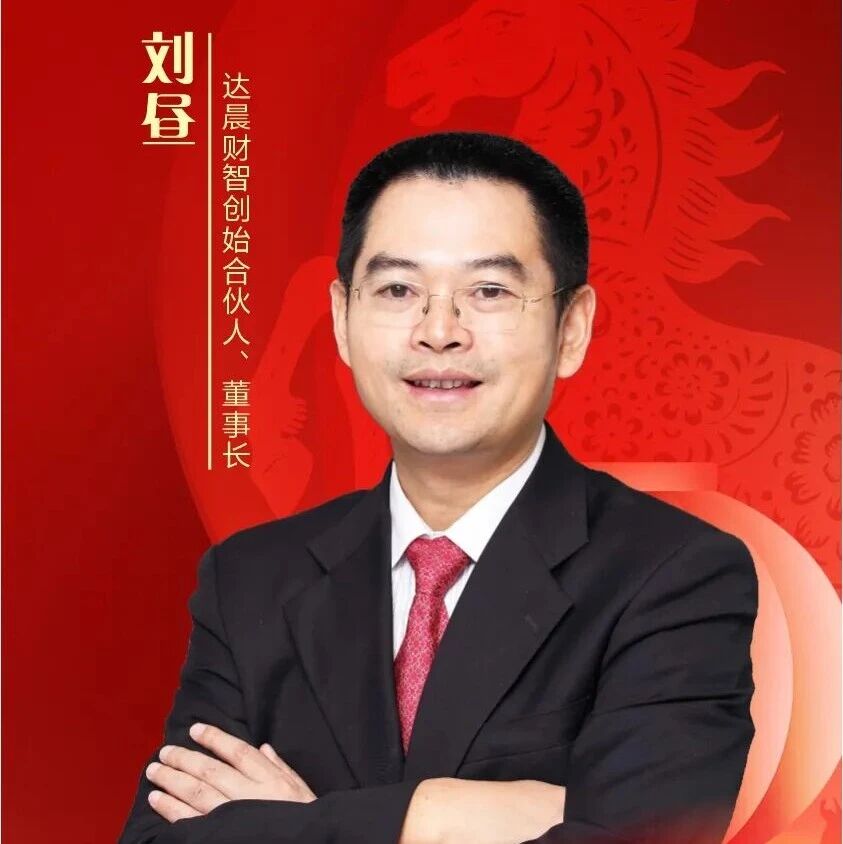
达晨财智刘昼:骏马奔腾迎新岁,坚韧笃行启华章丨创投贺新春
证券时报· 2026-02-16 14:19
Core Viewpoint - The article emphasizes the resilience and potential of the Chinese economy amidst global changes, highlighting the importance of innovation and investment in high-quality development as key drivers for future growth [5][6]. Fundraising - The company successfully completed the fundraising for a new fund and continued to gain trust from national-level funds and insurance capital, ensuring adequate resources to seize future opportunities [5]. Investment Strategy - The investment strategy focuses on "early-stage, small-scale, and technology-driven" investments, particularly in cutting-edge fields such as artificial intelligence, embodied intelligence, commercial aerospace, and life sciences [6]. Empowerment and Ecosystem - The company has established an efficient council mechanism within its listed company alliance, facilitating over 80 mutual visits among listed companies and forming a dedicated committee for artificial intelligence to enhance industry collaboration [7]. Exit Strategy - Successful exits include companies like YouSheng Aluminum and WoAn Robotics, with the anticipated listing of ZhiPu in Hong Kong marking a significant milestone for the company [7]. Future Outlook - The year 2026 is seen as pivotal for the "14th Five-Year Plan," with a focus on building a modern industrial system and enhancing the role of venture capital in driving technological self-reliance and high-quality development [8]. Technological Innovation - The article highlights the exponential growth of technological innovation, particularly in artificial intelligence, commercial aerospace, and biotechnology, as crucial elements for China's modernization and economic strength [8].

算力供不应求,智谱全网寻找合伙人
财联社· 2026-02-16 09:37
Core Insights - The article highlights the surge in global demand for GLM-5, leading to service issues such as queuing, response delays, and lag, which have affected user experience [1] - Despite multiple expansions of domestic chip clusters and the limited release of the GLM Coding Plan package, the company has not been able to fully resolve the supply-demand imbalance [1] - To enhance user experience, the company has launched a "Computing Power Partner" recruitment program aimed at optimizing GLM-5 through collaboration with chip manufacturers and computing partners [1] Group 1 - The company acknowledges the recent spike in demand for GLM-5, resulting in service disruptions [1] - The company has attempted to address the supply-demand issue through chip cluster expansions and limited product offerings, but challenges remain [1] - The "Computing Power Partner" initiative aims to collaborate with chip manufacturers and inference service providers to improve service performance [1]

AI“最强春节档”来了
财联社· 2026-02-16 07:41
Core Viewpoint - The article discusses the competitive landscape of AI models during the 2026 Spring Festival, highlighting significant investments from major tech companies and the emergence of new AI products, indicating a shift in the industry towards multi-modal AI models and increasing token consumption [4][5][6]. Group 1: AI Model Releases and Market Dynamics - Major tech companies are engaging in a "red envelope war" with substantial financial commitments, including Baidu's 500 million, Tencent's 1 billion, and Alibaba's 3 billion [4]. - A series of AI model releases, including ByteDance's Doubao 2.0 and others, signifies a strategic positioning in the AI market, with each release aiming to reshape industry dynamics [4][6]. - The rapid release of multi-modal AI models is expected to increase the demand for tokens, leading to a structural rise in token consumption [6][7]. Group 2: Token Consumption Trends - The daily token consumption for major AI models has seen exponential growth, with Volcano Engine's model reaching 63 trillion tokens daily by the end of 2025, up from 20 trillion at the end of 2024 [7][8]. - The overall daily token consumption in China is projected to escalate from 100 billion in early 2024 to 180 trillion by February 2026, indicating a significant increase in AI usage [7][9]. Group 3: Pricing and Market Implications - The global cloud computing market is experiencing a price increase, with major players like Amazon and Google raising their prices, prompting domestic companies to follow suit [10]. - Zhizhu's recent price hike for its GLM Coding Plan, with an increase of at least 30%, reflects the strong market demand and the need for enhanced service quality [10][11]. - The shift in the industry from measuring success by user engagement to token consumption indicates a new pricing strategy, allowing model providers to leverage their bargaining power [11]. Group 4: Investment Directions - Investment opportunities are identified in cloud service providers and infrastructure, as AI-driven IT spending continues to rise, benefiting from increased demand for GPU computing and storage [12]. - Large model providers that can maintain subscription retention and expand their enterprise presence in high ROI scenarios are positioned to thrive despite competitive pressures [12]. - The need for AI safety and governance tools is expected to grow as companies integrate AI into workflows, creating a demand for AI security platforms [13].
港股收红!
Shang Hai Zheng Quan Bao· 2026-02-16 06:23
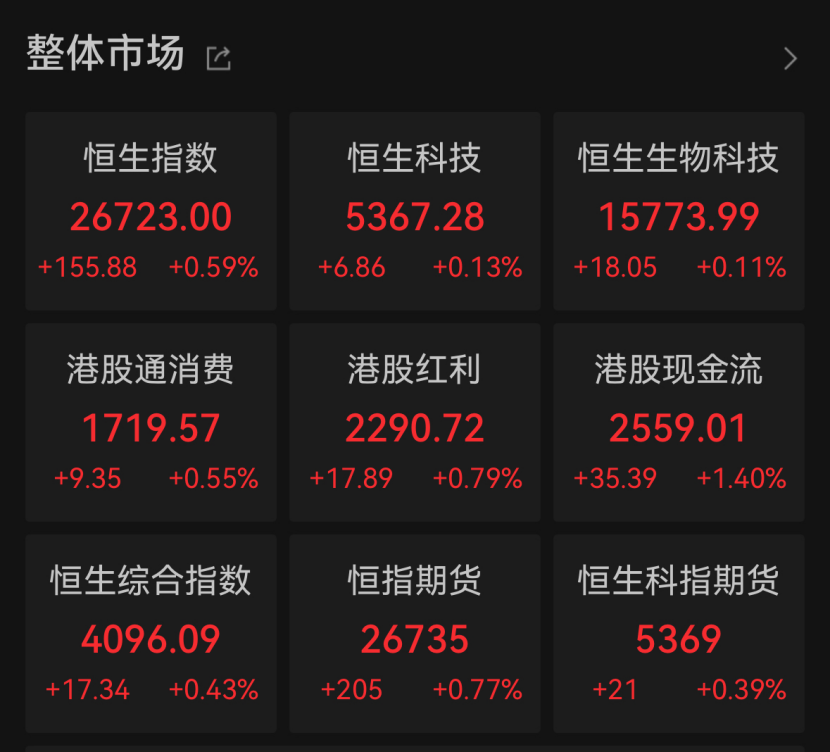
Market Performance - The Hong Kong stock market showed active performance on February 16, with major indices such as the Hang Seng Index, Hang Seng Tech Index, and Hang Seng Composite Index closing higher. The Hang Seng Index closed at 26,723 points, up 0.59% [1][2] - The Hang Seng Tech Index closed at 5,367.28 points, up 0.13%, while the Hang Seng Composite Index closed at 4,096.09 points, up 0.43% [1][2] Semiconductor Sector - The semiconductor sector in Hong Kong exhibited structural differentiation, with stocks like Zhaoyi Innovation and Lanke Technology reaching new highs, with Zhaoyi Innovation's stock price peaking at 435 HKD per share, up over 17% [2][3] - Major storage chip manufacturers are raising chip prices, with Kioxia expected to implement a revised pricing policy for North American customers starting Q1 2026, anticipating an average sales price increase of approximately 50% [2][3] AI Application Sector - The AI application sector in Hong Kong continued its upward trend, with Haizhi Technology Group's stock reaching a high of 125.6 HKD per share, closing at 120 HKD per share, up 29.59% [3] - MINIMAX-WP's stock hit a new high, rising 24.56%, while Zhiyu closed at 508 HKD per share, up 4.74% [3] Non-Ferrous Metals Sector - The non-ferrous metals sector strengthened, with the Wind Hong Kong Non-Ferrous Metals Index rising by 3.64%. Stocks like China Nonferrous Mining and Luoyang Molybdenum Co. saw gains of over 5% [3] - Other stocks in this sector, including Lingbao Gold and Jiangxi Copper, also experienced significant increases, with some rising over 3% [3] Gold Market - The gold market is experiencing a seasonal uptick in demand due to the traditional peak sales period before the Spring Festival, alongside diverse needs for gifting and investment, leading to increased gold consumption [5] Analyst Insights - Analysts from Huatai Securities noted that the Hong Kong market remains volatile, influenced by factors such as the US stock market, domestic consumption during the Spring Festival, and advancements in AI [6] - Recommendations include balanced allocation in the Hong Kong market, with a focus on semiconductor hardware, specialty consumption, and electrical equipment in the short term [6]
港股蛇年收官!AI应用板块大爆发
Sou Hu Cai Jing· 2026-02-16 06:10
Group 1 - The Hang Seng Index increased by over 30% throughout the year, closing with a rise of 0.52% on the last trading day before the Lunar New Year [1] - The Hang Seng Technology Index also showed a slight increase of 0.13% on the same day [1] - AI application concepts saw significant gains, with MINIMAX-WP rising by 24% and other companies in the sector, such as Zhiyuan and semiconductor firms, also experiencing notable increases [3] Group 2 - ByteDance announced the launch of the Doubao-Seed-2.0 model, optimized for large-scale production environments, enhancing capabilities in time series and motion perception [3] - Zhiyuan is planning a secondary listing on the STAR Market, with recent updates indicating a change in its IPO advisory firms [3] - Southbound funds have seen continuous net inflows for six weeks, with cross-border ETFs experiencing significant growth, totaling a net inflow of 313.87 billion yuan in February alone [3] Group 3 - GF Securities noted that the recent breakthrough of the Hang Seng Technology Index above the annual line indicates a release of emotional suppression, suggesting potential for market recovery [4] - The firm recommends gradual investments in technology leaders benefiting from the AI industry trend, while also highlighting the importance of monitoring the upcoming lock-up period for shares, which could involve nearly 100 billion yuan [4] - The market may find a temporary bottom if it adjusts to absorb selling pressure before the lock-up expiration [4]
AI大模型角逐“春节档”,这家京企火出圈
Xin Lang Cai Jing· 2026-02-16 05:42
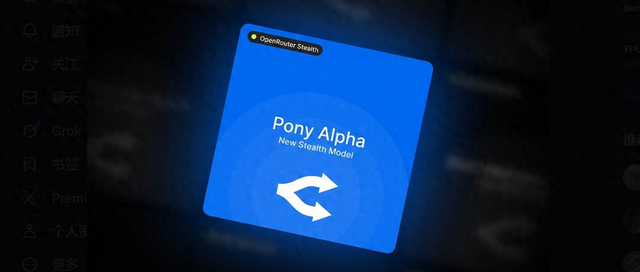
Core Insights - The article highlights the recent surge in the release of domestic AI models in China, particularly focusing on ByteDance's Seedance 2.0 and Zhiyu's GLM-5, which have gained significant attention in the global tech community [1][8] Group 1: Product Launches and Features - ByteDance launched the video generation model Seedance 2.0, which has received acclaim for its advancements in storyboard design, multi-shot narrative capabilities, and audio-visual matching [1] - Zhiyu's GLM-5, positioned as a foundational model for complex system engineering and long-range agent tasks, has demonstrated superior programming capabilities, surpassing competitors like Gemini3 Pro and ranking fourth globally among AI models [3] - The testing version of GLM-5, known as "Pony Alpha," was able to autonomously repair code and develop a usable C language compiler, showcasing its advanced capabilities [1][3] Group 2: Market Impact and Adoption - The release of GLM-5 has led to a significant increase in user demand, resulting in a price adjustment for subscription packages, with increases starting at 30% [7] - Following the launch of GLM-5, Zhiyu's market capitalization reached a record high, with shares peaking at 496 HKD, reflecting a more than threefold increase since its listing on January 8 [7] - The model's successful integration with various domestic chip manufacturers has enabled high throughput and low latency performance, enhancing its competitiveness in high-value engineering scenarios [7] Group 3: Global Recognition and Strategic Implications - International recognition of GLM-5 and Seedance 2.0 has been notable, with foreign tech leaders praising their capabilities, indicating China's rapid advancement in AI technology [8] - The developments in China's AI sector are attributed to its unique institutional advantages, market environment, and strategic focus on technological self-reliance, contrasting with other countries' approaches to AI development [8]
智谱:全球范围内对GLM-5的需求激增,全网寻找“算力合伙人”
Xin Lang Cai Jing· 2026-02-16 05:41
Core Insights - The company has experienced a surge in demand for GLM-5, leading to service delays and user experience issues due to exceeding planned access limits [1] - Despite multiple expansions of domestic chip clusters and limited sales of the GLM Coding Plan package, the company has not been able to fully resolve the supply-demand imbalance [1] - To enhance user experience, the company has launched a "Computing Power Partner" recruitment program aimed at optimizing GLM-5 through collaboration with chip manufacturers and service providers [1] Group 1 - The global demand for GLM-5 has significantly increased, resulting in service queuing and response delays [1] - The company has expanded its chip cluster capacity multiple times but still faces supply shortages [1] - The "Computing Power Partner" program includes collaboration with chip manufacturers for core technology interface optimization and building a more efficient inference network [1]
港股V形反弹!AI、半导体爆发,最牛新股5分钟飙涨32%
21世纪经济报道· 2026-02-16 05:15
Market Overview - The Hong Kong stock market experienced a V-shaped rebound on the last trading day before the Spring Festival, with the Hang Seng Index rising by 0.5% and the Hang Seng Tech Index increasing by 0.1% despite a drop of nearly 2% during the session [1][3]. Gold and Silver Market - Gold and silver stocks saw a collective rise, with Luoyang Molybdenum up over 6% and Zijin Mining and Ganfeng Lithium both rising over 4%. However, spot gold and silver prices fell sharply, with spot silver dropping over 3% and spot gold falling below $5,000 to touch $4,980 per ounce [3][6]. AI and Semiconductor Sector - AI concept stocks surged, with MINIMAX-WP soaring by 24.6% and Zhizhu rising by 4.74%, both reaching new highs since their listings. Douyin concept stock Duoxiangyun saw a peak increase of 40%. The "first AI stock to eliminate illusions," Chenghai Technology Group, experienced a dramatic rise of 32% within the first five minutes of trading, closing up 29.6% with a market value of HKD 48.1 billion. On February 13, Chenghai Technology Group's stock price increased by over 200% on its first trading day, marking it as the best-performing new stock of the year [3][4]. Institutional Insights - Institutions indicate that the Hong Kong stock market has the potential for short-term rebound momentum. Foreign capital is increasingly allocating to Chinese assets, particularly in the tech sector, with notable IPOs such as Wolong Nuclear Materials scheduled for February 13. The IPO of Lanke Technology attracted significant long-term investments from major firms like UBS Asset Management and JPMorgan Asset Management. According to Industrial Securities, the current market sentiment is at a relatively low point, with short-selling transactions accounting for approximately 19.2%, indicating potential for a short-term rebound [4][5].

港股蛇年收官:三大指数低开高走,恒指收涨0.52%全年累涨超32%,恒生科指涨0.13%盘中一度跌近2%,港股“AI双雄”齐创新高
Jin Rong Jie· 2026-02-16 05:05
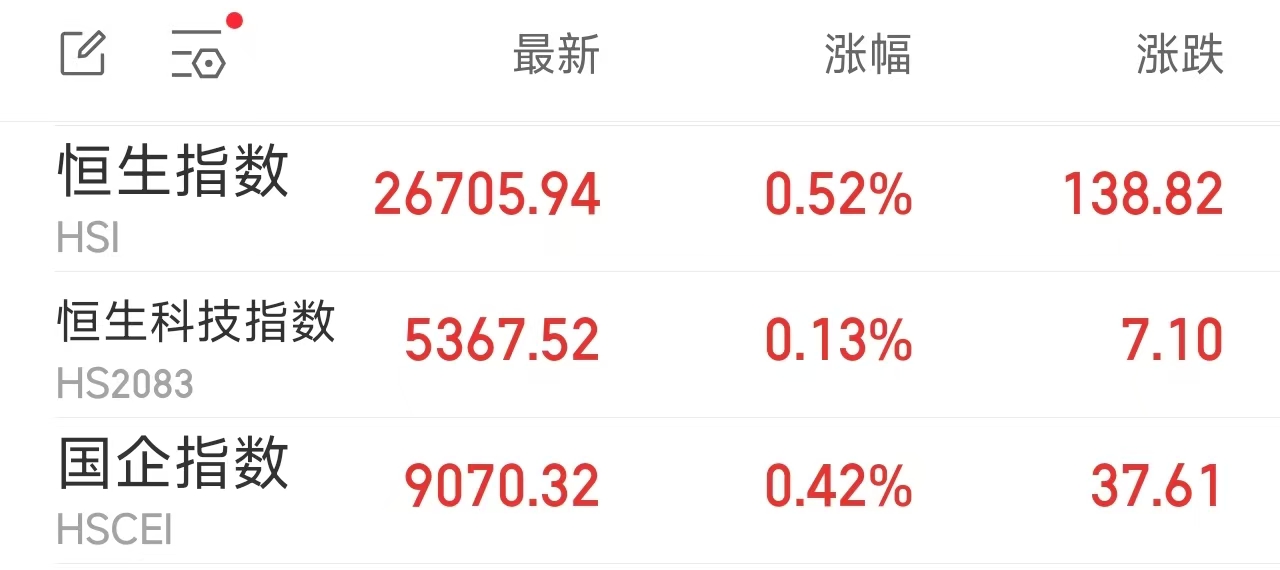
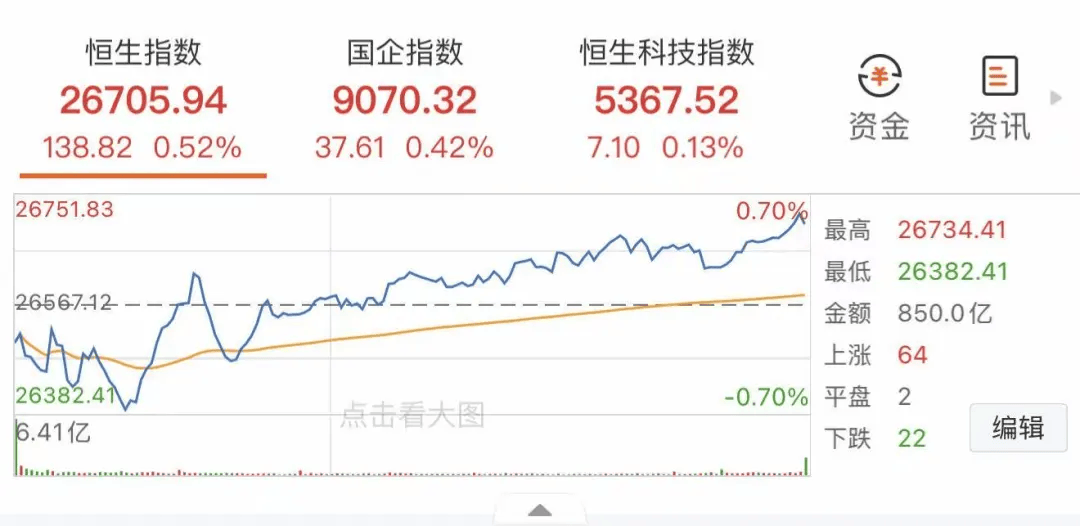
Market Performance - The Hong Kong stock market experienced a half-day trading session on February 16, with the Hang Seng Index closing up 0.52% at 26,705.94 points, the Hang Seng Tech Index up 0.13% at 5,367.52 points, and the National Enterprises Index up 0.42% at 9,070.32 points [1][2] - For the year of the Snake, the Hang Seng Index has increased by over 32%, the Hang Seng Tech Index by over 13%, and the National Enterprises Index by over 23% [1] Sector Performance - The precious metals, semiconductor, and oil & petrochemical sectors showed strength, while defense, consumer discretionary, and hardware equipment sectors underperformed [2] - Notable movements among major tech stocks included Alibaba down 0.26%, Tencent up 0.47%, JD.com down 2.26%, Xiaomi down 0.16%, NetEase up 2.32%, Meituan up 0.43%, Kuaishou up 0.15%, and Bilibili up 0.67% [2] AI Sector Developments - AI application stocks saw significant gains, with Hong Kong's AI leaders, Zhizhu and MiniMax-WP, reaching new highs, with Zhizhu up 4.74% and MiniMax-WP up 24.26% [4] - Zhizhu launched its flagship model GLM-5, which has gained popularity overseas, and announced a price increase for its AI programming subscription plan [5] Semiconductor Sector Insights - The semiconductor sector showed strength, with stocks like Zhaoyi Innovation and Lanke Technology rising over 17%, closing at increases of 9.78% and 14.05% respectively [7] - A price increase trend in storage chips is emerging, with Kioxia expected to raise average selling prices by approximately 50% starting Q1 2026, which is anticipated to significantly improve profitability in the NAND industry [9][10] Precious Metals Market - The precious metals sector is experiencing a surge, with companies like Luoyang Molybdenum rising over 5% and others like Zijin Mining and Ganfeng Lithium also seeing gains of over 4% [6] - Analysts from ANZ have raised their Q2 gold price forecast from $5,400 to $5,800 per ounce, citing ongoing structural drivers despite recent price corrections [6]