豆包大模型2.0系列

Search documents
谁在消耗5万亿模型算力?
经济观察报· 2026-03-08 03:49
Core Insights - The article highlights a significant shift in the usage of artificial intelligence (AI) models, particularly in the context of token consumption, indicating a transition from traditional question-answering models to more complex agent-based models that perform multi-step tasks [2][3][6]. Token Consumption Trends - In February 2026, China's AI models achieved a weekly token consumption of 5.16 trillion, surpassing the U.S. models for the first time, reflecting a 127% increase over three weeks [2]. - The OpenRouter platform, which aggregates global AI model interfaces, reported that programming task tokens rose from 11% to over 50% of total token usage, indicating a shift towards more complex applications [6]. Application Shifts - The transition to agent-based models allows for continuous task execution in the background, leading to exponential growth in token consumption per session [6][8]. - Multi-modal applications, such as video generation, significantly increase token consumption, with a 10-second video requiring approximately 350,000 tokens [7][8]. Industry Impact - The surge in token consumption is primarily supported by high-frequency, scalable commercial applications across sectors like internet, finance, cross-border e-commerce, and entertainment [9]. - Key application areas include enterprise-level solutions (e.g., intelligent customer service, marketing automation), content generation services, and AI-generated content tools [9]. Market Dynamics - The competitive landscape is shifting as domestic AI chip manufacturers gain opportunities due to changing procurement standards, moving from a focus on training costs to operational efficiency and cost-effectiveness [4][14]. - The pricing of Chinese AI models is significantly lower than their overseas counterparts, with input prices around $0.3 per million tokens compared to $5 for similar foreign products [10]. Infrastructure Developments - The launch of the Zhengzhou core node, capable of supporting over 30,000 domestic acceleration cards, marks a significant advancement in China's AI computing infrastructure [18]. - The deployment of large-scale AI computing clusters is enabling various applications, including simulations for the automotive industry and support for luxury brands [19]. Financial Performance - Domestic AI chip manufacturers are experiencing explosive growth, with companies like Cambrian achieving a revenue increase of 453.21% in 2025, driven by rising demand for AI computing power [20]. - The market penetration of domestic AI chip brands has increased from approximately 29% in 2024 to 42% in 2025, indicating a shift towards local solutions in the AI sector [21].



未知机构:重视国内液冷制冷产业链字节seedance20应用爆发-20260227
未知机构· 2026-02-27 02:15
Summary of Key Points from Conference Call Industry Overview - Focus on the domestic liquid cooling and refrigeration industry chain, highlighting the increasing demand for AI infrastructure driven by domestic computing power needs [1][2] Company Highlights ByteDance - On February 12, ByteDance launched the next-generation AI video generation model, Seedance 2.0 [1] - On February 14, ByteDance introduced the Doubao model 2.0 series, which includes three general-purpose models (Pro, Lite, Mini) and a Code model specifically designed for programming scenarios [1] - The ByteDance chip R&D team has over 1,000 members, with more than 500 focused on AI chip development, approximately 200 in the CPU team, and expansions in the VPU (Video Processing Unit) and DPU (Data Processing Unit) teams [1] Feirongda - Feirongda is a leading company in liquid cooling, having established a comprehensive layout with major domestic and international clients [1] - The company achieved mass supply of server liquid cooling solutions in 2025 and is transitioning from a supplier of cooling materials and modules to a provider of complete liquid cooling solutions by 2026, enhancing its value and industry position [1] Gaolan Co., Ltd. - Gaolan Co., Ltd. is a leader in ultra-high voltage pure water cooling equipment, with liquid cooling solutions for data centers tied to major domestic clients such as ByteDance and others [2] - The establishment of overseas subsidiaries is expected to facilitate international expansion and volume growth [2]


AI人工智能ETF(512930)涨超1%,春节期间海内外催化不断
Xin Lang Cai Jing· 2026-02-24 01:52
Core Viewpoint - The artificial intelligence (AI) industry is experiencing a significant surge, driven by the release of new AI models and a shift in focus towards productivity and efficiency in AI applications [1][2]. Group 1: Market Performance - As of February 24, 2026, the CSI Artificial Intelligence Theme Index (930713) rose by 1.29%, with notable gains from stocks such as Runze Technology (up 20.00%), Beijing Junzheng (up 3.52%), and Xiechuang Data (up 2.88%) [1]. - The AI Artificial Intelligence ETF (512930) increased by 1.10%, with the latest price reported at 2.3 yuan [1]. Group 2: Industry Developments - During the Spring Festival, both domestic and international AI developments accelerated, with major companies releasing updated AI models, including ByteDance's Seedance 2.0, Alibaba's Qwen 3.5, and Google's Gemini 3.1 Pro [1]. - The focus of the current AI model updates has shifted from a "parameter competition" to a "productivity competition," emphasizing the ability of models to solve complex real-world tasks [1]. Group 3: Index Composition - The CSI Artificial Intelligence Theme Index comprises 50 listed companies that provide foundational resources, technology, and application support for AI, reflecting the overall performance of AI-related securities [1]. - As of January 30, 2026, the top ten weighted stocks in the index include Zhongji Xuchuang, Xinyi Sheng, and Hanwujing, accounting for a total of 57.27% of the index [2].
海外AI行业周报春节成为C端AI全民普及拐点,国产大模型跻身全球第一梯队
KAIYUAN SECURITIES· 2026-02-24 00:35
Investment Rating - The industry investment rating is "Positive" (maintained) [1] Core Insights - The report highlights that the 2026 Spring Festival marks a critical turning point for the widespread adoption of AI applications among consumers in China, transitioning from technical parameter competition to user experience and commercial closure [15][13] - The competition landscape in the C-end AI sector is characterized by a leading player, ByteDance, and two strong competitors, Alibaba and Tencent, with smaller firms facing increasing pressure [15][13] - AI applications are evolving from simple question-answering tools to executable task agents, emphasizing the importance of scenario adaptation capabilities [15][13] - The report recommends focusing on leading companies with robust AI deployment and ecosystem barriers, such as Alibaba, Baidu, and Pinduoduo, while also highlighting the rapid growth of domestic AI chips [4][7] Summary by Sections Internet Sector - The report emphasizes the synergy between AI commercialization and anti-involution policies, with ByteDance leading the C-end AI race through its content ecosystem and Alibaba enhancing its consumer engagement via the Qwen3.5 model [10][16] - The Spring Festival serves as a peak traffic period, significantly boosting user engagement and retention for AI applications [15][13] Smart Driving - Tesla's Cybercab, the first mass-produced autonomous vehicle, is set to launch in April 2026, aiming for a production capacity of 2 million units annually, with a target price below $30,000 [21][22] AI Developments - OpenAI's valuation is projected to reach $850 billion, with revenue forecasts exceeding previous targets, while Google’s Gemini 3.1 Pro shows significant improvements in abstract reasoning capabilities, outperforming competitors [24][26] - Domestic AI models, such as those from Zhiyuan and MiniMax, are gaining recognition, with significant stock price increases reflecting market confidence [33][6] Investment Recommendations - The report suggests focusing on AI commercialization and application expansion in the internet sector, recommending stocks like Alibaba, Pinduoduo, and Baidu [43] - In the computer sector, it highlights opportunities arising from increased IT spending by state-owned enterprises, recommending companies like Kingdee International and Baidu [43] - The automotive sector is poised for growth with the approval of L3 autonomous driving trials, with recommended stocks including XPeng Motors and Tesla [43]
明天是A股节后首个交易日,机构解读春节四大变量影响
2 1 Shi Ji Jing Ji Bao Dao· 2026-02-23 11:27
Group 1: Tariff Policy Changes - The U.S. Supreme Court ruled against certain tariffs under the IEEPA, affecting approximately half of the tariffs and potentially requiring the government to refund over $175 billion in taxes [3] - The Trump administration quickly shifted to impose a temporary 10% import tariff under the Trade Act of 1974, which was later raised to 15% [3] - Analysts suggest that the new tariffs could raise the average tariff level in the U.S. to between 11% and 18%, indicating ongoing trade tensions [3][4] Group 2: AI and Robotics Industry Growth - The Spring Festival Gala showcased humanoid robots, leading to a significant increase in search and order volumes on platforms like JD.com, indicating strong market interest [5][6] - The humanoid robot index surged after the Spring Festival Gala in 2025, with domestic orders exceeding 4.6 billion yuan, highlighting the industry's nearing commercialization [6] - Major companies like ByteDance and Alibaba have made significant advancements in AI technology, with applications gaining widespread user engagement [7] Group 3: Currency Strength and Market Impact - The Chinese yuan appreciated significantly, reaching the 6.89 range against the U.S. dollar, with a cumulative increase of nearly 1.3% since February [8][9] - Analysts predict that the yuan's strength will enhance the attractiveness of yuan-denominated assets, leading to a trend of foreign capital inflow into Chinese markets [8][9] - The appreciation of the yuan is expected to positively impact the stock, bond, and currency markets, with a notable focus on A-shares and government bonds [8][9] Group 4: Geopolitical Uncertainty - Ongoing geopolitical tensions, particularly between Russia and Ukraine and the U.S. and Iran, are contributing to market volatility [10][11] - The lack of substantial progress in negotiations between Russia and Ukraine, along with escalating tensions in the U.S.-Iran relationship, are key factors influencing global market sentiment [10][11] - Analysts highlight that geopolitical events often lead to price fluctuations in commodities, with gold and oil being critical hedging tools in uncertain times [10][11]
中国银河策略:地缘风险叠加关税风险,港股节后行情怎么看?
Jin Rong Jie· 2026-02-23 07:57
Market Performance - During the week from February 16 to February 20, the Hong Kong stock market experienced fluctuations with the Hang Seng Index declining by 0.58% to 26,413.25 points, the Hang Seng Tech Index falling by 2.78% to 511.50 points, and the Hang Seng China Enterprises Index decreasing by 0.81% to 8,959.56 points [1][6][30] - Among the primary sectors, 8 sectors saw gains while 3 sectors experienced losses. The energy, materials, and industrial sectors had the highest increases, rising by 3.65%, 2.27%, and 1.03% respectively. Conversely, the consumer discretionary, consumer staples, and communication services sectors faced the largest declines, dropping by 1.86%, 1.50%, and 0.13% respectively [1][7][30] Market Liquidity - Due to the Spring Festival holiday, the Hong Kong stock market only operated for half a day on February 16, with a trading volume of HKD 850.56 billion. On February 20, the trading volume was HKD 1,654.61 billion, which is lower than the previous week's average daily trading volume of HKD 2,406.43 billion. The short-selling amount was HKD 237.27 billion, accounting for 14.43%, significantly higher than the previous week's average of 12.56% [2][13][15] Valuation and Risk Premium - As of February 20, 2026, the PE and PB ratios of the Hang Seng Index were 12.09 times and 1.23 times, respectively, placing them at the 79% and 55% percentiles since 2010. The Hang Seng Tech Index had PE and PB ratios of 21.51 times and 2.83 times, respectively, at the 18% and 49% percentiles since 2010 [3][17][22] - The risk premium of the Hang Seng Index was calculated at 4.19%, which is at the 5% percentile since 2010, while the risk premium based on the 10-year Chinese government bond yield was 6.48%, at the 42% percentile since 2010 [3][19][21] Investment Outlook - The geopolitical risks in the Middle East are rising, which may lead to increased volatility in energy and precious metals sectors. The U.S. is exerting pressure on Iran, with potential military actions being considered [4][9][30] - The consumer sector is currently valued relatively low, and with increasing consumer promotion policies, there is potential for growth in this sector [4][30] - The technology sector remains a long-term investment focus, with reduced valuation pressure following recent corrections, and is expected to rebound due to accelerated AI model updates and applications [4][30]

地缘风险叠加关税风险,港股节后行情怎么看?
Zhong Guo Yin He Zheng Quan· 2026-02-23 05:45
Investment Rating - The report does not explicitly state an investment rating for the industry [1]. Core Insights - Geopolitical risks and tariff risks are impacting the Hong Kong stock market, with a focus on how these factors will influence market performance post-holiday [1]. - The report highlights that the U.S. GDP growth rate for Q4 2025 was 1.4%, significantly below the expected 2.5%, indicating a slowdown in the U.S. economy [2][44]. - The report suggests that the recent increase in U.S. tariffs from 10% to 15% on global goods may lead to heightened investor risk aversion, benefiting sectors like precious metals and energy [2][46]. - The consumption sector is currently at a relatively low valuation, with potential for growth as consumer policies increase [2][46]. - The technology sector remains a long-term investment focus, with reduced valuation pressure and potential for rebound due to advancements in AI [2][46]. Market Review - During the week of February 16 to February 20, 2026, the Hong Kong stock market saw declines, with the Hang Seng Index down 0.58% to 26,413.25 points, the Hang Seng Tech Index down 2.78% to 511.50 points, and the Hang Seng China Enterprises Index down 0.81% to 8,959.56 points [4][6]. - Among the primary sectors, 8 sectors increased while 3 sectors decreased, with energy, materials, and industrial sectors showing the highest gains [6][14]. - The trading volume was affected by the Spring Festival, with a total turnover of HKD 850.56 billion on February 16 and HKD 1,654.61 billion on February 20, lower than the previous week's average [14][18]. Valuation and Risk Premium - As of February 20, 2026, the PE and PB ratios for the Hang Seng Index were 12.09 and 1.23, respectively, placing them at the 79% and 55% percentiles since 2010 [22][29]. - The risk premium for the Hang Seng Index was calculated at 4.19%, indicating a low-risk environment compared to historical data [29][31]. - The report notes that the dividend yields for the energy and communication services sectors are above 5%, suggesting stable income opportunities for investors [36][41]. Investment Outlook - The report recommends focusing on sectors that may benefit from geopolitical tensions and tariff adjustments, particularly precious metals and energy [46]. - The consumption sector is expected to gain momentum as consumer policies are implemented, while the technology sector is anticipated to rebound due to advancements in AI [46].
产品涨价、股价飙升,中国AI大模型龙头“爆”了!
Mei Ri Jing Ji Xin Wen· 2026-02-22 13:05
Core Insights - The two AI companies, Zhipu and MiniMax, have seen significant stock price increases, with Zhipu rising over 42% on the first trading day of the Year of the Horse, and MiniMax increasing over 14% on the same day, leading to market capitalizations exceeding 300 billion HKD [1][2][7] - Both companies have experienced substantial growth since their IPOs, with Zhipu's stock price increasing by 523% and MiniMax's by 487.88% within a month of their listings [1][7] - Despite their high valuations, both companies are currently operating at a loss, with a price-to-sales ratio (PS) exceeding 700, significantly higher than OpenAI's 65 [2][17] Company Performance - Zhipu's stock closed at 725 HKD per share, with a market capitalization surpassing 323.2 billion HKD, while MiniMax closed at 970 HKD per share, reaching a market cap of 304.2 billion HKD [2][11] - Zhipu's cumulative losses from 2022 to mid-2025 amount to approximately 6.238 billion CNY, while MiniMax reported a net loss of 512 million USD (around 3.605 billion CNY) for the first nine months of 2025 [17][20] Market Position - Zhipu and MiniMax's market capitalizations have surpassed those of major companies like Ctrip and Kuaishou, and are approaching the valuations of Pop Mart and Baidu [2][11] - The market's enthusiasm for these companies is attributed to their technological advancements and product breakthroughs, particularly in AI model development [12][19] Technological Advancements - Zhipu launched its flagship model GLM-5, which has shown over a 20% performance improvement compared to its predecessor, while MiniMax introduced M2.5, designed for full-stack programming development [12][13] - Both models have achieved significant performance metrics in industry benchmarks, with MiniMax M2.5 being the most called model in a recent week, reaching 3.07 trillion tokens [14][16] Pricing Strategy - Following the launch of GLM-5, Zhipu raised the prices of its coding plans by 30% in China and over 100% internationally, indicating strong demand for its services [12][19] - MiniMax's pricing for token usage is significantly lower than that of competitors like Claude Opus 4.6, making it an attractive option for users [14][15] Future Outlook - The market is betting on the future potential of these companies, as the demand for AI capabilities continues to grow, particularly in areas requiring high token consumption for complex tasks [19][20] - Analysts suggest that the transition of AI from simple tasks to more complex operations will drive up token consumption, positioning these companies favorably in the evolving AI landscape [19]

AI“百模大战”,春节爆发!
Xin Lang Cai Jing· 2026-02-21 10:02
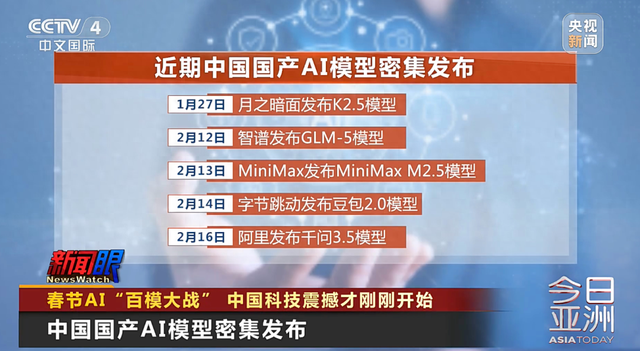
Group 1 - The core viewpoint is that China's technology industry has initiated an AI "hundred model war," with a series of domestic AI models being released and upgraded, indicating that the impact of Chinese technology on the world is just beginning [1][17]. - Multiple Chinese tech companies, including Moonlight Dark Side, Zhiyu, and Xiyu Technology, have launched new generation AI large models since before the Spring Festival, with ByteDance releasing the Doubao Model 2.0 series on February 14, enhancing its ability to perform complex real-world tasks [3][5]. - The Seedance 2.0 video generation model was officially launched by ByteDance, showcasing its capabilities during the 2026 Spring Festival Gala, where it animated a traditional Chinese ink painting, demonstrating advanced motion and camera control [7][9]. Group 2 - The release of Seedance 2.0 has sparked global discussions, with industry insiders noting that the focus on video and image generation models represents the next stage of AI technology, with breakthroughs occurring sooner than previously expected [11]. - The recent upgrades in domestic AI models emphasize the development of "AI agents," which are designed to perform more complex tasks beyond basic language communication, resembling intelligent assistants [13]. - Alibaba released the new base model Qianwen 3.5 on February 16, which supports mixed visual and text pre-training and significantly enhances capabilities in problem-solving, spatial reasoning, and video understanding [15]. Group 3 - Following the release of domestic models, several Chinese chip companies announced compatibility with these models, indicating that they can run effectively on their chips, achieving expected performance levels [15][17]. - Huawei's Ascend chips are providing training support for domestic large models, showcasing China's rapid progress in AI despite export controls, with innovations emerging from demand-driven needs [17].

互联网巨头AI超级入口的第一战场
Sou Hu Cai Jing· 2026-02-16 20:06
Core Viewpoint - The article discusses the intense competition among major internet companies during the Spring Festival, particularly focusing on the rise of AI applications and the strategic battles for user engagement and market share in the AI sector [3][4][37]. Group 1: AI Competition Landscape - The Spring Festival has become a battleground for internet giants to compete for traffic, with significant events like the 2015 payment war and the 2020 short video competition [3][4]. - In 2025, a new player, DeepSeek, emerged, surpassing existing applications in daily active users, indicating a shift in the AI market landscape [4]. - By 2026, the competition intensified, with major companies preparing extensively for the Spring Festival, marking it as a critical moment for AI applications [4][5]. Group 2: Model Updates and Innovations - Major companies like Baidu, Alibaba, and ByteDance have updated their AI models recently, with Baidu's Wenxin 5.0 featuring 2.4 trillion parameters and advanced multi-modal capabilities [6][8]. - Alibaba's Qwen3-Max-Thinking model, with over a trillion parameters and 36 trillion tokens of pre-training data, enhances its tool-calling capabilities [8][10]. - ByteDance launched several models, including Seedance 2.0 and Seedream 5.0 Lite, which significantly improved video and image generation capabilities [10][14][15]. Group 3: AI Super Entry Points - Companies are focusing on creating AI super entry points that integrate their core business models, such as Baidu's AI+search and Alibaba's AI+e-commerce [21][25]. - Alibaba's launch of the Qwen APP aims to enhance the e-commerce experience by integrating various services into a single platform [25][28]. - Tencent's Yuanbao group chat feature incorporates AI to enhance user interaction and engagement, including a cash red envelope feature during the Spring Festival [30][32]. Group 4: Cash Incentives and User Engagement - Major companies are investing heavily in cash incentives to attract users, with Tencent announcing a 1 billion yuan cash giveaway and Baidu offering 500 million yuan in red envelopes [35][37]. - The competition for user attention and brand recognition is driving these cash distribution strategies, as companies aim to establish their AI super entry points [37].