上海家化

Search documents
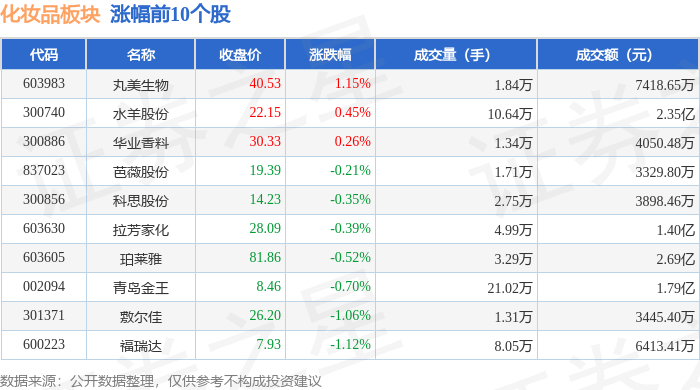
化妆品板块9月12日跌1.22%,上海家化领跌,主力资金净流出2.11亿元
Zheng Xing Xing Ye Ri Bao· 2025-09-12 08:37
Group 1 - The cosmetics sector experienced a decline of 1.22% on September 12, with Shanghai Jahwa leading the drop [1][2] - The Shanghai Composite Index closed at 3883.69, up 0.22%, while the Shenzhen Component Index closed at 12996.38, up 0.13% [1] - Major stocks in the cosmetics sector showed mixed performance, with Marubi Biological and Water Sheep shares increasing by 1.15% and 0.45% respectively, while Shanghai Jahwa fell by 4.07% [1][2] Group 2 - The net outflow of main funds in the cosmetics sector was 211 million yuan, while retail investors saw a net inflow of 113 million yuan [2][3] - Specific stocks like Water Sheep and LaFang Home had varying net inflows and outflows, with Water Sheep seeing a net inflow of 14.77 million yuan from main funds [3] - Shanghai Jahwa and other companies like Beitaini and Furuida experienced significant net outflows from main funds, indicating potential investor concerns [3]


研判2025!中国壳聚糖行业产业链、市场规模及重点企业分析:天然可降解材料需求激增,行业应用加速拓展[图]
Chan Ye Xin Xi Wang· 2025-09-12 01:49
Core Insights - The market demand for chitosan is increasing due to growing concerns about food safety, healthcare, and environmental protection, with the market size in China projected to reach 758 million yuan in 2024, representing a year-on-year growth of 19.37% [1][7]. Industry Overview - Chitosan is a natural biodegradable biopolymer derived from chitin, primarily sourced from the shells of crustaceans and certain fungi and plants [2][4]. - The unique physical and chemical properties of chitosan, influenced by its degree of deacetylation, allow for a wide range of applications across various sectors [2][4]. Industry Chain - The upstream of the chitosan industry includes raw materials such as crustacean shells, insects, fungi, and chemicals like hydrochloric acid and sodium hydroxide [5]. - The midstream involves the production and manufacturing of chitosan, while the downstream applications span pharmaceuticals, food preservation, cosmetics, environmental protection, agriculture, textiles, and paper [5][6]. Market Size - The chitosan industry in China is expected to grow significantly, with applications in food preservation, medical materials, and as an eco-friendly alternative to traditional plastics [1][7]. Key Companies - Jiangsu Kangting Biotechnology Co., Ltd. is a major player in the chitosan industry, focusing on research, production, and sales, with a wide range of applications in health foods, medical devices, and agriculture [8][9]. - Shandong Weikang Biomedical Technology Co., Ltd. specializes in marine sugar bioengineering, emphasizing research and development in chitosan and its derivatives [9]. Industry Development Trends 1. Continuous technological innovation is crucial for industry upgrades, with new extraction methods like enzyme extraction and supercritical fluid extraction expected to replace traditional methods [10][11]. 2. The application of chitosan is expanding into emerging fields beyond traditional sectors, including its use as a natural preservative and in high-end medical products [10][11]. 3. The industry's strategic value is highlighted by the push for sustainable development and carbon neutrality, with international competition driving technological upgrades and collaborations [11].


【干货】功能性护肤品产业链全景梳理及区域热力地图
Qian Zhan Wang· 2025-09-11 06:25
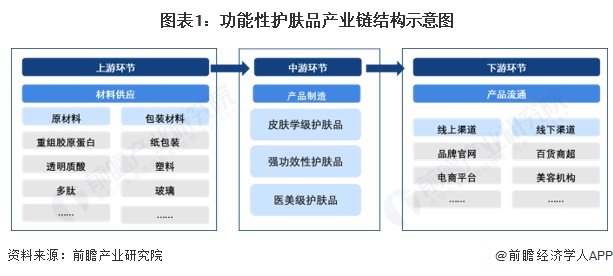
Core Insights - The article discusses the functional skincare product industry in China, highlighting key players, market dynamics, and recent developments in the sector [1][10]. Industry Overview - The functional skincare industry is segmented into upstream (raw materials and packaging), midstream (manufacturing), and downstream (distribution) [1][3]. - Key raw materials include recombinant collagen, hyaluronic acid, and peptides, while packaging materials consist of paper, plastic, and glass [1][3]. Key Players - Major companies in the functional skincare sector include Betaini, Huaxi Biological, Shanghai Jahwa, and international brands like L'Oréal and Estée Lauder [3][10]. - Upstream suppliers include Kesheng Co., Qingsong Co., and Linsen Biological, while contract manufacturers include Norsbel, Cosme, and Yingteli [3]. Regional Distribution - The majority of functional skincare companies are located in China's eastern coastal regions, with Shanghai and Guangdong having the most comprehensive distribution of industry players [5][7]. Recent Developments - Betaini is focusing on its Winona brand for sensitive skin, investing nearly 500 million yuan in a new central factory with an expected annual output value of 5 billion yuan [10][11]. - Huaxi Biological plans to invest over 100 million yuan in strategic innovation and expand production capacity in multiple cities [10][11]. - Shanghai Jahwa is establishing an innovation center for synthetic biology to develop new functional ingredients [10][11]. - Other companies like Chuang'er Biological and Fulejia are also expanding their production capabilities and investing in new technologies [10][11].
薇诺娜、可复美等主打功效型的国货护肤品,护城河在哪?
Ge Long Hui· 2025-09-10 11:35
Core Viewpoint - The domestic functional skincare brands in China are facing challenges despite achieving significant sales during promotional events like Double 11, with concerns over product quality and market positioning becoming increasingly prominent [1][2][3]. Group 1: Market Overview - The Chinese skincare market has evolved over the past fifty years, starting from local brands like Meijiajing and Yumeijing in the 70s and 80s to the dominance of international brands such as Estée Lauder and L'Oréal, which now hold over 60% market share [2]. - As consumer expectations have shifted towards products that address specific skin issues, domestic brands struggle to compete against established international labels that have ingrained safety and efficacy perceptions in consumers' minds [2]. Group 2: Brand Strategies - Brands like Winona and Yuze have focused on soothing sensitive skin and barrier repair, capitalizing on a market trend that prioritizes these attributes over traditional Japanese skincare concepts [3][4]. - The success of domestic brands is heavily reliant on online sales channels, with companies like Betaini (Winona's parent company) reporting that 82.34% of their sales came from online platforms in 2021 [5]. Group 3: Financial Metrics - Domestic brands face high customer acquisition costs, with sales expense ratios for Betaini, Giant Biological, and Shanghai Jahwa at approximately 46%, 22%, and 40% respectively, compared to international brands like L'Oréal and Estée Lauder at around 30% and 25% [7]. - Research and development (R&D) expenditure remains low for many domestic brands, with Betaini's R&D rate at 2.99% and Giant Biological at 1.6%, significantly lower than international competitors like Shiseido at 4.3% [7]. Group 4: Future Challenges - Despite positive sales trends, the core competitiveness of domestic skincare brands hinges on their R&D capabilities, which need to improve to compete with international brands that showcase advanced technologies at events like the China International Import Expo [8][9]. - The overall market for domestic skincare is entering a new cycle, with uncertainty about which brands will successfully navigate the challenges ahead [10].
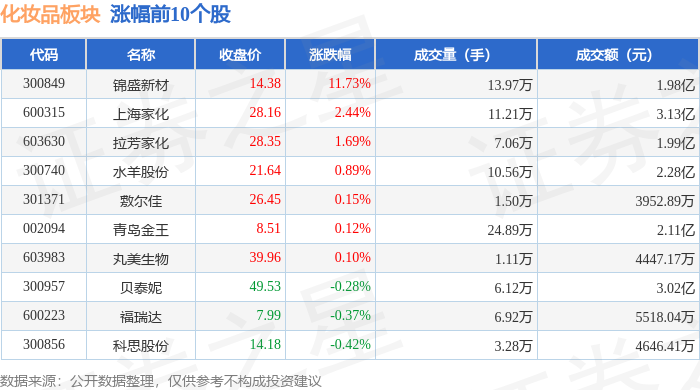
化妆品板块9月10日涨0.22%,锦盛新材领涨,主力资金净流出1099.12万元
Zheng Xing Xing Ye Ri Bao· 2025-09-10 08:39
Group 1 - The cosmetics sector experienced a slight increase of 0.22% on September 10, with Jinsheng New Materials leading the gains [1] - The Shanghai Composite Index closed at 3812.22, up 0.13%, while the Shenzhen Component Index closed at 12557.68, up 0.38% [1] - Jinsheng New Materials saw a significant rise in its closing price to 14.38, reflecting an increase of 11.73% with a trading volume of 139,700 shares and a transaction value of 198 million yuan [1] Group 2 - The cosmetics sector faced a net outflow of 10.99 million yuan from institutional investors and 78.76 million yuan from retail investors, while individual investors saw a net inflow of 89.75 million yuan [2] - The trading data indicates that Jinsheng New Materials had a net inflow of 24.75 million yuan from institutional investors, despite a net outflow from retail and speculative investors [3] - Qingdao Kingway and Beitaini also reported net inflows from retail investors, while other companies like Shanghai Jahwa and Marubi experienced net outflows from both institutional and speculative investors [3]


上海家化涨2.00%,成交额1.52亿元,主力资金净流出102.38万元
Xin Lang Zheng Quan· 2025-09-10 05:34
Company Overview - Shanghai Jahwa United Co., Ltd. is located at 11F, Shuangshi Hui Building A, 399 Dongchangzhi Road, Hongkou District, Shanghai, established on December 1, 1995, and listed on March 15, 2001. The company specializes in the research, production, and sales of skincare, personal care, household cleaning, and maternal and infant products [1]. Financial Performance - As of June 30, 2025, Shanghai Jahwa achieved a revenue of 3.478 billion yuan, representing a year-on-year growth of 4.75%. The net profit attributable to shareholders was 266 million yuan, reflecting an increase of 11.66% year-on-year [2]. - The company has distributed a total of 3.569 billion yuan in dividends since its A-share listing, with 318 million yuan distributed over the past three years [3]. Stock Performance - On September 10, Shanghai Jahwa's stock price increased by 2.00%, reaching 28.04 yuan per share, with a trading volume of 152 million yuan and a turnover rate of 0.82%. The total market capitalization stood at 18.849 billion yuan [1]. - Year-to-date, the stock price has risen by 65.82%, with a 6.29% increase over the last five trading days, 28.39% over the last 20 days, and 31.52% over the last 60 days [1]. Shareholder Structure - As of June 30, 2025, the number of shareholders increased to 37,800, a rise of 10.15% from the previous period. The average circulating shares per person decreased by 9.22% to 17,804 shares [2]. - Among the top ten circulating shareholders, Hong Kong Central Clearing Limited is the second-largest shareholder with 32.7782 million shares, an increase of 15.0639 million shares from the previous period. New entrant招商产业精选股票A holds 3.4 million shares, while 富国研究精选灵活配置混合A has exited the top ten list [3]. Business Segmentation - The revenue composition of Shanghai Jahwa includes personal care products (45.70%), beauty products (21.48%), overseas sales (20.20%), innovation (12.55%), and other segments (0.06%) [1].
上海家化20250909
2025-09-09 14:53
Summary of Conference Call for 嘉化公司 Company Overview - 嘉化公司 has undergone significant organizational restructuring since Q4 2023, establishing brand, e-commerce, and market management teams to enhance communication efficiency and integrate offline sales departments for 10 private brands [4][2]. Key Points and Arguments - **Channel Inventory Management**: The company has initiated a channel inventory cleanup, reducing 百草集百货's inventory turnover days to approximately 89 days, indicating a more comprehensive inventory status [5][2]. - **Brand Hierarchy Adjustment**: The brand hierarchy has been redefined, with 玉泽 and 六神 in the first tier, and 百草集 and 美加净 in the second tier. This restructuring aims to enhance brand positioning and product offerings [6][2]. - **Product Launches and Market Focus**: - 六神 is focusing on price control and has launched the 驱蚊弹 2.0, targeting over 100 million in sales in its launch year, with a significant increase in sales compared to the previous version [7][2]. - 玉泽 has returned to a growth trajectory with double-digit growth driven by brand repositioning, new product launches, and improved e-commerce capabilities [8][2]. - 佰草集 plans to promote new product lines, including 新七白, 修护线, and 抗老线, with expectations of strong online sales performance [11][2]. - **Market Strategy for 高夫**: The brand has shifted its target market from 30-40-year-old men to 18-24-year-old male college students, launching products like气泡水洁面巾 and achieving high conversion rates through live streaming [12][2]. Additional Important Insights - **Profitability and Growth Expectations**: The company anticipates that its skincare business will maintain rapid growth and improve profitability over the next two years, with 六神 contributing approximately 20 billion in revenue annually [15][3][16][3]. - **E-commerce and ROI**: 玉泽 and 佰草集 have shown slight improvements in profitability, with e-commerce channels becoming increasingly important for revenue generation [11][2]. - **Future Product Development**: The company is focusing on long-term brand investments and product development to enhance market share, with 玉泽's new products priced under 200 yuan to support growth [9][2][8][2]. - **Impact of Management Changes**: The management restructuring has led to improved performance, with the skincare business showing signs of stability and growth, particularly in Q2 2025 [15][3][16][3]. This summary encapsulates the key developments and strategic directions of 嘉化公司 as discussed in the conference call, highlighting the company's focus on brand management, inventory control, and market repositioning.
申万宏源证券晨会报告-20250908
Shenwan Hongyuan Securities· 2025-09-08 00:44
Group 1: Gold Market Analysis - Recent surge in gold prices, with London gold reaching nearly $3580 per ounce on September 3, 2025, after a four-month period of high volatility [12][10] - Under neutral assumptions, the gold price midpoint for the second half of the year is projected at $3627 per ounce, with an optimistic scenario suggesting a rise to $3816 per ounce [12][10] - Key drivers for the recent price increase include a shift in investment from long-term US and European bonds to gold due to concerns over debt risks, particularly in Europe [12][11] Group 2: International Beauty Market Trends - The global beauty market is expected to grow at a rate of 4.5% in 2024, down from 8% in 2023, with significant regional disparities [13][13] - The European market outperformed the global average with a 7.5% year-on-year growth, while the North Asia market saw a decline of 2% [13][13] - Major international beauty brands are adapting to the competitive landscape in China by embracing new online channels and local partnerships, leading to a slight recovery in market performance [13][13] Group 3: Fourth Paradigm Company Overview - The company is projected to achieve revenues of 68.52 billion, 88.19 billion, and 112.26 billion yuan from 2025 to 2027, with year-on-year growth rates of 30%, 29%, and 27% respectively [17][17] - The company is expected to turn a profit by 2025, with net profits forecasted at 0.55 billion, 2.83 billion, and 5.68 billion yuan for the same period [17][17] - The company's strategy focuses on standardization, which is anticipated to drive rapid industry expansion and maintain long-term competitiveness [14][14]




上海家化(600315):改革成果逐步落地,下半年上新值得期待
Changjiang Securities· 2025-09-07 14:43
Investment Rating - The investment rating for the company is "Buy" and is maintained [8]. Core Insights - The company has completed four core tasks since the second half of 2024: defining direction, clarifying governance, boosting morale, and eliminating burdens. The results of past promotions are beginning to show in specific products and brands, and the upcoming new product launches and brand promotions are highly anticipated [2][10]. - In the first half of 2025, the company achieved operating revenue of 3.478 billion yuan, a year-on-year increase of 5%, and a net profit attributable to shareholders of 266 million yuan, a year-on-year increase of 12%. However, the net profit excluding non-recurring items decreased by 6% to 221 million yuan [6][10]. - In the second quarter of 2025, the company reported operating revenue of 1.775 billion yuan, a year-on-year increase of 25%, and a net profit of 49 million yuan, marking a turnaround from losses. The net profit excluding non-recurring items was 29 million yuan [6][10]. Financial Performance Summary - In the first half of 2025, the personal care, beauty, innovation, and overseas divisions generated revenues of 1.6 billion yuan, 700 million yuan, 400 million yuan, and 700 million yuan, respectively. The beauty segment saw a growth of 32%, while personal care remained stable with slight growth [10]. - The second quarter of 2025 saw rapid growth in the beauty segment and e-commerce channels, contributing to strong revenue performance. The personal care and beauty segments achieved revenue of 800 million yuan and 420 million yuan, with growth rates of 42% and 56%, respectively [10]. - The improvement in net profit margin in the second quarter of 2025 was primarily due to an increase in gross margin and a decrease in sales expense ratio. The gross margin increased by 5 percentage points year-on-year, mainly driven by the higher proportion of beauty products and an increase in average selling prices across categories [10]. Future Outlook - The company is expected to see earnings per share (EPS) of 0.50 yuan, 0.63 yuan, and 0.85 yuan for the years 2025, 2026, and 2027, respectively. The anticipated new product launches and enhanced brand promotions in the second half of 2024 are expected to drive growth [10].
化妆品医美行业周报:换季护肤拉开板块消费旺季,上市公司交流会指引发展方向-20250907
Shenwan Hongyuan Securities· 2025-09-07 12:44
Investment Rating - The report maintains a "Buy" rating for the cosmetics and medical beauty sector, highlighting strong growth potential and investment opportunities in the industry [14][19]. Core Insights - The cosmetics and medical beauty sector has shown resilience, outperforming the market during the week of August 29 to September 5, 2025, with the Shenwan Beauty Care Index declining only 0.8% [3][4]. - The transition to autumn skincare marks the beginning of a consumption peak for the sector, with significant sales events such as the Autumn Beauty Consumption Festival and Double 11 approaching, creating new investment opportunities [9][10]. - Major companies in the sector are optimistic about their performance in the second half of 2025, as indicated by a recent conference involving over ten beauty care companies [9]. Summary by Sections Industry Performance - The Shenwan Cosmetics Index remained stable, outperforming the Shenwan A Index by 1.4 percentage points, while the Shenwan Personal Care Index fell by 1.8%, underperforming the Shenwan A Index by 0.3 percentage points [3][4]. Key Company Reviews - **Mao Geping (1318HK)**: Reported a revenue of 2.59 billion yuan for H1 2025, a year-on-year increase of 31%, with a net profit of 670 million yuan, up 36%. The color cosmetics segment saw a revenue of 1.42 billion yuan, while skincare generated 1.09 billion yuan, reflecting strong brand momentum [10][11]. - **Shangmei Co. (02145HK)**: Achieved a revenue of 4.108 billion yuan in H1 2025, a 17.3% increase, with a net profit of 556 million yuan, up 34.7%. The main brand, Han Shu, contributed significantly to growth, with a revenue of 3.344 billion yuan [16][17]. Investment Recommendations - Recommended companies include Shangmei Co., Porlaia, and Shanghai Jahwa, which have strong brand matrices and relatively low PE multiples. Other notable mentions are Marubi Biological and Mao Geping, which are positioned well to benefit from the rise of domestic beauty brands [10][19]. - The report suggests focusing on companies with strong R&D capabilities and product pipelines, particularly in the upstream medical beauty segment, with a recommendation for Aimeike [10][19]. Market Trends - The report notes a significant increase in online sales, with H1 2025 online revenue for Mao Geping reaching 1.297 billion yuan, a 39% year-on-year increase, marking a shift in consumer purchasing behavior towards online platforms [12][18]. - The overall cosmetics retail market showed a 4.5% growth in July 2025, indicating a robust recovery in consumer spending [23][26]. Strategic Developments - Porlaia's investment in Huazhi Xiao reflects a strategic move to enhance its multi-brand strategy and capitalize on the influence of Gen Z consumers [28]. - The report highlights the competitive landscape, noting that domestic brands are increasingly capturing market share, with a notable shift in consumer perception from "value for money" to "quality choice" [32].