上海家化

Search documents
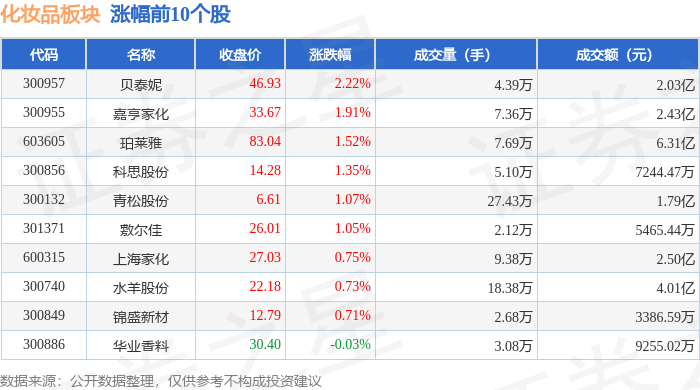
化妆品板块9月5日涨0.61%,贝泰妮领涨,主力资金净流出1.07亿元
Zheng Xing Xing Ye Ri Bao· 2025-09-05 09:06
Market Overview - On September 5, the cosmetics sector rose by 0.61% compared to the previous trading day, with Beitaini leading the gains [1] - The Shanghai Composite Index closed at 3812.51, up 1.24%, while the Shenzhen Component Index closed at 12590.56, up 3.89% [1] Individual Stock Performance - Beitaini (300957) closed at 46.93, with a gain of 2.22% and a trading volume of 43,900 shares, amounting to a transaction value of 203 million yuan [1] - Other notable performers included: - Jiahen Home (300955) at 33.67, up 1.91% [1] - Kesheng Co. (300856) at 14.28, up 1.35% [1] - Qing Song Co. (300132) at 6.61, up 1.07% [1] - Conversely, LaFang Home (603630) saw a significant decline of 4.68%, closing at 29.73 [2] Fund Flow Analysis - The cosmetics sector experienced a net outflow of 107 million yuan from institutional investors, while retail investors saw a net inflow of 66.81 million yuan [2] - The detailed fund flow for individual stocks showed: - Jiahen Home had a net inflow of 5.16 million yuan from retail investors [3] - Beitaini experienced a net outflow of 9.28 million yuan from retail investors despite a net inflow of 5.03 million yuan from institutional investors [3] - Qingdao King (002094) had a net outflow of 11.19 million yuan from institutional investors [3]

2025年中国功能性护肤品行业技术发展现状分析 三大赛道品牌商核心技术各异【组图】
Qian Zhan Wang· 2025-09-05 04:08
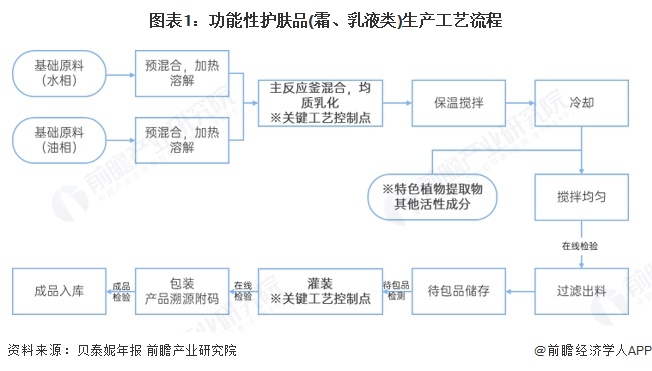
Core Insights - The article focuses on the research and development (R&D) investments of listed companies in China's functional skincare industry, highlighting the importance of R&D intensity relative to revenue [1][10]. R&D Investment Overview - The leading company in R&D investment is Huaxi Biological, with a projected investment of 466 million yuan in 2024, representing 8.68% of its revenue [10]. - Other companies like Chuang'er Biological also show significant R&D investment intensity, indicating a competitive landscape in innovation [10]. Key Companies and Their R&D Focus - **Betaini**: Focuses on the R&D of Yunnan specialty plants to address various skin issues and enhance product lines [11]. - **Huaxi Biological**: Concentrates on active ingredient delivery control and efficacy extension projects [10][11]. - **Chuang'er Biological**: Specializes in collagen protein project development [10][11]. - **Fuerjia**: Aims to expand its product line, including Class III medical devices and sunscreen products [10][11]. Production Processes - Functional skincare products include creams, lotions, masks, serums, and emulsions, each with distinct production processes. For instance, Betaini's cream and lotion production involves several key steps, with homogenization and filling being critical control points [1]. Competitive Landscape - The article outlines various brands and their core technologies, such as Vichy and La Roche-Posay from France, which emphasize thermal spring water, and Curel from Japan, which focuses on ceramide care [6][7].
十强换血、双百亿在望:国货美妆加速全球抢位
FBeauty未来迹· 2025-09-04 15:30
Core Viewpoint - The article discusses the recent developments in the domestic beauty market, highlighting the completion of a Series B funding round for HuazhiXiao, led by domestic beauty giant Proya, and the strategic shifts among the top ten domestic beauty companies as they seek new growth avenues amid a slowing market [3][4]. Group 1: Financial Performance of Top Domestic Beauty Companies - Proya, Shangmei, and Shanghai Jahwa ranked as the top three domestic beauty companies, with Proya achieving a revenue of 5.362 billion yuan in the first half of the year, surpassing half of last year's total revenue [5][6]. - Shangmei's revenue grew by 17.3% year-on-year to 4.108 billion yuan, with net profit increasing by 34.7% [5][6]. - The top ten domestic beauty companies saw eight achieve revenue growth, and seven companies reported positive net profit growth, indicating a robust overall performance [6][8]. Group 2: Strategic Shifts and Market Positioning - The top domestic beauty companies are rapidly building multi-brand matrices and advancing overseas strategies to adapt to the slowing domestic market [3][4]. - Proya's skincare segment remains dominant, while its hair care and color cosmetics categories have shown significant growth, with hair care growing by 131.25% and color cosmetics by 25.79% [11]. - Shangmei's main brand, Han Shu, generated 3.344 billion yuan in revenue, while its new brand, newpage, focusing on children's skincare, achieved a remarkable 146.5% growth [14][16]. Group 3: International Expansion and Investment Strategies - Proya aims to enter the top ten global cosmetics companies by 2035, targeting a revenue of at least 50 billion yuan, and is actively pursuing international market opportunities [22][23]. - The investment in HuazhiXiao is a strategic move for Proya to enhance its multi-brand strategy and recognize HuazhiXiao's global potential [23]. - Water Sheep Co. is also focusing on international expansion, with a goal to become a global luxury beauty brand management group, launching a "10+3" global strategy [26][28]. Group 4: Challenges and Future Outlook - The domestic beauty market is facing challenges such as slowing growth and increased competition, prompting companies to seek international opportunities to escape price wars [29]. - Companies that possess product originality, brand narrative capabilities, and cross-market operational efficiency are more likely to transition from "Chinese leaders" to "global players" [29].




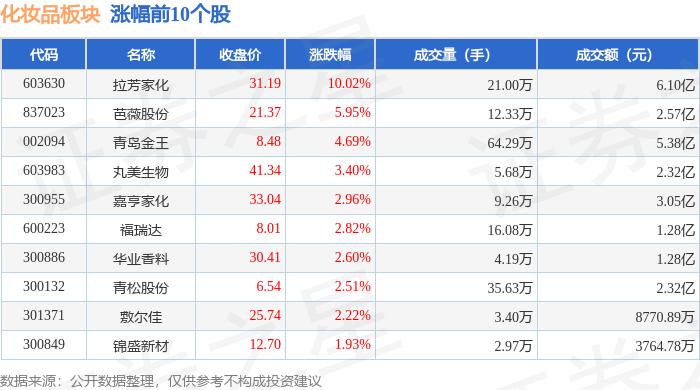
化妆品板块9月4日涨1.93%,拉芳家化领涨,主力资金净流入4956.52万元
Zheng Xing Xing Ye Ri Bao· 2025-09-04 08:55
Market Overview - On September 4, the cosmetics sector rose by 1.93%, led by Lafang Jiahua, while the Shanghai Composite Index closed at 3765.88, down 1.25%, and the Shenzhen Component Index closed at 12118.7, down 2.83% [1] Individual Stock Performance - Lafang Jiahua (603630) closed at 31.19 with a gain of 10.02%, trading volume of 210,000 shares and a turnover of 610 million yuan [1] - Other notable performers include: - Bavi Co. (837023) with a closing price of 21.37, up 5.95% [1] - Qingdao Kingking (002094) at 8.48, up 4.69% [1] - Marubi Biological (603983) at 41.34, up 3.40% [1] - Jiahen Jiahua (300955) at 33.04, up 2.96% [1] Capital Flow Analysis - The cosmetics sector saw a net inflow of 49.57 million yuan from institutional investors, while retail investors contributed a net inflow of 10.45 million yuan. However, there was a net outflow of 60.02 million yuan from speculative funds [2][3] Detailed Capital Flow for Key Stocks - Qingdao Kingking (002094) had a net inflow of 30.51 million yuan from institutional investors, but a net outflow of 8.71 million yuan from speculative funds [3] - Other stocks with significant capital flow include: - Furuida (600223) with a net inflow of 15.46 million yuan from institutional investors [3] - Qing Song Co. (300132) with a net inflow of 14.33 million yuan from institutional investors [3] - Marubi Biological (603983) with a net inflow of 10.76 million yuan from institutional investors [3]

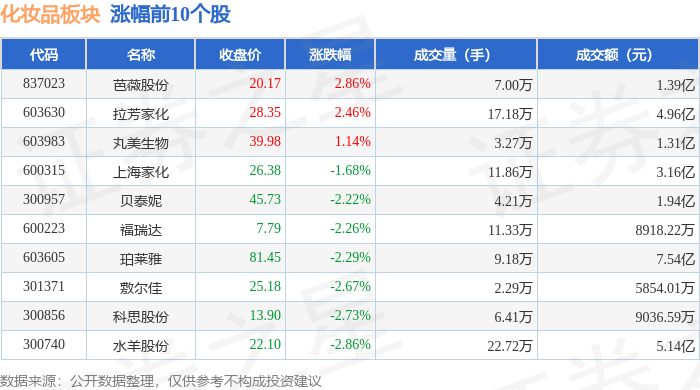
化妆品板块9月3日跌1.93%,嘉亨家化领跌,主力资金净流出1.76亿元
Zheng Xing Xing Ye Ri Bao· 2025-09-03 08:46
Market Overview - The cosmetics sector experienced a decline of 1.93% on September 3, with Jiaheng Jiahua leading the drop [1] - The Shanghai Composite Index closed at 3813.56, down 1.16%, while the Shenzhen Component Index closed at 12472.0, down 0.65% [1] Individual Stock Performance - Bawei Co. (837023) saw an increase of 2.86%, closing at 20.17 with a trading volume of 70,000 shares and a turnover of 139 million yuan [1] - Lafang Jiahua (603630) increased by 2.46%, closing at 28.35 with a trading volume of 171,800 shares and a turnover of 496 million yuan [1] - Jiaheng Jiahua (300955) experienced the largest decline of 8.73%, closing at 32.09 with a trading volume of 141,300 shares and a turnover of 475 million yuan [2] - Other notable declines include Huaye Fragrance (300886) down 6.05% and Jincheng New Materials (300849) down 3.78% [2] Capital Flow Analysis - The cosmetics sector saw a net outflow of 176 million yuan from institutional investors, while retail investors contributed a net inflow of 95.35 million yuan [2] - The main capital inflow and outflow for individual stocks showed that Lafang Jiahua had a net inflow of 28.51 million yuan from institutional investors, while Jiaheng Jiahua had a net outflow of 7.93 million yuan [3] - The overall trend indicates a mixed sentiment among retail and institutional investors, with retail investors showing some interest despite the overall sector decline [2][3]



研判2025!中国沐浴露行业发展历程、产业链、市场政策、销售规模、竞争格局及发展趋势分析:TOP10品牌占比超50%[图]
Chan Ye Xin Xi Wang· 2025-09-03 01:41
Overview - The increasing national income level has led to a heightened focus on personal hygiene and skin health among consumers, resulting in a growing demand for functional and personalized bathing products. Traditional products with a single function of "cleansing + moisturizing" are becoming less favored, while diverse needs such as "fragrance experience," "skin repair," and "emotional therapy" are becoming mainstream [1][14] - The Chinese shower gel market is undergoing structural differentiation, with emotional fragrance shower gels meeting consumers' self-expression and emotional regulation needs, while efficacy-based products target specific skin issues like oil control, whitening, and sensitive skin care. Both types are major drivers of market growth [1][14] - In 2024, the total sales of shower gels in China are projected to reach 13.052 billion yuan, a year-on-year decrease of 1.62%. Despite the decline, the drop is less than the overall market, indicating a trend towards rational and fundamental consumption in the shower gel market [1][14] Market Policies - The Chinese government places significant emphasis on the development of the cosmetics industry, including shower gels, and has issued a series of policies aimed at improving production quality, safety, and regulatory compliance. These policies create a favorable environment for the development of the shower gel industry [8] Industry Chain - The shower gel industry consists of an upstream supply chain that includes raw material suppliers (surfactants, soap bases, moisturizers, fragrances, thickeners) and packaging material suppliers. The midstream comprises manufacturing enterprises, while the downstream includes various sales channels such as supermarkets, specialty stores, and e-commerce platforms [10] Consumer Insights - Female consumers dominate the shower gel market in China, accounting for over 60% of consumption. They are often the primary decision-makers in household purchases. Over 90% of consumers prioritize product efficacy, with key considerations including moisturizing, whitening, and antibacterial properties, followed by ingredient safety and natural formulations [12][13] Competitive Landscape - The Chinese shower gel market is highly competitive, featuring numerous participants, including international brands like Dove and Lux, as well as domestic brands like Six God and Lafang. The top 10 brands account for over 50% of the market share, with Six God holding the largest share [14][15] - Shanghai Jahwa, a long-established player in the personal care industry, reported a total revenue of 5.679 billion yuan in 2024, with a gross profit of 3.271 billion yuan and a gross margin of 57.60% [15] - Lafang, established in 2001, achieved a total revenue of 889 million yuan in 2024, with its personal care segment contributing 778 million yuan, representing 87.57% of total revenue [16] Future Trends - The demand for functional shower gels is expected to rise, with products targeting specific skin issues gaining popularity. There will be a trend towards multifunctional products that combine cleansing, moisturizing, fragrance, and mild sun protection. Additionally, as consumers become more health and environmentally conscious, there will be a preference for natural, organic, and additive-free shower gels containing plant extracts and essential oils [17]

趋势研判!2025年中国婴童洗护行业发展全景分析:市场规模平稳增长,有望达到358.6亿元,国产品牌市场逐渐扩大[图]
Chan Ye Xin Xi Wang· 2025-09-03 01:35
Core Insights - The baby and child care market is specifically designed for children aged 0-12 years, focusing on cleaning, skincare, and care products [2][4] - The Asia-Pacific region is the largest market globally, accounting for 41% of the market share, driven by population advantages and rapid economic development [5][6] - China's baby and child care market is rapidly growing, with the market size expected to increase from 27.42 billion yuan in 2021 to 32.9 billion yuan in 2024 [5][6] Industry Definition and Classification - Baby and child care products include categories such as shampoo, bath products, skincare, oral care, sunscreen, and mosquito repellent, designed with a focus on the physiological characteristics of infants [2][4] - Products are classified by function (cleaning, skincare, oral care, etc.), dosage form (liquid, cream, foam, solid), age group (newborns, toddlers, children), and market positioning (mass, mid-high end, premium) [4][6] Current Market Status - The global baby and child care market is experiencing steady growth, projected to rise from 13.06 billion USD in 2021 to 14.48 billion USD in 2024, with expectations to surpass 15 billion USD by 2025 [6][8] - In China, the market is expected to reach 35.86 billion yuan by 2025, with body care products holding a significant share [5][6] Industry Chain - The upstream of the industry includes raw materials like oils, emulsifiers, surfactants, and packaging materials, while the midstream focuses on product development, production, and brand operation [6][8] - The downstream sales channels include mother-baby stores, supermarkets, pharmacies, e-commerce, and medical institutions, primarily targeting millennial parents [6][8] Development History - The baby and child care industry in China has evolved through several stages, including the introduction of international concepts in the 1990s and the rise of domestic brands [8][9] Competitive Landscape - The Chinese market features a mix of international and domestic brands, with local brands gaining market share in recent years [9][10] - In 2024, international brands are expected to account for 40% of the market, while domestic brands will hold 60% [9][10] Industry Trends - The industry is expanding due to factors such as consumer upgrades, the popularization of scientific parenting concepts, and stricter regulatory policies [10] - The market is moving towards age-specific care and sustainable practices, with an increasing share for domestic brands [10]

中国香妆协会召开三大年度重点会议
FBeauty未来迹· 2025-09-02 10:53
Core Viewpoint - The article discusses the initiatives and events organized by the China Fragrance and Cosmetic Industry Association to promote safety in cosmetic use and enhance the industry's global standing through media collaboration and scientific communication [4][12]. Group 1: Events and Initiatives - The 2025 Safety Cosmetic Use Science Promotion Week will take place from September 1 to 7, with the theme "Safe Use of Cosmetics, Science to Safeguard" [5]. - The China Fragrance and Cosmetic Industry Association aims to strengthen public awareness of safe cosmetic use and establish a new social governance model [5][12]. - The association's annual media collaboration meeting focuses on building a better media cooperation ecosystem and enhancing scientific communication within the industry [14][17]. Group 2: Key Activities - The first execution plan for the Safety Cosmetic Use Science Promotion Week includes a "Full Media Science Promotion Action" with activities such as expert-written articles and engaging multimedia content [10]. - The second plan involves a "Consumer Safety Use of Cosmetics Public Welfare Action," encouraging companies to showcase their green and sustainable development practices [11]. - The third plan, "Green Action: Empty Bottle Recycling," aims to set up around 300 recycling points nationwide and promote consumer participation in sustainability efforts [11]. Group 3: 2025 CAME Highlights - The 2025 China Fragrance and Cosmetic Industry Annual Conference and Boutique Expo (2025 CAME) will be held from September 25 to 27 in Nanjing, focusing on "Technology and Brand Co-Progress" [21][23]. - The expo will feature over 115 exhibitors and more than 500 brands, showcasing innovations in the industry, including biotechnological advancements and sustainable packaging [25][27]. - The event will also host numerous thematic conferences, inviting over 100 influential guests to discuss key industry topics, enhancing the exchange of ideas and collaboration [28][30].



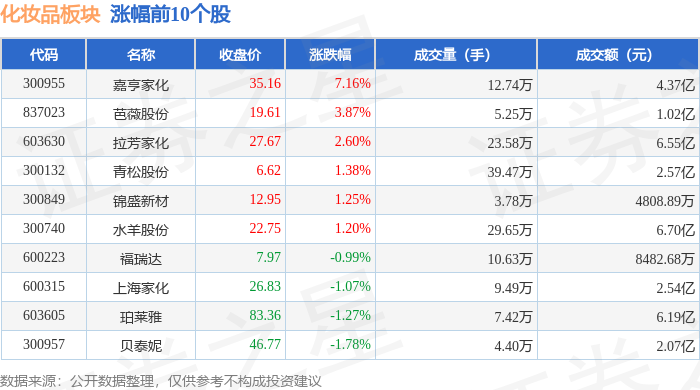
化妆品板块9月2日跌0.97%,华业香料领跌,主力资金净流出2.16亿元
Zheng Xing Xing Ye Ri Bao· 2025-09-02 09:09
Market Overview - The cosmetics sector experienced a decline of 0.97% on September 2, with Huaye Fragrance leading the drop [1] - The Shanghai Composite Index closed at 3858.13, down 0.45%, while the Shenzhen Component Index closed at 12553.84, down 2.14% [1] Individual Stock Performance - Jiahen Jiahua (300955) saw a significant increase of 7.16%, closing at 35.16 with a trading volume of 127,400 shares and a turnover of 437 million yuan [1] - Other notable gainers included Bawi Co. (837023) with a 3.87% increase and Lafang Jiahua (603630) with a 2.60% increase [1] - Conversely, Huaye Fragrance (300886) led the declines with a drop of 4.05%, closing at 31.55 [2] - The overall performance of the cosmetics sector showed mixed results, with several stocks experiencing declines [2] Capital Flow Analysis - The cosmetics sector saw a net outflow of 216 million yuan from institutional investors, while retail investors contributed a net inflow of 210 million yuan [2] - The table of capital flow indicates that Lafang Jiahua had a net inflow of 49.77 million yuan from institutional investors, despite a net outflow from retail investors [3] - Other companies like Jinxing New Materials (300849) and Shanghai Jahwa (600315) also experienced varying degrees of net inflows and outflows from different investor categories [3]


就在今天|“新消费时代”国泰海通证券2025消费品年会
国泰海通证券研究· 2025-09-01 22:20
Core Viewpoint - The article discusses the upcoming 2025 Consumer Goods Annual Conference organized by Guotai Junan Securities, highlighting key trends and opportunities in the consumer goods sector, particularly in the context of new consumption patterns and technological advancements [3][6]. Group 1: Conference Agenda - The conference will feature a series of presentations and discussions on various topics, including consumption trends in the longevity era, the resurgence of domestic beauty brands, and the era of functional health products [6][7]. - Notable speakers include experts from Fudan University, leading beauty industry commentators, and health product executives, indicating a diverse range of insights [6][7]. - A roundtable forum will address the new consumption era, emphasizing the sustained high demand and strong policy support for consumer goods [6][7]. Group 2: Industry Trends - The article highlights the high growth potential in the smart home sector and the exploration of new trade routes in foreign trade, alongside domestic demand [7]. - There is a focus on emerging consumer trends, such as the pet industry and the impact of AI on internet investment paradigms [7][8]. - The conference will also cover the development trends of smart glasses and the growth of cleaning appliances, reflecting the intersection of consumer demand and technological innovation [8][10]. Group 3: Company Participation - Various companies from sectors such as food and beverage, cosmetics, retail, social services, agriculture, and textiles will participate in the conference, showcasing their latest developments and strategies [10]. - Notable participants include well-known brands like Huazhu Beer, Shanghai Jahwa, and Petty Holdings, indicating a broad representation of the consumer goods landscape [10].