
沪农商行

Search documents
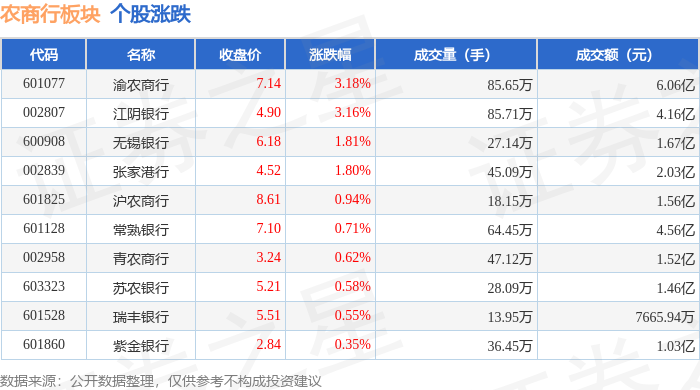
农商行板块11月3日涨1.58%,渝农商行领涨,主力资金净流出4308.08万元
Zheng Xing Xing Ye Ri Bao· 2025-11-03 08:43
Market Performance - The rural commercial bank sector increased by 1.58% on November 3, with Chongqing Rural Commercial Bank leading the gains [1] - The Shanghai Composite Index closed at 3976.52, up 0.55%, while the Shenzhen Component Index closed at 13404.06, up 0.19% [1] Individual Stock Performance - Chongqing Rural Commercial Bank (601077) closed at 7.14, up 3.18% with a trading volume of 856,500 shares and a transaction value of 606 million yuan [1] - Jiangyin Bank (002807) closed at 4.90, up 3.16% with a trading volume of 857,100 shares and a transaction value of 416 million yuan [1] - Wuxi Bank (600908) closed at 6.18, up 1.81% with a trading volume of 271,400 shares and a transaction value of 167 million yuan [1] - Other notable performances include Zhangjiagang Bank (002839) up 1.80% and Shanghai Rural Commercial Bank (601825) up 0.94% [1] Capital Flow Analysis - The rural commercial bank sector experienced a net outflow of 43.08 million yuan from institutional investors, while retail investors saw a net inflow of 35.81 million yuan [1] - The table indicates that Chongqing Rural Commercial Bank had a net inflow of 13.38 million yuan from institutional investors but a net outflow of 64.68 million yuan from retail investors [2] - Jiangyin Bank had a net inflow of 2.47 million yuan from retail investors despite a net outflow from institutional and speculative investors [2]



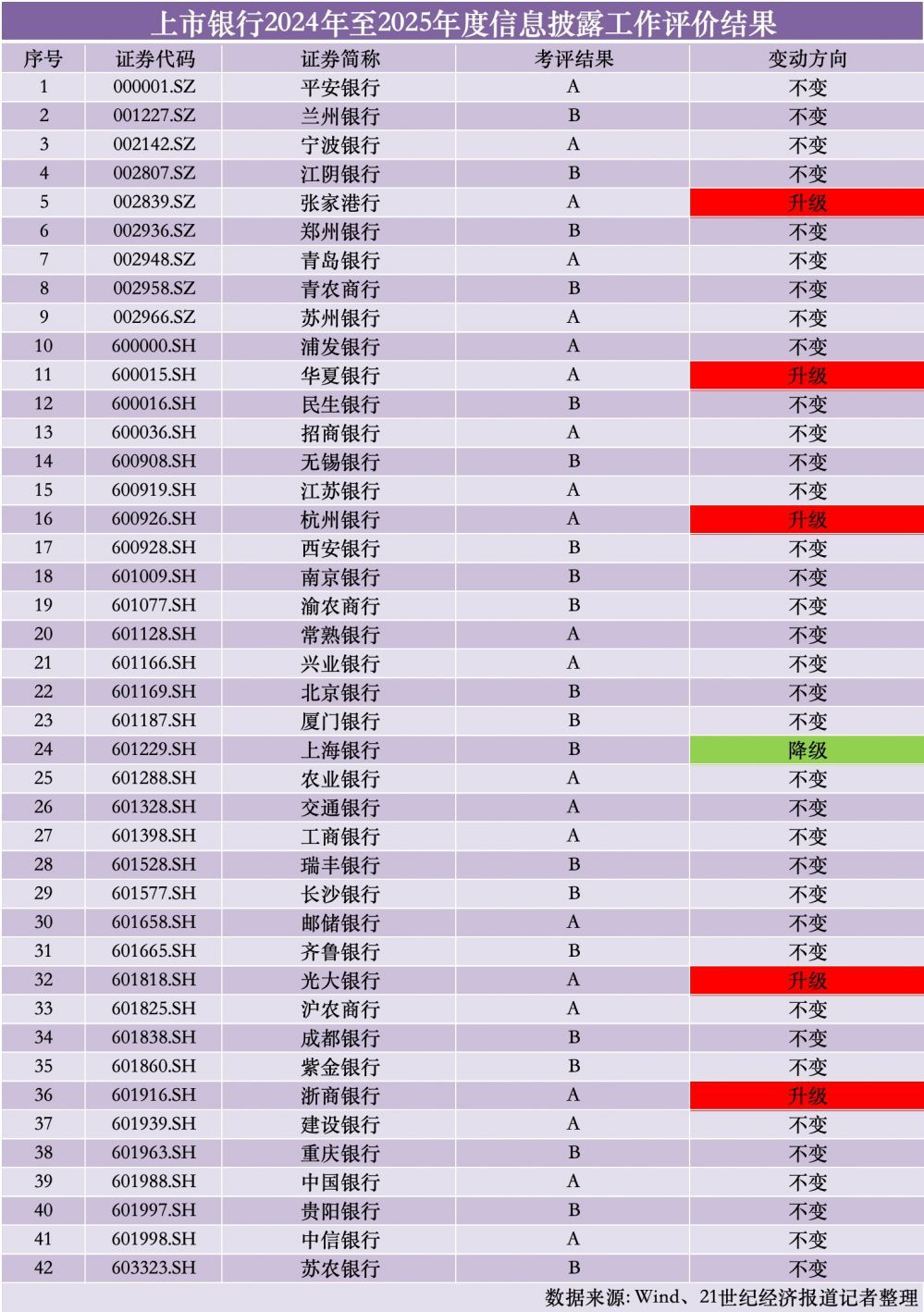
42家上市银行信披考评出炉:22家获A,光大、华夏和浙商银行提级
2 1 Shi Ji Jing Ji Bao Dao· 2025-11-03 08:21
Core Insights - The recent disclosure evaluation results for listed banks in China for the 2024-2025 period show that all listed banks received ratings of B or above, with 22 banks rated A, indicating a strong performance in information disclosure [1] Summary by Category Overall Ratings - All listed banks achieved a rating of B or higher, with 22 banks rated A, reflecting consistent performance compared to the previous year [1] - Only six banks experienced rating changes, with five banks improving their ratings and one bank, Shanghai Bank, experiencing a downgrade [1] Banks with Rating Changes - The following banks improved their ratings: - Zhangjiagang Bank - Hangzhou Bank - Huaxia Bank - Everbright Bank - Zhejiang Commercial Bank [1] - Shanghai Bank was the only bank to see a downgrade in its rating [1] Detailed Ratings - A selection of banks and their ratings includes: - Ping An Bank: A - Ningbo Bank: A - Agricultural Bank of China: A - Industrial and Commercial Bank of China: A - Shanghai Bank: B (downgraded) [2]




寻找绩优股:2026年银行业年度策略
GUOTAI HAITONG SECURITIES· 2025-11-03 05:20
Investment Rating - The report indicates a cautious outlook on the credit growth rate, suggesting a shift towards quality improvement, with expectations for a recovery in corporate loan increments by 2026 [5][9]. Core Insights - Credit growth is expected to slow significantly starting in 2024, but the decline in growth rate is anticipated to moderate by 2026, with corporate loans likely to see a year-on-year increase [7][9]. - The relationship between credit growth and economic growth is weakening, emphasizing the need to optimize credit structure and reduce idle financial resources [9]. - The report highlights that the banking sector's total asset growth will outpace loan growth in 2025, driven by government bond supply and fiscal policies [9]. Summary by Sections Credit Growth Forecast - New RMB loans are projected at 21.3 trillion, 23.6 trillion, and 18.9 trillion yuan for 2022, 2023, and 2024 respectively, with a further estimate of 14.7 trillion yuan for the first three quarters of 2025 [9]. - For 2026, new loans are expected to be between 17.2 trillion and 17.7 trillion yuan, corresponding to a growth rate of 6.3% to 6.5% [9]. Loan Composition - In 2023, the total RMB loans are expected to reach 237.59 trillion yuan, with a year-on-year growth rate of 10.6% [8]. - Retail loans are projected to grow from 80.10 trillion yuan in 2023 to 82.84 trillion yuan in 2024, reflecting a growth rate decline from 5.7% to 3.4% [8]. - Corporate loans are anticipated to increase from 157.07 trillion yuan in 2023 to 171.01 trillion yuan in 2024, with a growth rate of 12.7% [8]. Regional Performance - Regions such as Jiangsu, Zhejiang, Sichuan, and Shandong are expected to continue outperforming the national average in loan growth due to strong economic performance and support from new policy financial tools [12]. Banking Sector Dynamics - The report notes that state-owned banks are expected to maintain a competitive edge due to lower funding costs and capital injections from the Ministry of Finance [12]. - The net interest margin is in a downward trend, but the rate of decline is expected to slow starting in 2025, with some smaller banks potentially stabilizing their margins by 2026 [13][17]. Asset Quality - As of Q2 2025, the non-performing loan (NPL) ratio for listed banks is reported at 1.25%, indicating a stable asset quality despite pressures on retail credit [37]. - The report emphasizes that while retail loan NPLs have increased since 2021, corporate loan clearances have improved significantly, providing a buffer against retail risks [37].



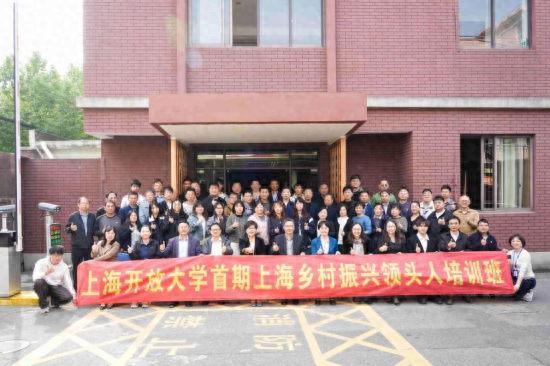
上海开放大学举办首期乡村振兴领头人培训班
Zhong Guo Xin Wen Wang· 2025-11-03 03:11
Core Viewpoint - The Shanghai Open University has launched the first "Shanghai Rural Revitalization Leaders Training Class," aimed at enhancing the skills and knowledge of grassroots officials, agricultural operators, and rural entrepreneurs in the context of China's rural revitalization strategy [2][5]. Group 1: Training Program Overview - The training program combines non-degree training with degree education, creating a dual-track model of "skill enhancement + degree advancement" [5]. - A comprehensive needs assessment and course discussion were conducted to ensure the training's relevance and effectiveness [2]. - The program features a strong "industry mentor team" composed of experienced experts from the frontlines of rural revitalization [2]. Group 2: Target Audience and Participation - The training primarily targets grassroots workers and agricultural cooperative managers in Shanghai, with the first session held in Jinshan District's Fengjing Town, attracting over 60 participants [3][4]. - Participants include village leaders and committee members who face practical challenges in rural governance, industry development, and resource mobilization [3]. Group 3: Curriculum and Practical Applications - The curriculum includes courses on rural entrepreneurship, governance communication, financial policies, and new media operations, supplemented by successful case studies from local projects [4]. - Practical examples such as the revitalization of idle farmhouses into "Lian Chain Light House" homestays and the "Self-Family Live Streaming Base" for rural marketing are integrated into the training [3]. Group 4: Future Implications and Expansion - Successful completion of the training will provide participants with a certificate from Shanghai Open University, which can contribute to lifelong education credits [5]. - The program is set to expand to other key agricultural areas in Shanghai, aiming to cultivate a new generation of high-quality leaders in rural revitalization [5].
掘金银行三季报:险资继续“扫货”
Jing Ji Wang· 2025-11-03 02:21
Core Insights - The A-share listed banking sector experienced a significant decline of over 13% in the third quarter of 2025, following a strong performance in the previous year, while insurance funds continued to increase their holdings in bank stocks [1][6] Group 1: New Shareholder Dynamics - In the third quarter, six insurance companies entered the top ten shareholders of six A-share listed banks, indicating a growing presence of insurance capital in the banking sector [1] - China Life Insurance Company entered the top ten shareholders of Industrial and Commercial Bank of China (ICBC) with 757 million shares, representing 0.21% of the bank's total shares [2] - Other banks such as Wuxi Bank, Nanjing Bank, and Changshu Bank also saw new insurance capital entering their top ten shareholder lists [2] Group 2: Continued Investment by Insurance Funds - Several insurance companies that had already entered the top ten shareholders of listed banks continued to increase their holdings in the third quarter, with some seeking board seats [4] - For instance, Dajia Life Insurance increased its stake in Industrial Bank by 62.12 million shares, raising its holding to 3.38% [4] - China Life Insurance and Guomin Pension Insurance also increased their stakes in Suzhou Bank, reaching 3.4% and 2.76% respectively by the end of September [4] Group 3: Major Shareholder Concentration - By the end of the third quarter, at least two insurance companies were listed among the top ten shareholders of 12 A-share listed banks, highlighting a trend of concentration of insurance capital [6] - Zheshang Bank had four insurance shareholders, while banks like Industrial Bank and Changsha Bank had three [6] - The top five shareholders of Industrial Bank collectively held over 50% of the bank's shares, indicating strong institutional support [6] Group 4: Investment Strategy Insights - Insurance asset management institutions are focusing on companies with strong fundamentals and stable dividend growth potential for their core holdings [7]

无惧回调!掘金银行三季报:险资继续“扫货”
券商中国· 2025-11-02 23:27
Core Viewpoint - The article discusses the significant changes in the shareholder structure of A-share listed banks following the disclosure of their Q3 2025 reports, highlighting the increasing presence of insurance funds as long-term investors in the banking sector [1][2]. Shareholder Changes - A-share listed banks experienced a substantial decline in Q3 2025, with an overall drop exceeding 13% in a single quarter, while insurance funds continued to increase their holdings in bank stocks [2]. - Six insurance companies entered the top ten shareholders of six A-share listed banks in Q3, with several existing insurance shareholders also raising their stakes and seeking board seats [2]. - By the end of September, at least two insurance funds were present in the top ten shareholders of 12 listed banks, with Zhejiang Zheshang Bank having four insurance shareholders [2]. New Top Shareholders - China Life Insurance Company entered the top ten shareholders of Industrial and Commercial Bank of China in Q3, holding 757 million shares, representing 0.21% of the bank's total shares [3]. - In addition to ICBC, China Life also became a top shareholder in Nanjing Bank, holding approximately 256.8 million shares (2.08%) [4]. - Li'an Life Insurance entered the top ten shareholders of Wuxi Bank, holding 50 million shares (2.96%), while Changcheng Life Insurance increased its stake in Wuxi Bank to over 7% [4]. Continued Increases in Holdings - Several insurance companies that entered the top ten shareholders of listed banks continued to increase their holdings in Q3, with Dajia Life Insurance raising its stake in Industrial Bank to 3.38% [5]. - China Life Insurance and Guomin Pension Insurance both increased their holdings in Suzhou Bank to 3.4% and 2.76%, respectively [5]. - Hongkang Life was nominated for a non-executive director position at Sunong Bank after entering its top ten shareholders with a 4.95% stake [6]. Concentration of Insurance Shareholders - By the end of Q3, 12 listed banks had at least two insurance funds among their top ten shareholders, with Zhejiang Zheshang Bank having the highest concentration of four insurance shareholders [7]. - Industrial Bank had three insurance shareholders, while several other banks, including Postal Savings Bank and Agricultural Bank, had two [7]. - The presence of multiple insurance shareholders in these banks is expected to attract further investment from existing and new investors in the secondary market [7]. Investment Focus - Insurance asset management institutions are advised to focus on companies with strong fundamentals and stable dividend growth potential for their core holdings [8].

债市波动 挤压银行投资收益空间
Shang Hai Zheng Quan Bao· 2025-11-02 17:54
Core Viewpoint - The volatility in the bond market and the narrowing net interest margin have pressured the revenue of several listed banks in the first three quarters of this year, leading to a gradual decline in the benefits from the "bond bull" market [1][2] Group 1: Revenue Impact - Many listed banks have faced revenue pressure due to bond market fluctuations and a slowdown in credit expansion, with investment income becoming a crucial support for profits [2][3] - As of the end of Q3 2025, 24 out of 42 listed banks reported a year-on-year decline in non-interest income, and 8 banks saw a drop in net investment income [2] - Notably, China Merchants Bank reported a significant loss of 8.827 billion yuan in fair value changes, with a quarterly loss of 4.008 billion yuan in Q3 alone [2][3] Group 2: Strategies to Mitigate Losses - Some banks have managed to achieve year-on-year growth in investment income by actively selling bonds to lock in floating profits during high market conditions [4] - For instance, China Construction Bank's investment net income increased by 150.55%, while several other banks reported over 70% growth in investment income [4] - The strategy of "selling bonds to realize floating profits" is based on the classification of financial assets, where certain assets can confirm investment income upon sale [4] Group 3: Future Outlook and Adjustments - Analysts suggest that the sustainability of the "selling bonds to supplement profits" strategy will decline as previously accumulated floating profits are exhausted [5] - The People's Bank of China has signaled a return to government bond trading operations, which is expected to enhance monetary policy flexibility and stabilize market expectations [6] - As the bond market enters a low-volatility phase, banks are shifting their investment strategies from relying solely on interest margin gains to enhancing active trading and risk management capabilities [7]



债市波动挤压银行投资收益空间
Shang Hai Zheng Quan Bao· 2025-11-02 17:53
Core Viewpoint - The volatility in the bond market and the narrowing net interest margin have pressured the revenue of several listed banks in the first three quarters of the year, leading to a gradual decline in the benefits from the "bond bull" market [1][2]. Group 1: Revenue Impact - Many listed banks have faced revenue pressure due to bond market fluctuations and a slowdown in credit expansion, with investment income becoming a crucial support for profits [2][3]. - As of the end of Q3 2025, 24 out of 42 listed banks reported a year-on-year decline in non-interest income, and 8 banks saw a drop in net investment income [2]. - Notably, China Merchants Bank reported a loss of 8.827 billion yuan in fair value changes, with a quarterly loss of 4.008 billion yuan in Q3 alone [2][3]. Group 2: Strategies to Mitigate Losses - Some banks have managed to achieve year-on-year growth in investment income by actively selling bonds to lock in profits during high market conditions [4]. - For instance, China Construction Bank's investment net income increased by 150.55%, while several other banks also reported over 70% growth in investment income [4]. - The strategy of "selling bonds to realize floating profits" is based on the classification of financial assets, where certain assets can confirm investment income upon sale [4]. Group 3: Future Outlook and Adjustments - Analysts suggest that the sustainability of the "selling bonds to supplement profits" strategy will decline as previously accumulated floating profits are exhausted [5]. - The People's Bank of China has signaled a return to government bond trading operations, which is expected to enhance monetary policy flexibility and stabilize market expectations [6]. - As the bond market enters a low-volatility phase, banks are shifting their investment strategies from relying solely on interest margin gains to enhancing active trading and risk management capabilities [7].
上海银行股份有限公司 监事会2025年第六次会议决议公告
Zhong Guo Zheng Quan Bao - Zhong Zheng Wang· 2025-11-02 14:28
登录新浪财经APP 搜索【信披】查看更多考评等级 证券代码:601229 证券简称:上海银行 公告编号:临2025-058 优先股代码:360029 优先股简称:上银优1 可转债代码:113042 可转债简称:上银转债 上海银行股份有限公司 监事会2025年第六次会议决议公告 上海银行股份有限公司(以下简称"公司")监事会及全体监事保证本公告内容不存在任何虚假记载、误 导性陈述或者重大遗漏,并对其内容的真实性、准确性和完整性承担法律责任。 公司监事会2025年第六次会议于2025年10月30日以现场加视频接入方式召开,会议通知已于2025年10月 20日以电子邮件方式发出。本次会议应出席监事3人,实际出席监事3人。本次会议的召开符合《中华人 民共和国公司法》《上海银行股份有限公司章程》《上海银行股份有限公司监事会议事规则》的规定。 本次会议由葛明监事主持,会议经审议并通过以下议案: 一、关于2025年第三季度报告的议案 表决情况:同意3票,反对0票,弃权0票。 监事会对公司2025年第三季度报告进行了审议,并出具如下审核意见:公司2025年第三季度报告的编制 和审议程序符合国家法律、法规和公司章程等规定;报告 ...

三季报业绩呈现筑底企稳态势
Xiangcai Securities· 2025-11-02 12:22
Investment Rating - The industry rating is maintained at "Overweight" [10] Core Insights - The third quarter performance of listed banks shows signs of stabilization, with revenue growth remaining relatively steady and net profit growth improving [8][10] - For the first three quarters, the revenue growth rate of listed banks decreased by 0.1 percentage points to 0.9%, while the net profit growth rate increased by 0.7 percentage points to 1.5% compared to the mid-term [8][10] - Large banks showed improved performance growth, while revenue and profit growth for joint-stock banks and regional banks declined [8][10] Summary by Sections Revenue and Profit Trends - Listed banks' net interest income decline continues to narrow, with a decrease of 0.6% in the first three quarters, an improvement from a 1.3% decline in the mid-term [8][10] - Non-interest income growth decreased by 2 percentage points to 5.0%, while fee income growth increased by 1.5 percentage points to 4.6% [8][10] Asset and Loan Growth - Total asset growth of listed banks slightly slowed to 9.3%, while financial investment growth remained strong at 15.8% [9][10] - Loan growth decreased by 0.3 percentage points to 7.7%, and deposit growth fell to 7.9% [9][10] Investment Recommendations - The report suggests focusing on state-owned banks for stable high dividend yields, recommending Industrial and Commercial Bank of China and Bank of China, as well as joint-stock and regional banks for valuation recovery opportunities [10]