
中国交建

Search documents
国泰海通晨报-20250901
GUOTAI HAITONG SECURITIES· 2025-09-01 06:56
Group 1: Macro Research - The actual tariff collection intensity in the US in the first half of 2025 was lower than expected, leading to a moderate rise in inflation. The average import tax rate is expected to increase further in the second half of the year, which may accelerate the pace of price increases by companies [4][5][7] - If the average import tax rate rises by 10% within the year, inflation could push the PCE year-on-year growth to 3.1% and core PCE to 3.4% under stable demand conditions [4][5] Group 2: Strategy Research - The Chinese stock market is expected to continue rising, driven by accelerated transformation, declining risk-free returns, and capital market reforms. The market is not expected to be limited to small-cap stocks, with mid-cap and low-priced blue-chip stocks likely to become significant contributors to the next phase of market growth [5][7][8] - The market's style conflict is not between value and growth, but rather between monopolistic-stable assets and transformative-growth assets, indicating a broader improvement in the investment logic in China [8][9] Group 3: Industry Research - Household and Personal Care - In the first half of 2025, the beauty and personal care sector saw revenue and net profit growth of 7.2% and 1.9% respectively, with personal care outperforming cosmetics and medical aesthetics [16][17] - The personal care segment experienced a revenue increase of 30.2% and a net profit increase of 6.9% in the first half of 2025, driven by product innovation and new channel development [17] - The cosmetics segment faced challenges with profit growth lagging behind revenue growth due to increased competition for online traffic and rising promotional costs [17] - The medical aesthetics segment showed stable growth in collagen materials, with leading companies maintaining a competitive edge [17] Group 4: Fund Holdings - The overall holdings in the beauty and personal care sector increased in the second quarter of 2025, reflecting a long-term logic benefiting from the rise of domestic brands and the emergence of high-growth stocks [18]
“开往山海的地铁”驶近:深惠城际大鹏支线首个区间隧道贯通
Nan Fang Du Shi Bao· 2025-09-01 06:31
Core Viewpoint - The construction of the Shenzhen-Huizhou Intercity Railway Dapeng Branch is progressing rapidly, with significant milestones achieved, and it is expected to transform transportation in the Dapeng Peninsula and enhance regional development [1][2][3][4][5][6] Group 1: Project Overview - The Dapeng Branch is approximately 39.4 kilometers long, featuring six stations and designed for a maximum speed of 160 km/h [1] - The project is part of the Guangdong-Hong Kong-Macao Greater Bay Area intercity railway network and is crucial for Shenzhen's "Eastward Strategy" [1][3] Group 2: Construction Challenges - The construction faced complex geological conditions, particularly at the Kuichong Station, where around 1,100 caves were discovered [2] - Advanced technologies such as BIM modeling and dynamic construction adjustments were employed to ensure safety and quality [2] Group 3: Economic and Social Impact - The Dapeng Branch is expected to alleviate traffic bottlenecks, reducing travel time from Longgang and Pingshan to Dapeng Peninsula to under 30 minutes [3] - It will transform Dapeng from a tourist destination into a livable area, attracting residents and high-end industries [4][5] Group 4: Future Development - The railway will create a new "rail + tourism" model, with stations becoming hubs for transportation, tourism services, and commercial activities [4] - It will enhance internal integration within the Shenzhen metropolitan area, promoting economic and social connections among districts [5][6]
东吴证券:8月建筑PMI仍弱势 推荐洁净室工程板块
智通财经网· 2025-09-01 06:02
Core Insights - The construction PMI in August decreased, indicating a slowdown in construction activities, while the infrastructure investment growth rate has also slowed down, suggesting potential space for further fiscal policy support [1][2] Group 1: Construction Industry Trends - The business activity index for the construction industry fell by 1.5 percentage points in August, entering a contraction zone, with new order indices remaining weak [2] - There is an increasing focus on urban renewal and major infrastructure projects, with expectations for central fiscal support to accelerate the implementation of key projects [2] - Recommendations include focusing on major projects in regions like Xinjiang, Tibet, and the Sichuan-Chongqing area, as well as state-owned enterprises with historically low valuations [2] Group 2: International Engineering and Cooperation - From January to June 2025, China's foreign contracted projects saw a 9.3% year-on-year increase in revenue, with new contracts up by 13.7%, particularly in Belt and Road Initiative countries where new contracts grew by 21% [3] - The ongoing geopolitical tensions and trade frictions may lead to intensified diplomatic negotiations, with expectations for closer cooperation in Europe and ASEAN regions [3] - Recommendations for international engineering firms include focusing on companies like China National Materials, Shanghai Port Construction, and others [3] Group 3: Emerging Opportunities in Specific Sectors - Certain specialized manufacturing sectors, energy-saving and carbon-reduction initiatives, and new energy-related infrastructure fields are showing high demand, presenting investment opportunities [3] - The semiconductor cleanroom sector is expected to maintain its favorable conditions, with recommendations for companies like Shenghui Integrated and Yaxiang Integrated [3]

中国交建跌超5% 上半年纯利同比减少16.9% 不派中期息
Zhi Tong Cai Jing· 2025-09-01 02:20
Core Viewpoint - China Communications Construction Company (CCCC) experienced a decline in stock price, dropping over 5% to HKD 5.3, with a trading volume of HKD 136 million [1] Financial Performance - The company reported a revenue of CNY 335.45 billion for the first half of 2025, representing a year-on-year decrease of 5.78% [1] - The profit attributable to the parent company was CNY 9.99 billion, down 16.9% year-on-year [1] - No interim dividend was declared [1] Contractual Activity - New contract value reached CNY 991.05 billion, showing a year-on-year growth of 3.1% [1] - The new contracts in emerging business sectors amounted to CNY 320.26 billion, accounting for approximately 32% of the total new contracts [1] Market Analysis - Guosheng Securities indicated that the decline in performance was primarily due to a slowdown in domestic project execution and a decrease in gross profit margin [1]

港股异动 | 中国交建(01800)跌超5% 上半年纯利同比减少16.9% 不派中期息
智通财经网· 2025-09-01 02:12
Core Viewpoint - China Communications Construction Company (CCCC) experienced a decline in stock price, dropping over 5% following the release of its mid-year results for 2025, indicating challenges in revenue and profit generation [1] Financial Performance - The company reported a revenue of 335.45 billion yuan, representing a year-on-year decrease of 5.78% [1] - The profit attributable to the parent company was 9.99 billion yuan, down 16.9% compared to the previous year [1] - No interim dividend was declared for this period [1] Contractual Developments - New contract value reached 991.05 billion yuan, showing a year-on-year growth of 3.1% [1] - The new contracts in emerging business sectors amounted to 320.26 billion yuan, accounting for approximately 32% of the total new contracts [1] Market Analysis - Guosheng Securities indicated that the decline in performance was primarily due to a slowdown in domestic project execution and a decrease in gross profit margin [1]
振华重工稳健增长,“AI+海工”想象力丰富
2 1 Shi Ji Jing Ji Bao Dao· 2025-08-31 23:40
Core Viewpoint - Zhenhua Heavy Industries demonstrated robust performance in the face of unprecedented global trade headwinds, with revenue and net profit showing positive growth in the first half of 2025 [1] Financial Performance - In the first half of 2025, the company's operating revenue was approximately 17.396 billion yuan, a year-on-year increase of 0.97% [1] - Net profit attributable to shareholders was about 344 million yuan, up 12.37% year-on-year [1] - Basic earnings per share were 0.064 yuan, reflecting a 12.28% increase year-on-year [1] - The net profit excluding non-recurring gains and losses reached 246 million yuan, a significant year-on-year growth of 111.44% [1] - Operating cash flow saw a net inflow of 3.483 billion yuan, a remarkable increase of 187.58% year-on-year [1] - Financial expenses totaled 94.42 million yuan, down 54.97% year-on-year due to a significant reduction in cash flow returns [1] Business Focus and Market Position - The company focuses on core businesses in port machinery, offshore engineering, and steel structures, forming a series of products in these areas [1] - New contracts and bids in the first half of 2025 amounted to 3.586 billion USD, with port machinery accounting for 87.48%, offshore engineering 10%, and steel structures 2.51% [1] - Zhenhua Heavy Industries maintains its leading position in the port machinery industry, having entered the 110th country and region with projects like the Casablanca port in Morocco [2] Technological Advancements - The company delivered two 35,000 cubic meter ultra-large dredging vessels equipped with an independently developed intelligent dredging operation system [2] - These vessels utilize artificial intelligence and digital twin technology for autonomous operation, achieving capabilities such as unmanned navigation and operation [3] - The dredging efficiency of these vessels has surpassed that of the world's largest dredging ships, positioning them as leaders in the Asian market [3] Strategic Importance - The new vessels are crucial for helping Chinese port general contractors secure overseas deep-water port projects [4]

建筑央企25H1收入、利润承压,现金流改善
Shenwan Hongyuan Securities· 2025-08-31 06:45
Investment Rating - The report maintains a "Positive" outlook on the construction sector, highlighting potential investment opportunities in specific companies and sub-sectors [2]. Core Insights - The construction industry is currently facing pressure on revenue and profits, but cash flow is showing signs of improvement. The overall industry performance is weak, with regional investments expected to gain traction as national strategic layouts deepen [3][4]. - The report emphasizes the need for real estate companies to adapt to changing market conditions and shift away from high-debt, high-leverage business models. It advocates for a transformation towards sustainable growth and innovation [13][15]. Industry Performance - The SW Construction and Decoration Index decreased by 0.87%, underperforming compared to the Shanghai Composite Index, which increased by 0.84%. The best-performing sub-sectors were infrastructure private enterprises (+0.85%) and professional engineering (+0.40%) [4][7]. - Year-to-date, the top-performing sub-sectors include ecological landscaping (+34.18%), infrastructure private enterprises (+27.36%), and professional engineering (+24.69%) [7][11]. Key Company Updates - Zhite New Materials reported a 14.02% increase in revenue and a staggering 906.32% increase in net profit for the first half of 2025 [16]. - Jinggong Steel Structure achieved a 29.48% increase in revenue and a 33.36% increase in net profit during the same period [17]. - Major state-owned enterprises such as China Railway and China Railway Construction experienced revenue declines of 5.9% and 5.2%, respectively, in the first half of 2025 compared to the previous year [22]. Investment Recommendations - The report suggests focusing on undervalued state-owned enterprises such as China Chemical, China Railway, and China Railway Construction, while also considering private companies like Zhite New Materials and Honglu Steel Structure for potential investment [3][4].




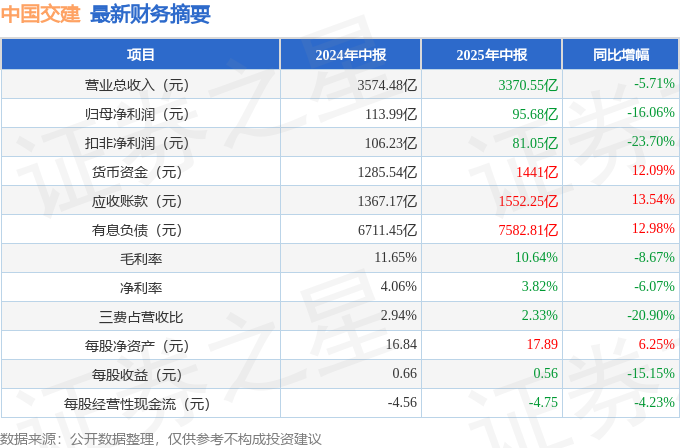
中国交建2025年中报简析:净利润同比下降16.06%,公司应收账款体量较大
Zheng Quan Zhi Xing· 2025-08-30 23:24
Core Viewpoint - China Communications Construction Company (CCCC) reported a decline in revenue and net profit for the first half of 2025, indicating challenges in its financial performance and operational efficiency [1][2]. Financial Performance - Total revenue for the first half of 2025 was 337.06 billion yuan, a year-on-year decrease of 5.71% - Net profit attributable to shareholders was 9.57 billion yuan, down 16.06% year-on-year - In Q2 2025, total revenue was 182.41 billion yuan, showing a slight increase of 1.03% year-on-year, while net profit for the quarter was 4.10 billion yuan, a decline of 21.99% year-on-year [1]. Profitability Metrics - Gross margin was reported at 10.64%, a decrease of 8.67% year-on-year - Net margin stood at 3.82%, down 6.07% year-on-year - Total selling, administrative, and financial expenses amounted to 7.84 billion yuan, accounting for 2.33% of revenue, a decrease of 20.9% year-on-year [1]. Cash Flow and Debt Analysis - The cash flow situation is concerning, with cash and cash equivalents to current liabilities at only 25.26% - The average operating cash flow over the past three years relative to current liabilities is just 1.5% - The interest-bearing debt ratio has reached 34.39%, and the total interest-bearing debt to average operating cash flow ratio is 80.97% [3]. Accounts Receivable - Accounts receivable are significantly high, with accounts receivable to profit ratio at 663.81%, indicating potential liquidity issues [1][3]. Investment Returns - The company's Return on Invested Capital (ROIC) for the previous year was 2.71%, with a historical median ROIC of 3.87% over the past decade, reflecting weak investment returns [2]. Fund Holdings - The largest fund holding CCCC is the GF CSI Infrastructure Engineering ETF, with 14.15 million shares, which has seen a decrease in holdings recently [4].

2025资阳城市品质推介暨精品楼盘巡展西宁站活动成功举行
Sou Hu Cai Jing· 2025-08-30 16:02
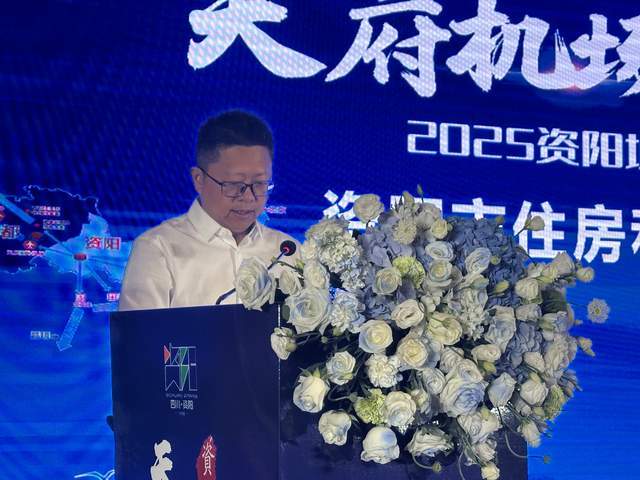
Core Viewpoint - The event in Xining serves as a bridge connecting Ziyang and Xining, promoting economic and cultural exchanges between the two cities, and attracting over 500 citizens from Xining to explore the opportunities in Ziyang [1][3]. Group 1: Event Overview - The Ziyang city quality promotion and boutique property exhibition in Xining was guided by the Ziyang Housing and Urban-Rural Development Bureau and organized by the Ziyang Real Estate Association, with support from the Qinghai Province Sichuan Chamber of Commerce [3]. - Key leaders from Ziyang attended the event, highlighting the city's emphasis on the promotion of its real estate projects [3]. Group 2: Geographic and Development Advantages - Ziyang is strategically located in the central Sichuan Basin, close to Tianfu International Airport, making it a vital node in the Chengdu-Chongqing economic circle [5]. - The city's improving transportation infrastructure is positioning Ziyang as a regional transportation hub, facilitating efficient movement of people and goods, which is crucial for economic growth and real estate market prosperity [5]. Group 3: City Advantages - The Ziyang Housing Security and Real Estate Affairs Center outlined eight key advantages of Ziyang, including a convenient transportation network, significant economic potential, rich resources, a pleasant living environment, cultural heritage, quality education and healthcare, high resident satisfaction, and dynamic urban development [7]. Group 4: Policy and Economic Opportunities - The Ziyang Housing and Urban-Rural Development Bureau emphasized that the city is entering a golden period of high-quality development, with combined advantages from location, policy incentives, and market potential creating new opportunities [9]. - The promotion aims to enhance the city's image and promote quality real estate, fostering a dual approach to policy and livelihood, deep integration of industry and consumption, and a win-win future for the city [9]. Group 5: Cultural and Tourism Cooperation - A strategic cooperation agreement was signed between Water Well Lane International Travel and Ziyang Cultural Tourism in Xining, focusing on resource integration, market expansion, and product development to enhance tourism experiences [10]. - This collaboration aims to enrich the tourism offerings of both cities, fostering economic exchange and cultural recognition between Ziyang and Xining [10]. Group 6: Future Outlook - The event showcased Ziyang's urban charm, development potential, and quality living environment, inviting Xining residents to experience the benefits of living in Ziyang [11]. - There is an optimistic outlook for broader cooperation and exchanges between Ziyang and Xining across various sectors, aiming for a prosperous future together [11].
中国交建(601800):Q2营收恢复增长 存量PPP新政有望带动报表修复
Xin Lang Cai Jing· 2025-08-30 08:31
Core Insights - The company experienced a decline in revenue and net profit in H1 2025, primarily due to a slowdown in domestic project execution and a decrease in gross margin [1][2] - The company’s cash flow showed slight improvement in Q2 2025, despite a net outflow in operating cash flow [2] - New contract signing remained stable, with a significant backlog of orders, indicating a healthy pipeline for future revenue [3][4] Financial Performance - In H1 2025, total revenue was 337.1 billion yuan, down 6% year-on-year, with net profit attributable to shareholders at 9.6 billion yuan, down 16% [1] - Q2 revenue improved sequentially to 182.4 billion yuan, a 1% increase year-on-year, while net profit dropped to 4.1 billion yuan, a 22% decline [1] - The gross margin for H1 2025 was 10.64%, a decrease of 1 percentage point, with specific declines in construction and design segments [2] Cost Management - The company maintained a favorable control over period expenses, with a total expense ratio of 4.94%, down 0.75 percentage points [2] - Financial expenses decreased significantly due to lower financing costs and increased interest income from infrastructure investment projects [2] Contracting and Order Backlog - New contracts signed in H1 2025 totaled 991.1 billion yuan, a 3% increase year-on-year, with domestic contracts at 790.7 billion yuan and international contracts at 200.4 billion yuan [3] - The company’s backlog of uncompleted contracts stood at 34,290 billion yuan, equivalent to 4.4 times the revenue for 2024, indicating a robust order book [3] Policy Impact - Recent government policies regarding PPP projects are expected to enhance the execution of existing contracts and improve the company’s financial position by facilitating debt repayment [4] - The company anticipates a gradual recovery in net profit from 21.9 billion yuan in 2025 to 22.7 billion yuan in 2027, with corresponding EPS growth [4]