小红书

Search documents
2026年传媒行业年度策略:AI赋能媒介与内容新叙事
Sou Hu Cai Jing· 2025-11-22 10:19
Core Insights - The report emphasizes that the media industry in 2026 will be significantly transformed by AI, marking a critical juncture as it aligns with the start of the "14th Five-Year Plan" [1] - AI is expected to drive fundamental changes in media forms, content production, and consumption patterns, leading to a new ecosystem in the media industry [1] Group 1: Media Ecosystem Transformation - The evolution of media forms is driven by hardware innovations, with new devices like XR equipment, AI glasses, and embodied intelligence becoming mainstream, creating new consumption scenarios [2] - The online media landscape is stabilizing, with short video platforms reaching over 1.1 billion monthly active users, shifting competition from growth to ecosystem collaboration [2] - Offline media is focusing on cinema and cultural tourism experiences, utilizing AI for enhanced engagement and visitor experiences [2] Group 2: Content Industry and AI Empowerment - AI is transitioning from a supportive tool to a substantial revenue generator in the content sector, particularly in gaming, film, and animation [3] - The emergence of "manhua" (dynamic comics) showcases AI's role in enhancing content quality and production efficiency, appealing to a male demographic aged 24-40 [3] - The micro-short drama market is evolving towards quality and standardization, with platforms focusing on premium IP and regulated production processes [3] Group 3: Economic and Technological Developments - The report highlights the rise of the "aesthetic economy," where the value of high-quality and useful content becomes increasingly significant as AI-generated content proliferates [3] - The acceleration of AI localization is shifting from market-driven to a dual approach of policy and market, with the AI agent market projected to reach 325.9 billion yuan by 2026 [5] - Major internet companies are driving application innovations, enhancing the visibility of domestic AI applications on the global stage [5] Group 4: Future Outlook and Opportunities - The integration of culture and technology is expected to create new opportunities in the media industry, with a focus on immersive experiences and digital performances [6] - The report anticipates that AI will not only reduce costs but also drive new revenue streams, particularly as the supply of AI-generated content increases [14] - The cultural and technological convergence is set to redefine the media landscape, emphasizing the importance of ecosystem building and value extraction [6]


清朗浦江再发力!上海整治网上金融信息乱象
Guo Ji Jin Rong Bao· 2025-11-21 13:30
Group 1 - The "Clear and Bright Pujiang · e Enterprise Co-Governance" initiative aims to establish a good ecological environment for online financial information dissemination, emphasizing the need for continuous efforts and collaboration [1] - Since March, various Shanghai authorities have been working together to combat illegal financial intermediaries, stock market manipulation, and the misuse of AI technology in financial activities, ensuring the protection of citizens' rights [3] - The Shanghai Financial Regulatory Bureau has guided key financial institutions to collaborate with major online platforms, utilizing big data and AI for precise monitoring and identification of financial misconduct [3] Group 2 - The rapid development of financial technology has led to an increase in hidden and intelligent financial black and gray market activities, prompting companies like Qifu Technology to innovate in fraud prevention and case management [4] - Qifu Technology has developed a "Fraud Prevention Expert Strategy System" that integrates fraud detection, strategy formulation, intelligence analysis, and case handling, creating a comprehensive process for addressing financial misconduct [4] - As of October, Qifu Technology has collaborated with various media platforms to address nearly 2,300 instances of illegal content, contributing to a cleaner online environment and maintaining financial order [4] Group 3 - The "Shanghai Guidelines for the Disposal of Bad Financial Information" has been officially released, providing standardized procedures for identifying and handling bad financial information [5] - An initiative was launched by several internet companies, including Qifu Technology and Alipay, to strengthen industry self-regulation and promote responsibility in the dissemination of financial information [5] - The initiative outlines seven specific measures to enhance accountability and maintain a clear and orderly online space for financial information [5]
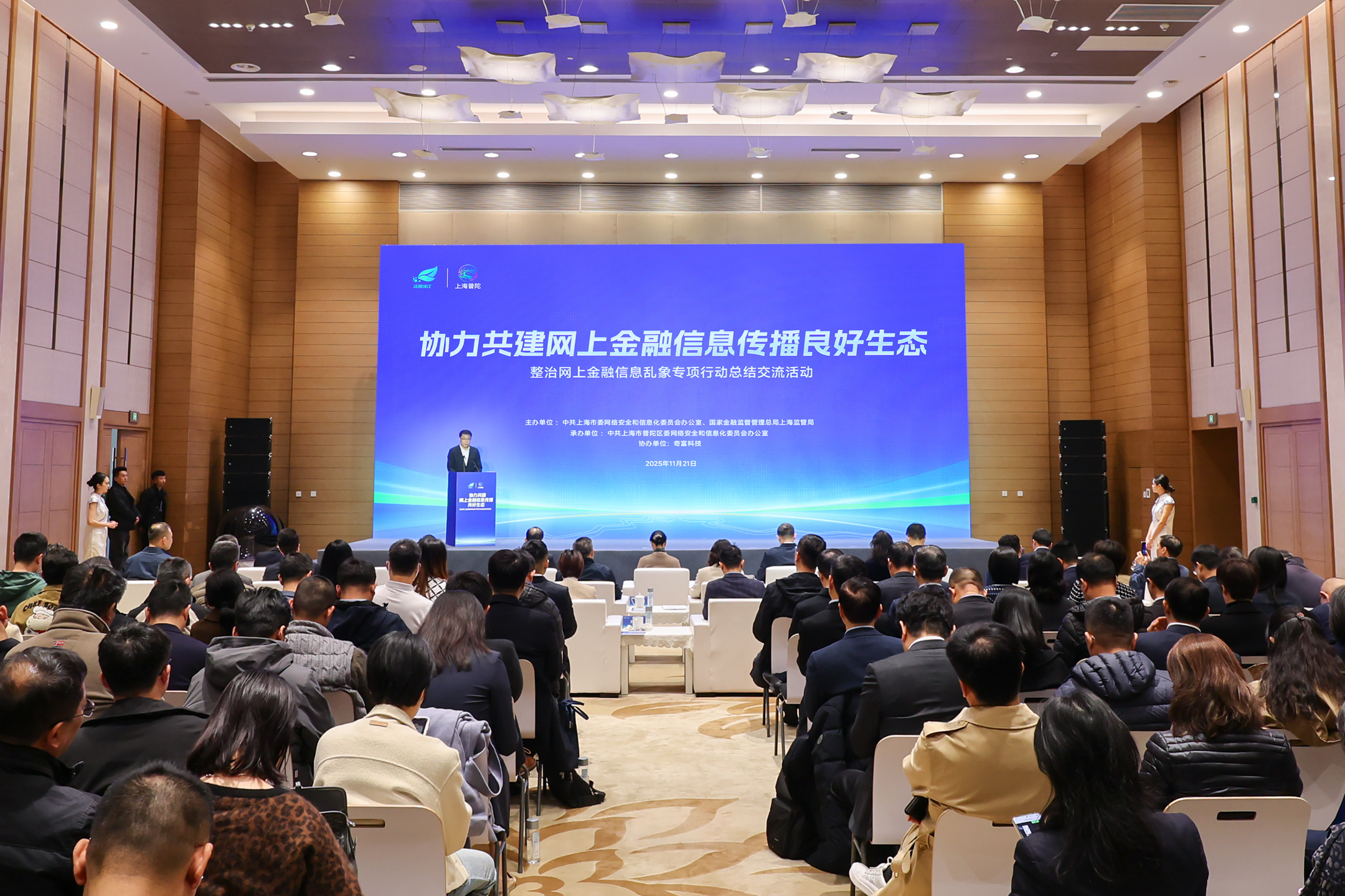
打击非法荐股、股市黑嘴 上海举行整治网上金融信息乱象专项行动总结交流活动
Xin Lang Cai Jing· 2025-11-21 12:59
Core Insights - The "Qinglang Pujiang · e-Enterprise Co-Governance" initiative aims to address online financial information chaos through a coordinated effort among various Shanghai regulatory bodies [1] - The initiative targets illegal financial intermediaries, stock recommendations, and the misuse of AI technology in financial activities, ensuring the protection of internet users' rights [1] Group 1: Initiative Overview - Since March, the Shanghai Municipal Cyberspace Administration has collaborated with financial regulatory bodies to combat illegal financial activities [1] - A permanent collaborative mechanism has been established to enhance the effectiveness of online financial information governance [1] - The initiative has led to the publication of the "Shanghai Guidelines for Handling Bad Financial Information," providing standardized procedures for online platforms and financial institutions [1] Group 2: Achievements and Actions - From 2025, the Shanghai Financial Regulatory Bureau and police have cracked 117 cases related to banking and insurance, arresting 323 suspects and involving over 3.7 billion yuan [1] - The initiative includes the organization of multiple "Financial Consumer Protection Network Governance Theme Days" to raise awareness about the dangers of bad financial information [1] - A joint initiative was launched by several internet companies to promote responsibility in financial information dissemination and to maintain an orderly online environment [1]
小红书上的假房源
Jing Ji Guan Cha Wang· 2025-11-21 10:29
Core Insights - The article highlights the prevalence of fake real estate listings on platforms like Xiaohongshu, where many listings are used as bait to attract potential buyers, often leading to misleading interactions [2][3][4] - Despite the establishment of a "true listing" system by companies like Lianjia (Beike), the issue of fake listings persists, particularly on user-generated content platforms that lack stringent regulation [3][14] - The article discusses the tactics used by agents to lure clients with attractive listings that do not exist or have already been sold, ultimately redirecting them to other properties [8][10] Group 1: Fake Listings - Numerous listings on Xiaohongshu are found to be either sold or non-existent, serving primarily as a marketing tool for agents [2][4] - The historical context reveals that up to 90% of listings were fake in the past, but initiatives like Lianjia's "true listing" system have improved transparency in the industry [2][13] - Agents often use low-priced listings to generate interest, only to pivot to properties located further from the city center, creating a cycle of misleading marketing [8][10] Group 2: Industry Response - The article notes that even agents from established companies like Beike are engaging in similar practices, using low-priced listings to attract clients [10][11] - The lack of a robust verification system on platforms like Xiaohongshu contributes to the ongoing issue of fake listings, as there is no accountability for the information shared [15] - The article emphasizes that the core issue is not just the existence of fake listings, but their use as a tool for client acquisition rather than genuine sales [14]

上海全力净化网络空间 网络生态治理成为营商环境建设关键一环 “清朗浦江”为企业排雷为信心铺路
Jie Fang Ri Bao· 2025-11-21 01:32
Core Viewpoint - The core of the business environment is confidence, which is derived from both a solid economic foundation and a purified online environment. Shanghai aims to integrate online ecological governance into its business environment strategy by 2025 [1] Group 1: Online Ecological Governance - Shanghai's "Clear Yangtze River" initiative focuses on optimizing the online business environment, addressing issues like negative online posts and organized attacks that can harm brand reputation and financing [2][3] - The initiative has already led to the closure of multiple accounts involved in spreading false information and extortion attempts against businesses [3][4] - The online black public relations issue is prevalent in sectors like real estate and automotive, prompting targeted actions from the Shanghai internet authorities [4] Group 2: Proactive Measures and Collaboration - Shanghai is establishing a proactive service and early warning mechanism to protect businesses, ensuring they feel a tangible sense of security [5][6] - The city has conducted numerous training sessions to help businesses effectively report online infringement, enhancing the capacity of local internet departments [6] - A collaborative governance model is being implemented, involving various departments to address online infringement comprehensively [7] Group 3: Comprehensive Governance Framework - Shanghai's online ecological governance has evolved into a systematic approach, addressing various online issues through over 20 targeted actions, resulting in the removal of over 8.18 million pieces of illegal content [8] - The governance framework includes addressing new risks associated with AI, ensuring that emerging technologies are regulated to prevent misuse [9][10] - The initiative aims to create a safe and trustworthy online environment, benefiting both citizens and businesses [10]
盘点今年“双11”的新变化
Ren Min Ri Bao Hai Wai Ban· 2025-11-20 22:56
Core Insights - The 2025 "Double 11" shopping festival has shown significant growth in consumer engagement and sales across various online platforms, with notable increases in user numbers and order volumes [7][10][17] E-commerce Performance - JD.com reported a 40% increase in the number of users placing orders and a nearly 60% increase in order volume during the "Double 11" period [7] - Douyin (TikTok) saw over 67,000 brands doubling their sales compared to the previous year, with over 100,000 merchants achieving similar results through live streaming [7] - Tmall indicated that new users from Taobao Flash Sales exceeded 100 million during the "Double 11" period [7] Consumer Behavior Trends - Consumers are shifting from a focus on low prices to seeking better shopping experiences and efficiency [7] - The trend of rational consumption is becoming more pronounced, with consumers preferring to make informed purchasing decisions rather than impulsive buys [13] Technological Integration - AI technology is being widely adopted in e-commerce, enhancing shopping experiences and decision-making processes for consumers [9][10] - JD's AI customer service, "Jing Xiaozhi 5.0," has improved user satisfaction by 15% and increased conversion rates by 37% for merchants [10] - Tmall's generative AI has produced 150 million images and videos during the "Double 11" period, showcasing the impact of AI on content creation [12] Extended Shopping Period - The "Double 11" shopping period has been extended to over 30 days, with pre-sales starting as early as October 7, marking the longest shopping festival duration to date [13][14] Marketing Strategies - E-commerce platforms are simplifying promotional strategies, focusing on targeted discounts rather than broad-based giveaways [14] - The dual focus on product and service consumption has emerged, with significant growth in service-related purchases such as travel and dining during the festival [14][15] Online-Offline Integration - There is a deeper integration of online and offline shopping experiences, with consumers able to experience products in-store while also having the option to order online for home delivery [16] - Instant retail has gained traction, with platforms like JD and Meituan seeing significant increases in order volumes and brand participation during the "Double 11" [17][18]




从“备选”到“必选”,互联网平台竞相入手支付牌照
Di Yi Cai Jing· 2025-11-20 12:41
Core Insights - The recent trend of internet platforms acquiring payment licenses is intensifying, with companies like Xiaohongshu, Tongcheng, and 58.com making significant moves in this space [1][2][3] - Following these acquisitions, compliance challenges are emerging, particularly as many acquired entities face operational weaknesses and increased scrutiny from regulators [1][6] Group 1: Acquisition Activities - Xiaohongshu's subsidiary Ningzhi Technology has fully acquired Dongfang Payment, a licensed payment institution since 2011, with a license valid until May 2026 [2] - Tongcheng Group's subsidiary, Yilong, acquired 100% of Xinsheng Payment for approximately 300 million yuan, increasing its registered capital to 330 million yuan [2] - 58.com purchased 70% of Shengya Yunding Payment for 23.85 million yuan, achieving full control through prior share pledges [2] - Douyin and Kuaishou have also made earlier acquisitions, with Douyin significantly increasing its registered capital from 150 million yuan to 3.15 billion yuan [2] Group 2: Capital Increases - Douyin Payment increased its capital by 3 billion yuan earlier this year, while Tencent's Tenpay raised its capital to 22.3 billion yuan [3] - JD's online banking service also raised its registered capital to 1.5 billion yuan, and Vipshop Payment increased its capital from 100 million yuan to 200 million yuan [3] Group 3: Strategic Importance of Payment Licenses - Internet platforms are increasingly viewing payment licenses as essential strategic assets rather than optional [4] - The growing complexity of business models necessitates a self-owned payment system to maintain transaction stability and compliance [4][5] - The new regulatory framework starting in 2024 emphasizes the need for platforms to hold licenses directly, reducing reliance on third-party payment processors [4] Group 4: Compliance Challenges - The central bank has tightened the review process for payment license renewals, with several institutions facing challenges due to historical weaknesses and insufficient technical investment [6][7] - In 2023, the central bank has already canceled 7 payment licenses, indicating a stricter regulatory environment [6] - The need for robust compliance measures across various operational aspects is emphasized, including customer identity verification and transaction monitoring [7]
小红书电商奇袭,梆梆就两拳
半佛仙人· 2025-11-20 09:11
Core Viewpoint - Xiaohongshu has successfully positioned itself in the e-commerce market by leveraging trust and community engagement, allowing it to thrive despite being a latecomer in a saturated market [2][3][21]. Group 1: E-commerce Strategy - Xiaohongshu upgraded its app to include a dedicated e-commerce section, attracting major brands like Apple and DJI, which indicates its growing influence in the e-commerce space [2][3]. - During this year's Double Eleven shopping festival, the number of merchants achieving over 10 million in sales on Xiaohongshu increased by 2.4 times compared to last year, showcasing significant growth [3]. - The platform has seen remarkable sales from native brands, with some achieving over 100 million in monthly sales, demonstrating its ability to cultivate successful brands [3]. Group 2: Consumer Behavior and Trust - In a market characterized by oversupply, consumers face an overwhelming number of choices, making trust a critical factor in their purchasing decisions [5][6]. - Xiaohongshu builds trust through genuine product offerings and community engagement, which is essential for attracting consumers who are wary of being misled [6][8]. - The platform's community-driven approach allows for effective supervision of sellers, ensuring that consumers can verify claims made by merchants, thus enhancing trust [11][12]. Group 3: Mechanisms of Trust - Trust on Xiaohongshu is established through high product quality, effective supervision, and significant consequences for breaches of trust, which collectively create a robust environment for consumer confidence [17][14]. - The platform's unique structure allows for real-time feedback and oversight from a large user base, which acts as a deterrent against dishonest practices [12][14]. - Xiaohongshu's community dynamics mean that negative experiences are quickly shared, raising the stakes for sellers and increasing the cost of non-compliance [14][19]. Group 4: Market Positioning - Xiaohongshu's ability to thrive in a competitive market is attributed to its focus on building trust rather than merely competing on price, which is a departure from traditional e-commerce strategies [21]. - The platform has created a consumer environment where purchasing decisions are made based on trust and personal connections rather than just product features or pricing [19][21]. - Xiaohongshu's model demonstrates that in an oversaturated market, establishing trust can be a more effective strategy than competing on the number of choices available [21].

华金证券:双11全网电商销售额稳增长 零售生态与技术融合深度变革
智通财经网· 2025-11-20 08:40
Core Insights - The 2025 Double 11 shopping festival is set to start earlier, showcasing a long-cycle normalization trend, with e-commerce platforms simplifying promotional rules to boost user engagement in October [1][2] - The overall retail sales during the Double 11 period are projected to reach nearly 1.8 trillion yuan, marking a year-on-year growth of over 10%, and a staggering increase of approximately 35,000 times since the inaugural event in 2009 [1] Group 1: E-commerce Growth and User Engagement - The early launch of the Double 11 marketing campaign has led to a synchronized increase in user scale across platforms, with significant growth in monthly active users for major apps like Taobao, Douyin, Pinduoduo, and JD [2] - As of October 2025, the monthly active user counts for these platforms reached 1 billion for Taobao, 948 million for Douyin, 720 million for Pinduoduo, and 648 million for JD, indicating robust user engagement [2] Group 2: Strategic Shifts and AI Integration - E-commerce platforms are transitioning towards a comprehensive ecosystem, integrating AI technologies throughout the consumer journey, with Taobao launching six AI shopping applications and JD implementing advanced logistics solutions [3] - JD's user orders increased by over 117% year-on-year, while the overall order volume grew by more than 125%, reflecting the effectiveness of their new strategies [3] Group 3: Instant Retail and New Consumption Drivers - Platforms are exploring instant retail strategies to drive new consumption growth, with Meituan reporting an average daily order volume of 14 million for its flash purchase service [4] - Taobao's flash purchase initiative has already attracted over 1 million new users during the Double 11 period, with significant sales growth in non-food brands [4] Group 4: Investment Opportunities - Companies to watch include BlueFocus Communication Group, InGravity Media, Tianyu Digital Technology, Chinese Online, Tianxia Show, and Zhidema, indicating potential investment opportunities in the evolving e-commerce landscape [5]


收到工资1182415.18元,爱你DeepSeek!
猿大侠· 2025-11-20 04:11
Group 1 - The article highlights the significant salary increases in the AI sector, with many positions at DeepSeek offering starting salaries above 30,000 yuan, and the highest annual salary reaching 1.54 million yuan, reflecting a year-on-year salary increase of over 120% for key technical roles [1][3] - Other companies are also raising salaries to attract talent, with some positions seeing increases of up to 70%, such as ByteDance offering 735,000 yuan for fresh graduates and Alibaba's Damo Academy exceeding 2 million yuan [3] - The year 2025 is projected to be a critical turning point for AI talent, where individuals must either capitalize on the technological benefits provided by companies like DeepSeek or risk being left behind, as there is a mismatch between the number of applicants and the actual qualifications needed for core AI positions [4][5] Group 2 - To address the skills gap, a comprehensive "Deep Algorithm Training Program" has been launched in collaboration with leading AI companies, aiming to equip candidates with the necessary skills for top-tier algorithm positions [6] - The program promises a full refund if participants do not secure job offers or if their annual salary does not meet 290,000 yuan, indicating a strong commitment to employment outcomes [7][34] - The training curriculum includes practical projects and real-world applications, ensuring that participants learn applicable skills that are directly relevant to industry needs [9][11] Group 3 - Previous cohorts of the training program have shown promising results, with 80% of students securing AI or algorithm-related job offers, and the average salary of employed students exceeding 300,000 yuan [15] - Success stories from past participants include significant salary increases and successful transitions into the AI field, with some achieving salaries as high as 470,000 yuan [21][24][26] - The program emphasizes the importance of practical experience and industry-relevant training, which has proven effective in helping individuals transition into high-demand AI roles [29]