万东医疗

Search documents
万东医疗(600055) - 北京市嘉源律师事务所关于北京万东医疗科技股份有限公司2026年第一次临时股东会的法律意见书
2026-01-26 10:30
北京市嘉源律师事务所 关于北京万东医疗科技股份有限公司 2026年第一次临时股东会的法律意见书 y 西城区复兴门内大街 158 号远洋大厦 4 楼 中国 · 北京 北京BEIJING·上海SHANGHAI·深圳SHENZHEN·香港HONG KONG·广州GUANGZHOU·西安XI'AN·武汉WUHAN·长沙CHANGSHA 致:北京万东医疗科技股份有限公司 北京市嘉源律师事务所 关于北京万东医疗科技股份有限公司 2026 年第一次临时股东会的法律意见书 嘉源(2026)-04-041 北京市嘉源律师事务所(以下简称"本所")接受北京万东医疗科技股份有 限公司(以下简称"公司")的委托,根据《中华人民共和国公司法》(以下简 称"《公司法》")《上市公司股东会规则》(以下简称"《股东会规则》") 等现行有效的法律、行政法规、部门规章、规范性文件(以下简称"法律法规") 以及《北京万东医疗科技股份有限公司章程》(以下简称"《公司章程》")的 有关规定,指派本所律师对公司 2026年第一次临时股东会(以下简称"本次股 东会")进行见证,并依法出具本法律意见书。 为出具本法律意见书,本所指派律师现场见证了本次股东会 ...

万东医疗(600055) - 万东医疗第十届董事会第十三次会议决议公告
2026-01-26 10:30
证券代码:600055 证券简称:万东医疗 公告编号:2026-007 北京万东医疗科技股份有限公司 第十届董事会第十三次会议决议公告 本公司董事会及全体董事保证本公告内容不存在任何虚假记载、误导 性陈述或者重大遗漏,并对其内容的真实性、准确性和完整性承担法律责 任。 北京万东医疗科技股份有限公司(以下简称"公司")第十届董事会 第十三次会议于 2026 年 1 月 26 日以通讯表决方式召开。本次会议的会议 通知及相关资料于 2026 年 1 月 21 日以电子邮件的方式向全体董事发出。 会议应到董事 8 人,实到 8 人,公司高管人员列席会议。本次会议的召开 符合《公司法》和《公司章程》的规定,所作决议合法有效。 依据《公司章程》规定,会议由董事共同推举王建国先生主持,形成 如下决议: 一、审议通过《关于选举董事长的议案》。 公司第十届董事会战略委员会、薪酬与考核委员会组成情况如下: 董事会战略委员会:王建国先生、宋金松先生、钟铮女士、刘啸先生, 王建国先生为召集人。 董事会薪酬与考核委员会:赵俊先生(独立董事)、孙岩女士(独立董 事)、王建国先生,赵俊先生为召集人。 本议案表决结果:同意 8 票,反对 ...
财政部剑指异常低价中标,医疗设备采购划定监管红线
2 1 Shi Ji Jing Ji Bao Dao· 2026-01-26 09:21
21世纪经济报道记者韩利明 为整治政府采购领域"内卷式"竞争,财政部日前印发《关于推动解决政府采购异常低价问题的通知》(下称"《通知》"),明 确将耗材使用量大的实验、医疗等仪器设备采购项目纳入重点管理范畴,从采购需求、审查范围、履约流程等维度划定监管红 线。 事实上,早在2024年12月,财政部便已印发试点通知,在北京、天津、上海、福建、广东自由贸易试验区和海南自由贸易港开 展异常低价问题试点工作;江西省也在2025年12月出台专项工作通知,推动政府采购从"低价导向"向"优质优价"转变。 在业内看来,医疗设备市场因政府采购占比高,近两年伴随行业竞争加剧,细分领域价格内卷现象愈发突出。此次《通知》的 落地实施,将进一步完善政府采购监管机制,引导行业从"价格战"转向理性竞价、良性竞争的轨道。 北京中医药大学卫生健康法学教授、博士生导师邓勇向21世纪经济报道记者指出,新规通过价格红线、全流程审查和履约监 管,从根源上遏制医疗设备领域的异常低价竞争。 "企业需从价格战转向技术+服务+合规的综合竞争,医院需建立全生命周期成本理念,监管部门需压实各方责任,共同推动行业 向优质优价转型。"邓勇教授表示,"行业洗牌不可避免 ...

AI医疗爆发,多股年内涨超30%
21世纪经济报道· 2026-01-23 04:53
Core Viewpoint - The AI healthcare sector is experiencing significant growth and interest in 2026, with the AI healthcare index rising over 11% in just 14 trading days, indicating a clear trend in capital market enthusiasm for this sector [1][2]. Market Performance - As of January 22, 2026, the AI healthcare index increased by over 11%, while the CSI Medical Index and Hang Seng Healthcare Index rose by 7.68% and 10.65%, respectively [1]. - Companies like Di'an Diagnostics and Baolait have seen their stock prices surge over 60%, with others like Weining Health and Chengdu Xian Dao also experiencing gains exceeding 30% [1]. Industry Growth Projections - According to Frost & Sullivan, the AI healthcare market in China is projected to grow from 8.8 billion yuan in 2023 to 315.7 billion yuan by 2033, with a compound annual growth rate (CAGR) of 43.1% [1]. Technological Advancements - Major tech companies are actively entering the AI healthcare space, with OpenAI launching a healthcare version of ChatGPT and other firms like Ant Group, Tencent, JD, and ByteDance developing AI healthcare models and applications [5][6]. - AI drug development is identified as the fastest-growing segment within AI healthcare, with companies like Insilico Medicine and WuXi AppTec significantly reducing drug development timelines [6][7]. Commercialization Challenges - Despite the enthusiasm, the commercialization of AI healthcare products is facing challenges, with many companies reporting losses. For instance, 24 out of 47 biomedicine companies forecasted losses or reduced profits for 2025 [10]. - Companies like KingMed Diagnostics and Anbiping are experiencing significant revenue declines, with Anbiping reporting a 28.29% drop in revenue year-on-year [10][11]. Regulatory Developments - Recent government policies are seen as a positive signal for the AI healthcare sector, with initiatives aimed at promoting and standardizing AI applications in healthcare [15][16]. - The National Healthcare Security Administration has clarified pricing for AI-assisted diagnostic services, which is expected to facilitate the integration of AI into routine clinical practice [15][16]. Future Outlook - Industry experts predict that 2026 will be a pivotal year for AI healthcare, with clearer payment structures and stronger financial backing expected to enhance commercialization prospects [16].

国产创新器械“第一股”井喷:多个细分赛道集体冲刺IPO
Xin Lang Cai Jing· 2026-01-22 10:08
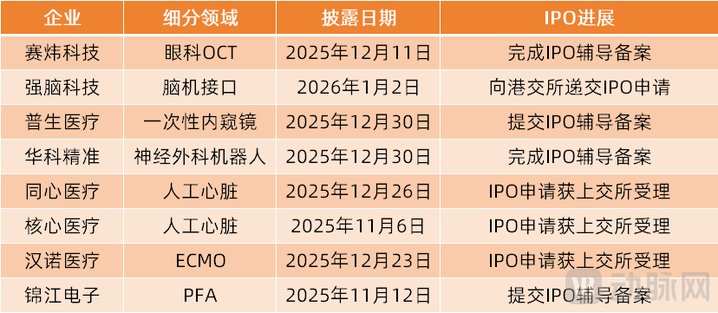
Core Viewpoint - The innovative medical device market is witnessing a surge in IPO activities across various segments, indicating a shift towards capitalization and maturity in the industry [1][20]. Group 1: IPO Developments - Several innovative medical device companies are moving towards IPO, including Saiwei Technology in the ophthalmic OCT field, Qiangnao Technology in brain-computer interfaces, and Pusong Medical in single-use endoscopes [1][19]. - The emergence of these IPOs suggests that multiple niche markets are collectively advancing, marking a new phase of high-end and capitalized development for domestic innovative medical devices [20]. Group 2: Investment Trends - Since 2020, there has been a significant influx of investment in the innovative medical device sector, with the number of financing events increasing from 118 in 2019 to 475 in 2021, although it has slightly decreased in subsequent years [5][21]. - The single-use endoscope sector has seen substantial funding, with companies like Ruipai Medical completing multiple rounds of financing, contributing to rapid industry growth [23]. Group 3: Policy and Market Support - Recent government policies have been implemented to support the high-quality development of innovative medical devices, facilitating their commercialization and market entry [8][24]. - For instance, the inclusion of artificial heart surgeries in insurance coverage has reduced patient financial burdens, leading to increased market growth for related companies [9][25]. Group 4: Future Outlook - The upcoming years are expected to see more niche markets achieving their first IPOs, particularly in areas like oral and hair transplant surgical robots, which have demonstrated commercial viability [30][31]. - The successful IPOs of these companies are anticipated to further accelerate industry growth and market penetration, fostering a more mature market landscape [32].
AI医疗爆发三重奏:亢奋、焦虑与希望
2 1 Shi Ji Jing Ji Bao Dao· 2026-01-22 08:03
Core Viewpoint - The AI healthcare sector is experiencing significant growth and interest in 2026, with substantial increases in various healthcare indices and notable stock performance among key companies in the sector [1][2]. Market Performance - As of January 21, 2026, the AI healthcare index surged over 11%, while the CSI Medical Index and Hang Seng Healthcare Index rose by 8% and 11.67% respectively [1]. - Companies like Dean Diagnostics and Baolite have seen stock increases exceeding 60%, with others like Weining Health and Chengdu Xian Dao also showing gains over 20% [1]. Market Trends and Projections - The AI healthcare market in China is projected to grow from 8.8 billion yuan in 2023 to 315.7 billion yuan by 2033, reflecting a compound annual growth rate of 43.1% [2]. - The rapid advancement in AI healthcare applications is driven by technological breakthroughs, favorable policies, and increasing market demand [2]. Technological Developments - Major tech companies are actively entering the AI healthcare space, with OpenAI, Google, and domestic firms like Ant Group and Tencent launching various AI healthcare applications [4]. - Significant advancements have been made in AI-assisted diagnostics, medical imaging, and drug development, indicating a trend towards more efficient healthcare solutions [5][6]. Commercialization Challenges - Despite the enthusiasm, the commercialization of AI healthcare products faces challenges, including ethical concerns, regulatory risks, and slow progress in translating technological advancements into financial performance [10][11]. - As of January 21, 2026, over half of the 47 biomedicine companies that disclosed earnings forecasts reported losses or reduced earnings, highlighting the disparity between market excitement and actual financial results [10]. Regulatory Developments - Recent government initiatives aim to promote and standardize the application of AI in healthcare, with a focus on establishing high-quality data sets and clinical models by 2027 [13][14]. - The National Healthcare Security Administration has clarified pricing for AI-assisted diagnostic services, which is expected to enhance the commercial viability of AI healthcare products [14]. Future Outlook - Industry experts predict that 2026 will be a pivotal year for the commercialization of AI healthcare, driven by clearer payment structures and stronger market demand [13][14]. - The focus will likely be on AI applications in drug development, diagnostics, and operational efficiency, with expectations for rapid growth in the sector [14].
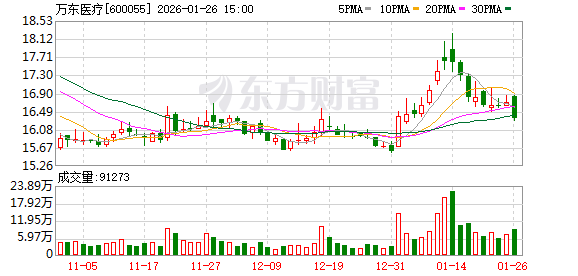
万东医疗涨2.22%,成交额5724.49万元,主力资金净流入402.41万元
Xin Lang Cai Jing· 2026-01-21 02:53
Core Viewpoint - WanDong Medical's stock has shown a mixed performance in recent trading, with a year-to-date increase of 9.11% but a decline of 3.41% over the last five trading days [1] Group 1: Stock Performance - As of January 21, WanDong Medical's stock price reached 17.00 CNY per share, with a market capitalization of 11.95 billion CNY [1] - The stock has experienced a trading volume of 57.24 million CNY and a turnover rate of 0.49% [1] - Year-to-date, the stock has increased by 9.11%, while it has decreased by 3.41% in the last five trading days [1] Group 2: Financial Performance - For the period from January to September 2025, WanDong Medical reported a revenue of 1.189 billion CNY, reflecting a year-on-year growth of 8.73% [2] - The company recorded a net profit attributable to shareholders of -27.21 million CNY, a significant decrease of 123.51% compared to the previous year [2] Group 3: Shareholder Information - As of September 30, 2025, the number of shareholders for WanDong Medical increased to 27,200, up by 1.23% from the previous period [2] - The average number of circulating shares per shareholder decreased by 1.22% to 25,882 shares [2] - The top ten circulating shareholders include notable entities such as HuaBao ZhongZheng Medical ETF and Hong Kong Central Clearing Limited, with varying changes in their holdings [3]
万东医疗(600055) - 万东医疗2026年第一次临时股东会会议资料
2026-01-19 09:30
万东医疗 2026 年第一次临时股东会会议资料 北京万东医疗科技股份有限公司 2026 年第一次临时股东会会议资料 2026 年 1 月 万东医疗 2026 年第一次临时股东会会议资料 北京万东医疗科技股份有限公司 2026 年第一次临时股东会会议议程 现场会议时间:2026 年 1 月 26 日 10 点 00 分 交易系统投票平台投票时间:2026 年 1 月 26 日交易时间段。 互联网投票平台投票时间:2026 年 1 月 26 日 9:15-15:00。 投票方式:本次股东会所采用的表决方式是现场投票和网络投票相结 合的方式。 为更好地服务广大中小投资者,确保有投票意愿的中小投资者能够及 时参会、及时投票,本公司使用上证所信息网络有限公司(以下简称"上证 信息")提供的股东会提醒服务,委托上证信息通过智能短信等形式,根据 股权登记日的股东名册主动提醒股东参会投票,向投资者主动推送股东会 参会邀请、议案情况等信息。投资者在收到智能短信后,可根据《上市公 司 股 东 会 网 络 投 票 一 键 通 服 务 用 户 使 用 手 册 》( 下 载 链 接 : https://vote.sseinfo.com ...
方洪波:白电要做全球“数一数二”,加大布局机器人、能源和医疗
2 1 Shi Ji Jing Ji Bao Dao· 2026-01-18 07:13
Core Insights - The chairman and president of Midea Group, Fang Hongbo, emphasized a strategic focus on "core growth" for 2026, concentrating on core businesses, markets, and capabilities to foster sustainable growth [2] - Midea's operational strategy in the past year was centered on "simplification to promote growth" and "self-disruption to face challenges," with expectations for significant breakthroughs in technology, product innovation, and global expansion by 2025 [2] - Midea's diverse business segments, including smart home, industrial technology, and medical sectors, have shown considerable growth, with notable product launches such as AI-driven home appliances and advanced HVAC solutions [2][3] Business Segments - The smart home segment introduced several innovative products, including the industry's first AI butler and a 45CM ultra-thin refrigerator, showcasing Midea's commitment to product innovation [2] - The industrial technology segment focused on HVAC and new energy vehicles, launching new products like wide-frequency rotary compressors and dual-stage variable capacity scroll compressors [2] - Midea Medical has entered a new development phase, launching the world's first full-link AI intelligent platform for MRI and acquiring international imaging giant Ricoh Medical to accelerate its entry into the high-end medical market [3] Core Business Focus - Despite the growth of diversified businesses, Midea's core operations in white goods and HVAC remain foundational, with a need to strengthen market advantages through continuous innovation and user experience enhancement [4] - The company aims to solidify its position as a market leader in core businesses while strategically developing its next core sectors: robotics, energy, and medical [4] - KUKA's goal is to become the number one player in the Chinese market, while the medical sector aims to leverage domestic innovation opportunities to build a trillion-yuan industry platform [4] Strategic Mindset - Fang Hongbo expressed a strong sense of urgency regarding market competition, advocating for a mindset of "only the paranoid survive" to encourage self-revolution and break away from path dependence [4] - The management is encouraged to decisively eliminate redundant businesses and inefficient assets, streamline organizational structures, and maintain agility and vitality within the company [5] - There is a call to disrupt existing mindsets and structures to foster growth, warning against the "big company disease" characterized by unclear responsibilities, slow decision-making, and stagnation in innovation [5]


方洪波:我们总有道路,前程崭新
Xin Lang Cai Jing· 2026-01-17 02:11
Core Insights - Midea Group's Chairman Paul Fang emphasized the company's resilience and strategic direction in his 2026 New Year address, highlighting the achievements of 2025 despite global challenges and expressing confidence in overcoming future obstacles [1][23][48] Group 1: Global Challenges and Company Progress - In 2025, Midea faced a turbulent global political and economic environment but continued to advance by adhering to a strategy of simplification for growth and self-disruption to meet challenges [2][27] - The company made significant strides in technology leadership, product innovation, and global impact across various business segments, including smart home, industrial technology, and healthcare [4][29][49] Group 2: Business Segments and Innovations - Midea's smart home segment introduced the first AI Butler and led the air conditioning industry with advanced AI interaction technologies, while also launching innovative products like a 45CM ultra-thin refrigerator [4][29] - In industrial technology, Midea focused on key components for HVAC and robotics, launching new products and establishing manufacturing bases in Mexico and Brazil [4][29][49] - The healthcare sector saw the establishment of a dedicated division, with significant innovations such as the world's first full-chain AI platform for MRI and the acquisition of Carestream International [5][30][49] Group 3: Strategic Focus for 2026 - Midea's strategy for 2026 centers on "Core-Focused Growth," emphasizing core businesses, markets, and capabilities to create a sustainable growth relay between ToC and ToB operations [31][50] - The company aims to solidify its leadership in white goods and HVAC, targeting top global positions through continuous innovation and enhanced user experience [6][31][50] - Secondary core businesses, including robotics, energy, and healthcare, will be strategically developed to ensure resilience across economic cycles [34][50] Group 4: Efficiency and Globalization - Midea plans to enhance efficiency across its value chain, focusing on cost leadership and digitalization to improve decision-making and operational efficiency [39][50] - The company will implement an OBM-first strategy to strengthen its global presence, emphasizing localization in R&D, manufacturing, and supply chains in key regions [39][50] Group 5: Embracing Change and Future Opportunities - Midea recognizes the necessity of continuous self-reinvention and the courage to disrupt existing patterns to foster growth amid fierce competition [40][51] - The company is committed to maintaining an enterprising spirit and adapting to changing market demands, ensuring that innovation and self-improvement remain central to its identity [44][51] - Midea believes that by focusing on core strengths and embracing change, every direction will lead to new opportunities for growth [45][51]