云南白药

Search documents
云南白药(000538) - 关于股东部分股份质押的公告
2026-02-03 10:00
质押股份是否负担重大资产重组等业绩补偿义务:否。 1 / 3 股票代码:000538 股票简称:云南白药 公告编号:2026-02 云南白药集团股份有限公司 关于股东部分股份质押的公告 本公司及董事会全体成员保证信息披露的内容真实、准确、完整,没有 虚假记载、误导性陈述或重大遗漏。 云南白药集团股份有限公司(以下简称"公司"或"云南白药")于近 日接到公司股东新华都实业集团股份有限公司(以下简称"新华都")的通 知,获悉新华都将其持有的公司部分股份办理了质押。具体情况如下: 股东名 称 是否为控 股股东或 第一大股 东及其一 致行动人 本次质押数 量(股) 占其所 持股份 比例 占公司 总股本 比例 是否为限 售股(如 是,注明 限 售 类 型) 是否 为补 充质 押 质押起始日 质押 到期 日 质权人 质押 用途 新华都 实业集 团股份 有限公 司 否 6,750,000 1.55% 0.38% 否 否 2026-02-02 至办 理解 除质 押之 日止 兴业银 行股份 有限公 司福州 分行 融资 担保 合计 / 6,750,000 1.55% 0.38% / / / / / / 一、本次股份质押基本情况 ...

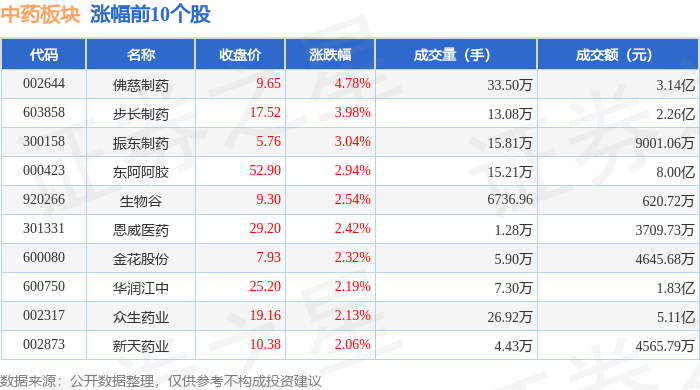
中药板块2月3日涨0.73%,佛慈制药领涨,主力资金净流出1.93亿元
Zheng Xing Xing Ye Ri Bao· 2026-02-03 09:03
Market Overview - The Chinese traditional medicine sector increased by 0.73% on February 3, with Foci Pharmaceutical leading the gains [1] - The Shanghai Composite Index closed at 4067.74, up by 1.29%, while the Shenzhen Component Index closed at 14127.1, up by 2.19% [1] Stock Performance - Foci Pharmaceutical (002644) closed at 9.65, rising by 4.78% with a trading volume of 335,000 shares and a transaction value of 314 million yuan [1] - Other notable performers include: - Bichang Pharmaceutical (603858) at 17.52, up by 3.98% [1] - Zhendong Pharmaceutical (300158) at 5.76, up by 3.04% [1] - Dong'e Ejiao (000423) at 52.90, up by 2.94% with a transaction value of 800 million yuan [1] Capital Flow - The traditional medicine sector experienced a net outflow of 193 million yuan from institutional investors, while retail investors saw a net inflow of 190 million yuan [2] - The capital flow for key stocks includes: - Bichang Pharmaceutical with a net inflow of 42.06 million yuan from institutional investors [3] - Foci Pharmaceutical with a net inflow of 14.63 million yuan from institutional investors [3] - Dong'e Ejiao had a net inflow of 12.57 million yuan from institutional investors [3]


云南省政府工作报告:稳妥有序组建云南农村商业银行
Sou Hu Cai Jing· 2026-02-03 08:36
报告提到,"十四五"期间,云南省地区生产总值突破3万亿元、年均增长4.7%,人均地区生产总值超1万 美元。 2025年,云南省完成地区生产总值32765亿元、增长4.1%,规模以上工业增加值增长4.5%,第一、第三 产业增加值分别增长3.1%、5.1%,社会消费品零售总额增长2.4%,货物贸易进出口总额增长10.2%,地 方一般公共预算收入增长2.3%、支出首次超过7000亿元,城镇调查失业率均值5.2%,居民人均可支配 收入增长4.6%。 2026年,云南省经济社会发展的主要预期目标为:地区生产总值增长4.5%左右,产业投资占比保持在 50%以上,地方一般公共预算收入增长2%,城镇调查失业率5.5%以内,城镇新增就业50万人以上,居 民人均可支配收入增长与经济增长同步,粮食总产量稳定在1955万吨以上,单位地区生产总值二氧化碳 排放降低完成经国家审核衔接后确定的目标。 云南省今年将具体抓好9个方面工作。其中包括突出重点领域改革。推进要素市场化配置改革。完善容 量电价机制,有效衔接电力市场、绿证市场、碳市场。健全用水权交易制度体系。深入整治"内卷式"竞 争。进一步深化国资国企改革,构建省属企业"1+N+X"规 ...
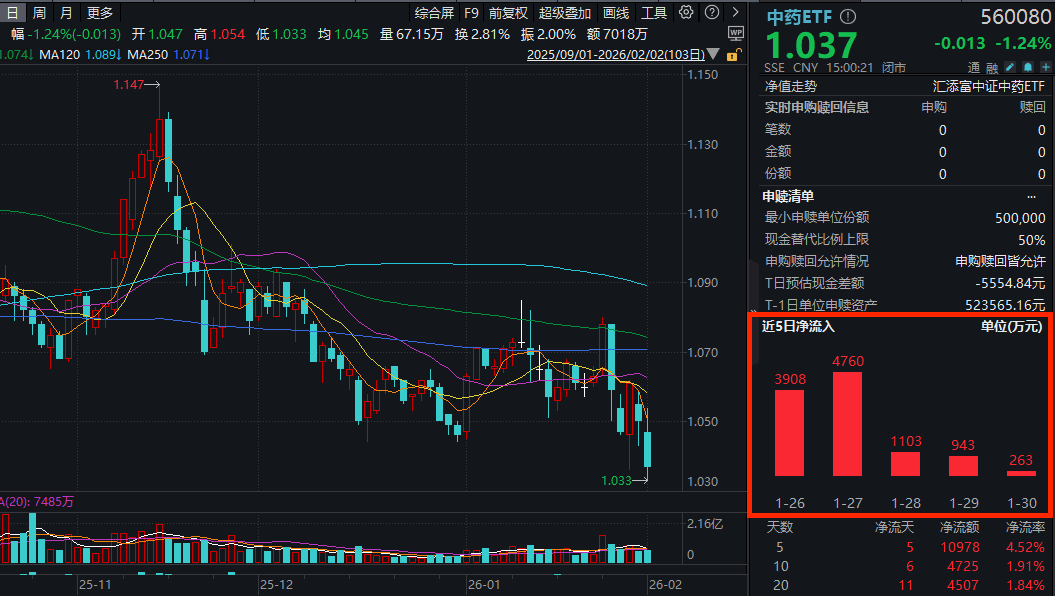
吉林敖东2025年净利同比增长46%-60%!中药ETF(560080)收跌1.24%,连续5日累计"吸金"超1亿元!后续交易回归"质量"?机构:关注中药三大主线
Sou Hu Cai Jing· 2026-02-02 09:53
Core Viewpoint - The recent performance of the Chinese medicine sector, particularly the Chinese Medicine ETF (560080), indicates a potential shift in investment style, with increasing capital inflow and favorable valuation metrics suggesting a recovery phase ahead for the industry [3][8]. Group 1: Market Performance - On February 2, the Shanghai Composite Index fell by 2.48%, while the Chinese Medicine ETF (560080) experienced a decline of 1.24%, with a total trading volume exceeding 70 million yuan [1]. - The Chinese Medicine ETF has seen continuous capital inflow, accumulating over 100 million yuan in net inflow over the past five days [1][3]. Group 2: Valuation Metrics - The latest price-to-earnings ratio (PE-TTM) for the index tracked by the Chinese Medicine ETF is 23.96, indicating that the valuation is below 85.61% of the time since its inception in May 2015, highlighting attractive valuation opportunities [3]. - The Chinese medicine sector is perceived to be entering a "sweet spot" in terms of valuation, with a significant portion of stocks showing potential for recovery [3]. Group 3: Individual Stock Performance - Most of the weighted stocks in the Chinese Medicine ETF index closed lower, with notable declines including Jilin Aodong down over 7% and Darentang down over 3% [5]. - Conversely, Dong'e Ejiao was one of the few stocks that rose, gaining over 1% [5]. Group 4: Earnings Forecasts - Jilin Aodong has projected a net profit of approximately 2.265 to 2.482 billion yuan for 2025, representing a year-on-year growth of 46.0% to 60.0%, attributed to increased fair value changes and investment income [7]. - As of January 31, 11 companies within the Chinese Medicine ETF index have released earnings forecasts, with six reporting positive year-on-year growth [7]. Group 5: Future Outlook - The Chinese medicine sector is expected to experience a rebound in 2026, driven by inventory digestion and an anticipated increase in flu incidence in Q4 2025, which may enhance sales of related OTC products [8]. - The potential update of the essential drug catalog is also seen as a catalyst for growth, with companies that can meet the new criteria likely to benefit [8]. Group 6: Investment Themes - Three main investment themes have been identified for the Chinese medicine industry: price governance, consumption recovery, and state-owned enterprise reform [9][10][11]. - The focus on price governance suggests that companies with competitive advantages may benefit from price reductions leading to increased market share [9]. - The recovery of consumer demand, driven by macroeconomic improvement and an aging population, is expected to support sales growth in the Chinese medicine sector [10]. - State-owned enterprises in the industry are anticipated to present investment opportunities as reforms aim to enhance efficiency and performance [11].

人到中年,家里达到3个条件,你已经超越90%的家庭了
洞见· 2026-02-02 04:00
Core Viewpoint - The article emphasizes the importance of health and wellness, particularly for individuals over 40, highlighting the need to take care of oneself to support family responsibilities and well-being [5][8][9]. Group 1: Health and Wellness - Individuals over 40 who have healthy parents and a stable family are considered to be at the top of the social pyramid [5]. - Taking care of one's health is not just a personal matter but a significant concern for the entire family [9]. - True wellness is described as a long-term commitment rather than a temporary trend or luxury [11]. Group 2: Yunnan Baiyao Brand - Yunnan Baiyao is presented as a century-old national brand, established in 1902, known for its quality and trustworthiness [15][16]. - The brand has a rich history, having been recognized and supported by historical figures, including Premier Zhou Enlai [18]. - Yunnan Baiyao's products are based on a secret formula that has been validated by generations of users, establishing a strong reputation [21]. Group 3: Product Offerings - The article promotes various health products, including broken wall ganoderma spore powder, western ginseng, and saffron, available at discounted prices during a live broadcast event [13][28]. - The broken wall ganoderma spore powder is highlighted for its high bioavailability and health benefits, including immune support and anti-aging properties [40][41]. - The article also mentions the three-seven powder, which is known for its blood circulation benefits, and emphasizes its quality through rigorous testing [54][56]. Group 4: Promotional Event - A promotional live broadcast event is scheduled for February 4, featuring significant discounts on health products, encouraging early reservations [27][28]. - The event aims to provide affordable health solutions, with prices as low as 9.9 yuan for certain products, making them accessible to a wider audience [28][29]. - The article encourages participation in the live event to secure exclusive offers and learn about the products from experts [27][76].

【践行“两高四着力”一线调研行】中原,真中!
Zheng Zhou Ri Bao· 2026-02-02 01:56
Core Viewpoint - The article emphasizes the development and transformation of the Central Plains region, particularly Zhengzhou, focusing on industrial innovation, urban integration, and cultural consumption to drive economic growth and improve quality of life [3][10][22]. Industrial Development - The Central Plains region is enhancing its industrial base by promoting smart manufacturing and digital transformation, with a focus on key sectors such as artificial intelligence, new materials, and low-carbon technologies [5][7]. - In 2025, the region aims to establish a comprehensive development system that integrates application research, enterprise incubation, and results transformation, with a projected industrial investment growth of 11.23% year-on-year [7][9]. - The number of technology service enterprises reached 9,156, with a revenue growth of 25.8% in the first three quarters [7][9]. Urban Integration - The strategy of "one area, multiple parks" is being implemented to enhance urban and industrial integration, leading to efficient resource utilization and increased investment ratios [11][14]. - The region has developed 57 operational industrial carriers, with over 16,000 enterprises registered, contributing 12.92 billion yuan in district-level tax revenue, accounting for 37.35% of the total [13][14]. Investment Attraction - The Central Plains region is actively improving its business environment to attract investments, with new projects signed totaling 48.6 billion yuan and an expected completion of 31.1 billion yuan in new construction projects [18][19]. - The region has successfully attracted high-profile enterprises and talents, enhancing its economic dynamism and fostering a robust investment landscape [19][21]. Cultural and Consumption Development - The region is leveraging cultural and sports events to enhance consumer engagement, hosting over 900 major events and generating significant economic activity [23][25]. - Initiatives to integrate cultural, tourism, and sports sectors are being promoted to transform transient visitors into regular consumers, thereby boosting local economic growth [25][27]. Smart Governance - The Central Plains region is adopting smart governance practices, utilizing data and technology to enhance service delivery and community engagement [28][32]. - A comprehensive data-sharing system has been established, facilitating efficient management and responsive governance to meet community needs [32][29].

趋势研判!2026年中国妇科用药行业发展背景、产业链、市场规模、重点企业及未来趋势:妇科疾病高发促进用药需求,行业规模增至595.3亿元[图]
Chan Ye Xin Xi Wang· 2026-02-02 01:09
Industry Overview - The gynecological medication industry encompasses drugs for the prevention, diagnosis, and treatment of gynecological diseases, including traditional hormone therapies, antibiotics, analgesics, and immunomodulators [1][3] - The market for gynecological medications in China has shown rapid growth, with the market size increasing from 27.735 billion yuan in 2012 to an estimated 56.137 billion yuan in 2024, reflecting a compound annual growth rate (CAGR) of 6.05% [1][9] - By 2025, the market size is projected to reach approximately 59.53 billion yuan, driven by increasing awareness of women's health and societal emphasis on female health [1][9] Market Dynamics - The prevalence of gynecological diseases among adult women in China is high, with an estimated incidence rate between 40% and 70%, including conditions such as tumors, cysts, reproductive-related diseases, and gynecological inflammation [6] - The rise in gynecological disease rates and the growing health consciousness among women are contributing to the steady expansion of the gynecological medication market [6] Industry Chain - The gynecological medication industry chain consists of upstream raw materials, intermediates, and pharmaceutical equipment; midstream production; and downstream distribution through pharmacies, hospitals, and e-commerce platforms [6][7] Key Companies - Notable companies in the gynecological medication sector include Qianjin Pharmaceutical, Tongrentang, Kangyuan Pharmaceutical, Jiuzhitang, Yunnan Baiyao, and others, which are focusing on R&D and product differentiation [10][11] Development Trends - Future product development in gynecological medications is expected to shift towards precision and individualized treatment, utilizing diagnostic technologies to enhance treatment efficacy and reduce side effects [12] - Innovations in drug formulations and delivery methods will improve patient compliance and experience, with a focus on long-acting, user-friendly options [13] - The role of gynecological medication companies is evolving from mere drug suppliers to providers of comprehensive health management solutions for women throughout their life stages [14]




代表委员通道|罗晓东委员:为“云药”腾飞插上科技翅膀
Xin Lang Cai Jing· 2026-01-31 06:05
Core Insights - Yunnan has a rich biodiversity and ranks among the top in China for traditional Chinese medicine cultivation area and variety, providing a solid foundation for the biopharmaceutical industry [1] - The biopharmaceutical industry in Yunnan has shown significant development, with companies like Yunnan Baiyao and Beitaini leading the market with their unique products [1] - Despite the potential, the industry faces challenges such as low levels of deep processing, insufficient core technological support, and a lack of integration between research and industry [1][2] Group 1: Industry Development - Yunnan's biopharmaceutical industry has made notable progress, with leading companies capitalizing on unique product offerings [1] - The industry is characterized by a strong foundation in traditional medicine, but it requires advancements in technology and processing capabilities [1] Group 2: Challenges and Recommendations - Key challenges include insufficient core technology, gaps in the translation of laboratory results to industry applications, and low levels of automation [1][2] - Recommendations include transitioning from resource-dependent to innovation-driven models, emphasizing technological empowerment in deep processing [1][2] - Establishing interdisciplinary innovation teams and enhancing collaboration between universities, research institutions, and enterprises is crucial for overcoming existing barriers [2] Group 3: Technological Advancements - The focus should be on modernizing traditional drugs and enhancing smart manufacturing through digital quality management systems and intelligent production lines [2] - The adoption of AI technology is recommended to optimize production parameters, reduce R&D cycles, and lower production costs [2] - Strengthening brand development and upgrading standards to promote the internationalization of natural drug products is essential for increasing the visibility of Yunnan's biopharmaceutical offerings [2]
“大批中成药将退出市场”是真的吗?
Sou Hu Cai Jing· 2026-01-30 13:02
Core Viewpoint - The recent implementation of the "Regulations on the Registration Management of Traditional Chinese Medicine" by the National Medical Products Administration is expected to significantly impact the market for traditional Chinese medicine, with a potential exit of many products by 2031 due to stricter requirements for drug registration and safety information [1][2][5]. Group 1: Policy Implementation and Timeline - The new regulations took effect on July 1, 2023, providing a transition period of three years, with an actual deadline for compliance extending to 2031 due to the five-year drug re-registration cycle [1][5]. - Many companies, including leading firms like Yunnan Baiyao and Tongrentang, are already preparing to meet the new requirements by enhancing their product safety information [1][5]. Group 2: Rationale Behind the Policy - The policy aims to improve drug safety by mandating that traditional Chinese medicine products clearly state contraindications, adverse reactions, and precautions, addressing public concerns about medication safety [2][4]. Group 3: Market Impact and Industry Dynamics - The regulations are not expected to lead to a mass exit of traditional Chinese medicine products; instead, they may encourage companies to focus on their core strengths and improve product quality [4][5]. - The Chinese traditional medicine market is characterized by excessive competition, with over 4,500 production companies and approximately 2,400 traditional Chinese medicine enterprises, leading to a potential consolidation as weaker companies may exit the market [5][6]. - The policy could facilitate a shift from a fragmented market to a more robust and high-quality development phase, aligning better with consumer needs [6].
从巨头布局到全场景渗透,AI+医药迈入竞争新阶段
2 1 Shi Ji Jing Ji Bao Dao· 2026-01-30 11:34
Group 1 - The global pharmaceutical industry is experiencing a surge in AI initiatives, with major companies like Eli Lilly and NVIDIA collaborating to establish an AI innovation lab, and AstraZeneca acquiring Modella AI to enhance its capabilities in biomedical AI [1][4] - AI's role in drug development is evolving from a supportive tool to a core innovation engine, as evidenced by its prominence at the 2026 JPM Healthcare Conference [1][4] - The AI wave is impacting not only drug development but also permeating various sectors within the healthcare industry, with hospitals and tech giants entering the AI healthcare space [1][2] Group 2 - Deloitte's report indicates that the innovation return on investment (IRR) for the top 20 global pharmaceutical companies is only 5.9%, with the average cost of drug development rising from $2.12 billion in 2023 to $2.229 billion in 2024 [4] - AstraZeneca's AI initiatives include the AIDA system aimed at reducing development time by 50%, while Eli Lilly and NVIDIA plan to invest $1 billion over five years in their AI lab [4][5] - Domestic AI pharmaceutical companies are also making strides, with companies like InSilico Medicine and CrystalClear Technology forming significant partnerships to enhance drug development using AI [5] Group 3 - The global AI healthcare market is projected to grow at a compound annual growth rate (CAGR) of 43% from 2024 to 2032, with generative AI in healthcare expected to grow at an even higher CAGR of 85% [6][7] - AI is anticipated to save the U.S. healthcare system approximately $150 billion annually by 2026, with long-term investment returns in AI healthcare reaching 10%-15% [7] - Companies are increasingly integrating AI across the entire pharmaceutical value chain, from drug discovery to marketing and patient services, enhancing operational efficiency [7][8] Group 4 - Innovative companies are focusing on specific scenarios to launch AI products, gaining attention from the capital market, with examples including Hangzhou Quanzhen Medical Technology and its AI application "Quanzhen Tong" [8][9] - Many domestic AI healthcare products are still in the data accumulation phase, with those that can effectively integrate into real medical processes and address industry pain points emerging as the future mainstream [9]