
西部超导

Search documents
未知机构:聚能磁体启动IPO辅导财联社2月12日电证监会网站披露西安聚能超导磁体科-20260213
未知机构· 2026-02-13 02:35
Summary of Key Points from the Conference Call Company Involved - Xi'an Juneng Superconducting Magnet Technology Co., Ltd. is preparing for an IPO and has registered for guidance with the Shaanxi Securities Regulatory Bureau on February 11, 2026 [1] Core Insights and Arguments - The company plans to publicly issue shares to unspecified qualified investors [1] - The guiding institution for the IPO process is CITIC Securities [1] - Western Superconducting Technologies Co., Ltd. holds 29.6 million shares in Juneng, representing a 34.82% ownership stake, making it the controlling shareholder [1] Other Important but Possibly Overlooked Content - The IPO guidance registration indicates a strategic move for Juneng to access capital markets, which may enhance its growth potential in the superconducting materials industry [1]
首款5吨级eVTOL完成首飞,通用航空ETF基金(561660)开盘上涨
Xin Lang Cai Jing· 2026-02-13 02:19
Group 1 - The core viewpoint of the news highlights the acceleration of the low-altitude economy's industrialization process, exemplified by the successful first flight of the V5000 eVTOL aircraft developed by Peak Flying Technology [1] - The China General Aviation Theme Index (931855) has shown a slight increase of 0.10%, with notable gains in constituent stocks such as Hangcai Co. (+5.91%) and Zongheng Co. (+4.67%) [1] - The General Aviation ETF (561660) has also seen a rise of 0.23%, currently priced at 1.31 yuan [1] Group 2 - Southwest Securities emphasizes that low-orbit satellites are a critical infrastructure for the 6G "space-ground integration" network, with development constrained by national strategic rigidity and the scarcity of orbital resources [2] - The industry logic is shifting from technology validation to a focus on constellation deployment, with three key advancement nodes identified: improved rocket reusability, operational commercial launch sites, and integrated communication terminals [2] - As of January 30, 2026, the top ten weighted stocks in the China General Aviation Theme Index account for 45.73% of the index, including companies like Aerospace Electronics and China Satellite Communications [2]
国防ETF(512670)涨超1.3%,我国完成首次载人飞船返回舱海上搜索回收任务
Xin Lang Cai Jing· 2026-02-12 05:53
Group 1 - The core viewpoint of the news highlights the successful test of the "Dream Boat" manned spacecraft's maximum dynamic pressure escape during the Long March 10 rocket system demonstration, indicating advancements in China's space capabilities [1] - In 2025, China achieved a record high of 92 space launches, with commercial space achieving 50 launches, and new rocket models like Long March 8A successfully making their first flights [1] - The Aerospace Science and Technology Group's annual meeting in 2026 emphasized the goal of breaking through reusable rocket technology, with several new rocket models planned for their inaugural flights, marking a potential turning point for the commercialization of space [1] Group 2 - The China Defense ETF closely tracks the CSI Defense Index, which includes listed companies under the top ten military industrial groups and those providing equipment to the armed forces, reflecting the overall performance of defense industry stocks [2] - As of January 30, 2026, the top ten weighted stocks in the CSI Defense Index accounted for 42.4% of the index, including companies like Aerospace Electronics and AVIC Engine [2]
五部门发文支持低空基础设施发展,通用航空ETF基金(561660)多股飘红
Xin Lang Cai Jing· 2026-02-12 02:23
Group 1 - The core viewpoint of the news highlights the growth and development of the general aviation sector in China, supported by government initiatives and advancements in technology [1][2] - The China General Aviation Theme Index (931855) has shown a slight increase of 0.04% as of February 12, 2026, with notable gains in constituent stocks such as BaoTi Co., Ltd. (up 4.08%) and Triangle Defense (up 2.23%) [1] - The Ministry of Industry and Information Technology, along with four other departments, has issued an implementation opinion aimed at enhancing the capacity of the information and communication industry to support low-altitude infrastructure development, targeting a ground mobile communication network coverage rate of no less than 90% by 2027 [1] Group 2 - The China General Aviation ETF closely tracks the China General Aviation Theme Index, which includes 50 listed companies involved in various aspects of general aviation, reflecting the overall performance of this sector [2] - As of January 30, 2026, the top ten weighted stocks in the index account for 45.73% of the total index, with companies such as Aerospace Electronics and China Satellite Communications leading the list [2]
聚能磁体启动IPO辅导

Mei Ri Jing Ji Xin Wen· 2026-02-12 01:31
Group 1 - The core point of the article is that Xi'an Juneng Superconducting Magnet Technology Co., Ltd. has completed the filing for guidance with the Shaanxi Securities Regulatory Bureau to publicly issue stocks and list them, with CITIC Construction Investment Securities as the advisory institution [1] - The guidance filing report indicates that Western Superconducting Technologies Co., Ltd. holds 29.6 million shares of Xi'an Juneng, accounting for 34.82% of the company's total shares, making it the controlling shareholder [1]
联创光电:向新而行厚积薄发,激光+超导双翼齐飞-20260212
Guoxin Securities· 2026-02-12 00:45
Investment Rating - The report initiates coverage with an "Outperform" rating for the company [3][5]. Core Views - The company has achieved a significant improvement in its financial performance, with a notable increase in net profit and revenue in the first three quarters of 2025, indicating a turning point in its business trajectory [1][21]. - The focus on "Laser + High-Temperature Superconductors" is optimizing the company's industrial structure, leading to enhanced profitability and growth potential in high-value sectors [2][14]. - The company is well-positioned to benefit from the growing demand in the laser and high-temperature superconducting markets, particularly in commercial aerospace and defense applications [23][40]. Financial Performance Summary - For the first three quarters of 2025, the company reported a revenue of 2.503 billion yuan, a year-on-year increase of 2.83%, and a net profit of 400 million yuan, up 19.40% year-on-year [1][8]. - The third quarter of 2025 saw a revenue of 856 million yuan, down 3.49% year-on-year but up 1.06% quarter-on-quarter, with a net profit of 137 million yuan, reflecting a 28.04% year-on-year increase [1][21]. - The gross margin for the first three quarters of 2025 was 19.73%, an increase of 3.84 percentage points year-on-year, while the net margin was 16.48%, also reflecting a significant improvement [8][25]. Earnings Forecast and Financial Metrics - The company is projected to achieve net profits of 477 million yuan, 584 million yuan, and 661 million yuan for 2025, 2026, and 2027 respectively, indicating growth rates of 97.9%, 22.3%, and 13.2% [4][3]. - Earnings per share (EPS) are expected to be 1.05 yuan, 1.28 yuan, and 1.45 yuan for the same years, with dynamic price-to-earnings (PE) ratios of 60, 49, and 44 [4][3]. - The report estimates the reasonable stock value to be between 72.4 and 75.1 yuan, suggesting a premium of 14.6% to 18.9% over the current stock price of 63.17 yuan [3][5]. Industry Positioning and Strategic Focus - The company is strategically positioned in the laser and high-temperature superconducting sectors, with a complete industrial chain from core components to system integration [40][47]. - The focus on high-temperature superconductors is expected to drive significant growth, particularly in applications related to controlled nuclear fusion and advanced manufacturing technologies [52][59]. - The company is also exploring opportunities in the commercial aerospace sector, leveraging its technological advancements in electromagnetic launch systems [66][74].

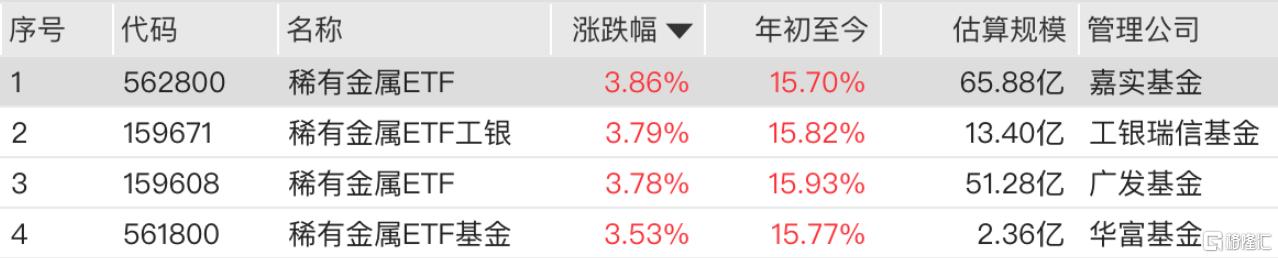
受相关期货价格提振,稀有金属ETF、稀有金属ETF工银、稀有金属ETF基金涨超3.5%
Ge Long Hui A P P· 2026-02-11 10:41
Market Overview - The three major A-share indices showed mixed performance today, with the Shanghai Composite Index rising by 0.09% to close at 4131.99 points, while the Shenzhen Component Index fell by 0.35% to 14160.93 points, and the ChiNext Index dropped by 1.08% to 3284.74 points. The total trading volume in the Shanghai and Shenzhen markets was 200.12 billion, a decrease of 123.7 billion from the previous day [1]. Rare Metals Sector Performance - The rare metals sector led the market gains today, driven by rising futures prices. Notable stocks included Zhongtung High-tech and Zhangyuan Tungsten, which hit the daily limit, while Xiamen Tungsten and Jinchuan Group rose over 7%, and Huayou Cobalt increased by over 5%. This momentum also boosted the Rare Metals ETF and related funds, which rose by more than 3.5% [1]. Rare Metals ETF Details - The Rare Metals ETF, which tracks the CSI Rare Metals Index, saw a rise of 3.86% today and has gained 15.70% year-to-date, with an estimated scale of 6.588 billion. Other related ETFs also showed positive performance, with the Industrial Bank Rare Metals ETF rising by 3.79% and the Rare Metals ETF Fund increasing by 3.53% [2]. Commodity Price Movements - There was a significant increase in commodity prices today, with lithium carbonate rising over 5%, nickel up over 4%, and other metals like tin and stainless steel increasing by over 2%. The main contract for lithium carbonate on the Guangzhou Futures Exchange surged by 9%, reaching 150,000 yuan/ton [3]. Global Rare Metals Market Trends - The global rare metals market is expected to continue its upward trend through 2026, with prices for rare earths, lithium, tungsten, cobalt, and nickel on the rise. This surge is attributed to three main factors: changes in global macroeconomic conditions, tightening supply constraints, and structural growth in demand from emerging industries [4][5]. Supply and Demand Dynamics - Supply constraints are a key driver of the current market dynamics, with countries like Indonesia and Vietnam implementing significant restrictions on exports of nickel and rare earths, respectively. China's export controls on certain rare metals further solidify its dominant position in global supply [4][6]. On the demand side, sectors such as electric vehicles, energy storage, and advanced manufacturing are driving robust demand for rare metals, indicating a structural growth trend [5][6].

通用航空ETF鹏华(563870)跌1.25%,半日成交额370.77万元
Xin Lang Cai Jing· 2026-02-10 03:43
Group 1 - The General Aviation ETF Penghua (563870) experienced a decline of 1.25%, closing at 0.951 yuan with a trading volume of 3.7077 million yuan [1] - Major holdings in the General Aviation ETF Penghua saw significant drops, including Aerospace Electronics down 3.98%, Haige Communication down 2.01%, and China Satellite Communications down 2.36% [1] - The fund's performance benchmark is the CSI General Aviation Theme Index return, with a return of -3.67% since its establishment on December 31, 2025, and a one-month return of -9.36% [1]


核聚变系列:磁体材料迭代推动产业升级
2026-02-10 03:24
Summary of the Conference Call on Nuclear Fusion and Magnetic Materials Industry Overview - The focus of the conference call was on the nuclear fusion industry, specifically the magnetic materials segment, which is expected to undergo significant upgrades and present investment opportunities as the industry matures and technology evolves [1][2]. Core Insights and Arguments - The nuclear fusion industry is experiencing accelerated growth driven by strong policy support and capital expenditure, with projects in cities like Hefei, Shanghai, and Chengdu progressing rapidly [2]. - The cost structure of magnetic materials is critical, with superconducting magnets representing a significant portion of the costs in fusion projects. For instance, in the ITER project, component costs account for 86%, with magnets alone making up 28% of that [3][25]. - The market for second-generation high-temperature superconducting materials is projected to grow from approximately 300 million yuan in 2024 to 4.9 billion yuan by 2030, reflecting a compound annual growth rate (CAGR) of 59% [4][27]. - The transition from low-temperature superconductors (primarily niobium-titanium and niobium-tin) to high-temperature superconductors (such as rare-earth barium copper oxide) is anticipated, which will enhance performance and reduce costs [3][15]. Key Developments and Trends - The global nuclear fusion sector is shifting from research to practical energy applications, with countries like the US, Japan, and Germany implementing strategic plans to support fusion development [6]. - The magnetic confinement approach remains the dominant commercial method, with significant projects like BEST and ITER expected to achieve breakthroughs in the next three years [7][25]. - The demand for superconducting materials is expected to rise significantly, with the market for niobium-titanium projected to reach 600 million USD, niobium-tin at 450 million USD, and rare-earth barium copper oxide at 790 million USD by 2024 [17]. Potential Risks and Considerations - The industry faces challenges related to the high costs of liquid helium for cooling low-temperature superconductors, which may hinder their commercial viability [14][18]. - The supply chain for critical metals used in superconductors, such as tantalum and niobium, is under scrutiny due to geopolitical factors and market dynamics, which could impact availability and pricing [20][22]. Additional Important Insights - The integration of superconducting materials in various applications beyond fusion, including high-end manufacturing and medical equipment, is expected to enhance the overall market value of these materials [28]. - The development of high-temperature superconductors is crucial for future advancements in fusion technology, as they can operate at higher temperatures and reduce cooling costs [30]. - The conference highlighted the importance of monitoring the supply chain for rare metals and the potential for price increases due to rising demand from sectors like commercial aerospace and semiconductor manufacturing [21][24]. Conclusion - The nuclear fusion industry, particularly the magnetic materials segment, is poised for significant growth driven by technological advancements and increasing investment. Key players in the superconducting materials market are expected to benefit from this trend, making them worthy of investor attention [34].
未知机构:华金电新核聚变系列深度三磁体材料迭代推动产业升级政策支持资本开支-20260210
未知机构· 2026-02-10 02:10
Summary of Key Points from the Conference Call Industry Overview - The fusion industry is entering an accelerated phase driven by policy support and capital expenditure, with major countries expected to introduce fusion policies by 2025, marking a shift from laboratory research to industrial layout and regulatory framework development [1] Technological Developments - Low-temperature superconductors (NbTi, Nb₃Sn) are relatively mature, while high-temperature superconductors (REBCO) are anticipated to become the mainstream in the future. The current landscape features a parallel development of low-temperature and high-temperature superconducting materials, with low-temperature superconductors supporting existing fusion device operations due to their industrial application advantages. High-temperature superconductors are seen as key to breakthroughs in next-generation high-field fusion technology due to their superior adaptability to extreme environments [1] Market Dynamics - The magnetic system is identified as a core cost component of fusion projects. Future Tokamak devices are expected to trend towards compact designs and high-temperature superconductors, leading to a significant increase in industry demand. The market size for second-generation high-temperature superconducting tapes for controllable fusion devices is projected to be 300 million yuan in 2024, with an expected growth to 4.9 billion yuan by 2030, representing a compound annual growth rate (CAGR) of 59.3% from 2024 to 2030 [2] Investment Recommendations - It is advised to focus on core supply chain manufacturers in the magnetic component segment: 1. Low-temperature superconductors: Western Superconductors 2. High-temperature superconductors: Shanghai Superconductor (not publicly listed, with Jingda Holdings as the largest shareholder), Lianchuang Optoelectronics, Eastern Superconductor (not publicly listed, a subsidiary of Yongding Co., Ltd.) 3. Core suppliers of tantalum and niobium: Dongfang Tantalum [2]
