
可复用火箭技术

Search documents
暴力拉升!300369,20cm涨停
Zhong Guo Ji Jin Bao· 2026-02-13 03:16
Market Overview - The A-share market opened lower and then fluctuated upward, with the Shanghai Composite Index down 0.36%, Shenzhen Component Index down 0.42%, and ChiNext Index down 0.7%, while the Sci-Tech Innovation Board Index rose by 0.37% [2] - The aerospace and military industry sector saw a rapid rise, while sectors such as maritime transport, oil and gas, and CPO experienced fluctuations [2] Aerospace and Military Sector - The aerospace and military sector rebounded, with companies like Andavil (300719) and Hangcai Co. showing significant gains [6] - Multiple new-generation rockets are expected to successfully launch, with over 100 launches anticipated in 2026, including models like Tianlong-3 and Lijian-2, which may challenge reusable rocket technology [7][8] Cybersecurity Sector - Cybersecurity stocks performed actively, with Green Alliance Technology (300369) hitting a 20% limit up, and other companies like Guotou Intelligent (300188) and Zhongxin Saike (002912) also showing strong gains [4] - The market saw significant increases in stock prices, with Green Alliance Technology up by 19.96% and Guotou Intelligent up by 10.15% [5] Key Company Performances - Tencent Music saw a decline of 8.77%, with a market cap of 183.7 billion [3] - Baidu Group decreased by 4.00%, with a market cap of 369.9 billion [3] - Bilibili dropped by 3.90%, with a market cap of 99.5 billion [3] - Meituan fell by 3.30%, with a market cap of 501.5 billion [3] - Alibaba decreased by 2.40%, with a market cap of 2,956.6 billion [3]




国防ETF(512670)涨超1.3%,我国完成首次载人飞船返回舱海上搜索回收任务
Xin Lang Cai Jing· 2026-02-12 05:53
Group 1 - The core viewpoint of the news highlights the successful test of the "Dream Boat" manned spacecraft's maximum dynamic pressure escape during the Long March 10 rocket system demonstration, indicating advancements in China's space capabilities [1] - In 2025, China achieved a record high of 92 space launches, with commercial space achieving 50 launches, and new rocket models like Long March 8A successfully making their first flights [1] - The Aerospace Science and Technology Group's annual meeting in 2026 emphasized the goal of breaking through reusable rocket technology, with several new rocket models planned for their inaugural flights, marking a potential turning point for the commercialization of space [1] Group 2 - The China Defense ETF closely tracks the CSI Defense Index, which includes listed companies under the top ten military industrial groups and those providing equipment to the armed forces, reflecting the overall performance of defense industry stocks [2] - As of January 30, 2026, the top ten weighted stocks in the CSI Defense Index accounted for 42.4% of the index, including companies like Aerospace Electronics and AVIC Engine [2]
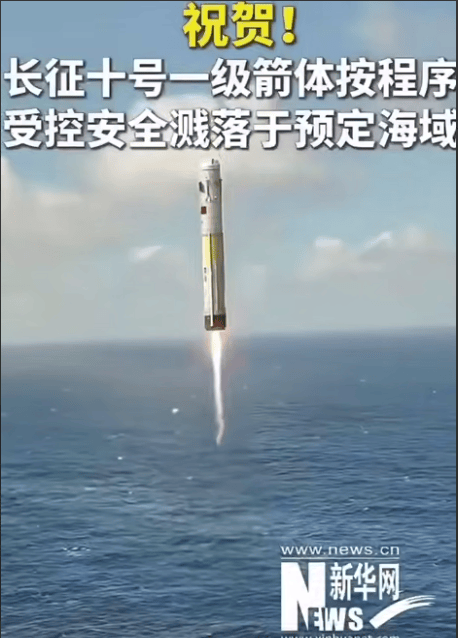
不是失败,是胜利!中国火箭“掉海里”,却让马斯克都得重新算一笔账
Sou Hu Cai Jing· 2026-02-12 02:24
Core Viewpoint - The successful controlled splashdown of the Long March 10 rocket marks a significant milestone in China's space exploration efforts, demonstrating advanced technology and paving the way for future manned lunar missions [1][5][7]. Group 1: Historical Context - Previously, rocket stages falling into the ocean were seen as mission failures, representing uncontrolled descents that posed risks to civilian areas and marine environments [3]. - Early attempts at sea recovery by companies like SpaceX faced numerous challenges, highlighting the difficulties in achieving controlled landings [3]. Group 2: Technological Achievements - The Long March 10's splashdown was executed with extreme precision, with a deviation of less than 10 meters from the target, showcasing advancements in re-entry, trajectory control, and recovery technologies [5]. - The rocket maintained structural integrity during the splashdown, which is crucial for future reuse, indicating significant breakthroughs in core technologies [5]. Group 3: Future Implications - This test is a critical step towards achieving China's goal of manned lunar missions by 2030, ensuring astronaut safety and validating the escape capabilities of the spacecraft under maximum dynamic pressure [7]. - The development of reusable rocket technology could reduce launch costs by 40%-60%, making future space exploration more economically viable [7]. - The successful controlled splashdown reinforces China's position as a leading nation in space technology and responsible exploration [7].
【Space X】全产业链!一天吃透马斯克的“商业帝国”
Sou Hu Cai Jing· 2026-01-30 12:30
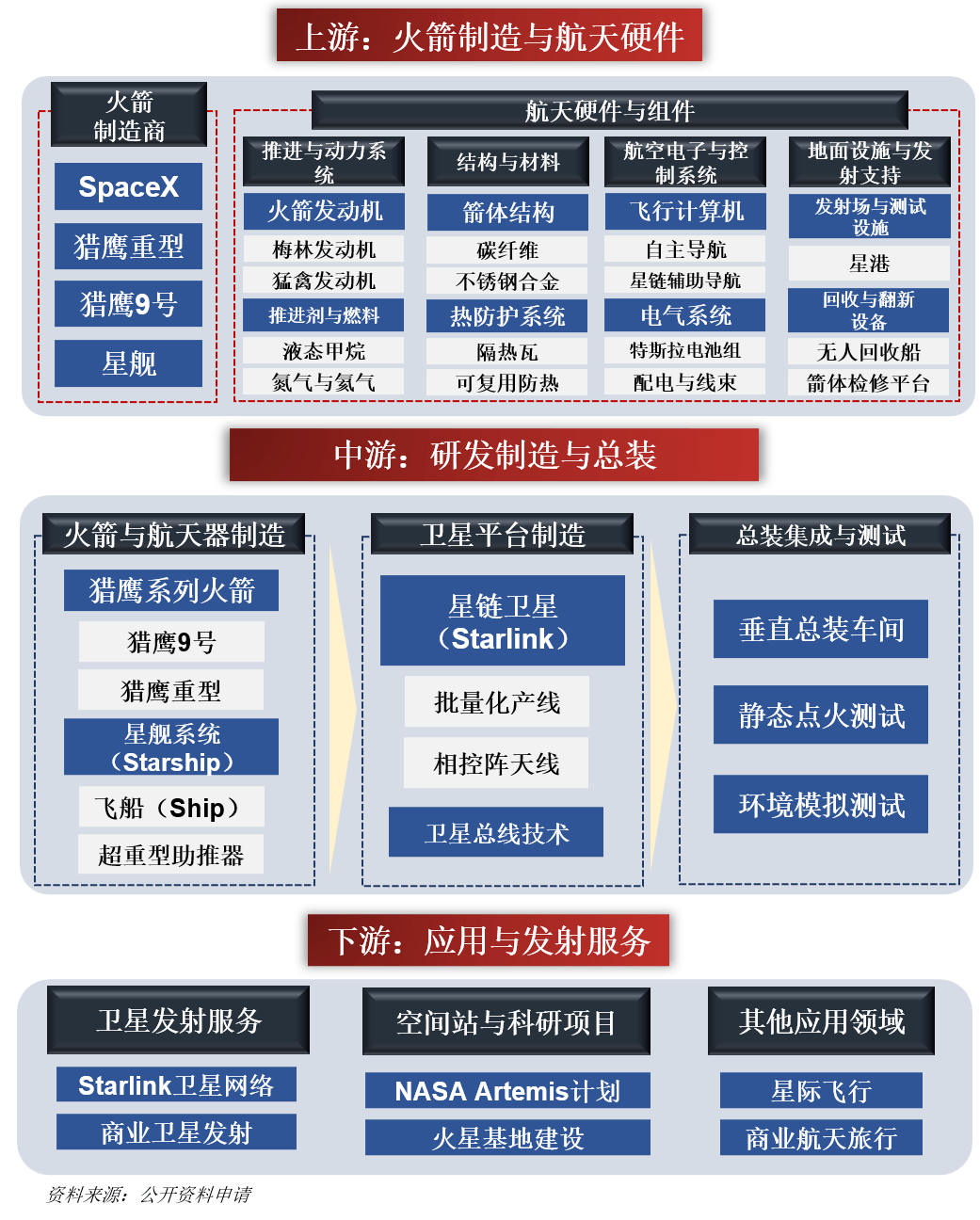
Core Insights - SpaceX has evolved through four key stages: initial struggle, technological breakthroughs, ecosystem development, and mature expansion, leading to its current dominance in the space industry [3][4]. Stage Summaries - **Initial Stage (2002-2008)**: SpaceX faced bankruptcy after three failed Falcon 1 launches but secured a $1.6 billion contract with NASA after a successful fourth launch in 2008, marking a turnaround [3]. - **Technological Breakthrough Stage (2008-2015)**: The Falcon 9 became the main rocket, achieving land recovery of the first stage booster in 2015, significantly reducing launch costs to $15-20 million [4]. - **Ecosystem Development Stage (2015-2020)**: SpaceX initiated the Starlink and Starship projects, transitioning from a rocket service provider to a space infrastructure company, with Starlink becoming the largest low Earth orbit satellite constellation [4]. - **Mature Expansion Stage (2020-Present)**: By 2023, SpaceX captured nearly 90% of U.S. orbital launch tasks and confirmed plans for an IPO with a valuation exceeding $100 billion [4]. Revenue Breakdown - SpaceX's core business is divided into two main segments, with Starlink emerging as the primary growth driver. By 2025, Starlink is expected to add over 4.6 million active users, generating $13-15 billion in revenue, accounting for 60-65% of total revenue [7][8]. - The revenue forecast for 2024 and 2025 across different business segments is as follows: - Starlink: $7-11 billion (2024), $13-15 billion (2025) [12] - Launch Services: $2.5-4 billion (2024), $5-7 billion (2025) [12] - Government and Defense Contracts: $1.2-1.8 billion (2024), $2-2.3 billion (2025) [12] - Starship Early Ecosystem and New Business: $0.2-0.4 billion (2024), $0.5-0.8 billion (2025) [12] Core Business Operations - SpaceX possesses advanced production, testing, and launch facilities, maintaining control over critical processes unlike NASA's outsourcing model [4][13]. - The Falcon series includes Falcon 1, Falcon 9, and Falcon Heavy, with Falcon 9 being the most frequently launched rocket globally [13][15]. Competitive Advantages - SpaceX's engine technology, particularly the Raptor engine, has undergone three generations of improvements, enhancing reliability and reducing costs through 3D printing [18][21]. - The company holds a dominant position in the global launch market, with Falcon 9 expected to conduct 165 launches in 2025, representing 97% of its total launches [22]. Business Model - SpaceX's business model focuses on creating a self-sustaining ecosystem, where rocket launches serve as a strategic foundation for scaling space services and interstellar exploration [38]. - The company offers two pricing models for launches: a full launch package at $69.85 million and a rideshare option for small satellites starting at $325,000 [40][41]. Future Projections - Launch volume predictions indicate Falcon 9 will maintain high launch frequency, while Starship is expected to accelerate commercialization with projected launches increasing significantly from 5 in 2026 to 150 by 2028 [42].
商业航天系列研究(一):国家战略与产业趋势共振,看好商业航天2026年投资机会
CMS· 2026-01-16 05:33
Investment Rating - The report maintains a positive outlook on the commercial aerospace industry, particularly focusing on the investment opportunities in the rocket supply chain due to existing supply gaps and the long-term potential of rocket manufacturers and satellite industry chains with commercial model advantages [1]. Core Insights - The Chinese commercial aerospace industry is identified as a strategic emerging industry that resonates with national strategies and industrial trends, expected to witness significant developments in 2026, including reusable rocket technology validation and IPO progress of commercial aerospace companies [1]. - The current core bottleneck in the industry is the insufficient launch capacity, which is crucial for the scaled development of the sector. The report highlights that in 2025, the global launch capacity is dominated by the US, with a significant gap compared to China [5][6]. - The report emphasizes the importance of reusable rocket technology, which can transform rockets from disposable assets to reusable ones, significantly reducing launch costs and increasing launch frequency and payload capacity [5][6]. Industry Overview - The commercial aerospace industry in China has developed a complete industrial chain consisting of satellites, rockets, and launch sites, gradually extending to measurement and control and applications [5]. - As of 2025, the US has conducted 193 rocket launches, while China has conducted 92, indicating a competitive landscape where the US currently leads [5]. - The report notes that the US has deployed 3,724 satellites compared to China's 372, highlighting the disparity in satellite deployment capabilities [5]. Investment Logic - Short-term opportunities are identified in the rocket supply chain due to the current launch capacity constraints, with specific recommendations for companies involved in high-value components and materials [6]. - Long-term prospects are focused on the transformation of rocket manufacturers' business models towards launch operations and the anticipated growth in satellite demand once the launch capacity bottleneck is resolved [6].
海上回收复用火箭基地开工,银河电子5连板,航天ETF(159267)大涨超4%
2 1 Shi Ji Jing Ji Bao Dao· 2026-01-09 06:41
Group 1 - Commercial aerospace concept stocks are performing strongly, with Galaxy Electronics achieving five consecutive trading limits, and Jiangshun Technology, Luxin Venture Capital, and Goldwind Technology reaching four consecutive trading limits [1] - The Aerospace ETF (159267) has a turnover rate exceeding 32%, with an intraday increase of 4.05%, and a nearly 27% increase over the past 20 days [1] - Beijing Arrow Yuan Technology Co., Ltd. has launched a project for a medium and large liquid launch vehicle assembly, testing, and recovery reuse base in Hangzhou, with a total investment of 5.2 billion yuan, aiming for an annual production capacity of 25 rockets [1] Group 2 - The domestic commercial aerospace industry is expected to receive policy support, technological breakthroughs, and capital investment by 2026, driving comprehensive development of the industry chain [2] - The rocket manufacturing sector will benefit from technological upgrades and capacity expansion, while the satellite industry and space computing sectors are anticipated to experience rapid growth due to increasing data demand [2]

底价33亿元!国内首家商业火箭公司拟转让股权
Sou Hu Cai Jing· 2026-01-08 12:32
Core Viewpoint - The first commercial rocket company in China, Aerospace Science and Industry Rocket Technology Co., Ltd. (Aerospace Science and Industry Rocket), is seeking to transfer nearly 30% of its shares, with a transfer base price of approximately 3.3 billion yuan, leading to an estimated overall valuation of about 11.2 billion yuan [1]. Group 1: Company Overview - Aerospace Science and Industry Rocket was established in 2016 and is located in Wuhan, primarily engaged in the research and production of solid launch vehicles, reusable liquid launch vehicles, and orbital spacecraft [1]. - The company is recognized as the first in China to provide commercial space launch services, having completed its first commercial launch service with the Kuaizhou-1A rocket on January 9, 2017, successfully launching three satellites [1]. Group 2: Financial Performance - The company is currently facing financial losses, with revenues of 63.81 million yuan and 67.36 million yuan for the first three quarters of 2024 and 2025, respectively, and net losses of 180 million yuan and 100 million yuan for the same periods [2]. Group 3: Share Transfer Details - The controlling shareholder, China Aerospace Sanjiang Group Co., Ltd. (Aerospace Sanjiang), holds 56.43% of Aerospace Science and Industry Rocket and will retain 26.84% of the shares after the transfer if completed [1]. - The transfer announcement includes specific conditions for potential buyers, such as agreeing to change the company's name post-transaction and not using any intangible assets associated with the China Aerospace Science and Industry Group [2]. Group 4: Market Context - Since 2025, there has been a sustained interest in commercial aerospace in the capital market, prompting the controlling party to transfer a significant portion of shares to help the company adapt to market needs and accelerate its development [3]. - Other leading domestic commercial rocket companies have initiated IPO preparations, with Aerospace Science and Industry Rocket lagging behind its peers in the IPO process despite being one of the earliest in the sector [3].
商业航天的“水下链主”,北京、成都、无锡都投了
投中网· 2026-01-06 06:11
Core Viewpoint - The commercial space industry is rapidly evolving, with significant market potential and investment opportunities emerging, particularly in rocket and satellite enterprises [3][4][5]. Group 1: Market Potential and Investment Trends - The commercial space sector is projected to become a major player in the capital market, with discussions around the first commercial space stock and the launch of satellite ETFs gaining traction [3]. - The successful recovery tests of rockets like Zhuque-3 and Long March 12A, along with SpaceX's anticipated IPO, highlight the industry's growth and the importance of reliable and cost-effective rocket launch capabilities [3][4]. - The Shanghai Stock Exchange's guidelines for commercial rocket enterprises emphasize the priority of launch cost efficiency, indicating a shift towards more sustainable business models in the sector [4]. Group 2: Role of Satellite Enterprises - Satellite companies are positioned as the demand initiators in the commercial space industry, driving the need for rocket launches and component manufacturing [5][6]. - The standardization and supply chain innovation led by satellite enterprises are crucial for achieving large-scale, low-cost manufacturing, which is essential for the industry's growth [6]. - Companies like Weina Space are emerging as key players, having secured significant funding to enhance their R&D capabilities and expand production capacity [6][12]. Group 3: Historical Context and Development - The commercial space industry has a rich history, with satellite technology evolving over 60 years, establishing its role as a critical infrastructure for communication and data collection [8]. - The establishment of policies promoting private investment in space has catalyzed the growth of commercial space ventures, with Weina Space exemplifying successful fundraising and market entry strategies [9][10]. Group 4: Future Outlook and Challenges - The potential for cost reductions in satellite launch services, particularly if reusable rocket technology advances, could lead to significant market shifts and investment opportunities [18]. - The involvement of local state-owned enterprises in funding commercial space projects indicates a growing recognition of the sector's importance and potential for economic development [19][20]. - The industry's maturation is reflected in the increasing ability of companies to deliver products and services that meet market demands, suggesting a transition towards industrialization and sustainability [22].

星链-2026年哪些关键事项和投资方向值得期待
2026-01-04 15:35
Summary of Key Points from the Conference Call Industry Overview - The focus is on the commercial aerospace market for 2026, highlighting key aspects in policy, technology, and capital [2][4] - The market is expected to transition from the introduction phase to the growth phase, with satellite bidding and launch quantities projected to at least double compared to 2025, indicating high growth potential [2][4] Core Insights and Arguments - **Policy Support**: The government is expected to continue optimizing policies for commercial aerospace, with significant developments such as the issuance of satellite operation licenses and promotion of satellite IoT commercialization policies [2] - **Technological Advancements**: Breakthroughs in reusable rocket technology are anticipated, which will lower construction costs in the space segment and enhance economic feasibility [2][4] - **Capital Movements**: Major companies in the sector are expected to undergo IPOs in 2026, including domestic commercial rocket companies and SpaceX, which will catalyze investment in the sector [2][3][4] Investment Opportunities - **Rocket Segment**: The rocket segment is poised for excess return opportunities due to technological breakthroughs and a dense launch schedule, alongside IPOs and financing activities of leading companies [4][5] - **Satellite Manufacturing and Operations**: These areas are also expected to exhibit high growth potential, with the first batch of satellite network tenders for the second-generation satellite system projected to increase bidding quantities by over 10 times compared to 2025 [2][5] - **Payload Value**: The value of satellite payloads is expected to rise, with communication capacity per satellite continuously improving [5] Market Dynamics - The ground operations and applications segment is identified as a critical investment area, with its market size estimated to be at least ten times that of the rocket launch and satellite manufacturing markets, potentially reaching a trillion-level market [6] - Specific companies such as China Satellite, Aerospace Electronics, and Fudan Microelectronics are noted for their technological advantages and growth potential [5] Emerging Companies and Technologies - New companies and technologies are highlighted, including NTN chip developments and flexible solar wing technologies, which are essential for meeting increasing power demands for launches [5][7] - The Starlink project is mentioned, with plans to have 650 satellites in orbit by the end of 2025, indicating a significant market opportunity in the consumer electronics space [7] Conclusion - The overall investment outlook for 2026 in the commercial aerospace sector is optimistic, with multiple catalysts expected to drive growth and investment opportunities across various segments [4][5]


危险信号,如果看不懂商业航天股疯涨,你可能正被时代抛弃
3 6 Ke· 2026-01-04 09:51
Core Viewpoint - The recent failures in rocket recovery did not dampen investor enthusiasm for China's commercial space sector, leading to a surge in related stocks and ETFs, with some doubling in price within days [1][2][3]. Group 1: Market Response - The market's positive reaction reflects an upgraded understanding of the development patterns in advanced technology, where a single setback is less significant compared to the rapid iteration of technology [2][17]. - Investors are increasingly attracted to China's "dual-track" model in commercial space, which combines the strengths of state-owned enterprises and agile private companies [4][5]. - The market has detected clear signals of acceleration, supported by national policies, tailored listing rules for commercial rocket companies, and a wave of IPOs from leading firms [6][7]. Group 2: Public Participation and Sentiment - The public's role in space exploration has shifted from passive observers to active participants through capital markets, allowing ordinary individuals to invest in rocket companies [13][14]. - This new engagement fosters a collective recognition of the value of "trial and error" in high-tech fields, contrasting with previous expectations of infallibility [15][16]. - The emotional resonance of commercial space has become a vital narrative, especially as traditional economic growth stories face challenges [19][20]. Group 3: Industrial Impact - The rise of commercial space is creating new high-skill job types, such as "high-skilled engineers" and "advanced manufacturing specialists," redirecting top talent back to the industrial front [25][26][29]. - The rigorous demands of commercial space serve as a catalyst for advancements across various industries, enhancing the capabilities of numerous suppliers [30][31]. - The development of new launch sites is reshaping economic landscapes, creating clusters of innovation and attracting high-end talent and capital [31][34]. Group 4: Strategic Importance - The commercial space sector is seen as crucial for China to secure a competitive position in the future global landscape, particularly in establishing next-generation infrastructure in space [39][40]. - The ongoing efforts in commercial space are not merely about achieving successful launches but are fundamentally about redefining the rules of engagement in the space economy [42][43]. - The market's enthusiasm for commercial space stocks reflects a broader societal commitment to long-term innovation and resilience in the face of challenges [46][47].