青岛银行

Search documents
城商行板块11月7日跌0.21%,齐鲁银行领跌,主力资金净流出1.48亿元
Zheng Xing Xing Ye Ri Bao· 2025-11-07 08:37
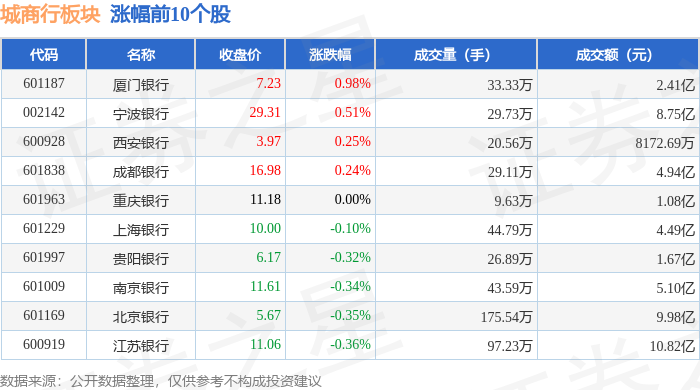
Market Overview - The city commercial bank sector experienced a decline of 0.21% on November 7, with Qilu Bank leading the drop [1] - The Shanghai Composite Index closed at 3997.56, down 0.25%, while the Shenzhen Component Index closed at 13404.06, down 0.36% [1] Individual Bank Performance - Xiamen Bank closed at 7.23, up 0.98% with a trading volume of 333,300 shares and a transaction value of 241 million [1] - Ningbo Bank closed at 29.31, up 0.51% with a trading volume of 297,300 shares and a transaction value of 875 million [1] - Qilu Bank closed at 6.08, down 1.46% with a trading volume of 648,100 shares and a transaction value of 39.86 million [2] - Suzhou Bank closed at 8.33, down 1.07% with a trading volume of 373,400 shares and a transaction value of 314 million [2] Capital Flow Analysis - The city commercial bank sector saw a net outflow of 148 million from institutional investors, while retail investors had a net inflow of 163 million [2] - Jiangsu Bank had a net inflow of 63.24 million from institutional investors, but a net outflow of 39.08 million from speculative funds [3] - Nanjing Bank experienced a net inflow of 24.45 million from institutional investors, with a net outflow of 30.58 million from speculative funds [3]




智通港股通占比异动统计|11月7日
Zhi Tong Cai Jing· 2025-11-07 01:15
Core Insights - The article highlights the changes in the Hong Kong Stock Connect holdings, with notable increases and decreases in ownership percentages for various companies [1][2] Group 1: Significant Increases in Holdings - Qingdao Bank (03866) saw the largest increase in holdings, up by 2.24% to a total of 14.87% [1] - Qin Port Co. (03369) and Guotai Junan International (01788) also experienced significant increases of 0.84% and 0.78%, bringing their holdings to 44.42% and 14.70% respectively [1] - Over the last five trading days, Qingdao Bank (03866) had the highest increase at 7.31%, followed by Hang Seng China Enterprises (02828) at 6.53% and Anjuke Food (02648) at 3.86% [1] Group 2: Significant Decreases in Holdings - Shandong Molong (00568) experienced the largest decrease in holdings, down by 0.87% to 58.74% [1] - Other notable decreases include China Merchants Energy (01138) and Lens Technology (06613), which saw reductions of 0.84% and 0.80%, resulting in holdings of 69.25% and 15.88% respectively [1] - Over the last five trading days, the largest decrease was recorded by Changfei Optical Fiber (06869) at -4.32%, followed by Delin Holdings (01709) at -3.75% and ZTE Corporation (00763) at -2.86% [1] Group 3: Long-term Trends in Holdings - Over the past 20 days, GX Hang Seng Technology (02837) had the highest increase in holdings at 19.01%, followed by Ying'en Bio-B (09606) at 16.05% [2] - Qingdao Bank (03866) also showed a significant increase of 7.76% over the same period, indicating a positive trend in investor interest [2] - Conversely, Changfei Optical Fiber (06869) recorded the largest decrease in holdings over 20 days at -10.14%, indicating potential concerns among investors [2]
智通港股通资金流向统计(T+2)|11月7日
智通财经网· 2025-11-06 23:34
Key Points - The top three companies with net inflows of southbound funds are China National Offshore Oil Corporation (CNOOC), Xiaomi Group, and Southern Hang Seng Technology, with net inflows of 1.045 billion, 0.998 billion, and 0.766 billion respectively [1] - The top three companies with net outflows of southbound funds are Alibaba Group, Sunny Optical Technology, and Luoyang Molybdenum, with net outflows of -0.873 billion, -0.339 billion, and -0.254 billion respectively [1] - In terms of net inflow ratio, Qingdao Bank, Dasheng Holdings, and Shougang Resources lead the market with ratios of 86.77%, 70.86%, and 63.91% respectively [1] - The companies with the highest net outflow ratios are Pacific Basin Shipping, Yimaitong, and Sichuan Chengyu Expressway, with ratios of -54.77%, -46.94%, and -37.64% respectively [1] Net Inflow Rankings - The top ten companies by net inflow include CNOOC (1.045 billion), Xiaomi Group (0.998 billion), and Southern Hang Seng Technology (0.766 billion) [2] - Other notable companies in the net inflow list are China Mobile (0.752 billion), Industrial and Commercial Bank of China (0.531 billion), and China Petroleum (0.431 billion) [2] Net Outflow Rankings - The top ten companies by net outflow include Alibaba Group (-0.873 billion), Sunny Optical Technology (-0.339 billion), and Luoyang Molybdenum (-0.254 billion) [2] - Other significant companies with net outflows are SMIC (-0.240 billion), Jiangxi Copper (-0.220 billion), and Bilibili (-0.200 billion) [2] Net Inflow Ratio Rankings - The top three companies by net inflow ratio are Qingdao Bank (86.77%), Dasheng Holdings (70.86%), and Shougang Resources (63.91%) [2][3] - Other companies with high net inflow ratios include Wanwuyun (61.22%) and Prudential (60.12%) [3] Net Outflow Ratio Rankings - The top three companies by net outflow ratio are Pacific Basin Shipping (-54.77%), Yimaitong (-46.94%), and Sichuan Chengyu Expressway (-37.64%) [3] - Other companies with significant net outflow ratios include Yancoal Australia (-34.65%) and Lens Technology (-33.16%) [3]




债市波动拖累投资收益 银行非息收入增长现分化
Zhong Guo Zheng Quan Bao· 2025-11-06 22:34
Core Viewpoint - In a low interest rate environment, banks are increasingly relying on non-interest income as a key driver for revenue growth, with significant disparities emerging among different banks in terms of non-interest income performance [1] Non-Interest Income Overview - In the first three quarters of this year, 42 listed banks achieved a total non-interest income of 1.22 trillion yuan, an increase of over 300 billion yuan compared to the first half of the year and an increase of 583 billion yuan year-on-year [1] - Among these banks, only 18 reported positive year-on-year growth in non-interest income, while 8 banks experienced a decline in investment income due to bond market fluctuations, and 31 banks reported negative fair value changes [1] Fee and Commission Income - A breakdown of non-interest income shows that net fee and commission income, investment income, and fair value changes significantly impact overall non-interest income [2] - In the first three quarters, 27 banks reported positive year-on-year growth in net fee and commission income, with 12 banks achieving growth rates exceeding 10% [2] - Notable performers include Changshu Bank and Ruifeng Bank, with increases of 364.75% and 162.66% respectively, while major state-owned banks like Agricultural Bank, Postal Savings Bank, and Bank of China also reported steady growth [2] Impact of Bond Market Fluctuations - The bond market's volatility has negatively affected investment income and fair value changes for several banks, leading to declines in non-interest income and overall revenue growth [3] - For instance, China Merchants Bank reported a 4.23% year-on-year decline in non-interest net income, primarily due to reduced returns from bond and fund investments [3] - Other banks, such as Ping An Bank and Huaxia Bank, also reported significant declines in revenue attributed to market fluctuations affecting their non-interest income [3] Regional Bank Performance - Regional banks like Qingdao Bank faced similar challenges, with a year-on-year decrease in investment income and fair value changes due to weaker bond market performance [4] - Conversely, some banks, such as China Construction Bank and Changsha Bank, reported over 100% year-on-year growth in investment income [4] Future Market Outlook - Analysts suggest that the bond market is likely to remain volatile in the short term, with fluctuations in fair value changes being more pronounced for joint-stock and regional banks due to their higher proportion of FVTPL assets [5] - Experts recommend that banks focus on differentiated operations and niche markets to support non-interest income growth, while also balancing short-term gains with long-term risks [6] - The outlook for the bond market indicates a gradual return to fundamentals and liquidity, but uncertainties remain regarding the growth of other non-interest income sources [6]
债市波动拖累投资收益银行非息收入增长现分化
Zhong Guo Zheng Quan Bao· 2025-11-06 20:15
Core Viewpoint - In a low interest rate environment, banks are increasingly relying on non-interest income to drive revenue growth, with significant disparities in performance among different banks [1][2]. Non-Interest Income Overview - In the first three quarters of the year, 42 listed banks achieved a total non-interest income of 1.22 trillion yuan, an increase of over 300 billion yuan compared to the first half of the year and an increase of 583 billion yuan year-on-year [1]. - Only 18 banks reported a year-on-year increase in non-interest income, while 8 banks experienced a decline in investment income due to bond market volatility, and 31 banks reported negative fair value changes [1][2]. Fee and Commission Income - Among the non-interest income components, net fee and commission income, investment income, and fair value changes significantly impacted overall non-interest income [1]. - 27 banks reported a year-on-year increase in net fee and commission income, with 12 banks showing growth exceeding 10%. Notably, Changshu Bank and Ruifeng Bank saw increases of 364.75% and 162.66%, respectively [1][2]. Wealth Management and Consumer Finance - The recovery in domestic consumption and capital markets has created opportunities for wealth management and consumer finance, contributing to the growth of some banks' intermediary business income [2]. - China Bank attributed its growth in net fee and commission income to strong performance in agency, custody, and other entrusted businesses [2]. Impact of Bond Market Volatility - The bond market's fluctuations have negatively affected investment income and fair value changes for several banks. For instance, 8 banks reported a year-on-year decline in investment income, and 31 banks had negative fair value changes [2][3]. - For example, China Merchants Bank reported a 4.23% year-on-year decline in non-interest net income, with a 0.90% increase in net fee and commission income but an 11.42% decrease in other net income due to reduced bond and fund investment returns [2]. Regional Banks' Performance - Regional banks like Qingdao Bank also faced challenges, with a year-on-year decrease in investment income and fair value changes due to weaker bond market performance [3]. - Conversely, some banks, such as China Construction Bank and Changsha Bank, reported over 100% year-on-year growth in investment income [3]. Future Outlook - Analysts suggest that the bond market is likely to remain volatile in the short term, with various factors creating disturbances [4]. - The overall liquidity in the market is expected to remain favorable for the bond market, but the performance of risk assets may weaken the attractiveness of bonds [4][5].
探底回升,科技、医疗跌幅居前,银行、消费逆势收涨
Ge Long Hui· 2025-11-06 12:24
Group 1 - The Hang Seng Index experienced a sharp decline after opening, followed by a rebound, closing with a slight decrease of 0.07% [1] - The Hang Seng Technology Index opened significantly lower, fluctuating throughout the day, and closed down 1.01%, with notable declines in stocks such as BYD down 1.75% and Bilibili down 4.09% [3] - The Hang Seng Medical Index opened with a deep V shape and maintained a weak consolidation below the midline, closing down 0.6%, with JD Health down 1.32% and WuXi AppTec up 2% [3] Group 2 - Bank stocks opened low but rose throughout the day, closing with a slight increase of 0.03%, with Chongqing Bank and Agricultural Bank both up 1.33% [3] - Other banks such as Zhengzhou Bank, Bank of Communications, and China Merchants Bank saw minor gains, while Qingdao Bank and Bank of China experienced declines [3]

厦门银行浦发银行青岛银行跌幅居银行板块前三
Zhong Guo Jing Ji Wang· 2025-11-06 09:00
Group 1 - Xiamen Bank's stock price fell to 7.16 yuan, a decrease of 2.59% [1] - Shanghai Pudong Development Bank's stock closed at 11.66 yuan, down by 1.69% [1] - Qingdao Bank's stock price decreased to 5.06 yuan, with a drop of 1.36% [1] Group 2 - The banking sector overall declined by 0.26% today [1] - Xiamen Bank, Shanghai Pudong Development Bank, and Qingdao Bank were the largest decliners in the banking sector [1]

城商行板块11月6日跌0.11%,厦门银行领跌,主力资金净流出6.08亿元
Zheng Xing Xing Ye Ri Bao· 2025-11-06 08:51
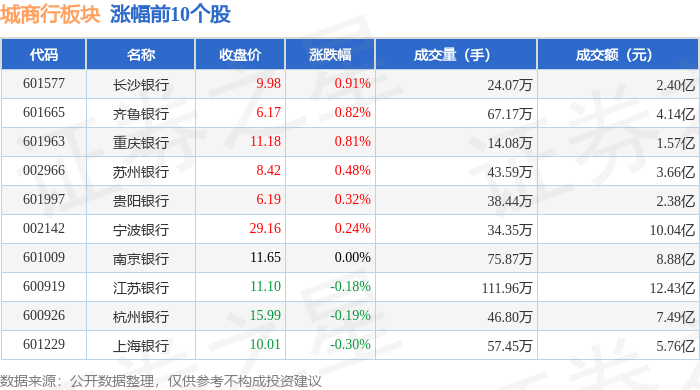
Core Viewpoint - The city commercial bank sector experienced a slight decline of 0.11% on November 6, with Xiamen Bank leading the drop, while the overall market indices showed positive movements with the Shanghai Composite Index up by 0.97% and the Shenzhen Component Index up by 1.73% [1][2]. Group 1: Market Performance - The closing price of Xiamen Bank was 7.16, reflecting a decrease of 2.59% with a trading volume of 539,700 shares and a transaction value of 387 million yuan [2]. - Other notable banks included Changsha Bank, which closed at 9.98 with a rise of 0.91%, and Qilu Bank, which closed at 6.17 with an increase of 0.82% [1]. - The city commercial bank sector saw a net outflow of 608 million yuan from major funds, while retail investors contributed a net inflow of 473 million yuan [2][3]. Group 2: Individual Bank Performance - Beijing Bank had a net inflow from major funds of 20.80 million yuan, while it experienced a net outflow from retail investors of 30.79 million yuan [3]. - Chongqing Bank recorded a net inflow of 11.91 million yuan from major funds but faced a net outflow of 12.20 million yuan from retail investors [3]. - Jiangsu Bank had a net inflow of 202.55 million yuan from major funds, while retail investors contributed a net inflow of 3.33 million yuan [3].

Q3单季营收却“掉链子”?青岛银行营利双增背后藏隐忧
智通财经网· 2025-11-06 08:21
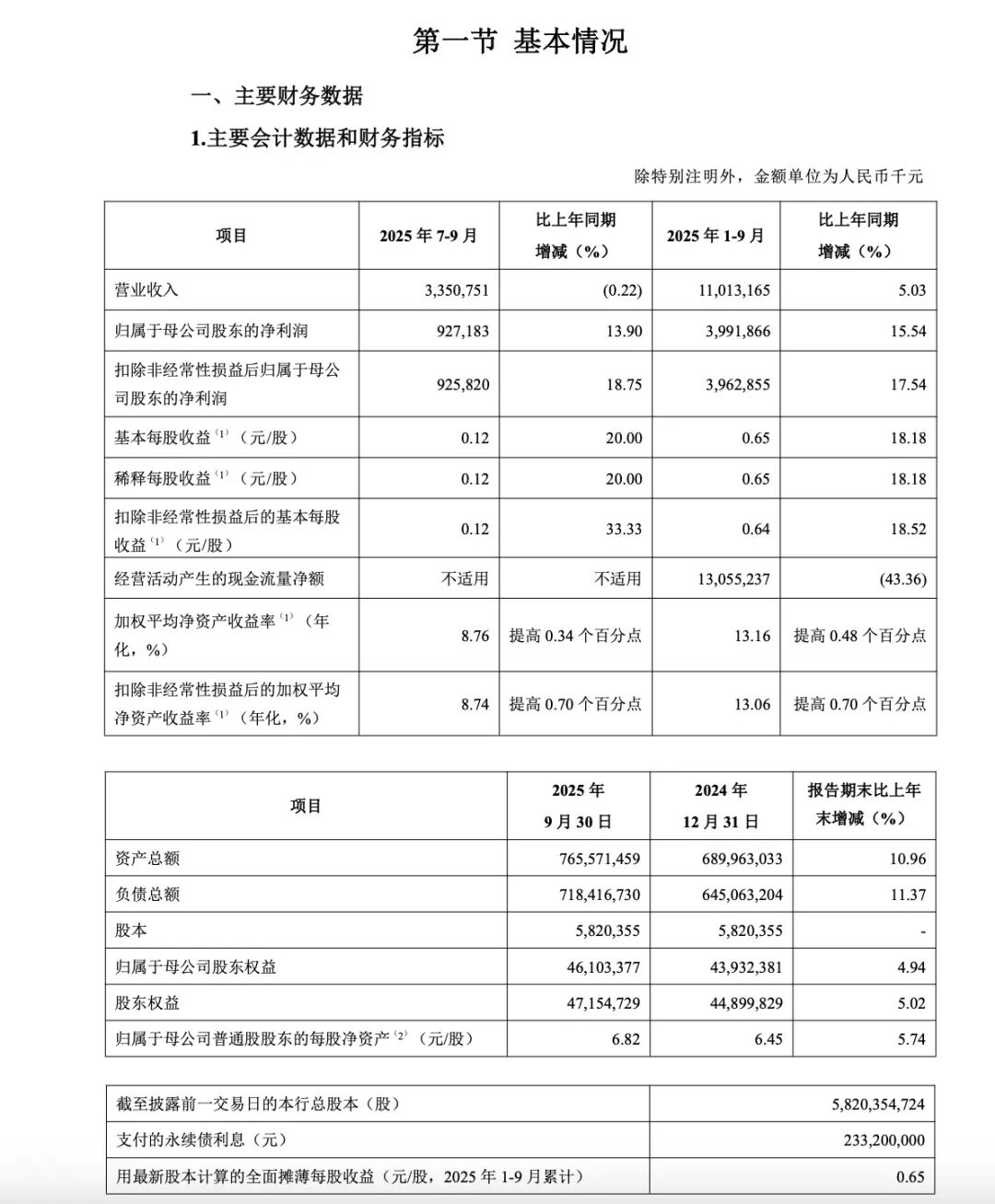
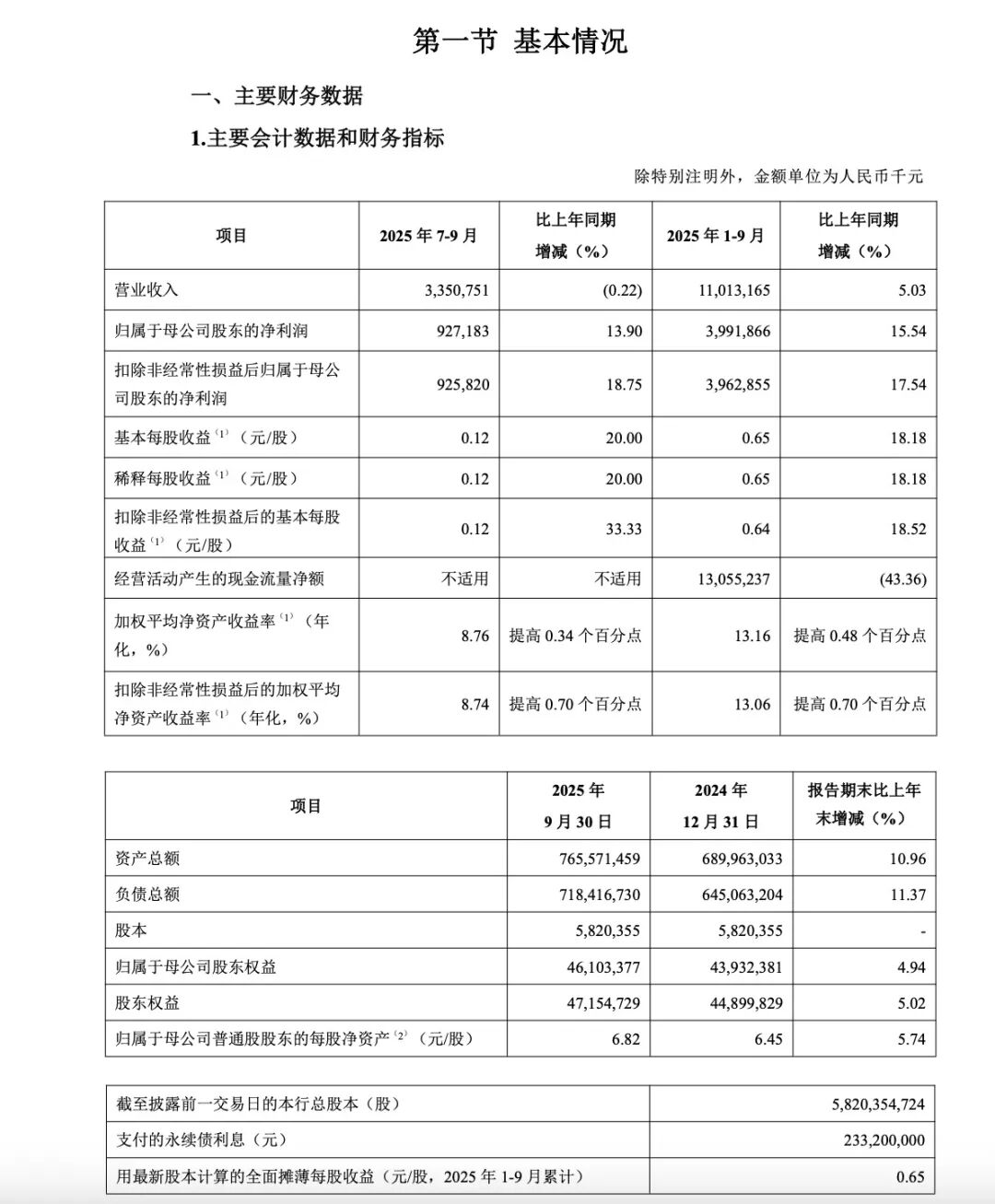
Core Viewpoint - Qingdao Bank's Q3 2025 report shows a slight decline in quarterly revenue, contrasting with overall growth in the first three quarters, highlighting challenges in non-interest income and management adjustments [1][2][5]. Financial Performance - For Q3 2025, Qingdao Bank reported revenue of 3.35 billion yuan, a minor decrease of 0.22% year-on-year, while total revenue for the first three quarters reached 11.01 billion yuan, up 5.03% [4][5]. - Net profit attributable to shareholders for Q3 was 927.18 million yuan, reflecting a 13.90% increase, and for the first three quarters, it was 3.99 billion yuan, up 15.54% [4][6]. - The bank's interest income for the first three quarters was 17.22 billion yuan, a year-on-year increase of 5.89%, while interest expenses decreased by 2.83 billion yuan [6]. Non-Interest Income Challenges - Non-interest income for the first three quarters was 2.87 billion yuan, down 10.72% year-on-year, primarily due to declines in investment income and fees from wealth management [5][6]. - The bank's reliance on non-interest income from the bond market and wealth management services exposes it to market fluctuations, indicating a lack of diversification in revenue sources [5][6]. Asset Quality and Capital Adequacy - As of September 30, 2025, the non-performing loan ratio was 1.10%, a decrease of 0.04 percentage points from the end of the previous year, with a provision coverage ratio of 269.97% [7][8]. - The capital adequacy ratio stood at 13.14%, below the industry average of approximately 15.8%, indicating a need for improved capital strength [8][9]. Management and Governance Changes - Qingdao Guoxin Group plans to increase its stake in Qingdao Bank to 19.99%, enhancing state-owned capital's influence in governance [9][10]. - Recent management changes include key personnel shifts across the bank's headquarters and branches, aimed at revitalizing operations and addressing challenges in non-interest income [10][11]. Wealth Management Performance - Qingyin Wealth Management has faced declining performance, with assets under management dropping from 2 trillion yuan in 2024 to 1.89 trillion yuan by mid-2025, alongside significant decreases in revenue and net profit [12][13].
Q3单季营收却“掉链子”?青岛银行(002948.SZ)营利双增背后藏隐忧
智通财经网· 2025-11-06 08:15
Core Viewpoint - Qingdao Bank's Q3 2025 report shows a slight decline in quarterly revenue, contrasting with overall growth in the first three quarters, highlighting challenges in non-interest income and management adjustments [1][2][6]. Financial Performance - In Q3 2025, Qingdao Bank reported revenue of 3.35 billion yuan, a minor decrease of 0.22% year-on-year, while the first three quarters saw total revenue of 11.01 billion yuan, up 5.03% [4][6]. - Net profit attributable to shareholders for Q3 was 927.18 million yuan, an increase of 13.90%, with a year-to-date net profit of 3.99 billion yuan, reflecting a 15.54% rise [4][8]. - The bank's interest income reached 17.22 billion yuan in the first three quarters, up 5.89%, while interest expenses decreased by 2.83 billion yuan [8]. Non-Interest Income Challenges - Non-interest income for the first three quarters was 2.87 billion yuan, down 10.72% year-on-year, primarily due to declines in investment income and fees from wealth management [7][8]. - The bank's reliance on non-interest income from bond markets and wealth management exposes it to market fluctuations, indicating a need for diversification in revenue sources [7][8]. Asset Quality and Capital Adequacy - As of September 30, 2025, the non-performing loan ratio was 1.10%, down 0.04 percentage points from the previous year, with a provision coverage ratio of 269.97%, up 28.65 percentage points [9][10]. - The capital adequacy ratio stood at 13.14%, below the industry average of approximately 15.8%, indicating a need for capital strengthening [12][13]. Shareholder and Management Changes - Qingdao Guoxin Group plans to increase its stake in Qingdao Bank to 19.99%, enhancing state-owned capital's influence in governance [13][14]. - Recent management changes include key personnel shifts across the bank's headquarters and branches, aimed at revitalizing operations and addressing challenges in non-interest income [13][14][15]. Wealth Management Performance - Qingyin Wealth Management has faced declining performance, with assets under management dropping from 2,081.22 billion yuan in 2023 to below 2,000 billion yuan in 2024, and a significant decrease in revenue and net profit [16].