
宁波银行

Search documents
设备更新贷款贴息范围扩容
Di Yi Cai Jing· 2026-01-20 09:25
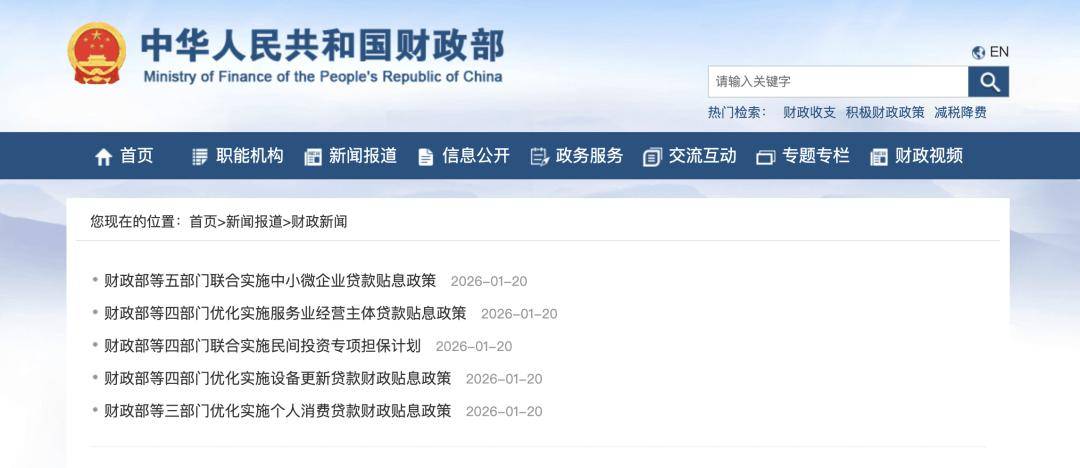
不久前,中国人民银行决定增加科技创新和技术改造再贷款额度4000亿元。增加后,科技创新和技术改 造再贷款总额度为1.2万亿元。另外央行适当拓展政策支持领域,自2026年起,将研发投入水平较高的 民营中小企业纳入科技创新和技术改造再贷款政策支持领域。 另外,此次设备更新贷款财政贴息领域扩围。 贴息政策实施至2026年12月31日,后续可视情况延长 为了支持经营主体开展设备更新和技术改造,降低经营主体融资成本,推动形成有效投资,中国加大财 政贴息政策支持力度。 1月20日,财政部等四部门公布《关于优化实施设备更新贷款财政贴息政策的通知》(下称《通 知》),明确经营主体实施设备更新行动且银行向其发放贷款的,中央财政对经营主体的设备更新项目 相关固定资产贷款本金贴息1.5个百分点,按照相关固定资产贷款发放之日起予以贴息,贴息期限不超 过2年。 这一政策与此前不同的是,扩大了设备更新贷款财政贴息支持范围,将科技创新和技术改造再贷款政策 支持的、银行2026年起新发放的科技创新类贷款纳入上述中央财政贴息支持范围。 《通知》称,上述设备更新财政贴息政策实施至2026年12月31日,后续可视情延长实施期限。 此外,设备更新财 ...
财政部连发多份重要文件,事关贷款贴息、民间投资贷款担保等 一揽子政策全文公布
Sou Hu Cai Jing· 2026-01-20 09:03
Group 1 - The core viewpoint of the news is the implementation of a financial subsidy policy for equipment renewal loans to support businesses in reducing financing costs and promoting effective investment [3][4][5] - The policy includes a 1.5% interest subsidy on fixed asset loans for equipment renewal projects, applicable for a maximum of two years, and is effective until December 31, 2026 [3][4] - The scope of support has been expanded to include various sectors such as construction, aviation, digital technology, and green energy, emphasizing high-end, intelligent, and digital equipment updates [4][6] Group 2 - A total of 26 banks are designated as eligible for processing the interest subsidy loans, including major national banks and several regional banks [4][5] - The subsidy process has been optimized to include a "pre-allocation + settlement" method, streamlining the application and approval process for banks and provincial financial departments [5][6] - The policy aims to enhance the experience of businesses by ensuring timely communication regarding subsidy payments through modern technology [6][7] Group 3 - The policy for small and micro enterprises includes a 1.5% interest subsidy on fixed asset loans, with a maximum loan amount of 50 million yuan, effective from January 1, 2026 [8][9] - The targeted sectors for this subsidy include new energy vehicles, medical equipment, and various service industries, aiming to stimulate investment and production [9][10] - The operational mechanism involves a "total-to-total" model for coordination between financial institutions and fiscal departments to ensure efficient processing of subsidy funds [11][12] Group 4 - The service industry loan subsidy policy has been extended until December 31, 2026, with an increased maximum loan amount of 10 million yuan and a 1% interest subsidy for one year [16][17] - New sectors such as digital, green, and retail have been added to the support scope, enhancing the policy's relevance to current economic trends [17][18] - The funding allocation process has been refined to improve efficiency and reduce redundancy in the approval process [18][19] Group 5 - A special guarantee plan for private investment has been introduced with a total quota of 500 billion yuan over two years, aimed at supporting small and micro enterprises [22][24] - The plan includes risk-sharing mechanisms where banks bear at least 20% of the loan risk, while the government guarantee fund covers up to 80% [24][25] - The initiative encourages innovative financing models and aims to enhance the capital strength of the government guarantee fund to support private investments effectively [26][27]







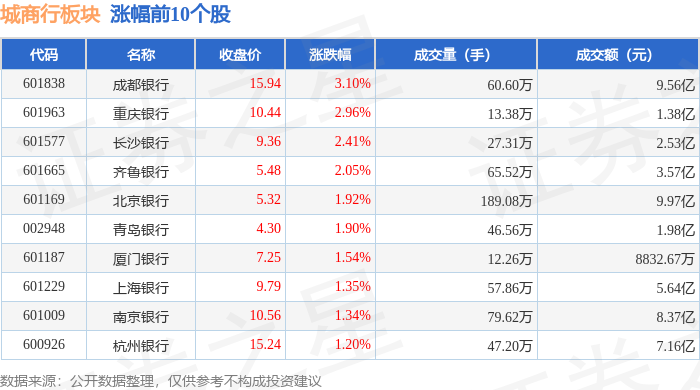
城商行板块1月20日涨1.35%,成都银行领涨,主力资金净流入2.66亿元
Zheng Xing Xing Ye Ri Bao· 2026-01-20 08:56
Core Insights - The city commercial bank sector experienced a rise of 1.35% on January 20, with Chengdu Bank leading the gains [1] - The Shanghai Composite Index closed at 4113.65, down 0.01%, while the Shenzhen Component Index closed at 14155.63, down 0.97% [1] Stock Performance - Chengdu Bank (601838) closed at 15.94, up 3.10% with a trading volume of 606,000 shares and a transaction value of 9.56 billion [1] - Chongqing Bank (601963) closed at 10.44, up 2.96% with a trading volume of 133,800 shares and a transaction value of 138 million [1] - Other notable performers include: - Changsha Bank (601577): closed at 9.36, up 2.41% [1] - Qilu Bank (601665): closed at 5.48, up 2.05% [1] - Beijing Bank (601169): closed at 5.32, up 1.92% [1] - Qingdao Bank (002948): closed at 4.30, up 1.90% [1] - Xiamen Bank (601187): closed at 7.25, up 1.54% [1] - Shanghai Bank (601229): closed at 9.79, up 1.35% [1] - Nanjing Bank (601009): closed at 10.56, up 1.34% [1] - Hangzhou Bank (600926): closed at 15.24, up 1.20% [1] Capital Flow - The city commercial bank sector saw a net inflow of 266 million from institutional investors, while retail investors experienced a net outflow of 42.84 million [1] - Detailed capital flow for selected banks includes: - Shanghai Bank (601229): net inflow of 1.051 billion from institutional investors, with net outflows from retail and speculative investors [2] - Hangzhou Bank (600926): net inflow of 90.48 million from institutional investors, with significant outflows from retail and speculative investors [2] - Nanjing Bank (601009): net inflow of 26.57 million from institutional investors, with outflows from retail investors [2] - Other banks also showed varying levels of net inflows and outflows [2]




鼎胜新材:为子公司提供2亿元担保,累计担保近28.29亿元
Xin Lang Cai Jing· 2026-01-20 08:01
鼎胜新材公告称,为满足全资子公司五星铝业、鼎胜进出口日常经营需要,公司分别为其向宁波银行提 供1亿元最高额连带责任保证,担保期限均为债务履行期限届满之日起两年,无反担保。本次担保在年 度股东会授权额度内。截至公告日,公司及子公司累计对外担保余额约28.29亿元,占最近一期经审计 净资产的42.41%,无逾期对外担保情形。 ...

小摩:预计内银今年股价上升 惟流动性顺风中相对落后 升民行评级至“增持”
Zhi Tong Cai Jing· 2026-01-20 06:49
Core Viewpoint - Morgan Stanley predicts that China Bank (601988) will experience absolute stock price appreciation but may underperform the market by 2026 [1] Group 1: Bank Ratings - Morgan Stanley upgraded the rating of Minsheng Bank (600016) from "Neutral" to "Overweight" [1] - The rating of Agricultural Bank (601288) was downgraded from "Overweight" to "Neutral" [1] Group 2: Market Liquidity and Growth Expectations - Approximately 110 trillion RMB of fixed-term deposits are expected to mature by 2026, including around 7 trillion RMB of excess household savings, which may provide liquidity support to the capital market and boost market performance [1] - The recovery of net interest income and wealth management fees is expected to lead to moderate improvements in revenue and profit growth for domestic banks in 2026 [1] Group 3: Stock Performance Preferences - In the context of high dividend stocks, Morgan Stanley prefers Bank of Communications (601328), China Bank (03988), and China Construction Bank (601939) [1] - Banks such as Ningbo Bank (002142), Shanghai Pudong Development Bank (600000), Industrial Bank (601166), and China Merchants Bank (600036) are seen as having better growth potential [1] - Growth-oriented stocks are expected to outperform high dividend stocks [1]




小摩:预计内银今年股价上升 惟流动性顺风中相对落后 升民行(01988)评级至“增持”
智通财经网· 2026-01-20 06:48
Core Viewpoint - JPMorgan expects Chinese bank stocks to achieve absolute price increases but may underperform the market by 2026 [1] Group 1: Ratings Changes - JPMorgan upgraded the rating of Minsheng Bank (01988) H-shares from "Neutral" to "Overweight" [1] - JPMorgan downgraded the rating of Agricultural Bank of China (01288) H-shares from "Overweight" to "Neutral" [1] Group 2: Market Predictions - JPMorgan anticipates approximately 110 trillion RMB in time deposits maturing by 2026, including around 7 trillion RMB in excess household savings, which could provide liquidity support to the capital market and boost market performance [1] - The bank expects a moderate improvement in revenue and profit growth for domestic banks in 2026, driven by a recovery in net interest income and wealth management fees [1] Group 3: Stock Preferences - Among high-dividend stocks, JPMorgan prefers Bank of Communications (601328.SH), Bank of China (03988), and China Construction Bank (00939) [1] - Banks such as Ningbo Bank (002142.SZ), Shanghai Pudong Development Bank (600000.SH), Industrial Bank (601166.SH), and China Merchants Bank (03968)(600036.SH) are seen as having good growth potential [1] - JPMorgan predicts that growth-oriented stocks will outperform high-dividend stocks [1]
大行评级|小摩:预计内银股将实现绝对股价上涨,偏好交通银行与建设银行
Ge Long Hui· 2026-01-20 06:33
Core Viewpoint - Morgan Stanley forecasts that domestic bank stocks will experience absolute price increases but may underperform the market by 2026 [1] Group 1: Market Outlook - The bank anticipates approximately 110 trillion yuan in time deposits maturing by 2026, including around 7 trillion yuan in excess household savings, which could provide liquidity support to the capital markets and boost market performance [1] - The recovery in net interest income and wealth management fees is expected to lead to moderate improvements in revenue and profit growth for domestic bank stocks by 2026 [1] - Despite the liquidity-driven rally, bank stocks may lag in performance compared to the overall market [1] Group 2: Stock Preferences - Among high-dividend stocks, the bank prefers Bank of Communications and China Construction Bank [1] - Ningbo Bank, Shanghai Pudong Development Bank, Industrial Bank, and China Merchants Bank are identified as having better growth potential [1] - The bank upgraded the rating of Minsheng Bank from "Neutral" to "Overweight," while downgrading Agricultural Bank of China from "Overweight" to "Neutral" [1]
国泰海通:预计2025年银行利息净收入增速转正 息差阶段性企稳
Zhi Tong Cai Jing· 2026-01-20 06:20
Core Viewpoint - The report from Guotai Junan predicts that the revenue and net profit growth rate for listed banks in 2025 will be 1.5% and 2.2% respectively, benefiting from stable interest margins and declining credit costs [1][2] Revenue and Profit Forecast - The expected revenue and net profit growth rates for the sample banks (26 listed banks) in 2025 are 1.5% and 2.2%, which represent an increase of 0.3 percentage points compared to the first three quarters of 2025 [2] - The net interest income growth is projected to turn positive, with an expected annual growth rate of 0.3%, improving from a negative growth of -0.6% in the first three quarters of 2025 [1][2] Asset Growth - For Q4 2025, the growth rates of interest-earning assets and loans are expected to be 9.04% and 8.07% respectively, showing a slight decline from Q3 2025 [2] - By the end of December 2025, the growth rates for loans and bond investments are projected to be 6.9% and 16.4%, respectively, both lower than the end of September 2025 [2] Interest Margin - The interest margin for 2025 is expected to stabilize at 1.40%, with the net interest income growth projected to improve to 0.3% for the year [2] - The stability in interest margin is attributed to the repricing of high-cost long-term deposits and a stable Loan Prime Rate (LPR) [2] Non-Interest Income - The growth rate for non-interest income is expected to be 4.8% in 2025, a decrease of 2.8 percentage points compared to the first three quarters of 2025 [3] - The attractiveness of dividend insurance products is expected to drive growth in fee income through the bancassurance channel [3] Asset Quality - The credit cost for 2025 is projected to be 0.58%, a decrease of 8 basis points compared to the first three quarters of 2025 [4] - The non-performing loan (NPL) ratio is expected to remain stable at 1.21%, with a slight decrease in the provision coverage ratio to 239.1% [4] Investment Recommendations - For 2026, the investment focus in the banking sector includes identifying banks with potential for growth, recommending Ningbo Bank, China Merchants Bank, and Nanjing Bank [4] - Emphasis on banks with convertible bond expectations, recommending Chongqing Bank and Changshu Bank [4] - Continuation of dividend strategies is anticipated, recommending Bank of Communications, Jiangsu Bank, and others [4]


银行业点评:存差困境破局:大小行中间业务差异化路径
Guoxin Securities· 2026-01-20 05:33
Investment Rating - The investment rating for the banking industry is "Outperform the Market" (maintained) [3][30]. Core Insights - The expansion of the deposit-loan gap (存差) reflects the natural mapping of the economic transformation phase, characterized by a decline in credit demand and increased fiscal efforts. This phenomenon has deeply impacted the profitability and balance of the banking sector. The core drivers of high credit growth over the past decade were industrialization and urbanization, but the natural decline in traditional credit demand is an inevitable result of the economy's shift from "investment-driven" to "consumption and innovation-driven" [4][7]. - The banking sector's response to the expanding deposit-loan gap is to enhance intermediary business development. Due to significant differences in resource endowments and customer structures between large and small banks, small banks should focus on wealth management, while large banks should enhance their comprehensive service capabilities to adapt to high-quality economic development [5][19]. Summary by Sections Industry Overview - The banking sector is currently experiencing a transition towards high-quality development, with fiscal policy becoming a key support for stabilizing growth and promoting transformation. The new landscape of "weak credit, strong fiscal" has led to a continuous expansion of the deposit-loan gap, which is projected to reach approximately 58 trillion yuan by 2025, up from about 40 trillion yuan in 2019 [4][7]. Impact of Deposit-Loan Gap - The trend of expanding deposit-loan gaps is not merely a signal of liquidity accumulation but has deeply penetrated the operational and systemic balance of the banking industry. This is primarily reflected in two aspects: low bond yields dragging down overall profitability and an imbalanced distribution of deposit-loan gaps between large and small banks, with small banks facing greater pressure [11][12]. Strategies for Addressing the Gap - The core strategy for large banks is to shift their business focus from the bank's balance sheet to the client's balance sheet, providing diversified and comprehensive services. This shift is essential for reducing reliance on credit and addressing the expanding deposit-loan gap. For small banks, the focus should be on wealth management to meet the strong demand for wealth preservation among their primary clientele, which consists of county residents and small enterprises [22][19]. Investment Recommendations - It is anticipated that the decline in net interest margins will significantly converge by 2026, marking the likely end of the current downtrend cycle. The fundamental stabilization of the banking sector is expected to drive a valuation premium for quality stocks. Long-term investment strategies should focus on nationwide banks with strong comprehensive capabilities and small banks with significant wealth management business potential. Recommended stocks include China Merchants Bank, CITIC Bank, Ningbo Bank, Changsha Bank, and Chongqing Rural Commercial Bank [6][24].
中国金融业-2026年展望:逐步回归正循环
2026-01-20 03:19
Summary of the Conference Call on China's Financial Industry Outlook for 2026 Industry Overview - The report focuses on the **Chinese financial industry** and its outlook for 2026, predicting a gradual return to a positive cycle after hitting a low in 2025 [1][8]. Key Points and Arguments 1. **Economic Recovery**: - The Chinese financial industry is expected to enter a positive cycle characterized by a gradual recovery in new loans and financial asset yields, stable credit costs, and active capital markets [1][8]. - Nominal GDP growth is projected to stabilize and improve compared to 2025, providing a favorable environment for financial stocks [1][8]. 2. **Policy Support**: - Policy support is shifting from credit to fiscal measures, which will help reduce long-term credit risks [1][8]. - The reduction in policy intervention regarding loan growth and pricing is anticipated, leading to a more favorable lending environment [1][8]. 3. **Financial Asset Yields**: - Financial asset yields are expected to gradually recover in the second half of 2026, driven by a slowdown in loan supply and a renewed focus on risk pricing [2][10]. - The banking sector's net interest margin is expected to bottom out in the first half of 2026 and rebound later due to delayed deposit repricing [12][13]. 4. **Insurance Sector Growth**: - The insurance sector is expected to benefit from improved investment spreads and strong growth in premium income, with double-digit growth anticipated [2][14]. - Ping An is highlighted as a preferred stock due to its advantages in structural growth and product innovation [2][17]. 5. **Banking Sector Performance**: - Ningbo Bank is noted for its strong revenue and profit growth, while Minsheng Bank shows potential for recovery [2][18]. - Overall, bank profits are expected to recover, supported by stable credit costs and improved fee income from active capital markets [2][14]. 6. **Credit Risk Management**: - The report indicates that credit risks in retail, small and micro enterprises, and industrial loans are being effectively managed, with new risk accumulation slowing significantly [15][16]. - The banking system is expected to continue digesting high-risk financial assets, with non-performing loans projected to decrease [15][16]. 7. **Market Opportunities**: - The report identifies several investment opportunities in the financial sector, particularly in insurance, banking, and brokerage firms [17][19]. - The anticipated recovery in A-share and Hong Kong stock markets, along with increased IPO activity, is expected to benefit brokers and exchanges [19][20]. Other Important Considerations - **Risks**: - A significant decline in loan or financial asset yields could adversely affect credit availability and the financial system's ability to absorb risks [23]. - The report emphasizes the importance of maintaining reasonable loan rates to support market-driven capacity clearing in the industrial sector [23]. - **Catalysts for Growth**: - Key catalysts for the banking sector include stable or slightly lower loan market rates and strong performance in 2025, which could support credit demand [21][22]. - **Investment Recommendations**: - The report provides a list of top investment ideas, including specific banks and insurance companies, highlighting their competitive advantages and growth potential [20]. This summary encapsulates the key insights and projections for the Chinese financial industry as discussed in the conference call, providing a comprehensive overview of expected trends, opportunities, and risks for 2026.