流动性支持

Search documents
小摩:预计内银今年股价上升 惟流动性顺风中相对落后 升民行评级至“增持”
Zhi Tong Cai Jing· 2026-01-20 06:49
Core Viewpoint - Morgan Stanley predicts that China Bank (601988) will experience absolute stock price appreciation but may underperform the market by 2026 [1] Group 1: Bank Ratings - Morgan Stanley upgraded the rating of Minsheng Bank (600016) from "Neutral" to "Overweight" [1] - The rating of Agricultural Bank (601288) was downgraded from "Overweight" to "Neutral" [1] Group 2: Market Liquidity and Growth Expectations - Approximately 110 trillion RMB of fixed-term deposits are expected to mature by 2026, including around 7 trillion RMB of excess household savings, which may provide liquidity support to the capital market and boost market performance [1] - The recovery of net interest income and wealth management fees is expected to lead to moderate improvements in revenue and profit growth for domestic banks in 2026 [1] Group 3: Stock Performance Preferences - In the context of high dividend stocks, Morgan Stanley prefers Bank of Communications (601328), China Bank (03988), and China Construction Bank (601939) [1] - Banks such as Ningbo Bank (002142), Shanghai Pudong Development Bank (600000), Industrial Bank (601166), and China Merchants Bank (600036) are seen as having better growth potential [1] - Growth-oriented stocks are expected to outperform high dividend stocks [1]




小摩:预计内银今年股价上升 惟流动性顺风中相对落后 升民行(01988)评级至“增持”
智通财经网· 2026-01-20 06:48
Core Viewpoint - JPMorgan expects Chinese bank stocks to achieve absolute price increases but may underperform the market by 2026 [1] Group 1: Ratings Changes - JPMorgan upgraded the rating of Minsheng Bank (01988) H-shares from "Neutral" to "Overweight" [1] - JPMorgan downgraded the rating of Agricultural Bank of China (01288) H-shares from "Overweight" to "Neutral" [1] Group 2: Market Predictions - JPMorgan anticipates approximately 110 trillion RMB in time deposits maturing by 2026, including around 7 trillion RMB in excess household savings, which could provide liquidity support to the capital market and boost market performance [1] - The bank expects a moderate improvement in revenue and profit growth for domestic banks in 2026, driven by a recovery in net interest income and wealth management fees [1] Group 3: Stock Preferences - Among high-dividend stocks, JPMorgan prefers Bank of Communications (601328.SH), Bank of China (03988), and China Construction Bank (00939) [1] - Banks such as Ningbo Bank (002142.SZ), Shanghai Pudong Development Bank (600000.SH), Industrial Bank (601166.SH), and China Merchants Bank (03968)(600036.SH) are seen as having good growth potential [1] - JPMorgan predicts that growth-oriented stocks will outperform high-dividend stocks [1]
中国股票策略:监管收紧,因 A 股情绪显示市场过热-China Equity Strategy-Regulatory Tightening as A-Share Sentiment Suggests Overheating
2026-01-16 02:56
Summary of Key Points from the Conference Call Industry Overview - The focus is on the **Chinese equity market**, specifically the **A-share** and **H-share** markets, amidst a backdrop of regulatory tightening and investor sentiment dynamics. Core Insights and Arguments 1. **Regulatory Tightening**: Regulatory measures have been implemented due to overheated market sentiment, as indicated by a surge in trading volume and turnover. The margin collateral ratio for onshore A-shares has been increased from 80% to 100% to promote a "slow-bull" market while curbing over-leverage [1][13] 2. **Investor Sentiment**: The A-share investor sentiment indicator (MSASI) reached 91%, marking the first time above 90% since September 2024. This reflects a significant increase of 13 percentage points from the previous cutoff date [2][4] 3. **Trading Volume Surge**: Average daily turnover (ADT) for ChiNext, A-shares, and equity futures saw substantial increases of 49% (to RMB 997 billion), 38% (to RMB 3,426 billion), and 50% (to RMB 625 billion), respectively [2] 4. **Earnings Estimate Revisions**: The breadth of consensus earnings estimate revisions remains negative, indicating a slight deterioration compared to the prior period [2] 5. **Liquidity Support**: Despite regulatory tightening, liquidity support for both A-shares and the Hong Kong market is expected to continue through the first quarter of 2026, driven by reallocations from bond investments and sustained insurance inflows [13] 6. **Macroeconomic Context**: The macroeconomic backdrop is mixed, with robust exports and a strengthening RMB, while core inflation remains soft. December exports exceeded expectations, particularly in capital-intensive sectors [4] 7. **Foreign Inflows**: Southbound trading saw net inflows of USD 1.7 billion from January 8 to January 14, with year-to-date and month-to-date net inflows reaching USD 5.3 billion [3] Additional Important Insights 1. **Market Volatility**: Near-term volatility is anticipated, especially in technology and innovation-heavy sectors where margin financing growth has been pronounced. However, such adjustments are expected to be temporary and manageable [13] 2. **Long-term Outlook**: The overall view on the A-share market remains constructive, supported by long-term liquidity catalysts and an improving opportunity set, alongside a strong IPO pipeline in the Hong Kong market [13] 3. **Currency Forecast**: The USDCNY is projected to reach 6.85 by the first quarter of 2026 and 7.0 by the end of 2026, reflecting a more favorable outlook for the Chinese currency [4] This summary encapsulates the key points discussed in the conference call, highlighting the current state of the Chinese equity market, regulatory impacts, investor sentiment, and macroeconomic conditions.
英大证券晨会纪要-20251203
British Securities· 2025-12-03 01:44
Core Viewpoints - The A-share market is likely to remain in a fluctuating but strong pattern in the short term, with pressures above and support below [2][10][13] - Key pressures include weak domestic economic recovery, uncertainties in overseas markets, potential profit-locking by institutions, insufficient willingness of incremental capital to enter, and significant selling pressure near the 4000-point mark [2][10][11] - Support factors include marginal improvements in the domestic economy, expectations for important policy meetings, and a continued loose monetary policy [3][11][12] Market Overview - On the previous Tuesday, the three major indices in Shanghai and Shenzhen experienced a downward trend, failing to continue the recovery from the previous week, with a general decline across the market and reduced trading volume [2][5][10] - The total trading volume on that day was approximately 1.6 trillion yuan, indicating a lack of effective market entry momentum [2][10][12] Sector Analysis - The shipbuilding and military sectors showed strong activity, with previous recommendations highlighting investment opportunities in this area, which has outperformed the broader market in recent years [7][10] - Consumer stocks, including tourism, food and beverage, and retail, also saw gains, supported by government initiatives to boost consumption [8][9] Future Market Outlook - The market is expected to maintain a "sector rotation, fluctuating but strong" characteristic, with the need for more effective stimulus to break the current deadlock [3][11][12] - Investors are advised to focus on individual stocks rather than indices, adopting strategies such as balanced allocation and high sell-low buy, particularly in sectors with strong performance support [4][12]
央行官宣:今日开展10000亿元MLF操作 期限为1年期
Zhong Guo Ji Jin Bao· 2025-11-25 00:20
Core Viewpoint - The People's Bank of China (PBOC) will conduct a 1 trillion yuan MLF operation to maintain liquidity in the banking system, indicating a continued supportive monetary policy stance to stabilize growth and expectations [1][2]. Group 1: MLF Operations - On November 24, the PBOC announced a 1 trillion yuan MLF operation with a one-year term, following the maturity of 900 billion yuan in MLF this month, resulting in a net injection of 100 billion yuan for November [1]. - This marks the ninth consecutive month of increased MLF operations, aligning with market expectations [1]. Group 2: Liquidity Injection - The total net liquidity injection in November reached 600 billion yuan, supported by an additional 500 billion yuan in reverse repos, maintaining a high liquidity level for four consecutive months [1]. - Factors contributing to this liquidity support include the issuance of local government bonds and the completion of new policy financial instruments, which are expected to increase loan issuance [1][2]. Group 3: Monetary Policy Outlook - Analysts suggest that the PBOC's actions signal a commitment to maintaining a stable liquidity environment, which is crucial for government bond issuance and encouraging financial institutions to increase credit supply [2]. - There is an expectation that while there is still room for moderately loose monetary policy, the effectiveness of such measures may be diminishing, leading to a potential reduction in expectations for significant rate cuts [2].
央行将开展8000亿元买断式逆回购操作
Jin Rong Shi Bao· 2025-11-14 12:41
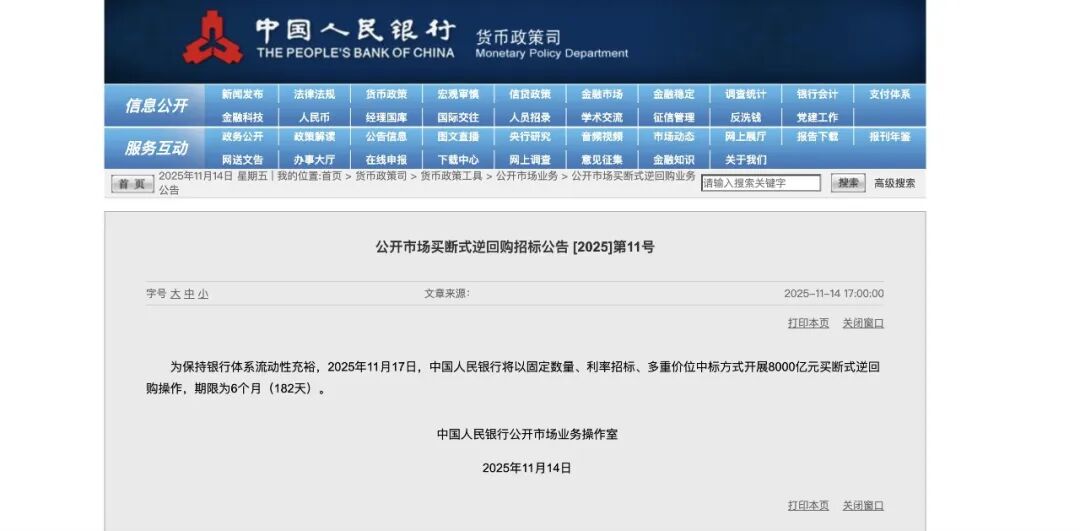
Core Viewpoint - The People's Bank of China (PBOC) will conduct a 800 billion yuan reverse repurchase operation on November 17, 2025, to maintain liquidity in the banking system, with a term of 6 months [1][2]. Group 1: Monetary Policy Actions - The PBOC's operation will involve a fixed amount and interest rate bidding with multiple price levels, indicating a proactive approach to liquidity management [1][2]. - In November, there will be a total of 500 billion yuan in additional reverse repos, which is an increase of 100 billion yuan compared to the previous month, marking the sixth consecutive month of liquidity injection through reverse repos [2][3]. Group 2: Economic Context and Implications - The increase in liquidity is necessary due to the upcoming issuance of 500 billion yuan in local government bonds and the completion of 500 billion yuan in new policy financial instruments, which are expected to boost loan growth [3][4]. - Analysts suggest that the PBOC's actions are aimed at stabilizing the funding environment, supporting government bond issuance, and encouraging financial institutions to increase credit lending [3][4]. - The fourth quarter is seen as a critical period for growth stabilization policies, with the PBOC's measures being timely and necessary to ensure sufficient market liquidity [3][4].

8000亿元!央行将出手
Zheng Quan Shi Bao· 2025-11-14 11:11
Core Viewpoint - The People's Bank of China (PBOC) is set to conduct a 800 billion yuan reverse repo operation on November 17, indicating a continued increase in liquidity support for the banking system amid upcoming debt maturities and liquidity tightening factors [1][2]. Group 1: Reverse Repo Operations - The PBOC will implement an 800 billion yuan reverse repo operation with a six-month term, resulting in a net injection of 500 billion yuan for the month [1]. - This operation marks the sixth consecutive month of increased reverse repo operations, with a total of 1.5 trillion yuan conducted in November alone [1]. - The central bank has been using reverse repos to address long-term funding gaps since their introduction last October [1]. Group 2: Monetary Policy Tools - The PBOC has employed various monetary policy tools, including reserve requirement ratio cuts, open market operations, medium-term lending facilities (MLF), and re-lending, to maintain ample liquidity in the banking system throughout the year [2]. - In October, the PBOC not only continued with increased reverse repos and MLF but also restarted government bond trading operations [2]. - Analysts expect the PBOC to continue increasing MLF operations despite 900 billion yuan maturing in November, indicating a commitment to maintaining a relatively loose monetary policy [2]. Group 3: Market Expectations - Market institutions view the resumption of government bond trading as a significant signal, although the necessity for large liquidity injections through bond purchases is considered low [2]. - The PBOC's ability to maintain liquidity in the banking system is not dependent on the resumption of government bond trading, as it has sufficient tools at its disposal [2].
万科再获深铁集团不超过22亿元借款
Zhong Guo Ji Jin Bao· 2025-10-30 14:57
Core Viewpoint - Vanke has secured a loan of up to 2.2 billion yuan from its largest shareholder, Shenzhen Metro Group, to repay bond principal and interest, with a loan term of no more than three years [2][3]. Group 1: Loan Details - The loan from Shenzhen Metro Group is intended for repaying Vanke's publicly issued bond principal and interest [3]. - The interest rate on this loan is lower than the rates Vanke currently pays to financial institutions, reflecting the support from the major shareholder [3][7]. - As of now, Shenzhen Metro Group has provided a total of 29.13 billion yuan in loans to Vanke, with the latest loan being part of a series of financial support measures [7]. Group 2: Financial Performance - In Q3 2025, Vanke reported revenue of 56.07 billion yuan but incurred a net loss attributable to shareholders of 16.07 billion yuan, primarily due to declining settlement scale in development business and low gross margins [6]. - For the first three quarters of 2025, Vanke's total revenue reached 161.39 billion yuan, with a net loss of 28.02 billion yuan, indicating ongoing operational challenges and increased financial pressure [6]. - The company has completed the delivery of 74,000 housing units and achieved sales of 100.46 billion yuan during the same period [6]. Group 3: Strategic Adjustments - Vanke is undergoing organizational adjustments to enhance its operational efficiency and has implemented measures to optimize its asset management [7]. - The company has also actively explored ways to revitalize its existing assets, achieving a total of 17.84 billion yuan in optimized and newly added capacity [6][7]. - Vanke's financing costs have decreased, with the average cost of new domestic financing at 3.44%, down by 6 basis points from the previous year [7].


央行加量续做6个月期买断式逆回购
Zheng Quan Ri Bao· 2025-10-14 15:41
Core Viewpoint - The People's Bank of China (PBOC) is implementing a 600 billion yuan reverse repo operation to maintain liquidity in the banking system, indicating a continued supportive monetary policy stance amid potential tightening of liquidity [1][2] Group 1: Reverse Repo Operations - On October 15, the PBOC will conduct a 600 billion yuan reverse repo operation with a term of 6 months (182 days) [1] - In October, the net injection from the 6-month reverse repo will be 1000 billion yuan, following the maturity of 5000 billion yuan from previous operations [1] - The total net injection from reverse repos in October will amount to 4000 billion yuan, marking the fifth consecutive month of increased reverse repo operations [1] Group 2: Market Conditions and Expectations - Factors such as large-scale government bond issuance and the promotion of new policy financial tools are expected to tighten liquidity, necessitating PBOC's support [1] - The strong performance of the stock market and the phenomenon of "deposit migration" among residents are also contributing to the tightening of funds [1] - The PBOC is expected to continue using both reverse repos and Medium-term Lending Facility (MLF) tools to inject liquidity into the market [2]
刘纪鹏评A股“924”一周年:“没有什么比四个月涨800点更显著”
Xin Lang Zheng Quan· 2025-09-25 07:44
Group 1 - The A-share market has shown a gradual bull trend, with an increase of 800 points over four months since the implementation of the "924" policy, indicating strong effectiveness of the measures taken by the government [1][2] - The central financial work committee has facilitated unprecedented cooperation among the central bank, the banking and insurance regulatory commission, and the securities regulatory commission, supporting the capital market [2] - The central bank has provided 500 billion yuan in swap facilities and 300 billion yuan in low-interest loans to listed companies for stock repurchases, reflecting a significant commitment to enhancing market liquidity [2] Group 2 - The new swap facilities differ from previous arrangements, as they involve the central bank supporting investment banks (securities companies, fund companies, and insurance companies) using ETFs and component stocks as collateral [2] - A total of 2.4 trillion yuan has been mobilized through these mechanisms, with nearly 2 trillion yuan already utilized since April 7, indicating strong liquidity support from the three major investment institutions [2]