
中伟股份

Search documents
成本与产能视角下的长周期展望:潜龙蓄锐,待势乘时
Dong Zheng Qi Huo· 2025-08-26 09:14
1. Report Industry Investment Rating - The trend rating for nickel is "oscillation" [1] 2. Core Views of the Report - The nickel industry has experienced different development stages driven by demand and supply. In the past, stainless - steel demand and later new - energy vehicle demand have respectively boosted nickel prices, while subsequent technological breakthroughs and capacity expansions have led to an oversupply situation. The industry cycle that started in 2017 may turn around in 2028, and new demand from solid - state batteries is expected to reverse the current oversupply pattern [1][2][3] 3. Summary According to the Table of Contents 3.1 Nickel Iron & Stainless Steel: A Close - knit Relationship 3.1.1 Before 2007: Stainless - steel demand drives nickel price up - From 1997 - 2007, global stainless - steel nickel consumption grew at a CAGR of about 3.3%, accounting for over 60% of nickel end - consumption. After China joined the WTO in 2001, its stainless - steel production increased rapidly, with a CAGR of 44.9% from 2000 - 2005 and 30% from 2005 - 2010. The shortage of supply led to a significant increase in nickel price and a pressing need for stainless - steel cost reduction. During this period, there were changes in the ore end and raw materials, with laterite nickel ore replacing sulfide nickel ore, and the smelting process evolving from one - step to two - step and three - step methods. Chinese enterprises also started using laterite nickel ore to smelt NPI, which became the main raw material for stainless - steel production, reducing costs [18][19][24] 3.1.2 2007 - 2015: Nickel capacity expands rapidly, and weakening stainless - steel demand causes nickel price to decline - High nickel prices attracted many domestic enterprises to produce NPI using laterite nickel ore. Since 2010, domestic nickel ore imports have increased significantly. By 2011, NPI accounted for over 50% of the primary nickel raw materials for stainless - steel production in China. However, stainless - steel demand weakened due to the global economic downturn, leading to a large accumulation of LME nickel inventory and a decline in nickel price [34][35] 3.1.3 RKEF and Oxygen - Enriched Side - Blowing Process Discussion and Cost Calculation - RKEF is the mainstream process for nickel - iron preparation, with advantages such as a short process flow, high production efficiency, and high nickel recovery rate, but it has limitations in terms of cobalt recovery and energy consumption. The oxygen - enriched side - blowing process (OESBF) is more advanced, with better raw - material applicability and lower energy consumption, and it can also recover cobalt. Cost calculations show that the cost of RKEF - produced nickel - iron is about 1333 dollars per physical ton, and the cost of OESBF - produced high - grade nickel matte is about 11,800 dollars per metal ton [38][40][50] 3.2 Intermediate Products: Technological Breakthroughs, Raw - Material Structure Shuffle 3.2.1 2018 - 2022: New - energy demand opens a second growth curve, and the smelting end breaks the binary supply - demand imbalance - With the rapid development of new - energy vehicles, the demand for ternary batteries increased, driving up the demand for nickel. The production of ternary precursors in China increased nearly four - fold from 2020 to 2022. However, the traditional "laterite nickel ore - stainless steel" and "sulfide nickel ore - nickel salt/pure nickel" binary supply - demand pattern could not meet the demand for nickel sulfate, leading to a supply - demand imbalance. Nickel beans/nickel powder were initially popular for producing nickel sulfate due to their short extraction cycle [56][57][62] 3.2.2 2023 - present: Supply - side expansion leads to an industry - wide oversupply - As the profit of producing nickel sulfate from pure nickel decreased, the HPAL process for laterite nickel ore and the production of nickel sulfate from high - grade nickel matte became mainstream. Currently, there is over 400,000 metal tons of MHP wet - process production capacity in Indonesia. The electric - deposition process has matured, leading to a rapid increase in pure - nickel production. The large - scale production of deliverable products has made it difficult to repeat the "short - squeeze" market, but the oversupply situation will continue until demand improves [70][80][84] 3.2.3 HPAL Process Discussion and Cost Calculation - HPAL has a high cobalt - recovery rate, which can significantly offset costs. The cost of HPAL - produced MHP is relatively low. After deducting the cobalt cost, the full cost of MHP is about 7732 dollars per metal ton. The investment cost of wet - process projects is expected to decrease with technological maturity, and the reduction of production cost depends on the increase in cobalt price [88][92][95] 3.3 Current Situation and Outlook of Smelting - End Capacity 3.3.1 Nickel Iron: FENI supply stabilizes after clearance, and NPI capacity reaches a phased peak - After the nickel - iron to high - grade nickel matte conversion process was established and the electric - deposition nickel capacity expanded, nickel iron became a raw material for electric - deposition nickel. However, the price change of nickel iron is difficult to be smoothly transmitted to the market. FENI has experienced production cuts due to high costs, and its supply is expected to remain stable [96][97]
光伏“反内卷”持续,新能源汽车旺季来临 | 投研报告
Zhong Guo Neng Yuan Wang· 2025-08-26 02:40
中银证券近日发布电力设备与新能源行业8月第4周周报:本周电力设备和新能源板块上 涨2.28%,其中工控自动化上涨3.84%,新能源汽车指数上涨3.69%,光伏板块上涨3.39%, 发电设备上涨2.79%,核电板块上涨2.69%,锂电池指数上涨2.45%,风电板块上涨0.50%。 本周行业重点信息:新能源车:乘联分会:新一批补贴资金到位后,各地以旧换新补贴 陆续重启,预计8月新能源零售可达110万左右,渗透率有望再创新高至56.7%。东风汽车启 动重大资产重组,推动旗下岚图汽车以介绍方式登陆香港联交所,同时对东风汽车集团股份 有限公司私有化。全新MG4将于8月29日正式上市,半固态电池版也将同步发布价格。动力 电池:先导智能在互动平台表示已成功输出量产级固态电池整线方案。楚能新能源与东风柳 汽签署动力电池开发合作协议,将在未来五年内向东风柳汽提供超过30GWh的多款乘用 车、商用重卡电池产品。光伏风电:工业和信息化部等部门联合召开光伏产业座谈会,部署 进一步规范光伏产业竞争秩序工作。中国光伏行业协会发布关于进一步加强行业自律,共同 维护公平竞争、优胜劣汰的光伏市场秩序的倡议。国家能源局:2025年7月,全国新增 ...
“反内卷”有望推动锂矿行业供需关系改善
Shang Hai Zheng Quan Bao· 2025-08-25 20:09
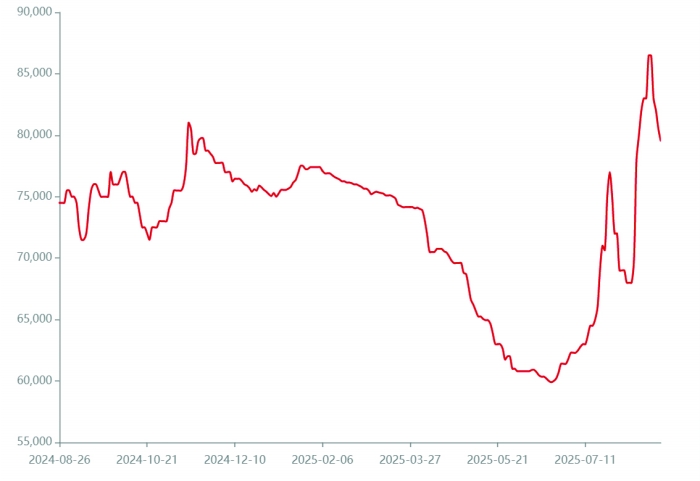
Core Viewpoint - The lithium mining industry is experiencing a challenging period due to falling lithium prices, but recent supply constraints and a potential recovery in prices may lead to improved financial performance for mining companies in the near future [2][6][10]. Group 1: Industry Performance - Lithium carbonate prices dropped below 60,000 yuan/ton in the first half of 2025, leading to disappointing financial results for many lithium mining companies, with some still facing losses [2][3]. - Major lithium mining companies like Zhongmin Resources reported a revenue of 3.267 billion yuan, a year-on-year increase of 34.89%, but a net profit decline of 81.16% [3]. - Rongjie Co. and Yongxing Materials also faced significant profit declines, with net profits down 48.54% and 47.84% respectively, despite some revenue growth [4]. Group 2: Supply and Demand Dynamics - The supply-demand imbalance characterized by strong supply and weak demand has led to a prolonged decline in lithium carbonate prices, with some companies expressing concerns about operating at a loss [6][10]. - Recent production halts, including those by CATL and other companies, have raised expectations for supply constraints, contributing to a rebound in lithium carbonate prices, which recently surpassed 80,000 yuan/ton [7][10]. - The suspension of CATL's Yichun mine, which has an annual capacity of 100,000 tons of lithium carbonate equivalent, is expected to impact domestic supply and support price recovery [7]. Group 3: Future Outlook - The anticipated supply contraction and industry initiatives to curb excessive competition are expected to support lithium prices and improve the financial health of mining companies [8][10]. - Companies like Ganfeng Lithium are focusing on increasing their resource self-sufficiency, with projections indicating a self-sufficiency rate exceeding 50% [11]. - The cost advantages of salt lake lithium resources are expected to be enhanced as prices recover, benefiting companies with low-cost operations [11].




中伟股份: 关于公司2025年中期分红方案的公告
Zheng Quan Zhi Xing· 2025-08-25 17:15
Core Viewpoint - The company has proposed a mid-term profit distribution plan for 2025, aiming to reward shareholders with cash dividends based on its financial performance [1][2]. Profit Distribution Plan - The company reported a net profit attributable to shareholders of 732,774,616.71 yuan for the first half of 2025, with the parent company achieving a net profit of 1,041,966,008.08 yuan [1]. - As of June 30, 2025, the total distributable profit for the consolidated financial statements was 5,107,444,981.02 yuan, while the parent company's distributable profit was 2,834,493,828.69 yuan [1]. - The proposed cash dividend is 2.8 yuan per 10 shares (including tax), with no capital reserve conversion to share capital or bonus shares [1]. Total Dividend Calculation - Based on the total share capital of 908,195,586 shares after excluding repurchased shares, the total cash dividend to be distributed amounts to 254,294,764.08 yuan (including tax) [2]. - The distribution total will be adjusted according to any changes in the total number of shares due to share repurchases or stock incentive plans, maintaining the distribution ratio [2]. Legality and Compliance - The profit distribution plan complies with relevant laws and regulations, including the Company Law of the People's Republic of China and the guidelines for cash dividends for listed companies [2][3]. - The plan is designed to ensure that all shareholders, especially minority shareholders, benefit from the company's operational success [3]. Review Process - The proposal was approved during the company's board meeting and will be submitted for review at the upcoming extraordinary general meeting of shareholders [2][3].
中伟股份:8月22日召开董事会会议
Mei Ri Jing Ji Xin Wen· 2025-08-25 16:10
Group 1 - The core point of the article is that Zhongwei Co., Ltd. announced its mid-term dividend plan for 2025 during its board meeting held on August 22, 2025 [1] - For the first half of 2025, Zhongwei's revenue composition is as follows: battery materials account for 45.17%, new energy metals account for 43.49%, and others account for 11.34% [1] - As of the report, Zhongwei's market capitalization is 33.7 billion yuan [1]
中伟股份(300919) - 中伟新材料股份有限公司内部审计制度
2025-08-25 14:28
第一条 为了进一步规范中伟新材料股份有限公司(以下简称"公司")内部 审计工作, 明确内部审计机构和人员的责任,保证审计质量,明确审计责任,促 进经营管理,提高经济效益,根据《中华人民共和国审计法》《审计署关于内部审 计工作的规定》、《深圳证券交易所上市公司自律监管指引第 2 号——创业板上市 公司规范运作》等法律法规规定、及《中伟新材料股份有限公司章程》(以下简称 "《公司章程》")的规定,制定本制度。 第二条 本制度所称内部审计,是指公司内部审计机构依据国家有关法律法规、 财务会计制度和公司内部管理规定,独立监督和评价公司及控股子公司的内部控 制和风险管理的有效性、财务信息的真实性和完整性以及对经营活动的效率和效 果等开展的一种评价活动。 第三条 内部审计的目的是促进公司内部控制的建立健全,有效地控制成本, 改善经营管理,规避经营风险,增加公司价值。 内部审计制度 中伟新材料股份有限公司 内部审计制度 第一章 总则 第四条 本制度所称内部控制,是指公司董事会、审计委员会、高级管理人员 及其他有关人员为实现控制目标而提供合理保证的过程。内部控制的目标是合理 保证公司经营管理合法合规,提高公司经营的效率和效果 ...
中伟股份(300919) - 中伟新材料股份有限公司内部问责制度
2025-08-25 14:28
为进一步完善中伟新材料股份有限公司(以下简称"公司")的法人 治理结构,健全内部约束和责任追究机制,促进公司董事、高级管理人员和其他 相关人员恪尽职守,提高公司决策与经营管理水平,减少和避免因决策失误给公 司和股东造成重大损失或对职工合法权益造成严重侵害,根据《中华人民共和国 公司法》(以下简称"《公司法》")、《中华人民共和国证券法》(以下简称 "《证券法》")、《深圳证券交易所创业板股票上市规则》(以下简称《股票上市 规则》)、《深圳证券交易所上市公司自律监管指引第2号——创业板上市公司规 范运作》、《公司章程》以及公司内部控制制度的相关规定,特制定本制度。 公司董事会、高级管理人员应当按照《公司法》、《证券法》等相关 法律法规、部门规章、规范性文件及《公司章程》等有关规定完善公司内部控制 体系建设,并严格遵守和执行内部控制制度,规范运作。 内部问责制是指对公司董事、高级管理人员在其所管辖的部门及工 作职责范围内,因其故意或者过失,不履行或者不正确履行工作职责,造成不良 影响和严重后果的行为,以致公司利益受损,而对其进行责任追究的制度。 本制度适用于对公司董事、高级管理人员及其他相关人员,纳入公 司合并报 ...
中伟股份(300919) - 中伟新材料股份有限公司募集资金管理制度
2025-08-25 14:28
中伟新材料股份有限公司 募集资金管理制度 第一章 总 则 第一条 为了规范中伟新材料股份有限公司(以下简称"公司")募集资金的管理和 使用,保护投资者的权益,依照《中华人民共和国公司法》(以下简称"《公司法》")、《中 华人民共和国证券法》(以下简称"《证券法》")、《上市公司募集资金监管规则》《深圳证 券交易所创业板股票上市规则》(以下简称"《创业板上市规则》")《深圳证券交易所上市 公司自律监管指引第 2 号——创业板上市公司规范运作》等法律、法规、规范性文件以 及《中伟新材料股份有限公司章程》的规定,结合公司实际情况,特制定本制度。 第二条 本制度所称募集资金是指公司通过向不特定对象发行证券或者向特定对象 发行证券(包括股票、可转换公司债券等)募集并用于特定用途的资金,但不包括公司 实施股权激励计划募集的资金。 第三条 公司必须按发行申请文件中承诺的募集资金投向和股东会、董事会决议及 审批程序使用募集资金,并按要求披露募集资金的使用情况。公司董事、高级管理人员 应当勤勉尽责,根据《公司法》《证券法》《创业板上市规则》等有关规定,督促公司规 范使用募集资金,确保公司资产安全,及时披露募集资金的使用情况。 ...
中伟股份(300919) - 中伟新材料股份有限公司董事会战略与ESG委员会议事规则
2025-08-25 14:28
战略与 ESG 委员会议事规则 中伟新材料股份有限公司 董事会战略与 ESG 委员会议事规则 第一章 总则 第一条 中伟新材料股份有限公司(以下简称"公司")为适应战略需要, 增强公司核心竞争力,确定公司发展规划,提升公司环境、社会责任和公司治理 (ESG)绩效,健全投资决策程序,加强决策科学性,提高重大投资决策的效益 和决策的质量,特设立董事会战略与 ESG 委员会,作为负责公司长期发展战略、 ESG 绩效和重大投资决策的专门机构。 第二条 为确保战略与 ESG 委员会规范、高效地开展工作,公司董事会根据 《中华人民共和国公司法》(以下简称"《公司法》")、《上市公司治理准则》 《公司章程》及其他有关法律、法规和规范性文件的规定,特制定本议事规则。 本制度所称的 ESG 职责,是指公司在经营发展过程中应当履行的环境 (Environmental)、社会(Social)和公司治理(Governance)方面的责任和义 务,主要包括对自然环境和资源的保护、社会责任的承担以及公司治理的健全和 透明。公司应当按照本制度的要求,积极履行 ESG 职责,不定期评估公司 ESG 职责的履行情况,自愿披露公司 ESG 报告 ...
中伟股份(300919) - 中伟新材料股份有限公司独立董事工作制度
2025-08-25 14:28
独立董事工作制度 中伟新材料股份有限公司 独立董事工作制度 第一章 总则 第一条 为了进一步完善中伟新材料股份有限公司(以下简称"公司")治理 结构,规范公司运作,更好地维护公司整体利益,保障全体股东特别是中小股东 的合法权益不受损害,根据《中华人民共和国公司法》(以下简称"《公司法》")、 《上市公司治理准则》《上市公司独立董事管理办法》《深圳证券交易所创业板股 票上市规则》等相关法律、法规的以及《中伟新材料股份有限公司章程》(以下 简称"《公司章程》")规定,制定本制度。 第二条 独立董事是指不在公司担任除独立董事外的任何其他职务,并与公 司及主要股东不存在可能妨碍其进行独立客观判断的关系的董事。独立董事应当 忠实履行职务,维护公司利益,尤其要关注社会公众股股东的合法权益不受损害。 独立董事应当独立履行职责,不受公司主要股东、实际控制人等单位或个人 的影响。 第三条 公司设独立董事 3 名。 第二章 独立董事的任职条件 第四条 担任公司独立董事应当符合下列基本条件: (一)根据法律、行政法规及其他有关规定,具备担任公司董事的资格; (二)具有本制度第三章所要求的独立性; (三)具备上市公司运作的基本知识, ...