
OpenAI

Search documents
Meta 扎克伯格豪赌 AI:连续 2 年砍普通员工股权,涨核心人才薪资
Jin Rong Jie· 2026-02-20 09:38
IT之家注:股权奖励是公司发给员工的"股票兑换券"。员工可以在未来某个时间点,以特定价格买入公 司股票(或者直接获得股票)。这是科技公司为了留住人才,让员工和公司利益绑定的一种常见福利, 通常占员工总收入的很大一部分。 知情人士透露,公司将年度股票期权分配额度下调了约 5%,这一调整波及数万名员工。继去年削减约 10% 之后,此次"再次缩水"让不少员工感到失望。 这一薪酬调整迅速在匿名职场社区 Blind 上引发了热议。有员工抱怨道:"又是削减,看来我的努力白 费了,再见 Meta!"还有人调侃称将"相应减少 5% 的工作时间"以示抗议。 金融时报今天(2 月 20 日)发布博文,报道称 Meta 为筹集资金应对昂贵的 AI 军备竞赛,已连续第二 年削减员工股权奖励(Equity-based awards)。 这家市值 1.6 万亿美元的巨头预估,其 2026 年的资本支出可能高达 1300 亿美元。资金主要流向两个无 底洞:建设庞大的数据中心集群,以及从竞争对手那里挖角顶尖 AI 人才,后者的年薪包往往高达数百 万甚至上亿美元。 为了安抚因 AI 投资回报尚不明朗而感到不安的投资者,扎克伯格正极力在内部推行 ...

Nvidia's next big AI investment – revealed
Finbold· 2026-02-20 09:31
Core Viewpoint - Nvidia is reportedly finalizing a $30 billion investment in OpenAI, which is part of a larger $100 billion funding round aimed at significantly increasing OpenAI's valuation to $830 billion [2][3]. Group 1: Investment Details - Nvidia's investment of $30 billion is expected to be used primarily for purchasing Nvidia chips, raising concerns about the circular nature of the deal [4][5]. - The investment is part of OpenAI's broader strategy to secure $100 billion in funding from multiple sources, including SoftBank and Amazon [3]. Group 2: Financial Projections - OpenAI is projected to incur a loss of $14 billion in 2026, despite expectations of revenue soaring to $100 billion by 2029 [7][9]. - Nvidia, as of February 2026, holds a market capitalization of nearly $4.6 trillion, significantly surpassing Apple by approximately $700 billion [9]. Group 3: Market Sentiment - The ongoing investment and the scale of funding have led to speculation about the sustainability of the AI bubble, with critics questioning the actual demand for such large investments [8]. - The perception of the AI industry has been negatively impacted by issues such as RAM shortages, which have been exacerbated by OpenAI's operational strategies [8].



印度想多了,硅谷没少想
虎嗅APP· 2026-02-20 09:23
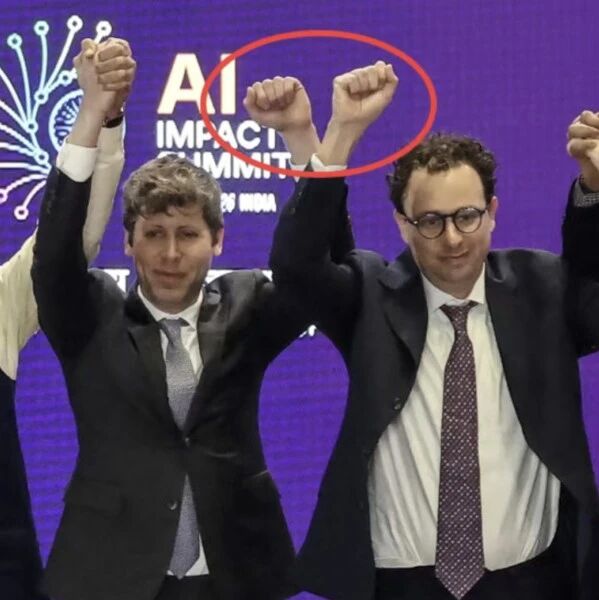
Core Viewpoint - The article discusses the recent AI summit in New Delhi, highlighting the contrasting objectives of India and Silicon Valley companies, where India aims for global leadership in AI governance while Silicon Valley focuses on business opportunities and market growth [5][66][92]. Group 1: Summit Highlights - The AI summit in New Delhi was described as the largest and highest-profile AI event in Asia, attracting significant attention from major tech leaders [5][6]. - A notable moment during the summit was when OpenAI's Sam Altman and Anthropic's Dario Amodei did not join the hand-holding gesture symbolizing unity among tech leaders, indicating underlying tensions [11][12][15]. - Nvidia CEO Jensen Huang's absence was significant, as he represents a crucial player in AI infrastructure, particularly in chip supply, which India lacks [18][19][20]. Group 2: Investment and Agreements - Major agreements were announced during the summit, including Google's $15 billion investment in AI infrastructure in India, OpenAI's partnership with Tata Group for a data center, and Microsoft's commitment to invest $50 billion globally by 2030, with India as a key focus [29]. - Despite the high-profile agreements, the article suggests that the underlying relationships among the companies are competitive rather than collaborative, reflecting a cautious approach to partnerships [30][34]. Group 3: India's AI Landscape - India has a strong pool of English-speaking engineers and a large market, but it faces significant challenges, including reliance on foreign chips and a lack of top-tier native AI models [43][58][59]. - The Indian government has initiated the India AI Mission, investing over $1 billion to build a public computing pool, but the country still struggles with infrastructure and regulatory stability [45][62]. Group 4: Diverging Objectives - India's ambition is to position itself as a global AI hub and a voice for developing countries, while Silicon Valley companies are primarily interested in market expansion and immediate business opportunities [67][68]. - The article emphasizes that while India seeks to establish itself as a leader in AI governance, Silicon Valley's focus remains on transactional relationships and market-driven strategies [70][72]. Group 5: Conclusion - The summit illustrated the disconnect between India's aspirations and Silicon Valley's pragmatic approach, with India wanting to assert its role in AI governance while tech companies prioritize business interests [92][94]. - The absence of a unified commitment from Silicon Valley leaders, as symbolized by the empty seat of Jensen Huang and the unjoined hands of Altman and Amodei, reflects the ongoing tension between collaboration and competition in the AI space [82][96].



X @Forbes
Forbes· 2026-02-20 09:00
Sam Altman told Forbes Pres. Trump has been easy to work with when it comes to AI, though the administration’s nationalist policies don’t quite align with his own or OpenAI’s.“His job is to make sure America wins. And I view our mission as for all of humanity,” Altman said. “There’s some opposition there.”Read more from our conversation with Sam Altman: https://t.co/4CNTnfMosn (Photo: Cody Pickens for Forbes) #Forbes250 ...
为对抗中国AI,美国想给这个冷战产物披上“新羊皮”
Guan Cha Zhe Wang· 2026-02-20 07:58
Core Viewpoint - The U.S. government is launching a new "Tech Corps" initiative to send thousands of American science and math graduates abroad to enhance foreign reliance on U.S. technology and reduce the global prevalence of Chinese competitive products [1][5]. Group 1: Initiative Overview - The "Tech Corps" program aims to deploy up to 5,000 American volunteers and advisors to partner countries over the next five years, focusing on promoting the adoption of U.S. AI hardware and software [1][5]. - The initiative will be announced by Michael Kratsios at the "India AI Impact Summit," marking a new mission for the historically significant "Peace Corps" [1][4]. Group 2: Historical Context - The original "Peace Corps" was established in 1961 to promote U.S. foreign policy through volunteer work in developing countries, serving as a tool for U.S. soft power [2]. Group 3: Strategic Goals - The Trump administration views winning the global AI competition as a top priority, aiming to increase the export of U.S. technology, including advanced processors from companies like NVIDIA [5]. - The initiative is designed to counter China's growing influence in AI, particularly in regions like South America, Africa, and parts of Europe, where China has been active in infrastructure development [5][7]. Group 4: Funding and Implementation - Funding for the tech initiative will come from corporate and philanthropic donations, with the organization receiving approximately $410 million in funding from Congress for the fiscal year 2026 [5][6]. - Recruitment and training for technology volunteers will begin this year, with an initial target of attracting 500 professionals for the first projects [6]. Group 5: Competitive Landscape - The initiative is expected to intensify competition between the U.S. and China in the Southern Hemisphere, where Chinese tech companies are gaining ground with low-cost products [7]. - Recent comments from Microsoft highlight concerns that U.S. AI companies are being outpaced by Chinese competitors, particularly in emerging markets where open-source models are rapidly gaining traction [8][10].
智谱与MiniMax市值双双突破3000亿港元,Kimi新一轮超7亿美元融资将交割,AI大模型赛道持续升温
Jin Rong Jie· 2026-02-20 07:58
Group 1 - The AI large model sector in Hong Kong continues its strong performance post-Spring Festival, with companies like Zhipu (02513.HK) and MINIMAX-WP (00100.HK) seeing their market values exceed 300 billion HKD, collectively surpassing 580 billion HKD, outpacing well-known tech firms like Trip.com, Kuaishou, and JD.com [1][2] - Zhipu and MiniMax went public on January 8 and 9, raising nearly 10 billion HKD, with share prices of 116.20 HKD and 165 HKD respectively, both companies have recorded several-fold increases in their stock prices since listing [2][3] - The primary market remains active, with Kimi, under the Dark Side of the Moon, set to complete a new round of financing exceeding 700 million USD shortly after raising 500 million USD, with a latest valuation surpassing 10 billion USD [3] Group 2 - Recent reports indicate that multiple large models are releasing new features or integrating ecosystems, potentially leading to a new wave of innovation in the sector, shifting the internet value chain from traditional traffic scale to a focus on execution, capability invocation, governance, and result-based business models [4] - The AI application sector is transitioning from being a technology follower to becoming the core narrative of a new technological era, with accelerated commercialization, restructured user behavior, and clearer profit models, indicating a shift in AI investment focus from "computing infrastructure" to "scenario realization" [4]

X @Bloomberg
Bloomberg· 2026-02-20 07:31
“We built something special.”Microsoft President Brad Smith discusses the company's OpenAI partnership with Bloomberg TV’s @haslindatv https://t.co/oo3VNnaDGY https://t.co/pat1Q5s46R ...
CNBC Daily Open: U.S. markets rocked by private credit worries and potential strike on Iran
CNBC· 2026-02-20 07:30
Market Overview - U.S. markets experienced volatility due to escalating tensions with Iran and concerns over private credit, leading to a decline in major indices [1][3] - The S&P 500 decreased by 0.28%, the Dow Jones Industrial Average fell by 0.54%, and the Nasdaq Composite closed down by 0.31% [3] Oil Market - Oil prices increased by nearly 2% in U.S. trading amid fears of supply disruptions due to potential military action in Iran [1] Private Credit Market - Blue Owl Capital sold $1.4 billion in loan assets, raising concerns about liquidity and stability in the private credit market, resulting in a nearly 6% drop in its stock [2] - Other asset managers, including Blackstone and Apollo Global Management, also saw declines in their stock prices [2] Aerospace Industry - Airbus stock fell by 6% after the company announced that its deliveries for the year would be below analyst expectations, citing supplier-driven engine shortages as "unsatisfactory" [3] Artificial Intelligence Sector - Positive sentiment was noted at India's AI Impact Summit, with discussions involving leaders from Microsoft, OpenAI, and Qualcomm on the AI industry and semiconductor manufacturing [3] - Google DeepMind's CEO highlighted that the memory chip shortage remains a limiting factor for agentic AI [4] - Nvidia plans to invest up to $30 billion in OpenAI, which would value the startup at $730 billion pre-money [4]
OpenAI 发布智能合约基准测试,这意味着什么?
Xin Lang Cai Jing· 2026-02-20 07:17
Core Insights - OpenAI has released a benchmark test called evmbench to evaluate the capabilities of agents in understanding, repairing, and utilizing smart contracts, indicating a significant step towards assessing their survival in the crypto environment [2][3] Group 1: Benchmark Overview - The benchmark utilizes 120 high-risk vulnerabilities from 40 real-world projects, divided into three categories: finding vulnerabilities, repairing them, and simulating attacks [3] - The release of this benchmark suggests OpenAI's proactive interest in the crypto space, influenced by crypto VC Paradigm [3][4] Group 2: Future of Agents - The report indicates that the future of agents in the crypto ecosystem is not just a possibility but a necessity, with expectations for agentic stablecoin payments to grow [4] - As agents evolve, they may operate independently without human oversight, leading to a new economic system where trust and collaboration are managed differently [5][6] Group 3: Infrastructure Needs - A fundamental question arises regarding the operation of an economic system without human intermediaries, as traditional trust mechanisms may not apply to agents [6][7] - Agents will require their own infrastructure, with smart contracts providing a potential solution by enforcing agreements through code rather than human trust [9] Group 4: Implications of EVMbench - The capabilities measured by EVMbench—understanding contracts, identifying vulnerabilities, and executing transactions—are crucial for agents to thrive in a decentralized environment [9][10] - OpenAI recognizes that the ability of agents to autonomously navigate the blockchain world will determine who gains entry into the next phase of this technological evolution [9]
史上最大融资,来了!
Xin Lang Cai Jing· 2026-02-20 07:13
Core Insights - OpenAI is set to complete a new funding round that may exceed $100 billion, aimed at developing its artificial intelligence tools [1][3] - The total valuation of OpenAI, including this funding, is expected to surpass $850 billion, higher than the initial estimate of $830 billion, with a pre-money valuation maintained at $730 billion [1][3] Funding Details - The first part of this funding round will primarily come from strategic investors, including Amazon, SoftBank Group, NVIDIA, and Microsoft, with total commitments potentially nearing $100 billion if investments reach the upper limits of discussions [1][4] - Amazon is expected to invest up to $50 billion, SoftBank plans to invest up to $30 billion, and NVIDIA has discussed a potential investment of $20 billion [4] Future Investment Stages - The next phase of the deal will involve venture capital firms, sovereign wealth funds, and other financial investors, which could significantly increase the total fundraising amount [4] - Funds from corporate investors are anticipated to be received in batches or installments throughout the year [4] Strategic Partnerships - As part of its partnership with Amazon, OpenAI plans to expand its use of Amazon's chips and cloud computing services [4] - OpenAI's CEO, Sam Altman, noted the remarkable advancements of Chinese tech companies across the entire technology stack, indicating that they are approaching the technological frontier in many areas, including AI [4]
