DeepSeek

Search documents
计算机行业周观点第47期:2025年人工智能产业总结与回顾-20260104
Western Securities· 2026-01-04 06:55
Investment Rating - The industry is rated as "Overweight," indicating an expected increase in value exceeding 10% compared to the market benchmark index over the next 6-12 months [6]. Core Insights - The large model has entered a post-training and COT expansion phase, with the capabilities of the base model in 2025 likely remaining unchanged, as the GPT-5 series may still utilize the GPT-4o base model. The focus for 2025 will be on enhancing post-training and reasoning capabilities [1]. - Google's Gemini 3 model has achieved significant advancements in cross-modal dialogue, understanding, and content generation, but still faces challenges with logical coherence in complex scenarios and controllability of generated content, highlighting key areas for future technological breakthroughs [1]. - Domestic AI chip manufacturers have reached H-series performance levels, with advancements in interconnect speeds and software ecosystem capabilities. Notably, Alibaba's latest PPU chip has surpassed NVIDIA's A800 in key performance metrics, and Huawei's CloudMatrix 384 super node aims to optimize computing efficiency [2]. - The capabilities of robotic bodies have improved significantly, while the cognitive abilities of their "brains" lag behind, limiting their application to structured scenarios. The VLA model architecture has been criticized for its limitations in real-time reasoning in complex physical environments [3]. - The business models for AI applications are still under exploration, with domestic companies facing challenges in monetization despite high revenue growth rates, while international firms struggle with high computing costs and low profit margins [3].
DeepSeek上新mHC,R2还远吗?
Tai Mei Ti A P P· 2026-01-04 06:05
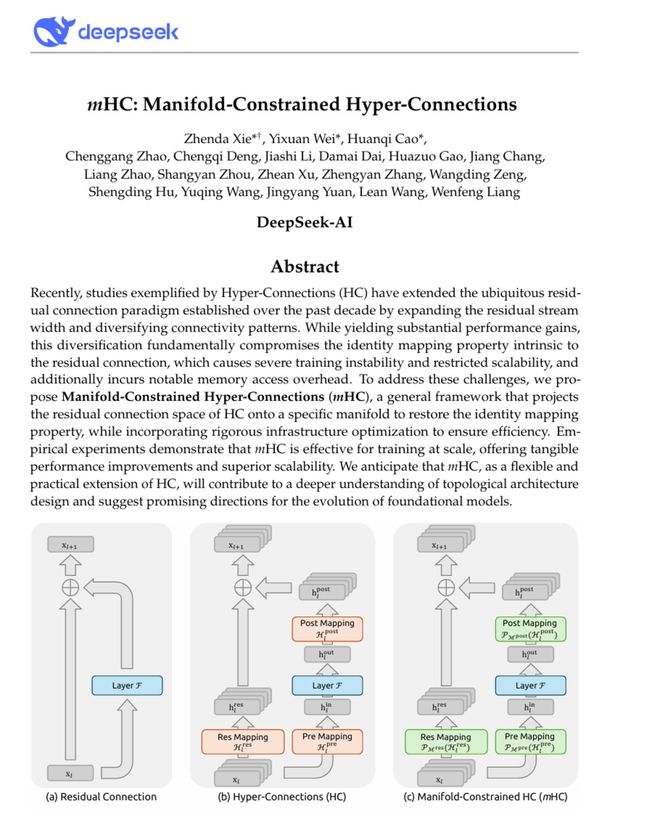
Core Insights - DeepSeek has introduced a new neural network architecture optimization called mHC (Manifold-Constrained Hyper-Connections), which is expected to significantly impact the AI industry, including large models and chips [1][5][9] Group 1: mHC Architecture - The mHC architecture builds on the Hyper-Connections (HC) framework released by the Byte Bean team in November 2024, aiming to replace the nearly decade-old ResNet architecture [5] - mHC introduces a Manifold-Constrained approach using the Sinkhorn-Knopp algorithm to stabilize signal propagation during training, addressing issues of signal explosion and instability in large model training [5][6] - In training demonstrations with 27 billion parameters, mHC maintained a signal amplification of only 1.6 times, while HC experienced a catastrophic failure with a 3000 times amplification [6][8] Group 2: Performance and Efficiency - mHC shows a significant reduction in training loss and improved performance on challenging tasks, with over 2% enhancement in reasoning and reading comprehension benchmarks compared to traditional architectures [6][8] - The additional training time overhead for mHC, even with a fourfold expansion of residual channels, is only 6.7%, indicating a focus on cost-effectiveness and efficiency [8] Group 3: Industry Impact and Reactions - The release of mHC has sparked high discussion levels among researchers and industry professionals, with expectations of a paradigm shift in large model architectures by 2026 [9][10] - Competitors are already responding, with new architectures like Deep Delta Learning emerging shortly after mHC's announcement, indicating a potential chain reaction in AI architecture development [9][10] - Analysts predict that DeepSeek may make significant announcements around the Lunar New Year, potentially unveiling the long-awaited R2 model or a faster universal model V4 [10] Group 4: Compatibility and Market Dynamics - mHC's architecture is primarily designed for NVIDIA's supernode links, raising concerns about compatibility with domestic chips, which may require enhanced adaptation efforts [11] - As U.S. AI chip manufacturers gradually exit the Chinese market due to geopolitical factors, domestic chipmakers are accelerating their development and ecosystem building to adapt to DeepSeek's models [12]


AI周报|Meta斥资数十亿美元收购Manus;梁文锋署名DeepSeek新论文
Di Yi Cai Jing· 2026-01-04 02:26
Group 1: Meta's Acquisition of Manus - Meta has acquired the AI startup Manus for a price reported to be in the billions, marking it as Meta's third-largest acquisition after WhatsApp and Scale.ai [1] - Manus will continue its operations in Singapore and maintain its product offerings through its app and website without changes to its decision-making processes [1] - The acquisition reflects Meta's urgency to enhance its AI capabilities, especially in light of competition from Google's Gemini 3 [1] Group 2: SoftBank's Investment in OpenAI - SoftBank has completed a $40 billion investment commitment to OpenAI, making it one of the largest private financings in history [2] - The final tranche of the investment, amounting to $22 billion to $22.5 billion, has been sent recently [2] - SoftBank's divestment of Nvidia shares for $5.83 billion indicates a strategic shift to fund AI projects, including the partnership with OpenAI [2] Group 3: DeepSeek's New Research - DeepSeek has introduced a new network architecture called mHC (manifold-constrained hyperconnection) aimed at improving model training stability and efficiency [3] - The research addresses issues related to the scalability and memory access costs of existing hyperconnection models [3] - Industry experts view this innovation as a foundational advancement that could lead to significant updates in future versions of DeepSeek's technology [3] Group 4: Moonlight's Financing and Market Position - Moonlight, a large model unicorn, has completed a $500 million Series C financing, significantly exceeding its target, and currently holds over 10 billion yuan in cash [4] - The funds will be used to aggressively expand GPU resources and accelerate the training and development of its K3 model [4] - Moonlight aims to surpass competitors like Anthropic to become a leading AGI company [4] Group 5: Upcoming IPOs in the AI Sector - Companies including OpenAI, Anthropic, and SpaceX are preparing for potential IPOs this year, with total fundraising expected to reach hundreds of billions [6] - OpenAI is negotiating a new valuation of $750 billion, while Anthropic's valuation may exceed $300 billion [6] - The combined valuation of these companies could approach 13 trillion yuan, indicating a significant market impact [6] Group 6: MiniMax's IPO Plans - MiniMax has initiated its IPO process, aiming to raise up to 4.19 billion HKD (approximately $538 million) with a share price range of 151 to 165 HKD [7] - The company is set to list on the Hong Kong Stock Exchange on January 9, 2026, shortly after its competitor, Zhipu AI [7] - MiniMax's cornerstone investors include major financial institutions and investment funds, highlighting strong market interest [7] Group 7: Baidu's Kunlun Chip IPO - Baidu has submitted a confidential application for its AI chip subsidiary Kunlun to independently list on the Hong Kong Stock Exchange [8] - This move follows Baidu's earlier evaluation of the potential for a spin-off, indicating a strategic shift in its business model [8] - The competitive landscape for Kunlun includes major players like Nvidia and AMD, as well as domestic competitors [8] Group 8: Wall Street's Response to Wall Street's IPOs - Wall Street analysts predict that if any of the aforementioned companies successfully go public, it could overshadow the total fundraising of approximately 200 companies in the U.S. in 2025 [6] - The anticipated IPOs are expected to generate significant returns for venture capitalists and investment bankers involved in the transactions [6] Group 9: Wall Street's Response to Wall Street's IPOs - Wall Street analysts predict that if any of the aforementioned companies successfully go public, it could overshadow the total fundraising of approximately 200 companies in the U.S. in 2025 [6] - The anticipated IPOs are expected to generate significant returns for venture capitalists and investment bankers involved in the transactions [6] Group 10: xAI's Expansion - xAI, led by Elon Musk, has purchased a third building to enhance its training capabilities, aiming for nearly 2 gigawatts of computing power [15] - The new facility is set to be transformed into a data center by 2026, supporting xAI's growth and operational needs [15] - xAI's previous investments in data centers indicate a strong commitment to expanding its AI infrastructure [15]





详细解读DeepSeek新年的第一篇论文,他们就是这个时代的真神。
数字生命卡兹克· 2026-01-04 01:20
2026年新年第一天,DeepSeek又开卷了。 发了他们新年的第一篇论文。 《 mHC: Manifold-Constrained Hyper-Connections 》 感觉是DeepSeek-V4的铺垫,当然一些小道消息,不保真,我也不懂,我只是拍脑袋预测一下,有问题别找我。 就是V4,大概在1月中下旬或者1月底,然后呢,有多模态输入,没有多模态输出。 就酱,回到论文。 这篇论文我是说实话,有点过于硬核了。 但同时,传递出来的信息量和对AI界的改变,又是巨大的。 在给自己放了一天假,然后啃了一天以后(这玩意比我想象的难啃多了。。。)我还是想,用最通俗易懂最有意思的方式,来跟你聊聊,这篇论文的有 趣之处,以及,是如何对现在的生态进行一些新的输入的。 当然也给我自己叠个甲,我不是算法出身,我只是读完以后觉得很棒想分享给大家看,我对这篇论文的理解和乱七八糟的各种名词解释,都是我自己民 科瞎JB自学的,部分措辞也有为了能让大家更好理解而做的部分简化,如果有我理解的错误或者事实性错误的地方,欢迎大佬们在评论区指正讨论,感 谢。 话不多说,我们,正是开始。 在最开始之前,我想先问大家一个问题,就是大家认为,一个要处 ...
法国对马斯克旗下聊天机器人涉嫌生成色情内容启动调查;全球首款视觉AI网球机器人Tenniix亮相CES 2026丨AIGC日报
创业邦· 2026-01-04 01:08
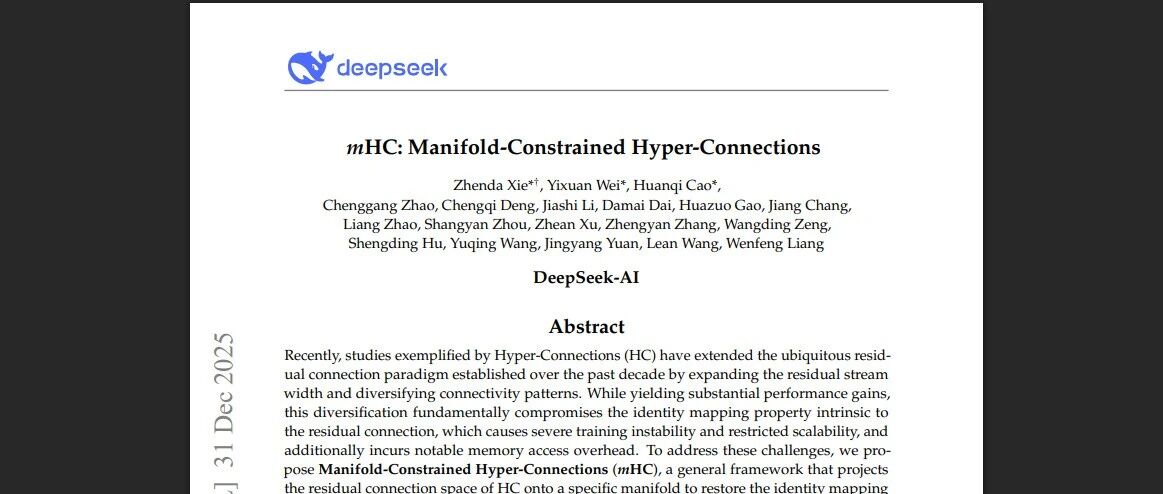
Group 1 - France's Paris prosecutor has confirmed an investigation into Elon Musk's AI company xAI regarding its chatbot "Grok" for allegedly generating illegal pornographic content, extending an existing investigation into the X platform since July last year for foreign interference assistance [2] - MSI has announced a pre-release of its gaming monitor MEG X, claiming it to be the world's first AI esports monitor equipped with next-generation QD-OLED technology, featuring a wider aspect ratio than 16:9 [2] Group 2 - DeepSeek has published a paper proposing a more efficient AI development method, introducing a framework called "manifold-constrained hyperconnection" (mHC) aimed at enhancing scalability while reducing computational and energy demands for training advanced AI systems [5] - The world's first visual AI tennis robot, Tenniix, is set to debut at CES 2026, featuring smart tracking, adaptive learning, and human-like training capabilities, with a starting price of $699 [5]

南宁“人工智能+企业开办”案例入选国家级数字政府优秀创新案例
Xin Lang Cai Jing· 2026-01-03 20:20
Group 1 - The core viewpoint of the article highlights the recognition of Nanning's "AI + Enterprise Establishment" initiative as an exemplary case in the 2025 Digital Government Service Capability report, showcasing its innovative approach to enhancing government services through artificial intelligence [1][2] - The initiative was selected from over 600 practice cases recommended by more than 200 units, indicating its significance as a benchmark in the field of digital public services and generative AI applications [1] - The report is organized by the Ministry of Industry and Information Technology and the China Software Evaluation Center, emphasizing its authoritative status in the domain of digital government construction [1] Group 2 - Since 2025, Nanning's government service bureau has focused on improving enterprise establishment services by integrating advanced AI models like DeepSeek, creating a comprehensive technical framework that addresses common pain points such as complex form filling and cumbersome material preparation [2] - The new model allows for automatic data filling, real-time material generation, and full-process intelligent assistance, significantly enhancing the efficiency of government services and the experience of businesses [2] - Future plans include further deepening the integration of AI technology in government services and expanding its application across more service scenarios to support high-quality development in the capital [2]
腾讯研究院AI速递 20260104
腾讯研究院· 2026-01-03 16:01
Group 1 - DeepSeek team released a new paper titled "Manifold-Constrained Hyper-Connections," co-authored by founder Liang Wenfeng, proposing the mHC scheme to stabilize large model training and enhance scalability [1] - The mHC scheme projects the residual mapping matrix onto a double-random matrix manifold space, preserving topological expressiveness while restoring the identity mapping property, controlling the signal amplification factor from 3000 to 1.6 [1] - Experiments with a 27B model show that mHC outperforms traditional HC across tasks like BBH and DROP, introducing only a 6.7% training time overhead, with a maximum improvement of 2.3 percentage points [1] Group 2 - Claude Code, launched 6 months ago, generated nearly $1 billion in annualized revenue, with project lead Boris Cherny confirming that 100% of code was completed by Claude Code in the past 30 days [2] - Key configurations include running 5 Claude instances in parallel on terminals, 5-10 Claude instances on the web, utilizing the Opus 4.5 model, and team collaboration through CLAUDE.md files integrated via GitHub actions [2] - Important techniques involve planning mode, slash command encapsulation for workflows, sub-agent handling of repetitive tasks, and PostToolUse hook for code formatting, with feedback loops for Claude to validate its work [2] Group 3 - Tesla's FSD V14.2 successfully completed a cross-country drive from Los Angeles to South Carolina in a 2025 Model 3, covering 2732.4 miles with zero human intervention, including parking and charging [3] - FSD V14.2 or pre-installed Grok shows significant enhancements in driving performance, perception capabilities, and decision-making logic, handling complex intersections and lane changes more decisively, resulting in a more human-like driving rhythm [3] - Tesla's end-to-end architecture contrasts with Waymo's modular approach, as demonstrated by a power outage in San Francisco that disrupted Waymo's operations, while Tesla's FSD remained largely unaffected [3] Group 4 - OpenAI is developing its first AI hardware, potentially a pen-shaped device or portable audio device, codenamed "Gumdrop," which integrates a microphone and camera to convert handwritten notes into text for ChatGPT [4] - The device is similar in size to an iPod Shuffle and aims to become the "third core device" following the iPhone and MacBook, initially planned for production by Luxshare Precision, later shifted to Foxconn, with manufacturing expected in Vietnam or the US [4] - OpenAI is also working on a new audio model architecture set to launch in Q1 2026, promising more natural emotional voices, more accurate and in-depth responses, and improved interruption handling capabilities [4] Group 5 - TSMC's N2 technology is set to enter mass production in Q4 2025, utilizing the first-generation nanosheet transistor (GAA) technology, achieving a 10%-15% performance improvement at the same power level compared to N3E, and a 25%-30% reduction in power consumption at the same speed [6] - The N2 process employs gate-all-around nanosheet transistors that wrap around the current channel, combined with SHPMIM capacitors, resulting in approximately a 20% increase in transistor density and over a 2x increase in capacitance density compared to N3E [6] - TSMC is expanding production simultaneously at its Kaohsiung and Hsinchu fabs, catering to both mobile and AI/HPC chip markets, with N2P and A16 expected to enter mass production in the second half of 2026 [6] Group 6 - Zhiyuan announced the launch of a "small-sized full-body force-controlled humanoid robot," named Q1, standing approximately 0.8 meters tall and capable of fitting into a 30-35L backpack, utilizing innovative materials and control algorithms to shrink QDD joints to "smaller than an egg" while maintaining full-size force control performance [7] - The Q1 robot employs advanced composite material technology for durability and is only 1/8 the size and weight of full-sized robots, with an open-source SDK and HDK supporting 3D printing for custom appearances [7] - It features the "Zhiyuan Lingxin" AI platform for natural conversation and encyclopedic Q&A, and through the "Zhiyuan Lingchuang" platform, users can arrange actions and logic like building blocks, positioning it as a desktop robot for individual creators [7] Group 7 - Elon Musk announced that Neuralink will begin large-scale production of brain-machine interface devices in 2026, transitioning to a streamlined, nearly fully automated surgical process, with electrode wires passing through the dura mater without the need for removal [8] - The new minimally invasive technology reduces costs, lowers risks, and shortens recovery times, making standardization more accessible; as of September 2025, Neuralink had served only 12 patients, increasing to 20 by December [8] - Founded in 2016, Neuralink focuses on treating neurological disorders such as paralysis, muscular atrophy, and Parkinson's disease, with the first patient, Noland Arbaugh, able to post and play games using only the brain chip post-surgery [8] Group 8 - Meta faced criticism from Turing Award winner LeCun after his departure, alleging that Llama 4's testing results were manipulated by using different models on various benchmarks to achieve better scores, leading to a loss of confidence from Zuckerberg in the original AI team [9] - LeCun criticized his 28-year-old supervisor, Alexandr Wang, for lacking research experience and understanding of research methodologies, asserting that Meta's hiring practices have led to a team overly influenced by large language models [9] - LeCun has founded AMI Labs, focusing on world models, with plans to release a "baby-level" model with preliminary physical intuition within 12 months, emphasizing the need for models to understand the physical world's operations rather than relying solely on language [9]

斯坦福报告揭秘中国开源AI全景:本土模型能否领跑全球?
Sou Hu Cai Jing· 2026-01-03 13:19
Core Insights - The report titled "Beyond DeepSeek: China's Diverse Open Weight AI Ecosystem and Its Policy Implications" highlights China's transition from a follower to a leader in the open weight AI model sector, emphasizing the significance of this development in the global context [1][29]. Group 1: Market Position and Growth - China has evolved from a follower to a leader in the open weight AI model field, with open weight models allowing developers to download, use, and modify model parameters [4][30]. - As of December 2025, Alibaba's Qwen model series surpassed Meta's Llama, achieving approximately 385 million downloads compared to Llama's 346 million [4][30]. - Between August 2024 and August 2025, Chinese developers accounted for 17.1% of total downloads on Hugging Face, surpassing the United States' 15.8% for the first time [4][30]. Group 2: Model Development and Ecosystem - The number of derivative models based on Qwen and DeepSeek has significantly increased, with Chinese models representing 63% of new derivative models uploaded to Hugging Face by September 2025 [6][32]. - The report analyzes four representative Chinese model families: Qwen, DeepSeek-R1, Kimi K2, and GLM-4.5, each with unique capabilities and open-source licenses [7][33]. Group 3: Technical Architecture and Efficiency - Many of these models utilize a Mixture of Experts (MoE) architecture, which enhances efficiency by allowing models to perform well with limited computational resources [9][35]. - DeepSeek's V3 model, for instance, has a total parameter count of 671 billion but activates only 37 billion parameters during inference, balancing performance and cost [9][35]. Group 4: Licensing and Policy Support - In 2025, both Qwen3 and DeepSeek R1 adopted more permissive open-source licenses (Apache 2.0 and MIT License, respectively), reflecting a shift towards attracting global developer communities [10][36]. - The Chinese government has played a complex role in supporting the development of open weight AI, with policies emphasizing "openness" and "open-source" as key components of national innovation strategies [11][37]. Group 5: Commercial Strategies and Market Dynamics - Chinese developers are exploring diverse monetization paths, with Alibaba positioning Qwen as an "AI operating system" to drive cloud computing growth through enterprise and government adoption [12][38]. - DeepSeek and Z.ai are pursuing a light-asset approach, collaborating with various cloud and computing service providers to offer localized services [12][38]. Group 6: Global Implications and Geopolitical Context - The report discusses the global implications of China's high-performance models, which provide affordable AI capabilities to low- and middle-income countries, potentially reshaping the competitive landscape [13][26]. - The release of DeepSeek R1 has influenced U.S. policy towards open weight AI, prompting a reevaluation of export controls and regulatory approaches [14][27].


DeepSeek发布最新论文,破解大模型训练拥堵难题
Bei Ke Cai Jing· 2026-01-02 12:44
Core Viewpoint - The DeepSeek team has introduced a new framework called "mHC" (Manifold-Constrained Hyper-Connections) that significantly improves the training performance of large-scale models by addressing issues related to the previous "HC" (Hyper-Connections) paradigm [1][4]. Group 1: Paper Overview - The paper focuses on the foundational aspect of large model training, specifically the residual connection paradigm, and proposes the mHC framework as a theoretical innovation to enhance model training stability [4][5]. - The mHC framework is likened to a smart traffic management system that regulates data flow in multi-lane connections, thereby increasing training stability and performance [5][6]. Group 2: Theoretical Innovation - The mHC framework builds upon the work of AI pioneers such as He Kaiming and ByteDance, who previously introduced the residual connection and HC paradigms, respectively [7][8]. - DeepSeek's contribution is positioned as an optimization of existing frameworks, aiming to reignite interest in macro-architecture design within the AI community [9]. Group 3: Company Strategy - Amidst a trend of commercialization in the large model sector, DeepSeek's focus on foundational model research underscores its strategic commitment to advancing basic model theory rather than immediate commercial applications [9].
梁文锋参与撰写,DeepSeek发布新论文
财联社· 2026-01-02 11:14
Core Insights - DeepSeek has released a paper outlining a more efficient method for artificial intelligence development [1] - The framework proposed, named "Manifold-Constrained Hyperconnection" (mHC), aims to enhance scalability while reducing the computational power and energy requirements for training advanced AI systems [1] - DeepSeek's next-generation flagship system, R2, is expected to be launched around the Spring Festival in February [2]