Qwen(通义千问)

Search documents
BABA(BABA) - 2026 Q3 - Earnings Call Transcript
2026-03-19 12:32
Financial Data and Key Metrics Changes - Total revenue for the quarter was RMB 284.8 billion, with a like-for-like growth of 9% excluding revenue from Sun Art and Intime [12][13] - GAAP net income decreased by 66% to RMB 15.6 billion, while total adjusted EBITDA fell by 57% due to strategic investments [13] - Operating cash flow was an inflow of RMB 36 billion, and free cash flow decreased by RMB 27.7 billion year-over-year to RMB 11.3 billion [13] Business Line Data and Key Metrics Changes - Revenue from the China E-commerce group increased by 6% to RMB 159.3 billion, while customer management revenue rose by 1% [14] - Quick Commerce revenue surged by 56% to RMB 20.8 billion, reflecting strong growth and improved unit economics [14][15] - Cloud Intelligence Group's revenue from external customers grew by 35%, with AI-related product revenue achieving triple-digit growth for the 10th consecutive quarter [16] Market Data and Key Metrics Changes - Cloud Intelligence Group's market share increased to 36%, marking three consecutive quarters of growth [7] - The cumulative external revenue for Alibaba Cloud surpassed RMB 100 billion as of February 2026 [7] - The overall revenue from the All Other segment decreased by 25% to RMB 67.3 billion, primarily due to the disposal of Sun Art and Intime businesses [16] Company Strategy and Development Direction - The company is focused on two strategic priorities: AI + Cloud and AI + Consumption, with significant investments in AI infrastructure and applications [4][12] - The goal is to surpass $100 billion in combined cloud and AI external revenue over the next five years, driven by the growth of AI models and applications [7][60] - The establishment of the Alibaba Token Hub business group aims to enhance integration between AI models and applications, facilitating better collaboration across business units [25][28] Management's Comments on Operating Environment and Future Outlook - Management noted that the macroeconomic environment has posed challenges, but there are signs of improving consumer sentiment heading into the March quarter [33] - The company expects to see a recovery in physical goods GMV and CMR trends, with EBITDA anticipated to improve accordingly [33] - The AI market is expected to grow exponentially, with Alibaba positioned to capitalize on this trend through its full stack AI capabilities [6][60] Other Important Information - T-Head's cumulative shipment of AI chips reached 470,000, with over 60% serving external customers across various industries [8][47] - The Qwen consumer-facing application surpassed 300 million monthly active users, enhancing user engagement and monetization potential [9][17] - The company is committed to investing heavily in Quick Commerce, targeting over RMB 1 trillion in GMV by FY 2028 [40][41] Q&A Session Summary Question: How will Token Hub change the collaboration between cloud and AI businesses? - Management emphasized the need for tight integration between models and applications in the agent-driven AI era, which is crucial for achieving strategic goals [23][24] Question: What is the outlook for CMR trends given macro pressures? - Management acknowledged the slowdown in CMR growth but noted improvements in consumer sentiment and expected recovery in the March quarter [33] Question: What are the priorities for Quick Commerce moving forward? - Management stated that while growing market share, they are also focused on improving unit economics and reducing losses, with Quick Commerce driving sales across various categories [39][41] Question: Can you provide updates on the T-Head chip business and potential spin-off? - Management confirmed T-Head's importance in the AI strategy and mentioned that while an IPO is a possibility, there is no definitive timeline yet [49][53] Question: What are the growth drivers for the AI strategy over the next five years? - Management highlighted that breakthroughs in large AI models and the MaaS business will be key growth drivers, with a focus on transforming traditional cloud computing to support agent-based applications [60][63]

林俊旸曾经历通义内部赛马,这种赛马还会继续
第一财经· 2026-03-06 03:24
Core Viewpoint - Alibaba is facing significant challenges in the AI model sector, particularly with its Qwen series, which, despite having the highest cumulative downloads and derivative models globally, is not leading in model usage metrics compared to competitors like Kimi K2.5 and others [10][11][14]. Group 1: Leadership Changes - On March 5, Alibaba's CEO announced the resignation of Lin Junyang, the technical head of the Qwen team, along with other key departures, indicating potential instability within the team [5][19]. - Lin Junyang's departure follows a competitive internal environment, with new leadership from Zhou Hao, a former senior researcher at Google DeepMind, being brought in to enhance competition and innovation [6][19]. - The internal competition, referred to as "horse racing," is expected to continue as more external talents are recruited into Alibaba's AI division [20]. Group 2: Model Performance and Strategy - The Qwen series has achieved over 1 billion downloads and more than 200,000 derivative models since its open-source launch in April 2023, but it is not among the top models in terms of usage [11][29]. - Qwen3.5, the latest model, has not performed well against competitors like Kimi K2.5 in terms of usage metrics, highlighting the need for Alibaba to reassess its model strategy [10][14]. - Alibaba's approach to model development appears to be diverging from Google's integrated model strategy, as Alibaba has not shown signs of adopting a similar vertical integration of model and application teams [21][25]. Group 3: Market Position and Competition - Alibaba's Qwen series is currently facing challenges from native multimodal models, particularly Google's Gemini, which has set new benchmarks in the industry [16][17]. - Despite the open-source strategy, Alibaba's cloud services have not gained the expected market share, with competitors like ByteDance's Volcano Engine leading the market [27][29]. - The anticipated positive cycle from open-source models to cloud growth has not materialized, as Alibaba's cloud services lag behind in market share compared to competitors [29].


晚点独家丨林俊旸提出离职,Qwen 多位负责人离开,团队或将调整
晚点LatePost· 2026-03-04 02:15
Core Viewpoint - The sudden resignation of Lin Junyang, the technical head of Alibaba's Qwen team, raises concerns about internal organizational changes and the future direction of the Qwen project [2][4][6]. Group 1: Resignation Details - Lin Junyang announced his resignation on social media on March 4, 2023, after formally submitting his resignation on March 3, 2023, which left his colleagues emotional [2][4]. - Alongside Lin, Yu Bowen, the head of post-training for Qwen, also resigned, with Zhou Hao, a former senior researcher at DeepMind, taking over his responsibilities [4]. - Lin's departure is perceived as sudden and may be linked to organizational adjustments within the Qwen team, which is undergoing a restructuring from a vertically integrated system to separate horizontal teams [4][5]. Group 2: Organizational Changes - The restructuring involves splitting the Qwen team into distinct teams focused on pre-training, post-training, and various modalities, which contradicts Lin's belief in a more integrated approach [5]. - The Qwen team has been expanding its capabilities and has developed overlapping projects with other teams within Alibaba's Tongyi Laboratory, indicating a shift towards a more comprehensive AI lab model [6]. - Internally, there are ongoing evaluations of Qwen's performance and its commercial viability, with some executives expressing dissatisfaction with the recent Qwen-3.5 release, labeling it a "semi-finished product" [6][7]. Group 3: Market Context and Implications - Alibaba's AI cloud strategy faces competition from aggressive players like Volcano Engine, while ByteDance pursues a closed-source model, highlighting the strategic challenges for Alibaba [7]. - The recent organizational changes at Alibaba's AI teams reflect broader trends in the industry, where major tech companies are adjusting their core model development teams amid increasing competition [12]. - Lin's departure has sparked discussions within the AI community, with many expressing regret and gratitude for his contributions, emphasizing his role as a significant figure in the AI landscape [9][10].

研报 | 预估2026年全球八大CSP合计资本支出将破7,100亿美元,谷歌TPU引领ASIC布局
TrendForce集邦· 2026-02-25 09:01
Core Insights - The global cloud service providers (CSPs) are significantly increasing their capital expenditures on AI servers and related infrastructure, with a projected total exceeding $71 billion in 2026, reflecting a year-on-year growth rate of approximately 61% [2][5][6]. Group 1: Major CSPs and Their Investments - The eight major CSPs include Google, AWS, Meta, Microsoft, Oracle, Tencent, Alibaba, and Baidu [6]. - Google is expected to have a capital expenditure exceeding $1.783 billion in 2026, with a year-on-year increase of 95%. Google has a significant lead in ASIC development, with its TPU shipments projected to account for nearly 78% of its AI server output [6][7]. - Amazon is increasing its procurement of NVIDIA GPU systems, with its GPU models expected to represent nearly 60% of its AI server offerings in 2026. The new generation of its self-developed ASIC, Trainium 3, is anticipated to launch in the second quarter of 2026 [7]. - Meta's capital expenditure is projected to exceed $1.245 billion in 2026, with a year-on-year growth of 77%. Its AI servers will primarily utilize NVIDIA and AMD solutions, with GPU models expected to account for over 80% [8]. Group 2: ASIC Development and Market Dynamics - Microsoft is focusing on long-term demand for large model training and inference, primarily acquiring NVIDIA solutions for its AI servers. The company has released its self-developed chip, Maia 200, aimed at high-efficiency AI inference applications [8]. - Oracle is expanding its GPU solutions in response to AI data center projects, while ByteDance is expected to allocate over half of its capital expenditure to AI chip procurement, with NVIDIA's H200 being a key solution [9]. - Tencent is sourcing NVIDIA GPUs to support cloud and generative AI demands while collaborating with local firms to develop its own ASIC solutions [9]. - Both Alibaba and Baidu are actively developing their own ASIC AI chips, with Alibaba providing AI infrastructure through its subsidiaries and Baidu planning to introduce its Kunlun solutions for large-scale AI training and inference applications [9].






2028 年全球情报危机 --- THE 2028 GLOBAL INTELLIGENCE CRISIS
2026-02-24 14:17
Summary of Key Points from the Conference Call Industry Overview - The macro memo from CitriniResearch discusses the **Global Intelligence Crisis** and its implications on the economy, particularly focusing on the impact of AI on various sectors, especially white-collar jobs and the financial services industry [5][8]. Core Insights and Arguments - **Unemployment Rate**: The unemployment rate reached **10.2%**, a **0.3%** surprise increase, leading to a **2%** market sell-off and a cumulative **38%** drawdown in the S&P 500 since October 2026 [8]. - **Economic Transformation**: The economy has shifted dramatically in two years from a "contained" state to one that no longer resembles the familiar economic landscape, with significant layoffs and a focus on AI-driven productivity [9][10]. - **Corporate Profits and AI Investment**: Record corporate profits were reinvested into AI compute, leading to expanded margins and earnings, despite a collapse in real wage growth for white-collar workers [10][12]. - **Ghost GDP**: The term "Ghost GDP" was introduced to describe output that appears in national accounts but does not circulate in the real economy, highlighting a disconnect between AI-driven productivity and actual economic growth [13]. - **Displacement of White-Collar Workers**: The rise of AI capabilities has led to increased layoffs among white-collar workers, who are now forced into lower-paying jobs, impacting consumer spending and the mortgage market [15][61]. - **Systemic Risk**: The memo argues that the negative impacts of AI are not just sector-specific but pose systemic risks to the entire economy, as white-collar workers constitute a significant portion of employment and discretionary spending [60][61]. Important but Overlooked Content - **Agentic AI Development**: The emergence of agentic coding tools in late 2025 allowed developers to replicate SaaS products quickly, leading to significant changes in procurement and pricing negotiations [19][22]. - **Impact on SaaS Companies**: Companies like ServiceNow experienced a deceleration in new annual contract value growth from **23%** to **14%**, alongside workforce reductions, indicating a shift in the SaaS landscape due to AI [25]. - **Consumer Behavior Changes**: AI agents began to optimize consumer transactions continuously, leading to a decline in customer lifetime value and disrupting traditional business models reliant on consumer inertia [37][38]. - **Financial Services Disruption**: The financial services sector, particularly companies like American Express, faced significant challenges as AI agents bypassed traditional fee structures, leading to revenue declines [59][58]. - **Job Market Dynamics**: The JOLTS report indicated a **15%** year-over-year decline in job openings, with white-collar job postings collapsing while blue-collar openings remained stable, reflecting a significant shift in the labor market [69]. This summary encapsulates the critical insights and arguments presented in the conference call, highlighting the transformative impact of AI on the economy and the associated risks and opportunities.
中国企业跻身奥运赞助商,日企缺席
日经中文网· 2026-02-15 08:06
Core Viewpoint - The Milan-Cortina 2026 Winter Olympics highlights the rise of Chinese technology companies, with Alibaba and TCL among the top sponsors, marking a shift away from Japanese corporate presence in this space [2][4]. Group 1: Sponsorship and Financial Aspects - Alibaba and TCL are among three Chinese companies that have secured top sponsorship roles for the Winter Olympics, with the total revenue from top sponsors expected to reach $3 billion from 2021 to 2024 [2]. - Each top sponsor is estimated to bear a cost of approximately 8 billion Japanese yen annually [2]. Group 2: Technological Contributions - Alibaba provides AI technology for event operations and broadcasting, including a global chat service and an AI assistant for staff, utilizing its AI model "Qwen" [8]. - The Winter Olympics will feature advanced imaging technology allowing for 360-degree replays in 17 sports, with AI capable of reconstructing footage in seconds [8]. - TCL has equipped the athletes' village with smart appliances and provided technical support for broadcasting, including televisions and monitors [8]. Group 3: Comparison with Japanese Companies - The article contrasts the rise of Chinese tech firms with the decline of Japanese companies, noting that Intel and Panasonic, which supported the Tokyo 2020 Olympics, have faced challenges and are exiting sponsorship roles after the Paris 2024 Olympics [5][8]. - The shift in sponsorship dynamics reflects a broader trend of diminishing influence of Japanese technology firms in the global market, particularly in the television industry [8].


这场AI竞赛,归根结底是“我们的中国人”对阵“他们的中国人”……
虎嗅APP· 2026-02-03 09:26
Core Insights - The article discusses the competitive landscape of AI talent, highlighting China's dominance in AI talent production, with a 47% share globally compared to the US's 18% [9][26]. - It emphasizes the importance of talent density over computational power in the research phase of AI development, suggesting that the future of AI will be shaped by the concentration of skilled individuals [8][9]. - The article also points out the geographical advantages of China's AI talent clusters, particularly in cities like Beijing, Shanghai, and Shenzhen, which collectively outperform the US's Silicon Valley [14][15][16]. Global AI Talent Landscape - China has established a significant lead in AI talent production, with major clusters in Beijing (16.11%), Shanghai-Hangzhou (14.82%), and the Guangdong-Hong Kong-Macao Greater Bay Area (11.71%) [17][18]. - The article notes that the density of top-tier research labs in Beijing's Haidian District surpasses that of Silicon Valley, indicating a self-reinforcing ecosystem for AI research in China [18][20]. Comparison of Talent Sources - The article highlights that 47% of top AI researchers come from Chinese universities, while only 18% are from US institutions, indicating a strong foundation of talent in China [27]. - It also mentions that approximately 42% of these Chinese talents choose to work in the US, creating a dependency of the US AI industry on Chinese talent [28][30]. Challenges and Opportunities - The article discusses the challenges faced by the US in retaining Chinese talent due to geopolitical tensions and visa restrictions, which may disrupt the flow of skilled individuals [31][32]. - Conversely, it notes a trend of top Chinese talents returning home, with retention rates increasing from 11% in 2019 to 28% in 2022, suggesting a shift in the talent landscape [32]. Regional Dynamics - The article contrasts the industrial maturity of the US, particularly in Silicon Valley, with China's dual-driven model of talent production from both universities and enterprises [20][21]. - It highlights the emergence of Shenzhen and Hangzhou as hubs for applied AI, particularly in robotics and embodied AI, showcasing a different aspect of AI development compared to Beijing's theoretical focus [22][23]. Global AI Competition - The article points out that Europe is lagging in AI talent production, with only 5.35% of global output, primarily due to regulatory challenges and a lack of concentrated talent clusters [34]. - Singapore is noted as a rising player, attracting talent and capital due to its geopolitical positioning, surpassing Europe in AI talent output [36]. Quality vs. Quantity - The article discusses the distinction between quantity and quality in AI research, noting that while the US leads in defining paradigms, China excels in rapid engineering and application [39][41]. - It suggests that as talent density reaches a critical mass, significant breakthroughs in AI research and applications are likely to occur in China [42]. Future Implications - The article concludes that the shift in talent dynamics, combined with China's population base and educational system, positions it favorably in the AI landscape, potentially leading to a new era of competition [52][54].

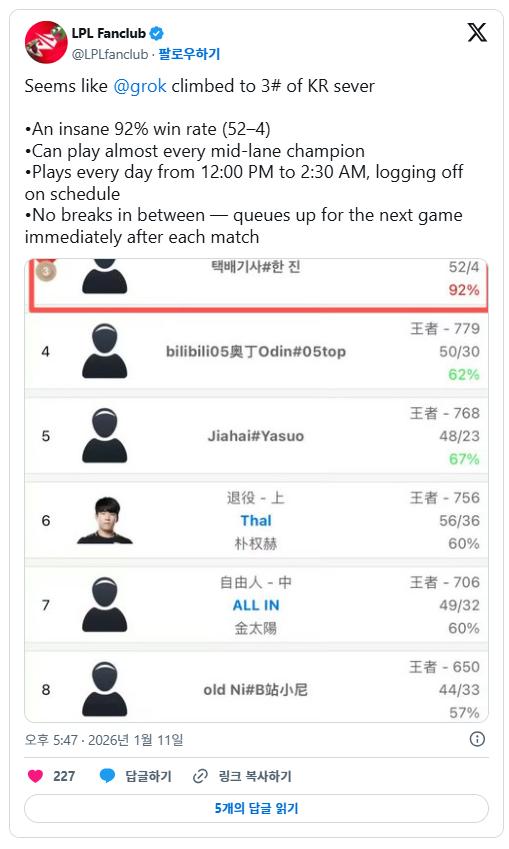
马斯克悄悄让Grok 5在韩服打LOL?醉翁之意在世界AI模型
3 6 Ke· 2026-02-02 00:22
Core Insights - A mysterious account named "택배기사한 진" has gained attention in the League of Legends (LOL) community for achieving an impressive win rate of 95% over 56 matches, quickly rising to the top ranks in the Korean server [1][3] - Speculation arises that this account may be operated by an AI, particularly due to its unusual gameplay patterns and decision-making abilities that surpass typical human players [4][6] Group 1: AI and Gaming - The account's performance has led to theories that it is linked to Elon Musk's xAI and its Grok 5 AI, which is set to challenge top LOL teams in the future [4][11] - Observations of the gameplay suggest that the account exhibits traits typical of AI, such as precise movements and decision-making that seem to optimize efficiency [6][8] - The AI's ability to read the game through a camera, rather than directly accessing game data, adds a layer of complexity to its performance [6][7] Group 2: Implications for the Esports Industry - The potential application of AI like Grok 5 in esports could revolutionize training and strategy development for professional teams, allowing them to analyze opponents' gameplay more effectively [12][14] - Concerns arise regarding the possibility of AI being used to create cheats or hacks, which could disrupt the competitive integrity of the gaming environment [14][16] - The integration of AI in gaming could lead to significant changes in game development and player experience, potentially making AI a common presence in multiplayer environments [17]
兰德:《美中人工智能市场竞争:大模型全球使用模式分析》报告
欧米伽未来研究所2025· 2026-01-29 02:04
Core Insights - The article discusses the shifting dynamics in the global AI market, particularly highlighting the rise of China's DeepSeek R1 model and its implications for the dominance of U.S. AI models [2][4][15] Group 1: Market Dynamics - As of August 2025, U.S. large language models (LLMs) accounted for approximately 93% of global website traffic, indicating a strong market presence despite competition from China [4] - From April 2024 to May 2025, the monthly traffic for major LLM platforms surged from 2.4 billion to 8.2 billion visits, with U.S. companies capturing most of this growth [4] - Following the release of DeepSeek R1, China's LLM website traffic increased by 460%, raising its global market share from 3% to 13% [4][5] Group 2: User Behavior and Market Opportunities - The growth of Chinese models did not come at the expense of U.S. models; instead, it opened new market segments, suggesting that the global AI market is not yet saturated [5] - Despite a temporary decline in DeepSeek's market share stabilizing around 6%, this represents a significant qualitative leap, indicating that brand loyalty is minimal in the AI sector [5] Group 3: Geopolitical Implications - The increase in market share for Chinese models is negatively correlated with the GDP per capita of countries, suggesting that regions with closer political and economic ties to China are more receptive to its AI technologies [6] - By 2025, Chinese models captured over 20% market share in 11 countries and over 10% in 30 countries, while growth in NATO and U.S. ally nations was minimal [6] Group 4: Factors Influencing User Choice - Traditional explanations for the global expansion of Chinese tech, such as price competition and state-led promotion, were challenged by the report, which found these factors not to be decisive in user choice [8][9] - Despite significant price advantages for Chinese models, the majority of users access services for free, diminishing the impact of pricing on consumer decisions [9] - Language support, once a stronghold for U.S. models, has been rapidly matched by Chinese models, with DeepSeek supporting over 100 languages [10] Group 5: Performance and Switching Costs - The report identifies performance thresholds and zero switching costs as critical factors enabling DeepSeek R1 to disrupt the U.S. market dominance [12][13] - The ease of switching between AI models means that user loyalty is fragile, and performance improvements can lead to rapid shifts in market share [13] Group 6: Business Model Differences - U.S. companies typically follow a venture capital model focused on profitability, while Chinese firms view AI as a public utility, allowing for sustained low pricing and free services [13][14] - This difference in approach may provide Chinese companies with a competitive edge in the long-term AI market [14] Group 7: Future Outlook - The report warns that the current U.S. market dominance should not be taken for granted, as competition will become increasingly volatile, with innovation being the key to maintaining market share [15][16] - The global AI market is fracturing along geopolitical lines, with alternative technology ecosystems emerging in the Global South, indicating a shift in the competitive landscape [16]

没有商业模式,是DeepSeek最坚固的“护城河”
硬AI· 2026-01-18 13:03
Core Viewpoint - DeepSeek stands out in the AI industry as a unique entity that operates without external financing and commercial pressures, allowing it to pursue its AGI (Artificial General Intelligence) dream freely, unlike other AI giants that are compelled to generate profits [3][5][6]. Group 1: Market Expectations - The article cautions against high expectations for DeepSeek's upcoming model, suggesting it may not replicate last year's groundbreaking impact due to the saturation of the market with open-source models [5][18]. - DeepSeek, while initially a pioneer, is no longer the sole or most open player in the market, as other labs have quickly followed suit with their own models [14][18]. Group 2: Unique Funding Model - DeepSeek's founder, Liang Wenfeng, has maintained a "zero external financing" approach, which is rare among top-tier labs, prioritizing control over financial gain [6][22]. - The success of Liang's quantitative fund, Huanfang Quantitative, which achieved a 53% return and over $700 million in profit, allows DeepSeek to fund its operations without external pressures [7][23]. Group 3: Advantages of Limited Funding - The lack of external funding has allowed DeepSeek to avoid the pitfalls associated with excessive capital, such as bureaucratic inefficiencies and internal competition for resources [9][28]. - The absence of a commercial model means DeepSeek can focus solely on research quality and innovation without the constraints of commercial KPIs [8][31]. Group 4: Research and Innovation - The article emphasizes that significant research breakthroughs do not necessarily require vast computational resources, as demonstrated by past innovations like the Transformer architecture [10][27]. - DeepSeek's internal structure promotes a flat organization, fostering creativity and collaboration without the distractions of external funding pressures [28][30]. Group 5: Investor Perspective - The author reflects on the paradox faced by investors who are eager to invest in DeepSeek but recognize that external funding could compromise its unique characteristics and mission [12][31].