
中航重机

Search documents
从沙盘推演走向实际赔偿: 董责险穿越费率洼地
Zhong Guo Zheng Quan Bao - Zhong Zheng Wang· 2026-01-15 23:33
Core Viewpoint - The upcoming regulations on the management of company secretaries in listed companies aim to enhance risk awareness and governance quality, which is expected to increase the demand for Directors and Officers Liability Insurance (D&O insurance) in the A-share market [1][3]. Group 1: Regulatory Changes and Market Trends - New regulations for company secretaries are being drafted to improve their performance and risk awareness, which will likely stimulate the demand for D&O insurance [1][3]. - A report indicates that by the end of 2025, over 1,750 A-share listed companies are expected to disclose their D&O insurance purchase plans, reflecting a rapid increase in market penetration [2][3]. Group 2: Industry Insights and Growth - The manufacturing sector leads in the number of companies purchasing D&O insurance, particularly in the computer, communication, and electronic equipment manufacturing industries [3]. - The implementation of new securities and company laws has significantly contributed to the rising penetration of D&O insurance in the A-share market [3][4]. Group 3: Financial Aspects and Pricing - The average premium for D&O insurance remains low, with some policies having coverage limits exceeding 100 million yuan and premiums around 300,000 yuan [6][5]. - The average D&O insurance rate is currently below 0.5%, with expectations of an increase in rates due to rising litigation risks and more claims being reported [6][7]. Group 4: Future Outlook and Recommendations - The D&O insurance market is currently in a "soft cycle," characterized by an oversupply and low prices, but this is expected to change as more claims emerge [7][8]. - To enhance the D&O insurance market, it is recommended to establish mandatory disclosure of insurance details by listed companies and improve the understanding of D&O insurance's role in corporate governance [8][9].
从沙盘推演走向实际赔偿:董责险穿越费率洼地
Zhong Guo Zheng Quan Bao· 2026-01-15 20:48
Core Viewpoint - The introduction of new regulations for the supervision of company secretaries is expected to enhance risk awareness and catalyze the demand for directors and officers liability insurance (D&O insurance) among listed companies in China [1][3]. Group 1: D&O Insurance Market Trends - As of the end of 2025, over 1,750 A-share listed companies are expected to disclose their D&O insurance purchase plans, reflecting a rapid increase in penetration rates [2][3]. - In 2025, 643 A-share listed companies announced their D&O insurance plans, marking a 19% increase from the previous year [2]. - The manufacturing sector leads in the number of new D&O insurance policies, particularly in the computer, communication, and other electronic equipment manufacturing industries [2]. Group 2: Regulatory Impact - The implementation of the new Securities Law and Company Law has significantly driven the rapid increase in D&O insurance penetration in the A-share market [3]. - The upcoming regulations for company secretaries are expected to clarify responsibilities and enhance risk awareness, further stimulating the demand for D&O insurance [3][6]. Group 3: Pricing and Market Dynamics - The average D&O insurance premium is currently below 0.5%, with actual rates potentially being even lower due to increased competition among insurers [4][5]. - Factors influencing D&O insurance pricing include industry environment, company size, and individual risk profiles, leading to significant variations in rates among different companies [4][5]. - The market is currently in a "soft cycle," characterized by an oversupply of insurance capacity, which is expected to change as more claims are reported [5]. Group 4: Future Development and Challenges - For the D&O insurance market to mature, it is essential to address issues such as market misconceptions, lack of transparency in claims data, and irrational pricing competition [5][6]. - Recommendations include establishing mandatory disclosure of D&O insurance details by listed companies to enhance governance and risk management [5][6]. - The industry must focus on improving underwriting and pricing capabilities while educating stakeholders about the true value and limitations of D&O insurance [6].
国产航母概念下跌0.74%,主力资金净流出28股
Zheng Quan Shi Bao Wang· 2026-01-14 09:21
Group 1 - The domestic aircraft carrier concept index declined by 0.74%, ranking among the top declines in the concept sector, with notable declines in stocks such as Beidou Star, Sichuan Electronics, and Yinbang Shares [1] - Among the domestic aircraft carrier concept stocks, 10 stocks saw price increases, with Haige Communication, China First Heavy Industries, and AVIC Heavy Machinery leading the gains at 10.00%, 10.00%, and 5.85% respectively [1][2] - The domestic aircraft carrier concept experienced a net outflow of 2.947 billion yuan in main funds today, with 28 stocks seeing net outflows, and 7 stocks experiencing outflows exceeding 100 million yuan [2] Group 2 - The top net outflow stock in the domestic aircraft carrier concept was Haige Communication, with a net outflow of 1.434 billion yuan, followed by China Satellite, Yinbang Shares, and Hailanxin with net outflows of 612.8 million yuan, 442.9 million yuan, and 319.8 million yuan respectively [2][3] - The stocks with the highest net inflow in the domestic aircraft carrier concept included China First Heavy Industries, AVIC Heavy Machinery, and China Shipbuilding, with net inflows of 573.0 million yuan, 408.0 million yuan, and 6.1 million yuan respectively [2][3] - The stock performance of Haige Communication showed a significant increase of 10.00% despite the overall sector decline, indicating potential investor interest [3]


20万颗“星海”压境,刺激商业航天产业链,航空航天ETF(159227)单日成交额超12亿元
Mei Ri Jing Ji Xin Wen· 2026-01-14 06:57
Group 1 - The A-share market saw all three major indices rise collectively, with the aerospace sector experiencing a slight pullback, presenting a potential investment opportunity [1] - The Aerospace ETF (159227) recorded a decline of 0.39% with a trading volume of 1.207 billion yuan, while leading stocks such as Guobang Electronics and Steel Research High-tech showed significant gains [1] - The Aerospace ETF has attracted a net inflow of over 1.7 billion yuan over the past four trading days, bringing its total size to 3.717 billion yuan, maintaining its position as the largest in its category [1] Group 2 - China submitted an application to the International Telecommunication Union (ITU) for an additional 203,000 satellites, covering 14 satellite constellations, with CTC-1 and CTC-2 being the main contributors [1] - The increase in satellite applications is expected to stimulate demand for rockets and satellites, positively impacting the industry chain [1] - Guotai Junan Securities recommends focusing on leading companies in satellite manufacturing and rocket launching, particularly those with large-scale low-cost production capabilities [1] Group 3 - The Aerospace ETF closely tracks the Guozheng Aerospace Index, covering key sectors such as fighter jets, aircraft engines, rockets, missiles, satellites, and radars, aligning with the "integrated aerospace" strategic direction [2] - The ETF includes a high commercial aerospace content of 70.19%, with top holdings featuring industry leaders like Aerospace Development and China Satellite [2]
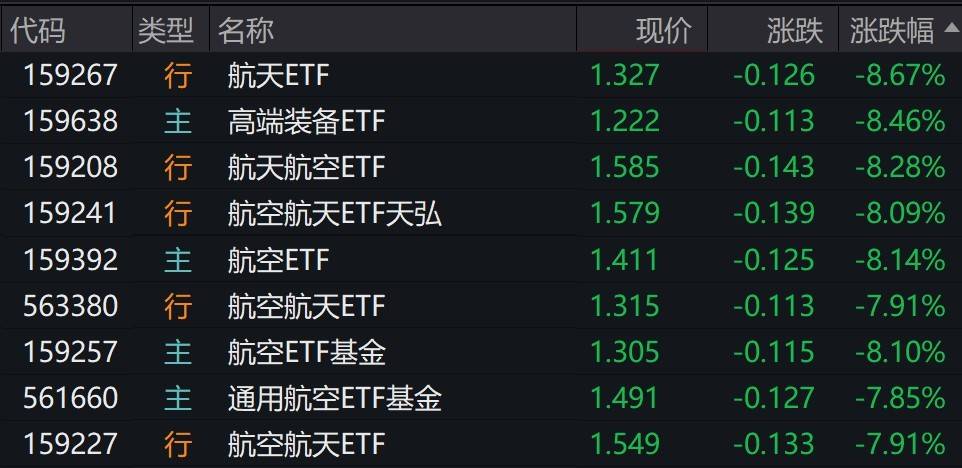
航天航空概念股早盘大幅调整,多只航天航空相关ETF跌超8%
Sou Hu Cai Jing· 2026-01-13 02:00
Group 1 - Aerospace and aviation concept stocks experienced significant declines in early trading, with Aerospace Electronics down over 8%, AVIC High-Tech down over 6%, and AVIC Heavy Machinery down over 5% [1] - Several aerospace-related ETFs also fell by more than 8%, reflecting the overall market trend [1] Group 2 - Specific ETFs reported the following price changes: Aerospace ETF (1.327, -8.67%), High-end Equipment ETF (1.222, -8.46%), Aerospace Aviation ETF (1.585, -8.28%), and others showing similar declines [2] - Analysts believe that recent improvements in top-level design and new policy support in the commercial aerospace sector have clarified the development blueprint for the industry, enhancing market confidence in its long-term growth [2] - With decreasing launch costs and increased in-orbit computing power, the future of space computing is expected to create a "more launches, more savings" scenario, potentially leading to a transformative industrial change with scalable commercial value [2]


董责险走热:1700多家上市公司投保,理赔有多少?
经济观察报· 2026-01-08 12:16
Core Viewpoint - The implementation of the new Securities Law and the increase in civil liability cases have heightened the awareness and necessity of Directors and Officers Liability Insurance (D&O Insurance) among A-share listed companies, with the insurance coverage rate expected to rise from 12% in 2020 to 32% by 2025 [1][2]. Group 1: D&O Insurance Market Trends - By the end of 2025, the number of listed companies that purchased D&O Insurance reached 1,753, with a market penetration rate increasing from 28% in 2024 to 32% [2]. - In 2025, 643 A-share listed companies announced plans to purchase D&O Insurance, a year-on-year increase of 19% [5]. - The average D&O Insurance premium rate has decreased to below 0.05% by the end of 2025, indicating a "rate trough" in the market [15][16]. Group 2: Industry and Company Insights - The highest D&O Insurance penetration rates are found in the real estate and electricity sectors, exceeding 60%, reflecting a correlation between industry risk and insurance demand [6]. - Companies with assets over 50 billion yuan have a D&O Insurance purchase rate of 68%, significantly higher than the 20% rate for companies with assets below 2 billion yuan [6]. - Private enterprises account for nearly 60% of new D&O Insurance purchases in 2025, but state-owned enterprises have the highest penetration rates [7]. Group 3: Legal and Regulatory Impact - The new Securities Law and Company Law have established a legal foundation for the proliferation of D&O Insurance, with high-profile cases like the Kangmei Pharmaceutical scandal driving increased awareness and adoption [11]. - The number of companies facing administrative investigations has risen significantly since 2020, with 366 companies having received warning letters after previously purchasing D&O Insurance [11][12]. - The long-tail effect of D&O Insurance claims means that while regulatory scrutiny and potential lawsuits are increasing, large-scale payouts have not yet fully materialized [16].


国产航母概念涨4.70%,主力资金净流入这些股
Zheng Quan Shi Bao Wang· 2026-01-08 08:52
Core Viewpoint - The domestic aircraft carrier concept has seen a significant increase of 4.70%, leading the gains among concept sectors, with 33 stocks rising, including notable performers like Hailanxin, which hit a 20% limit up [1][2]. Group 1: Market Performance - The domestic aircraft carrier sector recorded a net inflow of 2.284 billion yuan, with 24 stocks experiencing net inflows, and 8 stocks exceeding 100 million yuan in net inflow [2]. - Hailanxin led the net inflow with 888.7 million yuan, followed by China Shipbuilding, AVIC Aircraft, and AVIC Xi'an Aircraft, with net inflows of 726 million yuan, 525 million yuan, and 281 million yuan respectively [2][3]. - The top gainers in the domestic aircraft carrier sector included Hailanxin (20%), China First Heavy Industries (10.07%), and AVIC Aircraft (9.99%) [1][3]. Group 2: Stock Performance - The stocks with the highest net inflow ratios included AVIC Heavy Industry (43.69%), China First Heavy Industries (38.62%), and Hailanxin (24.87%) [3]. - Other notable performers in terms of daily gains included AVIC Xi'an Aircraft (5.60%), China Shipbuilding (4.09%), and Taihao Technology (7.67%) [1][3]. - Conversely, stocks that experienced declines included Bowei Alloy (-1.04%), Zhenxin Technology (-0.31%), and Haohua Technology (-0.18%) [1][5].


董责险走热:1700多家上市公司投保,理赔有多少?
Xin Lang Cai Jing· 2026-01-08 08:08
Core Viewpoint - The increasing awareness of investor rights and the rise in civil compensation lawsuits have led to a significant growth in the purchase and payout of Directors and Officers Liability Insurance (D&O Insurance) among listed companies in China, with the market penetration rate rising from 28% in 2024 to 32% in 2025 [1][14]. Group 1: D&O Insurance Market Overview - As of December 31, 2025, a total of 1,753 listed companies had purchased D&O Insurance, marking a 16% increase from 1,509 companies in 2024 [3][15]. - The number of companies purchasing D&O Insurance in 2025 reached 643, a year-on-year increase of 19% [3][15]. - The average premium rate for D&O Insurance in the A-share market has decreased to below 0.05% by the end of 2025, indicating a "price trough" in the market [11][23]. Group 2: Industry and Sector Insights - The highest D&O Insurance penetration rates are found in the real estate, wholesale, and electricity sectors, all exceeding 60%, indicating a correlation between industry risk and insurance demand [4][16]. - Among different stock exchanges, the Shenzhen Main Board has the highest penetration rate at 44%, followed by the Shanghai Main Board at 37% and the Sci-Tech Innovation Board at 34% [4][16]. - Companies with assets over 50 billion yuan have a D&O Insurance purchase rate of 68%, significantly higher than the 20% rate for companies with assets below 2 billion yuan [4][16]. Group 3: Legal and Regulatory Context - The implementation of the new Securities Law and the increase in civil liability cases have heightened the risk exposure for directors and officers, leading to a greater focus on D&O Insurance among listed companies [7][19]. - The number of companies receiving warning letters and previously purchasing D&O Insurance has rapidly increased, totaling 366 over the past five years [20]. - The rise in administrative penalties and investigations has led to a significant increase in the number of lawsuits filed by investors, further driving the demand for D&O Insurance [2][21]. Group 4: Claims and Payouts - The total amount of claims paid out for D&O Insurance has exceeded 10 billion yuan, with 26 claims totaling 390 million yuan in 2024 and 13 claims totaling 89.47 million yuan in the first three quarters of 2025 [10][21]. - The case of Jintongling, which resulted in a court ruling for compensation of 775 million yuan to investors, highlights the potential for significant payouts under D&O Insurance [6][18]. - The long-tail effect of D&O Insurance claims means that while regulatory scrutiny and potential claims are increasing, large-scale payouts have not yet fully impacted insurance companies' financial statements [12][24].
中航重机涨2.25%,成交额2.47亿元,主力资金净流入7.50万元
Xin Lang Cai Jing· 2026-01-08 02:06
Group 1 - The core viewpoint of the news is that AVIC Heavy Machinery has shown a positive stock performance with a 2.25% increase on January 8, 2023, reaching a price of 19.53 yuan per share, with a total market capitalization of 30.536 billion yuan [1] - As of September 30, 2025, AVIC Heavy Machinery reported a revenue of 7.776 billion yuan, representing a year-on-year growth of 3.35%, while the net profit attributable to shareholders decreased by 39.21% to 616 million yuan [2] - The company has distributed a total of 1.462 billion yuan in dividends since its A-share listing, with 833 million yuan distributed over the past three years [3] Group 2 - The main business segments of AVIC Heavy Machinery include forging and casting (83.02% of revenue), hydraulic control systems (17.08%), and other activities (0.59%) [1] - The company is classified under the defense and military industry, specifically in the aviation equipment sector, and is associated with concepts such as large aircraft, Airbus, military-civil integration, aerospace military industry, and commercial aerospace [1] - As of September 30, 2025, the number of shareholders decreased by 6.02% to 98,200, while the average number of circulating shares per person increased by 12.33% to 15,816 shares [2]
中航重机:2024年度公司营业收入和利润下降的原因主要系公司重点型号客户对公司产品价格进行调整导致
Zheng Quan Ri Bao Zhi Sheng· 2026-01-07 13:41
Core Viewpoint - The company anticipates a decline in revenue and profit for the fiscal year 2024 due to price adjustments made by key customers on its products [1] Group 1: Revenue and Profit Outlook - The expected decrease in revenue and profit for 2024 is primarily attributed to adjustments in product pricing by major clients [1] Group 2: Future Strategies - In 2025, the company plans to implement measures such as optimizing product structure, enhancing technical processes, improving intelligent production capabilities, and reducing operational costs to promote quality improvement and efficiency [1]