宝洁公司

Search documents
从米兰巨幅广告到快闪店,冬奥迎来史上最多中国顶级赞助商
第一财经· 2026-02-15 01:23
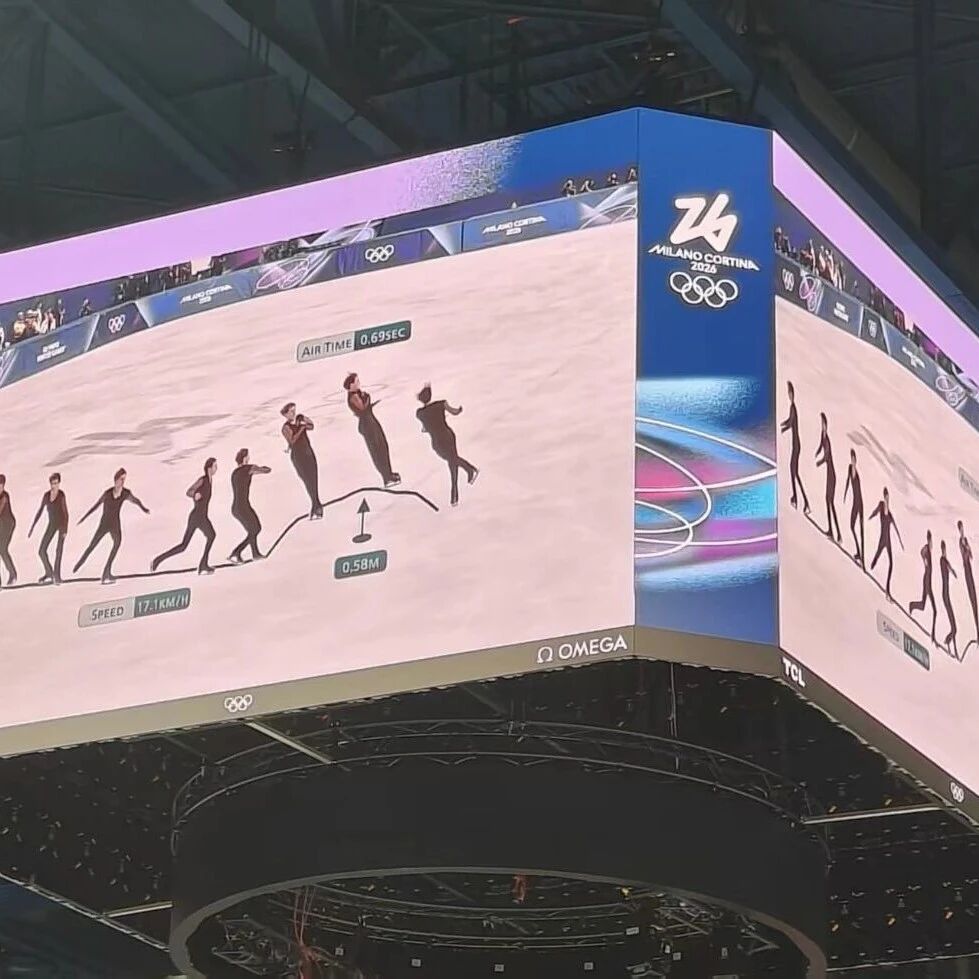
Core Viewpoint - The article highlights the significant presence and impact of Chinese brands as TOP sponsors at the Milan-Cortina Winter Olympics, showcasing the evolving landscape of sports marketing and sponsorship dynamics in the context of global sporting events [5][15]. Group 1: Sponsorship Landscape - The Milan-Cortina Winter Olympics features a record number of Chinese brands as TOP sponsors, with TCL, Alibaba, and Mengniu participating, marking the highest representation of Chinese sponsors in Olympic history [5][15]. - The TOP sponsorship program is crucial for the financial support of the Olympics, with companies paying over $300 million per cycle, contributing significantly to the International Olympic Committee's revenue [12]. - The article notes that the TOP sponsorship program has seen a shift in participants, with traditional sponsors like Panasonic and Toyota exiting, while new entrants like TCL and Budweiser are filling the gaps [17][18]. Group 2: Marketing and Brand Visibility - Major sponsors have utilized prominent advertising spaces in Milan, with TCL securing the largest outdoor billboard, showcasing their products alongside Olympic themes [7][10]. - The presence of sponsors extends beyond advertising, as they provide services and products within the Olympic Village, enhancing the experience for athletes and staff [10][11]. - The article emphasizes the importance of sports marketing for brand recognition, with TCL's market share in Italy growing by approximately 50% due to their Olympic sponsorship efforts [20]. Group 3: Technological Integration - The integration of new technologies, such as AI and cloud services, is highlighted as a key trend among sponsors, enhancing the viewing experience and operational efficiency during the Olympics [18][20]. - Alibaba's AI assistant and TCL's advanced display technologies are examples of how sponsors are leveraging innovation to improve engagement and service delivery at the event [11][18]. Group 4: Economic Impact and Market Strategy - The article discusses the economic implications of the Olympics for sponsors, noting that brands are seeking to expand their global presence through strategic marketing initiatives tied to the event [20]. - Companies like TCL are adapting their strategies to local market conditions in Italy, recognizing the diverse economic landscape and competitive environment [20].




FSTA Offers Lower Fees While RSPS Pays Higher Dividends
Yahoo Finance· 2026-02-14 23:26
Core Insights - The Fidelity MSCI Consumer Staples Index ETF (FSTA) and Invesco S&P 500 Equal Weight Consumer Staples ETF (RSPS) differ significantly in cost and portfolio concentration, with RSPS employing an equal-weight strategy and FSTA focusing on larger sector leaders [1][2] Cost & Size Comparison - FSTA has a lower expense ratio of 0.08% compared to RSPS's 0.40%, making it more cost-effective for investors [3][4] - As of February 13, 2026, FSTA has a one-year return of 10.7% while RSPS has a return of 14.9% [3] - FSTA's assets under management (AUM) stand at $1.4 billion, significantly higher than RSPS's $264 million [3] Performance & Risk Comparison - Over five years, FSTA has a max drawdown of 16.6%, which is less severe than RSPS's 18.6% [5] - An investment of $1,000 in FSTA would grow to $1,584 over five years, compared to $1,245 for RSPS [5] Portfolio Composition - FSTA tracks the MSCI USA IMI Consumer Staples Index and holds 97 stocks, with a heavy concentration in large companies like Walmart, Costco, and Procter & Gamble, which together account for over one-third of its assets [6] - RSPS equally weights 38 stocks, reducing concentration risk, with top holdings including Bunge Global SA, Colgate-Palmolive, and Church & Dwight, each around 3% of the portfolio [7] Investment Implications - Both ETFs provide defensive exposure to consumer staples, which are essential goods that consumers purchase regularly, making them attractive during market volatility [8] - FSTA's lower fees can lead to significant savings for investors over the long term, especially when compounded over a decade [9]
FSTA vs. VDC: Which Popular Consumer Staples ETF Is the Better Buy for Investors?
The Motley Fool· 2026-02-14 23:19
Core Insights - The Vanguard Consumer Staples ETF (VDC) and the Fidelity MSCI Consumer Staples Index ETF (FSTA) are designed to capture the performance of the U.S. consumer staples sector, focusing on essential goods [1][2] Cost & Size Comparison - VDC has an expense ratio of 0.09% while FSTA has a slightly lower expense ratio of 0.08% - The one-year return for VDC is 8.45% compared to FSTA's 8.16% - VDC offers a dividend yield of 2.10%, while FSTA provides a marginally higher yield of 2.18% - VDC has assets under management (AUM) of $9.1 billion, significantly larger than FSTA's $1.4 billion [3][9] Performance & Risk Comparison - Both ETFs have experienced similar maximum drawdowns over five years, with VDC at -16.56% and FSTA at -16.57% - The growth of $1,000 over five years is nearly identical, with VDC growing to $1,409 and FSTA to $1,406 [4][7] Portfolio Composition - FSTA tracks the MSCI USA IMI Consumer Staples 25/50 Index and holds 96 stocks, with major positions in Costco Wholesale, Walmart, and Procter & Gamble [5] - VDC invests in 105 holdings, also featuring Walmart, Costco Wholesale, and Procter & Gamble among its top stocks [6][7] Investor Implications - VDC and FSTA are nearly identical in performance, volatility, and portfolio composition, with only minor differences in AUM, expense ratios, and dividend yields [7][8]



RSPS and XLP Offer Distinct Approaches to the Consumer Staples Sector. Which Is the Better Buy?
Yahoo Finance· 2026-02-14 22:46
Core Insights - The State Street Consumer Staples Select Sector SPDR ETF (XLP) and the Invesco S&P 500 Equal Weight Consumer Staples ETF (RSPS) target the U.S. consumer staples sector but utilize different portfolio construction methods [1] Cost & Size Comparison - XLP has a lower expense ratio of 0.08% compared to RSPS's 0.40% - As of February 14, 2026, XLP's 1-year return is 9.94%, while RSPS's is higher at 11.75% - Both funds have similar dividend yields, with XLP at 2.56% and RSPS at 2.63% - XLP has an Assets Under Management (AUM) of $16 billion, significantly larger than RSPS's $250 million [2][3] Performance & Risk Analysis - Over a 5-year period, XLP experienced a maximum drawdown of -16.32%, while RSPS had a higher drawdown of -18.61% - An investment of $1,000 in XLP would grow to $1,363 over 5 years, compared to $1,095 for RSPS [4] Portfolio Composition - RSPS employs an equal-weight strategy across its 36 holdings, rebalancing quarterly, which allows smaller companies to have a similar influence as larger ones - XLP follows a market-cap-weighted index, leading to a portfolio dominated by larger companies like Walmart, Costco Wholesale, and Procter & Gamble [5][6] Implications for Investors - The different strategies of XLP and RSPS may appeal to various investor preferences - RSPS's equal-weighted approach limits single-stock risk by giving each holding roughly the same allocation, while XLP's market-cap weighting results in larger companies having a greater impact on performance [7][8]
Proctor (PG)’s a Machine Despite Slow Growth, Says Jim Cramer
Yahoo Finance· 2026-02-14 17:44
Core Viewpoint - The Procter & Gamble Company (NYSE:PG) is experiencing mixed performance, with a 6% decline in shares over the past year but a 13% increase year-to-date, indicating volatility in its stock performance amidst challenging market conditions [2]. Group 1: Stock Performance and Analyst Ratings - Procter & Gamble's shares are down by 6% over the past year and up by 13% year-to-date [2]. - Berenberg Bank set a price target of $156 and maintained a Hold rating, while TD Cowen downgraded the shares to Hold from Buy and raised the price target to $156 from $150 [2]. - UBS cut the price target to $161 from $176 but kept a Buy rating, indicating a belief in potential improvement in fundamentals despite a tough operating environment [2]. Group 2: Organic Sales Growth - TD Cowen noted that Procter & Gamble's organic sales growth could accelerate sluggishly, with optimism based on the belief that growth had bottomed out at 0% last year [2]. - Jim Cramer highlighted the contrast between Procter & Gamble's poor organic growth and its stock performance, referring to the company as a "machine" despite the slow growth [3].
多家国际知名企业宣布参加第六届消博会
Xin Lang Cai Jing· 2026-02-14 10:21
Group 1 - The sixth China International Consumer Products Expo (CICPE) will be held from April 13 to 18, 2024, at the Hainan International Convention and Exhibition Center, with several international companies confirming their participation [1] - Volkswagen Group will showcase multiple brands including Volkswagen, Bentley, Lamborghini, and Audi, aiming to deepen connections with Chinese consumers and expand its market presence [1] - L'Oréal Group, a leading global beauty company, has confirmed its participation, focusing on enhancing interactions with the Chinese market and exploring innovative retail models [3] Group 2 - OSIM, a high-end health lifestyle brand from Singapore, will participate for the sixth consecutive year, highlighting its deep connection with Chinese consumers and the importance of the Chinese market for its global development [3] - SK-II, a premium skincare brand under Procter & Gamble, will debut as an independent exhibitor at the expo, emphasizing its commitment to the Chinese market and the demand for high-end skincare solutions [4] - The CICPE is recognized as the largest consumer goods exhibition in the Asia-Pacific region, providing a significant platform for brands to showcase their strengths and enhance market communication [4]

击壤科技:2025年家清个护行业投放趋势分析报告
Sou Hu Cai Jing· 2026-02-14 02:43
Group 1: Core Insights - The 2025 home cleaning and personal care industry is experiencing structural adjustments in advertising investments across three main channels: TV commercials, variety shows, and web dramas, with notable changes in brand numbers and investment volumes [1][2] - The industry shows a strong trend towards brand fluidity, with hair care and skin care categories becoming the core of advertising investments and brand movements [1][2] Group 2: TV Commercials - The number of brands and advertising duration in the TV commercial sector has decreased, with a significant drop of 35.8% in prime time advertising duration, which is highly concentrated in other satellite channels, accounting for 73.3% [6][12] - CCTV-17 leads in client numbers, although many clients have small advertising volumes; CCTV-12 has seen a growth in advertising duration by 36.7% with top brands increasing their investments [18][21] - A total of 385 new brands entered the market while 454 brands exited, with new brands primarily focusing on satellite channels and exiting brands shifting towards variety shows and web dramas [1][24] Group 3: Variety Show Investments - In the variety show segment, both electric and web variety shows show a preference for new programs, with 69.7% of electric variety show clients being new programs, and web variety shows surpassing traditional formats for the first time with 55.6% [2][30] - Electric variety shows featured 33 brands across 20 programs, with Hunan TV leading in client numbers; store operation programs have become popular for their scene compatibility [30][34] - Web variety shows had 41 brands across 39 programs, with Mango TV leading in client numbers; new brands are primarily in the skin care category, while exiting brands are moving towards web dramas and TV commercials [2][30] Group 4: Web Drama Investments - The web drama sector saw 50 brands investing in 168 series, with Youku leading in client numbers; 98% of brands opted for self-promotion rights on platforms, while in-drama placements decreased [2][30] - Hair care brands dominate web drama investments, with brands like Safeguard and Head & Shoulders leading in the number of series invested [2][30] - The industry experienced the addition of 27 new clients and the loss of 35 clients, with skin care and hair/body wash categories showing the highest fluidity [2][30] Group 5: Overall Industry Trends - The 2025 home cleaning and personal care industry is increasingly focused on scene compatibility and channel precision, with leading brands maintaining advertising advantages while smaller brands frequently shift between channels [1][2]



超3600亿元,欧莱雅业绩创新高
3 6 Ke· 2026-02-13 13:01
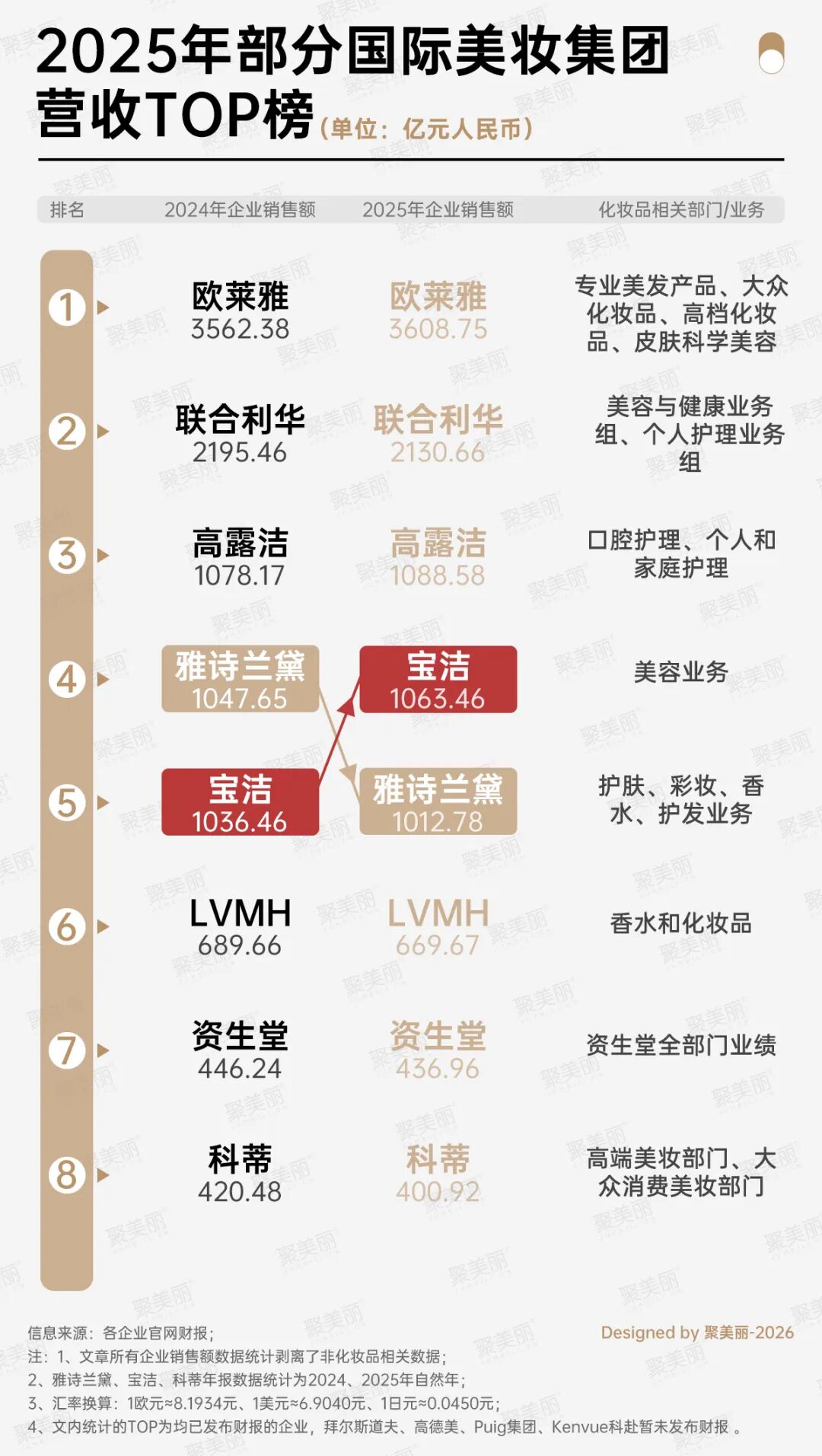
Core Insights - L'Oréal remains the top player in the global beauty market, with stable rankings among major beauty groups, while only Estée Lauder and Procter & Gamble have seen changes in their positions [1] Financial Performance - In 2025, L'Oréal reported total sales of €44.05 billion (approximately ¥360.88 billion), reflecting a year-on-year growth of 4% and a consolidated growth of 1.3% [4] - Operating profit reached €8.89 billion (approximately ¥728.97 billion), marking a 2.4% increase from the previous year [4] - The North Asia region, which includes China, generated €10.08 billion (approximately ¥825.96 billion) in revenue, showing a 0.5% year-on-year growth despite a consolidated decline of 2.2% [4][14] Regional Performance - North Asia experienced a revenue decline, with the overall market environment remaining challenging, particularly in travel retail [14] - Europe remains L'Oréal's largest market, with sales of €14.86 billion (approximately ¥121.80 billion) and a consolidated growth of 4.6% [18] - North America and Latin America both saw a consolidated decline of 0.7%, with North America generating €11.72 billion (approximately ¥960.18 billion) in sales [20] - The SAPMENA-SSA market recorded the highest growth rate at 10.9%, with sales of €4.11 billion (approximately ¥337.02 billion) [23] Departmental Performance - The Professional Products division achieved sales of €5.16 billion (approximately ¥423.02 billion), with a growth rate of 5.7% [29] - The Consumer Products division reported sales of €16.09 billion (approximately ¥1318.31 billion), with a slight growth of 0.7% [31] - The Dermatological Beauty division's sales reached €7.20 billion (approximately ¥590.25 billion), with significant contributions from brands like La Roche-Posay [34] - The Luxury division, while experiencing the slowest growth, still maintained a strong operating profit of €3.49 billion (approximately ¥285.78 billion) [27] Market Trends - L'Oréal's growth has slowed, with a 1.3% increase in 2025 being the lowest in five years, indicating a shift to single-digit growth [5][7] - The company has noted a recovery in its two largest markets, the U.S. and China, with ongoing expansion in emerging markets [6] - The high-end cosmetics sector has seen continuous growth challenges, while the professional hair care segment led with a 5.7% growth [5][27] Strategic Focus - L'Oréal emphasizes the importance of the Chinese market in its global strategy, indicating a recovery phase with a return to growth [44] - The company faces challenges from local brands and changing consumer preferences, necessitating a focus on innovation and market adaptation [46][47]

This Broad Market ETF Never Cut Its Dividend in 25 Years
247Wallst· 2026-02-13 12:40
Core Viewpoint - The SPDR Portfolio S&P 1500 Composite Stock Market ETF (SPTM) has maintained a consistent dividend payout for 25 years, reflecting strong corporate profit growth and a focus on capital appreciation rather than high yield [1] Group 1: Dividend Performance - SPTM paid $0.933 in dividends for 2025, marking a 1.9% increase from $0.916 in 2024, showcasing the underlying growth in corporate profits across the U.S. market [1] - The fund has never cut its dividend in its 25-year history, maintaining uninterrupted quarterly payments even during market disruptions like in 2020 [1] Group 2: Fund Composition and Strategy - The ETF consists of 1,500 holdings, providing broad exposure to the U.S. market with an ultra-low expense ratio of 0.03% [1] - Major technology companies such as NVIDIA, Apple, and Microsoft account for 19% of the portfolio, emphasizing a growth-oriented strategy that prioritizes reinvestment over high yields [1] - Financial stability is supported by conservative payout practices from holdings like JPMorgan Chase, which retains most earnings while rewarding shareholders [1] Group 3: Total Return and Investment Perspective - SPTM achieved a return of 15.54% over the past year, outperforming the S&P 500's 14.31%, and has increased by 85.59% over five years, highlighting the effectiveness of combining modest yield with capital appreciation [1] - Investors focused solely on high yield may overlook SPTM, but those recognizing the value of diversification across profitable, growing businesses will appreciate the fund's stability and growth potential [1]

PureCycle Schedules Fourth Quarter and Fiscal Year Ending 2025 Corporate Update
Globenewswire· 2026-02-12 21:10
Core Insights - PureCycle Technologies, Inc. will host a conference call on February 26, 2026, to update on recent corporate developments and fourth quarter and fiscal year results ending December 31, 2025 [1][2] Group 1: Conference Call Details - The conference call is scheduled for 5:00 p.m. EST on February 26, 2026, and will include a live Q&A session for analysts [2][3] - Participants can access the call via a provided link and submit questions in advance through email [3] Group 2: Corporate Overview - PureCycle Technologies LLC, a subsidiary of PureCycle Technologies, Inc., holds a global license for a patented dissolution recycling technology developed by Procter & Gamble, aimed at transforming polypropylene plastic waste into a renewable resource [4] - The purification process results in PureFive™ resin, which can be recycled and reused multiple times, altering the relationship with plastic [4]