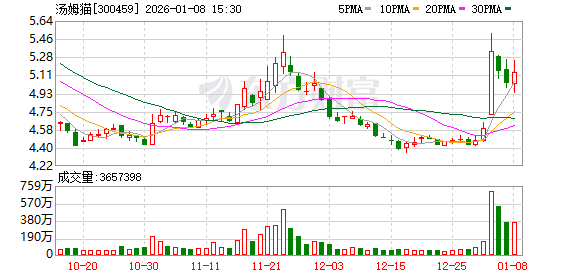
汤姆猫

Search documents
脑机接口概念股走强,爱朋医疗涨超9%
Ge Long Hui· 2026-01-12 06:37
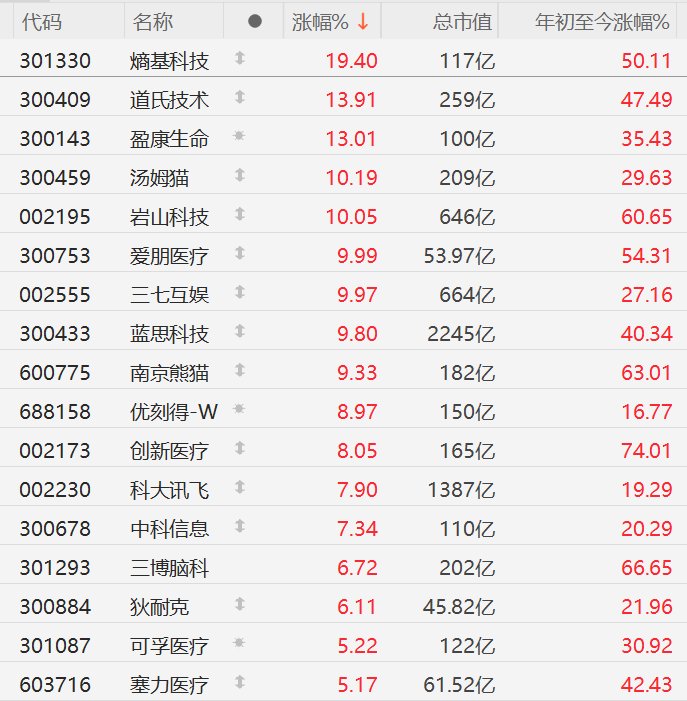
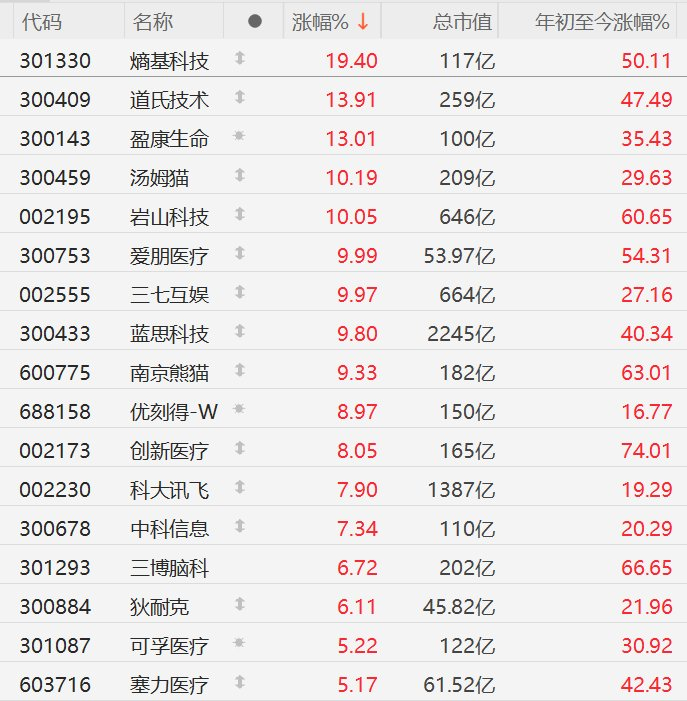
Group 1 - The A-share market saw a strong performance in brain-computer interface concept stocks, with several companies approaching or hitting their daily limit up [1] - Notable gainers included Entropy Technology, which approached a 20% limit up, and Dao's Technology and Yingkang Life, both rising over 13% [1] - Other significant performers included Tom Cat, which increased by over 10%, and Yanshan Technology, which hit a 10% limit up [1] Group 2 - The table lists various companies with their respective stock codes, percentage increase, total market capitalization, and year-to-date performance [2] - Entropy Technology (301330) had a 19.40% increase, with a market cap of 11.7 billion and a year-to-date increase of 50.11% [2] - Dao's Technology (300409) rose by 13.91%, with a market cap of 25.9 billion and a year-to-date increase of 47.49% [2] - Yingkang Life (300143) increased by 13.01%, with a market cap of 10 billion and a year-to-date increase of 35.43% [2] - Other companies like Tom Cat (300459) and Yanshan Technology (002195) also showed significant gains, with year-to-date increases of 29.63% and 60.65% respectively [2]






A股脑机接口概念股走强,爱朋医疗涨超9%
Ge Long Hui A P P· 2026-01-12 06:31
Core Viewpoint - The A-share market has seen a strong performance in brain-computer interface concept stocks, with several companies approaching or hitting their daily price limits [1] Group 1: Stock Performance - Entropy Technology (熵基科技) approached a 20% daily limit increase, with a rise of 19.40% and a market capitalization of 11.7 billion [2] - Dao's Technology (道氏技术) increased by 13.91%, reaching a market cap of 25.9 billion [2] - Yingkang Life (盈康生命) rose by 13.01%, with a market cap of 10 billion [2] - Tom Cat (汤姆猫) saw a 10.19% increase, with a market cap of 20.9 billion [2] - Rock Mountain Technology (岩山科技) hit a 10% daily limit increase, with a market cap of 64.6 billion [2] - Three Seven Entertainment (三七互娱) approached a 10% daily limit increase, with a rise of 9.97% and a market cap of 66.4 billion [2] - Other notable performers include Aipeng Medical (爱朋医疗) at 9.99%, Lens Technology (蓝思科技) at 9.80%, and Nanjing Panda (南京熊猫) at 9.33% [2] Group 2: Year-to-Date Performance - Entropy Technology has a year-to-date increase of 50.11% [2] - Dao's Technology has risen 47.49% year-to-date [2] - Yingkang Life has a year-to-date increase of 35.43% [2] - Tom Cat has increased by 29.63% year-to-date [2] - Rock Mountain Technology has a significant year-to-date increase of 60.65% [2] - Aipeng Medical has a year-to-date increase of 54.31% [2] - Nanjing Panda has a remarkable year-to-date increase of 63.01% [2] - Other companies like Innovation Medical (创新医疗) and Keda Xunfei (科大讯飞) have year-to-date increases of 74.01% and 19.29%, respectively [2]
脑机接口或步入规模量产阶段,机构称游戏作为重要应用场景,有望持续受益
Mei Ri Jing Ji Xin Wen· 2026-01-12 05:55
Group 1 - Shanghai Brain Tiger Technology launched China's first fully implanted, fully wireless brain-computer interface product, marking a significant breakthrough in core technology and positioning the country among the top international players [1] - The first paralyzed subject after surgery has shown good recovery, able to control electronic devices through thoughts for daily activities like watching videos and playing games [1] - Musk plans to mass-produce Neuralink brain-computer interface chips by 2026, with a streamlined and nearly fully automated surgical process for implantation [1] Group 2 - Hardware mass production and simplified implantation processes are expected to accelerate the maturity of various application scenarios in gaming and healthcare [1] - The development of brain-computer interfaces is anticipated to create new interactive experiences in gaming, fostering new growth points for the industry [1] - Gaming companies are actively investing in related fields, such as 37 Interactive Entertainment's investment in Strong Brain Technology, which is the first unicorn in China's brain-computer interface sector [1] - Century Huatong established a research center with Zhejiang University in 2020, focusing on emerging fields like brain-computer integration [1] - Talking Tom plans to collaborate with Zhejiang University and Ruijin Hospital in 2024 to advance research in brain-computer interfaces and digital game therapy [1] Group 3 - The gaming sector is experiencing multiple catalysts for transformation, including AI, content, and commercialization model changes [2] - The largest gaming ETF tracks the China Securities Animation and Gaming Index, reflecting the overall performance of A-share listed companies in the animation and gaming industry [2] - There are investment opportunities in gaming ETFs that should be monitored [2]
【明日主题前瞻】AI玩具从细分赛道跃升为主流消费新宠,未来市场规模或达千亿量级
Xin Lang Cai Jing· 2026-01-11 12:03
Group 1: AI Toys Market - The AI toy market is projected to exceed 100 billion yuan in 2023 and is expected to reach a scale of over 1 trillion yuan by 2030, with a compound annual growth rate (CAGR) exceeding 50% [2] - AI toys integrate artificial intelligence technologies such as dialogue models and emotional computing, evolving from simple interactions to deep companionship and emotional connections [2] - Companies like Tom Cat and Shifeng Culture are launching innovative AI toys that cater to various user demographics, including children, the elderly, and young adults [2] Group 2: Nuclear Fusion Research - Global nuclear fusion research has entered an engineering phase, indicating significant advancements in fusion energy technology [3] - The upcoming 2026 Nuclear Fusion Energy Technology and Industry Conference aims to promote collaboration and innovation within the nuclear fusion industry [3] - Companies involved in the nuclear fusion sector, such as Lianchuang Optoelectronics and Guokai Electronics, are focusing on key components and technologies necessary for fusion devices, which are expected to generate substantial orders [4][5] Group 3: AI in Healthcare - OpenAI has launched ChatGPT Health, targeting the rapidly growing AI healthcare market, which is projected to reach approximately 505.59 billion USD by 2033, with a CAGR of 38.8% [6] - Companies like Meinian Health and Weining Health are actively developing AI technologies for early disease screening and healthcare solutions, leveraging partnerships with tech giants [7] Group 4: Aerospace Industry in Guangzhou - Guangzhou aims to establish itself as a global hub for advanced manufacturing and commercial aerospace by 2035, focusing on satellite internet and reusable rocket technology [8] - Companies like Feiwo Technology are engaging in 3D printing for commercial aerospace engines, while investment firms are creating complete investment ecosystems in the aerospace sector [8] Group 5: Gaming Industry Trends - The gaming industry is experiencing a surge in new game launches and updates, which are expected to drive revenue growth [9] - AI is being integrated into gaming, enhancing production efficiency and creating new opportunities for innovation [9] Group 6: AI Programming - AI programming is becoming a core application of AI, with major tech companies increasingly relying on AI to generate new code [11] - Companies like Fabben Information and Keda Guokuan are developing AI tools to assist in programming, improving efficiency and code quality [12]
陪伴机器人,正在改写9亿人的孤独经济
机器人大讲堂· 2026-01-11 09:39
Core Insights - The article discusses the rise of companion robots, driven by the dual forces of emotional consumption and AI technology, transforming from toys to essential companions in various life scenarios [1][3]. Group 1: Market Demand - The "loneliness economy" is emerging, with 900 million people creating a strong demand for companionship. As basic needs are met, higher-level needs such as belonging and self-actualization are becoming central to consumption, with "emotional value" being key to product pricing [4][5]. - By 2025, the online market for AI toys in China is expected to surge by 394.9%, with emotional companionship products growing the fastest, increasing their market share from 7.0% to 15.7% [4]. Group 2: Target Demographics - Over 120 million young adults aged 18-35 live alone, showing a strong demand for anthropomorphic interaction products. Women aged 25-30 represent 72% of the consumer base for companion robots, willing to pay for aesthetics and empathy [7]. - The elderly population in China has reached 280 million, with over 50% being empty nesters. High-end companion robots are becoming essential in the elderly care market, despite their higher price points [7]. Group 3: Market Growth Projections - The global AI companionship market is projected to grow from $30 million to between $70 billion and $150 billion by 2030. The domestic market is expected to reach approximately $1 billion in 2024 and $3.86 billion by 2030, with a compound annual growth rate of 75% [9]. Group 4: Technological Advancements - The rise of companion robots is attributed to advancements in AI technology, enabling a shift from passive responses to active empathy. New generation robots can understand context, emotions, and subtleties in conversation, providing personalized interactions [10][11]. - Multi-modal sensors are being integrated into companion robots, allowing them to perceive voice, visual, tactile, and environmental cues, enhancing user interaction [14]. Group 5: Market Structure - The companion robot market is attracting three types of players: traditional toy manufacturers, tech startups, and IP holders, leading to differentiated competition [17]. - Traditional toy companies leverage established supply chains and IPs to transition into the AI space, while tech firms focus on high-end markets with advanced emotional interaction capabilities [19][21]. Group 6: Product Evolution - Companion robots are categorized into three price tiers: entry-level (100-500 RMB), mid-range (500-3000 RMB), and high-end (over 3000 RMB), catering to different user needs [26][28][30]. - Entry-level products focus on basic interactions and are popular among cost-conscious parents, while mid-range products are favored by urban professionals seeking emotional support [27][29]. Group 7: Future Trends - The market for companion robots is expected to transition from "conceptual popularity" to "demand-driven" growth, with four key trends: precision in emotional computing, deeper IP integration, diversified scene expansion, and service-oriented monetization models [31][34][35]. - Companies are exploring subscription services and dual revenue models to enhance profitability beyond single sales [36]. Group 8: Challenges and Opportunities - Despite the promising market outlook, challenges such as technology integration and safety risks remain prevalent. The industry must address issues related to data privacy and user dependency on technology [37][39]. - The reduction in computing costs and advancements in AI capabilities present significant opportunities for improving the cost-effectiveness of companion robots [40].
阿里云“杀入”AI硬件
财联社· 2026-01-10 10:25
Group 1 - The core viewpoint of the article emphasizes that major tech companies, including Alibaba Cloud, are aggressively entering the AI hardware market to capture the next generation of smart entry points and integrate "cloud-edge-end" solutions [3][31]. - Alibaba Cloud showcased its multi-modal interaction development kit at the AI hardware exhibition, integrating three foundational models for various AI hardware applications [3][4]. - The competition among tech giants in AI hardware is driven by the need to bridge the gap between cloud-based large models and physical applications, making AI hardware a crucial container for deploying these capabilities [3][31]. Group 2 - Various AI toys and robots powered by Alibaba's foundational models were prominently displayed at the exhibition, indicating a broad coverage of AI hardware categories [4][5]. - Companies like Ubiquiti and Shifeng Culture launched AI products that utilize Alibaba's models, showcasing capabilities such as emotional interaction and intelligent voice responses [5][7]. - The integration of Alibaba's models into products like AI glasses and smart toys highlights the trend towards creating emotionally engaging and interactive devices [11][19]. Group 3 - Alibaba Cloud's strategy involves collaborating closely with chip and module partners to enhance the capabilities of AI hardware, indicating a fragmented product landscape [26][25]. - The company is optimistic about the growth of smart hardware in 2026, predicting the emergence of new product categories beyond traditional devices [26]. - The exploration of embodied intelligence through multi-modal interaction and VLA models is a key focus for Alibaba Cloud, with expectations for significant advancements in the coming years [28][29]. Group 4 - The article discusses the parallel development of GUI and A2A paradigms in AI, with Alibaba Cloud actively engaging in both areas [29][30]. - The future of AI hardware is expected to shift from passive responses to proactive services, driven by advancements in multi-modal perception and agent memory technologies [32][31]. - The industry faces challenges in aligning user expectations with actual experiences, particularly in the AI toy sector, where high return rates indicate unmet consumer demands [31][32].

脑机接口概念下跌0.29%,10股主力资金净流出超亿元
Zheng Quan Shi Bao Wang· 2026-01-09 08:31
Group 1 - The brain-computer interface sector experienced a decline of 0.29%, ranking among the top losers in concept sectors, with notable declines from companies like Meihao Medical, Puni Testing, and Aipeng Medical [1] - Among the 32 stocks that rose, BGI Genomics, Innovation Medical, and Donghong Technology led with increases of 10.21%, 10.00%, and 6.94% respectively [1] - The brain-computer interface sector saw a net outflow of 7.63 billion yuan, with 54 stocks experiencing net outflows, and 10 stocks seeing outflows exceeding 100 million yuan [2] Group 2 - The top net outflow stock was Yanshan Technology, with a net outflow of 3.50 billion yuan, followed by Puli Te, Haige Communication, and Nanjing Panda, each with net outflows of 1.22 billion yuan [2] - The stocks with the highest net inflows included iFlytek, Century Huatong, and Tom Cat, with net inflows of 536 million yuan, 390 million yuan, and 209 million yuan respectively [2] - The brain-computer interface sector's outflow list included Yanshan Technology, Puli Te, and Haige Communication, with respective declines of 0.29%, 2.65%, and 1.53% [3][4]



汤姆猫股价涨5.26%,南方基金旗下1只基金位居十大流通股东,持有3216.02万股浮盈赚取868.33万元
Xin Lang Cai Jing· 2026-01-09 06:58
Group 1 - Tom Cat's stock price increased by 5.26%, reaching 5.40 CNY per share, with a trading volume of 2.407 billion CNY and a turnover rate of 13.98%, resulting in a total market capitalization of 18.985 billion CNY [1] - Zhejiang Jinke Tom Cat Cultural Industry Co., Ltd. is located in Hangzhou, Zhejiang Province, and was established on June 12, 2007, with its listing date on May 15, 2015. The company's main business involves the mobile internet cultural industry [1] - The revenue composition of Tom Cat includes: advertising business 72.41%, new commercial services 11.19%, mobile application distribution income 10.70%, other 2.64%, licensing business 2.34%, and other (supplementary) 0.72% [1] Group 2 - Southern Fund's Southern CSI 1000 ETF (512100) is among the top ten circulating shareholders of Tom Cat, having reduced its holdings by 312,300 shares in the third quarter, now holding 32.1602 million shares, which is 0.98% of the circulating shares [2] - The Southern CSI 1000 ETF (512100) was established on September 29, 2016, with a latest scale of 76.63 billion CNY. Year-to-date return is 4.96%, ranking 1463 out of 5509 in its category; the one-year return is 42.74%, ranking 1657 out of 4198; and since inception, the return is 20.03% [2]

汤姆猫涨2.14%,成交额9.91亿元,主力资金净流入479.47万元
Xin Lang Cai Jing· 2026-01-09 03:20
Core Viewpoint - Tom Cat's stock has shown a significant increase in price and trading volume, indicating positive market sentiment despite a decline in revenue and profit for the year [1][2]. Group 1: Stock Performance - On January 9, Tom Cat's stock rose by 2.14%, reaching a price of 5.24 CNY per share, with a trading volume of 9.91 billion CNY and a turnover rate of 5.84%, resulting in a total market capitalization of 184.23 billion CNY [1]. - Year-to-date, Tom Cat's stock price has increased by 14.16%, with a 14.16% rise over the last five trading days, 13.17% over the last 20 days, and 12.69% over the last 60 days [1]. Group 2: Financial Performance - For the period from January to September 2025, Tom Cat reported a revenue of 6.97 billion CNY, representing a year-on-year decrease of 19.77%, and a net profit attributable to shareholders of -439.398 million CNY, a decline of 152.61% compared to the previous year [2]. - Since its A-share listing, Tom Cat has distributed a total of 248 million CNY in dividends, with no dividends paid in the last three years [3]. Group 3: Shareholder Information - As of October 31, 2025, the number of shareholders for Tom Cat stood at 235,500, with an average of 13,956 shares held per shareholder, showing no change from the previous period [2]. - Among the top ten circulating shareholders, Hong Kong Central Clearing Limited is the third-largest, holding 32.7415 million shares, an increase of 6.5361 million shares from the previous period [3].
汤姆猫:在AI业务上,公司目前暂未与华为开展合作
Mei Ri Jing Ji Xin Wen· 2026-01-08 13:56
Group 1 - The core point of the article is that Tom Cat (汤姆猫) has not established any cooperation with Huawei regarding AI business despite inquiries from investors [2][3] Group 2 - Investors are interested in potential collaboration between Tom Cat and Huawei following the launch of Huawei's AI toy, "Huawei Hanhai" [2] - Tom Cat's response indicates a current lack of partnership with Huawei in the AI sector [2]