Stability AI

Search documents
Anthropic与Meta的“合理使用”裁决对比:美国48小时内的AI版权司法裂痕
3 6 Ke· 2025-07-08 00:03
Core Viewpoint - The recent rulings by the U.S. District Court regarding the use of copyrighted works for training generative AI models have highlighted the complexities and contradictions in the legal interpretation of "fair use" in the context of artificial intelligence, indicating that further clarification is needed in this area [1][2]. Group 1: Rulings Overview - The first ruling in the case Bartz v. Anthropic found that the use of copyrighted works for AI training could be considered transformative, favoring the defendant [2][3]. - The second ruling in Kadrey v. Meta also concluded that Meta's use of copyrighted materials for AI training was fair use, but the reasoning and implications differed significantly from the Anthropic case [2][3][4]. Group 2: Legal Analysis - Both judges recognized the use of copyrighted works for AI training as transformative, but their analyses lacked a discussion of the actual legal standards for determining transformative use [3][4]. - The judges acknowledged that the value of the copyrighted works lies in their creative expression, rejecting claims that only functional elements were used [5][6]. Group 3: Market Impact Considerations - The fourth fair use factor, concerning the impact on actual and potential markets, was minimally addressed in both rulings, with judges concluding that no market harm existed due to the lack of a legal market for AI training [7][8]. - The judges overlooked the existence of a burgeoning market for licensing AI training materials, which could challenge their conclusions regarding market harm [7][8]. Group 4: Specificity of Rulings - Both rulings were explicitly narrow, limited to the specific facts of the cases, suggesting that they may not adversely affect other ongoing cases with different circumstances [8][9]. - Judge Chhabria emphasized that the ruling does not imply that using copyrighted materials for AI training is automatically legal, highlighting the need for proper arguments from plaintiffs [8][9]. Group 5: Divergence in Judicial Reasoning - A significant point of contention between the judges was the comparison of AI training to human learning, with Judge Alsup favoring this analogy while Judge Chhabria criticized it as inappropriate [9][10]. - Judge Chhabria provided a more nuanced discussion on the potential market dilution caused by generative AI, recognizing the unique challenges posed by AI technologies to traditional copyright incentives [11][12]. Group 6: Use of Pirated Materials - The rulings differed on the treatment of pirated materials, with Judge Chhabria allowing Meta's use of works from shadow libraries under certain conditions, while Judge Alsup ruled that such use disqualified Anthropic from claiming fair use [13][14]. - Judge Alsup's interpretation emphasized that the use of pirated works, regardless of the intended transformative purpose, constituted an irreparable infringement [14].

在湍流中寻找航向
Hua Xia Shi Bao· 2025-07-07 13:26
Group 1 - The rapid development of artificial intelligence is reshaping the global economic landscape, creating both opportunities and challenges for businesses [2][7] - The concept of "pulsation speed" is introduced as a key to understanding current business dynamics, emphasizing the need for flexibility and foresight over scale in fast-paced industries [4][5] - The book highlights the transition of supply chain design from a cost center to a strategic asset, showcasing examples from companies like Dell and Chrysler [5][6] Group 2 - The notion that all competitive advantages are temporary challenges traditional strategic theories, as illustrated by Kodak's failure to adapt to digital trends despite having the necessary technology [3][8] - The emergence of AI technologies has accelerated the pace of change, leading to a state of "hyper-competition" where competitive advantages can diminish within days [8][9] - The book provides actionable frameworks for businesses to navigate the evolving landscape, emphasizing the importance of adapting to change rather than relying on static barriers [9][10]

山东:首个钙钛矿多技术应用、多场景融合示范项目投运;Cassio 330量产型电动混合动力飞机即将起飞丨智能制造日报
创业邦· 2025-07-01 05:44
Group 1 - Kede CNC, Shenyang Aircraft Industry Group, and AVIC Shenfei have signed a cooperation agreement to establish China's first pilot test base for large aircraft structural components based on domestically produced high-end five-axis CNC equipment, focusing on precision processing of complex structural parts for C919 and C929 aircraft [1] - A distributed photovoltaic demonstration project using perovskite technology has been launched in Qingdao, Shandong, marking the province's first multi-technology application and multi-scenario integration project, with a direct current installed capacity of 115 kWp [2] - Eleven automotive and technology companies, including Volkswagen, BMW, and Mercedes-Benz, have signed a memorandum of understanding to jointly develop and share an advanced automotive software platform to counter the growing dominance of the U.S. in technology [3] Group 2 - VoltAero showcased the Cassio 330 production model electric hybrid aircraft at the Paris Air Show, designed for low-cost operations with a 440 horsepower (330 kW) hybrid propulsion system, capable of operating on runways shorter than 1,800 feet (approximately 548.64 meters) [4]
AI一字不差背诵《哈利·波特》,居然不算盗版?地表最强法务迪士尼这次遇到对手了
3 6 Ke· 2025-06-30 11:25
Core Viewpoint - The ongoing legal battles surrounding AI companies and copyright issues highlight the complexities of using copyrighted material for training models, raising questions about what constitutes "fair use" and the potential implications for the industry [5][8][10]. Group 1: Legal Cases and Outcomes - Disney has filed a lawsuit against Midjourney for allegedly using its intellectual property without permission, specifically referencing "Star Wars" and "Minions" [1]. - Getty Images has taken legal action against Stability AI for using millions of copyrighted images without authorization, with AI-generated images still bearing the original watermark [4]. - Recent court rulings in favor of AI companies like Anthropic and Meta suggest a legal precedent for using copyrighted material for training AI, but the judges' comments indicate that the issue is far from settled [5][6]. Group 2: Implications for AI Companies - The rulings may provide temporary relief for large AI companies, allowing them to negotiate licensing agreements with media and publishing entities, thus transforming copyright issues into calculable business costs [10]. - Smaller AI companies that rely on open-source data may face significant challenges, as they lack the financial resources to pay for licensing fees and could be disproportionately affected by future copyright enforcement [10][11]. Group 3: Concerns Over AI Outputs - There are growing concerns about whether the outputs generated by AI, particularly if they closely resemble copyrighted works, could lead to further legal challenges [8][10]. - A study revealed that Meta's model retained over 40% of the original text from "Harry Potter and the Sorcerer's Stone," raising alarms about potential copyright infringement [8][10]. Group 4: Future of Copyright and AI - The legal landscape surrounding AI and copyright is evolving, with the potential for ongoing negotiations and litigation as the industry adapts to new regulations and market conditions [11].
全国首个脑机接口未来产业集聚区“脑智天地”启动建设;特斯拉北美首座磷酸铁锂电池工厂即将完工丨智能制造日报
创业邦· 2025-06-30 02:58
Group 1 - Tesla's first lithium iron phosphate battery factory in North America is nearing completion, located in Nevada, with patents and expert collaborations announced to optimize performance, highlighting the advantages and application prospects of lithium iron phosphate batteries [1] - Star Dynamics' founder Chen Jianyu announced that over 200 units of their humanoid robots have been shipped this year, with 9 out of the top 10 global tech companies as clients, focusing on general-purpose humanoid robots and robotic brains [1] - The Trump Group's T1 smartphone, initially marketed as "Made in America," has been found to be produced by a Chinese company, leading to the removal of the "American-made" label from its sales website [1] Group 2 - The construction of China's first brain-computer interface industrial cluster, "Brain Intelligence World," has commenced in Shanghai, with multiple agreements signed for collaboration and the launch of supportive policies and initiatives, including a clinical trial laboratory and an innovation consortium [1]


无3C标识的相机电池能否上飞机?上海机场回应;雷克萨斯新能源项目在上海市金山区正式开工丨智能制造日报
创业邦· 2025-06-28 03:18
Group 1 - The Shanghai Airport has clarified that from June 28, travelers are prohibited from carrying power banks without 3C certification, but this restriction does not apply to camera batteries, which will follow previous regulations [1] - Lexus has officially commenced construction of its new energy project in Jinshan District, Shanghai, with an expected completion date in August 2026 and an annual production capacity of 100,000 units [1] - The Dutch government and Groningen province plan to invest €200 million to build an artificial intelligence factory, which is expected to be operational by 2026 [1] Group 2 - Li Auto has announced a new organizational structure, merging its R&D and sales groups into a new "Smart Vehicle Group," with President Ma Donghui leading the group and reporting to CEO Li Xiang, who will focus more on AI initiatives [1]

英国研发新型机器人皮肤;广汽印尼智慧工厂投产,产能将逐步扩至5万台丨智能制造日报
创业邦· 2025-06-22 03:01
Group 1 - The UK has developed a new type of robotic skin made from soft and low-cost gel material, capable of sensing pressure and temperature, and distinguishing multiple contact points, which can be applied in various industries including humanoid robots and disaster rescue [1] - GAC Group's smart factory in Indonesia has officially commenced production, starting with a capacity of 20,000 units and plans to gradually expand to 50,000 units, covering both pure electric and hybrid platforms [1] - Meta has launched a new smart glasses model, Oakley Meta HSTN, starting at a price of $399, designed to enhance visibility for athletes under changing light and weather conditions [1] - Lantu's FREE+ model has rolled off the production line and will begin pre-sales on June 24, with a reported cumulative sales of 46,075 units from January to May, marking an 85% year-on-year increase [1]

Disney, Universal sue AI firm for copyright infringement: ‘Bottomless pit of plagiarism'
New York Post· 2025-06-11 18:33
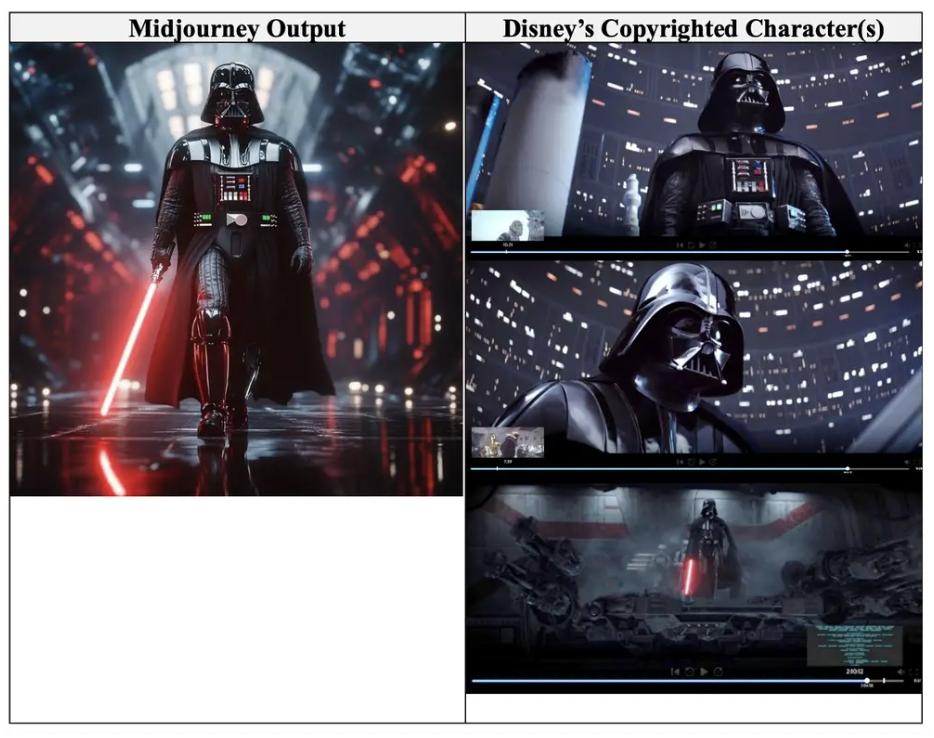
Core Viewpoint - Disney and Universal have initiated a copyright lawsuit against Midjourney, marking a significant legal confrontation between major Hollywood studios and generative AI technology [1][2]. Group 1: Lawsuit Details - The lawsuit was filed in federal district court in Los Angeles, alleging that Midjourney has pirated the libraries of Disney and Universal to create and distribute unauthorized copies of their iconic characters, including Darth Vader and the Minions [2][8]. - The complaint describes Midjourney as a "quintessential copyright free-rider" and emphasizes that the use of AI does not exempt the company from copyright infringement [3][5]. Group 2: Company Response and Context - Disney and Universal claim that Midjourney has ignored their requests to cease infringing activities and to implement technological measures to prevent such image generation [6]. - Midjourney's CEO, David Holz, previously characterized the service as a "search engine" for images, suggesting that copyright concerns should evolve alongside human creativity [7][10]. - The lawsuit is part of a broader trend, with increasing legal actions against AI developers, including cases against OpenAI and Anthropic, and a notable trial involving Getty Images and Stability AI in London [12].


新“SOTA”推理模型避战Qwen和R1?欧版OpenAI被喷麻了
量子位· 2025-06-11 05:13
Core Viewpoint - Mistral AI has launched its first inference model, Magistral, which claims to compete with other leading models but faces skepticism due to lack of direct comparisons with the latest versions of competitors like Qwen and DeepSeek R1 0528 [1][22]. Model Performance - Magistral shows a 50% accuracy improvement on the AIME-24 benchmark compared to its earlier model, Mistral Medium 3 [3]. - In the AIME-24 benchmark, the accuracy for English is 73.6%, while other languages like French and Spanish show lower accuracy rates of 68.5% and 69.3% respectively [8]. Model Versions - Two versions of Magistral have been released: - Magistral Small, which has 24 billion parameters and is open-source under the Apache 2.0 license [4]. - Magistral Medium, a more powerful version aimed at enterprises, available on Amazon SageMaker [5]. Multilingual Support - Magistral is designed for transparent reasoning and supports multilingual inference, addressing the issue where mainstream models perform poorly in European languages compared to local languages [7]. Enhanced Features - Unlike general models, Magistral has been fine-tuned for multi-step logic, improving interpretability and providing a traceable thought process in user language [10]. - The token throughput of Magistral Medium is reported to be 10 times faster than most competitors, enabling large-scale real-time inference and user feedback [14][15]. Training Methodology - Magistral is the first large model trained purely through reinforcement learning (RL) using an improved Group Relative Policy Optimization (GRPO) algorithm [16]. - The model achieves a significant accuracy leap from 26.8% to 73.6% on the AIME-24 benchmark by eliminating KL divergence penalties and dynamically adjusting exploration thresholds [18]. Training Architecture - The model employs an asynchronous distributed training architecture, allowing for efficient large-scale RL training without relying on pre-trained distilled data [20]. - The performance of the 24 billion parameter Magistral Small model reached an accuracy of 70.7% on the AIME-24 benchmark [21]. Competitive Landscape - Comparisons made by users indicate that Qwen 4B is similar in performance to Magistral, while a smaller 30B MoE model outperforms it, and the latest R1 model shows even better results [24].
AI追捧和起诉交织:全球多家动画工会紧急声明 AI挤占人类创作者生存空间
2 1 Shi Ji Jing Ji Bao Dao· 2025-06-11 01:25
Core Viewpoint - The animation industry is facing a crisis due to the rapid adoption of AI technologies, which threaten employment and creative integrity, prompting unions to declare a state of emergency and propose three key principles for AI development [1][4][5]. Group 1: Industry Concerns - The urgent statement from unions highlights fears of job displacement as AI encroaches on creative roles, using copyrighted works without creator consent, leading to a loss of unique human creativity [4][5]. - The animation industry is undergoing significant structural adjustments, with streaming platforms proving unprofitable, resulting in layoffs, outsourcing, and studio closures [5][6]. - AI is seen as a systemic threat to the animation sector, with 78% of animation-related companies planning to adopt generative AI technologies in the next three years, particularly in 3D and 2D animation [6]. Group 2: AI Implementation and Legal Issues - In domestic markets, AI is being integrated into production processes, with companies like Shanghai Hongli Culture using AI to enhance efficiency in early-stage art production, although complex tasks still require human input [7]. - Legal disputes are escalating over copyright issues related to AI training data, with notable cases involving Stability AI and Getty Images, highlighting the unresolved legal responsibilities surrounding AI usage [8]. - The Guangzhou Internet Court's ruling on the "AI Ultraman" case indicates ongoing legal challenges regarding copyright infringement and the responsibilities of AI platforms, with the boundaries of copyright and creator rights becoming increasingly contentious [8].