成都银行

Search documents
中泰证券:1H25理财配置基金规模达五年内高点 关注具备区域优势及高股息银行股
智通财经网· 2025-09-26 02:45
Core Viewpoint - The report from Zhongtai Securities indicates that the direct equity allocation scale of wealth management products in 1H25 has reached a five-year low, while the scale of fund allocations has reached a five-year high, suggesting a need to consider indirect equity allocations. It is expected that with the steady increase in wealth management scale, the equity allocation will also rise, with a conservative estimate of over 100 billion yuan in additional equity allocations in the second half of 2025 and throughout 2026 [1]. Wealth Management Investment Scale - The wealth management product scale is expected to exceed 35 trillion yuan in 2026. From January 2024 to early September 2025, the scale of wealth management products increased by 19% to 31.2 trillion yuan, with the number of products growing by 8% to 4.4 million. As of 1H25, the investment asset scale of wealth management products was 33 trillion yuan, with a semi-annual average increase of 1.32 trillion yuan. Assuming stable growth, the expected scales for 2025 and 2026 are 34.3 trillion yuan and 36.9 trillion yuan, respectively [1]. Product Perspective - The current status and changes in fixed income+, equity, and mixed-type wealth management products show that pure equity wealth management has a low proportion. The issuance of mixed and fixed income+ products has increased significantly since August, with mixed-type products rising by 12% and equity remaining stable. The number of new issuances for equity and mixed-type products increased by 19% and 57% year-on-year, respectively [2]. Underlying Asset Perspective - The allocation structure of wealth management underlying assets in 1H25 shows that equity allocation is at a near five-year low, while fund allocation is at a near five-year high. It is conservatively estimated that there will be over 100 billion yuan in additional equity allocations in the second half of 2025 and throughout 2026 [3][4]. Equity Allocation Estimates - The estimated equity allocation for wealth management products (excluding fund considerations) is projected to reach 816 billion yuan and 878.8 billion yuan for 2025 and 2026, respectively. The total scale of equity allocation is expected to increase by 457 billion yuan in 2025 compared to 1H25 and by 664 billion yuan in 2026 compared to 2025, totaling an estimated increase of 1.121 trillion yuan [5]. Investment Recommendations - The investment logic for bank stocks is shifting from "pro-cyclical" to "weak-cyclical," with bank stocks expected to remain attractive during periods of economic stagnation due to high dividends. Two main investment lines are suggested: regional banks with strong certainty and large banks with stable high dividends [6][7].

城商行板块9月25日跌0.94%,重庆银行领跌,主力资金净流出2.78亿元
Zheng Xing Xing Ye Ri Bao· 2025-09-25 08:37
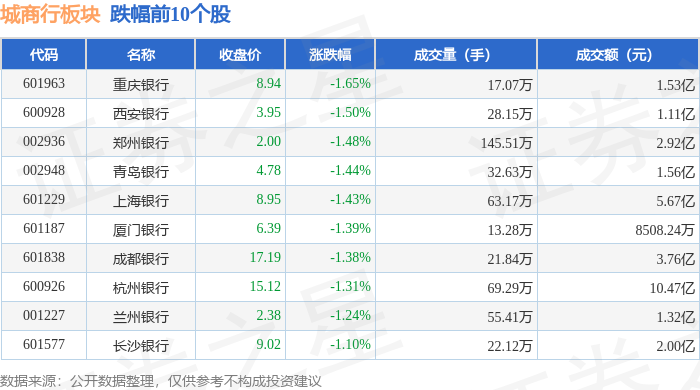
Market Performance - The city commercial bank sector declined by 0.94% on September 25, with Chongqing Bank leading the decline [1] - The Shanghai Composite Index closed at 3853.3, down 0.01%, while the Shenzhen Component Index closed at 13445.9, up 0.67% [1] Individual Stock Performance - Chongqing Bank closed at 8.94, down 1.65% with a trading volume of 170,700 shares and a transaction value of 153 million [1] - Other notable declines include Xi'an Bank down 1.50% to 3.95, Zhengzhou Bank down 1.48% to 2.00, and Qingdao Bank down 1.44% to 4.78 [1] - Shanghai Bank and Xiamen Bank also saw declines of 1.43% and 1.39%, respectively [1] Capital Flow Analysis - The city commercial bank sector experienced a net outflow of 278 million from institutional investors, while retail investors saw a net inflow of 152 million [1] - The table indicates that Suzhou Bank had a significant net outflow from institutional investors of 48.08 million, while Qilu Bank had a net inflow of 25.86 million [2] - Chongqing Bank specifically had a net outflow of 5.68 million from institutional investors but a net inflow of 10.91 million from retail investors [2]




透视城商银行半年报:房地产贷款超8成投向个人住房,不良率绝大多数低于2%
Jin Rong Jie· 2025-09-25 01:54
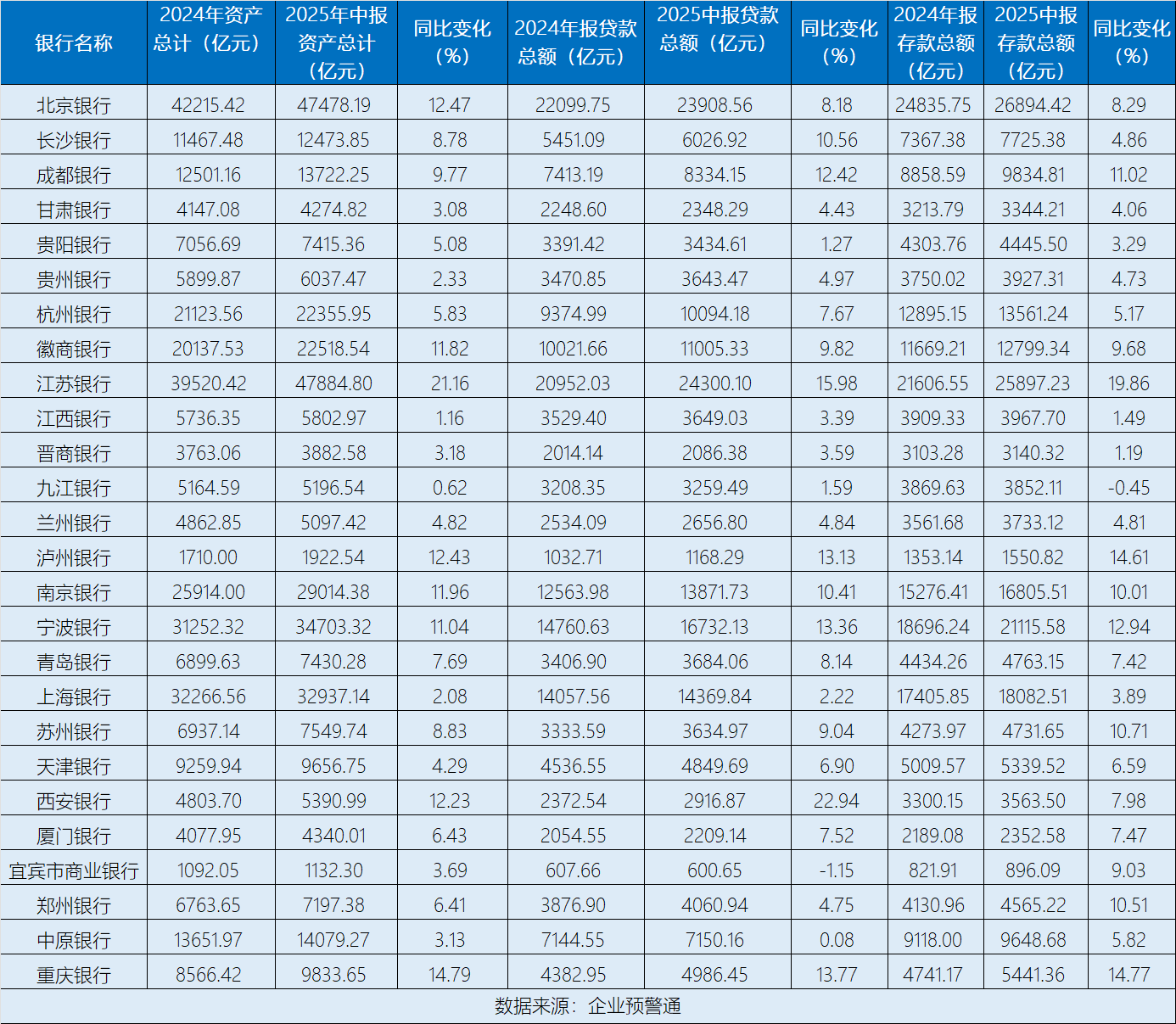
Core Insights - The total assets of 28 city commercial banks reached 38.99 trillion yuan in the first half of 2025, reflecting a year-on-year growth of 9.16% [1] - Jiangsu Bank and Beijing Bank lead in asset size, with 4.79 trillion yuan and 4.75 trillion yuan respectively, indicating strong market positions [2] - The overall loan growth for these banks was 8.66%, with notable increases from Ningbo Bank and Xi'an Bank, which saw growth rates of 13.36% and 22.94% respectively [4][5] Asset Scale - Jiangsu Bank and Beijing Bank are at the forefront with asset totals of 4.79 trillion yuan and 4.75 trillion yuan, respectively [2] - Other banks like Shanghai Bank and Ningbo Bank also show significant asset sizes above 2 trillion yuan, forming a strong first tier in the city commercial bank sector [2] - Year-on-year growth rates vary, with Jiangsu Bank at 21.16% and Chongqing Bank at 14.79%, while Jiujiang Bank showed minimal growth at 0.62% [2][3] Loan Performance - The total loan amount for the 28 banks increased to 19.41 trillion yuan, with a year-on-year growth of 8.66% [1][4] - Jiangsu Bank's loan total rose from 2.10 trillion yuan to 2.43 trillion yuan, marking a growth of 15.98% [3] - Xi'an Bank exhibited the highest loan growth rate at 22.94%, while Central Plains Bank's loan growth was negligible at 0.08% [4][5] Deposit Trends - Jiangsu Bank's deposits surged from 2.16 trillion yuan to 2.59 trillion yuan, reflecting a growth of 19.86% [5] - Other banks like Hangzhou Bank also reported deposit growth, increasing from 1.29 trillion yuan to 1.36 trillion yuan, a rise of 5.17% [5] - Jiujiang Bank experienced a slight decline in deposit growth, with a minimal increase of 0.45% [5] Real Estate Loan Distribution - The real estate loan proportion has generally decreased among city commercial banks, with Guiyang Bank leading at 15.36% [6][7] - Jiangsu Bank, on the other hand, has a low real estate loan ratio of 2.8%, indicating a conservative approach to real estate lending [6][7] - Ningbo Bank holds the highest total real estate loan amount at 1548.93 billion yuan, followed by Beijing Bank and Shanghai Bank [6][7] Personal Housing Loan Insights - Personal housing loans dominate the real estate loan portfolio, with banks like Weihai Bank and Central Plains Bank having high proportions of 36.26% and 17.8% respectively [8] - Most city commercial banks maintain low non-performing loan rates for personal housing loans, with the majority below 2% [8] - Yibin Commercial Bank reported a higher non-performing rate of 4.47% for personal housing loans [8]

充实资本储备 银行发债“补血”
Shen Zhen Shang Bao· 2025-09-25 00:28
Core Viewpoint - The recent surge in issuance of "perpetual bonds" (also known as secondary capital bonds) by various banks in China is primarily driven by the urgent need for capital replenishment due to declining capital adequacy ratios, especially among smaller banks [1][4]. Group 1: Issuance Overview - As of September 24, 2023, Chinese commercial banks have issued a total of 1.24 trillion yuan in perpetual bonds this year, with state-owned banks accounting for 695 billion yuan, making them the main issuers [1][2]. - Agricultural Bank of China has issued the most perpetual bonds, totaling 230 billion yuan across seven issuances, followed by Industrial and Commercial Bank of China with 190 billion yuan [3]. Group 2: Recent Issuances - Agricultural Bank of China announced the issuance of 600 billion yuan in secondary capital bonds, with two types: a 10-year bond at a 2.18% interest rate and a 15-year bond at a 2.50% interest rate [2]. - Everbright Bank successfully issued 400 billion yuan in perpetual bonds, marking the largest single issuance by a joint-stock bank this year, with a final interest rate of 2.29% [2]. Group 3: Market Conditions - The current market environment is favorable for bond issuance, with low interest rates allowing banks to replace high-cost debt and optimize their capital structure [4]. - The pressure on capital adequacy ratios, particularly for smaller banks, has increased due to the expansion of credit assets and rising risk-weighted assets, necessitating external capital replenishment [4].


晨会纪要:对近期重要经济金融新闻、行业事件、公司公告等进行点评-20250925
Xiangcai Securities· 2025-09-24 23:31
Group 1: Banking Industry - The People's Bank of China has implemented structural monetary policies to increase credit support for key service consumption sectors, including a special loan quota of 500 billion yuan for service consumption and elderly care [4] - As of the end of July, the loan balance in key service consumption sectors reached 2.79 trillion yuan, showing a year-on-year growth of 5.3% [4] - With the implementation of fiscal interest subsidies and the activation of credit stock, financing costs in the service consumption sector are expected to decrease, stimulating credit demand [5] - The banking sector is expected to see improved credit demand due to ongoing fiscal subsidy policies, with a positive outlook on bank performance and stock value recovery [6] Group 2: New Materials Industry - The rare earth magnetic materials sector experienced a significant decline of 8.06%, underperforming the benchmark by 7.62 percentage points [8] - Light rare earth concentrate prices have mostly rebounded, while praseodymium and neodymium prices have shown weak fluctuations [9] - The supply of praseodymium and neodymium is expected to increase slightly, while demand remains stable, leading to a balanced market [10] - The overall valuation and performance of the rare earth sector are under pressure, but there are opportunities for recovery as prices stabilize [11] Group 3: Innovative Pharmaceutical Industry - The global biotechnology sector showed mixed performance, with the Nasdaq biotech index rising by 0.86% while other indices fell [12] - The innovative drug industry in China is entering a pivotal phase where research results are beginning to translate into commercial success [13] - The MASH (Metabolic Dysfunction-Associated Steatotic Liver Disease) market is expected to expand rapidly, with significant investment opportunities in related treatments [14] - The innovative drug sector is anticipated to experience a dual recovery in performance and valuation, driven by ongoing policy support and market demand [15]
对公贷款成银行增长“胜负手” 行业无还本续贷规模达9.4万亿
2 1 Shi Ji Jing Ji Bao Dao· 2025-09-24 09:12
Group 1 - The financing environment for small and micro enterprises is improving, with banks actively seeking to provide loans, a shift from previous years where enterprises sought loans from banks [1][2] - In the first half of the year, at least 20 banks reported an increase in corporate loans, particularly for small and micro enterprises, indicating a competitive lending landscape [1][4] - The financial regulatory authority has established mechanisms to support small and micro enterprise financing, resulting in the issuance of loans totaling 22 trillion yuan, alleviating funding pressures for small businesses [1][4] Group 2 - Guangdong Huihua Plastic Technology Co., Ltd. has increased its production capacity due to rising orders, securing loans of 10 million yuan and 20 million yuan in June and July to purchase raw materials [2] - Banks are adapting their lending strategies, moving away from traditional collateral-based loans to more flexible credit solutions, such as domestic letters of credit, to meet the needs of businesses with insufficient collateral [2][3] - The competition among banks has intensified, with banks not only lowering interest rates but also enhancing service quality to attract clients, as evidenced by significant reductions in loan interest rates compared to two years ago [3][4] Group 3 - Postal Savings Bank reported a 14.83% year-on-year increase in corporate loans, amounting to 541.1 billion yuan in the first half of the year, while retail loans showed stable growth [4][5] - China Bank's corporate loan balance reached 13.52 trillion yuan, with notable growth in green loans, private enterprise loans, and manufacturing loans, reflecting a robust lending environment [4] - Citic Bank achieved a record high in corporate loan growth, with an increase of 296.8 billion yuan in the first half of the year, maintaining a low non-performing loan ratio of 1.01% [4][5]


城商行板块9月24日涨1.64%,齐鲁银行领涨,主力资金净流出6917.64万元
Zheng Xing Xing Ye Ri Bao· 2025-09-24 08:46
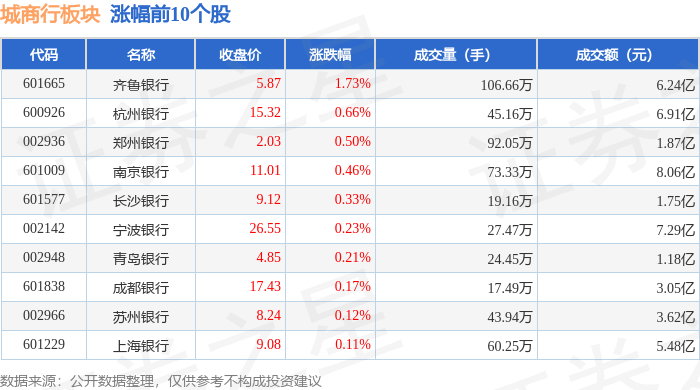
Market Performance - The city commercial bank sector increased by 1.64% on September 24, with Qilu Bank leading the gains [1] - The Shanghai Composite Index closed at 3853.64, up 0.83%, while the Shenzhen Component Index closed at 13356.14, up 1.8% [1] Individual Stock Performance - Qilu Bank closed at 5.87, with a rise of 1.73% and a trading volume of 1.0666 million shares, amounting to a transaction value of 624 million yuan [1] - Hangzhou Bank closed at 15.32, up 0.66%, with a trading volume of 451,600 shares and a transaction value of 691 million yuan [1] - Zhengzhou Bank closed at 2.03, up 0.50%, with a trading volume of 920,500 shares and a transaction value of 18.7 million yuan [1] - Nanjing Bank closed at 11.01, up 0.46%, with a trading volume of 1.7333 million shares and a transaction value of 806 million yuan [1] - Other banks such as Changsha Bank, Ningbo Bank, and Qingdao Bank also showed slight increases in their stock prices [1] Capital Flow Analysis - The city commercial bank sector experienced a net outflow of 69.1764 million yuan from institutional investors, while retail investors saw a net inflow of 55.8208 million yuan [2] - The overall capital flow indicates a mixed sentiment, with institutional investors withdrawing funds while retail investors continued to invest [2] Detailed Capital Flow for Selected Banks - Ningbo Bank had a net inflow of 74.388 million yuan from institutional investors, but a net outflow of 51.098 million yuan from speculative funds [3] - Shanghai Bank saw a net inflow of 17.1761 million yuan from institutional investors, while retail investors had a net outflow of 30.1701 million yuan [3] - Chengdu Bank experienced a net inflow of 16.3117 million yuan from institutional investors, with a net outflow from retail investors [3]

成都,开始拥挤
3 6 Ke· 2025-09-24 07:35
Group 1: Economic Overview - Chengdu's urban residents had a per capita disposable income of 32,000 yuan in 2022, compared to Beijing's 46,000 yuan, indicating a significant income gap [1][21] - In 2023, Chengdu's per capita disposable income reached 50,585 yuan, which is not among the top in major cities in China [14][21] - Chengdu's total economic output is only slightly more than half of Beijing's, despite having a similar population size, placing its per capita GDP outside the top 40 in the country [14][16] Group 2: Population and Infrastructure - Chengdu's permanent population reached 21.4 million by the end of 2023, ranking fourth in China and approaching Beijing's population [3][7] - The city has seen a population increase of 7.35 million from 2010 to 2023, largely due to its appeal to young people from other provinces [7][14] - Chengdu's urban rail transit system has expanded to 601.7 kilometers, with the metro system covering 562.4 kilometers, ranking fourth nationally [3] Group 3: Business Environment - Chengdu has attracted major investments, such as Intel's chip packaging plant, which produces half of its mobile device microprocessors globally [4] - The city has focused on developing its tertiary sector, particularly in culture and tourism, leveraging its unique cultural identity [6][25] - Chengdu's top companies, such as New Hope Group, reported revenues of 141.7 billion yuan in 2023, but the city lacks a significant number of high-revenue firms compared to Beijing, Shanghai, and Shenzhen [16][17] Group 4: Consumer Behavior - Chengdu residents spent approximately 11,000 yuan on food, tobacco, and alcohol in 2022, which is higher than Beijing's spending in this category [1][21] - The Engel coefficient in Chengdu is 33.7%, indicating a high proportion of income spent on food, which reflects the city's cultural emphasis on dining [21] - The city has a diverse range of businesses, with a high density of tea houses, convenience stores, and restaurants, showcasing a vibrant local economy [9][12] Group 5: Challenges and Opportunities - Despite its growth, Chengdu faces challenges in achieving high per capita economic outcomes, with many industries operating in low-profit segments [16][25] - The city has a relatively weak industrial base and lacks high-end industry clusters, which affects the overall economic quality and residents' perceptions of prosperity [25][26] - Chengdu's unique cultural and recreational offerings continue to attract residents and tourists, positioning it as a distinctive urban center in China [22][26]
银行行业9月23日资金流向日报
Zheng Quan Shi Bao Wang· 2025-09-23 10:11
Core Viewpoint - The banking sector showed a positive performance with a 1.52% increase, while the overall market experienced a slight decline of 0.18% on September 23, 2023 [1] Market Performance - The Shanghai Composite Index fell by 0.18% on September 23, 2023 - Among the sectors, five industries saw gains, with banking and coal being the top performers, increasing by 1.52% and 1.11% respectively - The sectors that faced the largest declines were social services and retail trade, with decreases of 3.11% and 2.90% respectively [1] Capital Flow - The net outflow of capital from the two markets reached 996.85 billion yuan, with only three sectors experiencing net inflows - The banking sector had a net inflow of 14.00 billion yuan, while the construction and decoration sector saw a net inflow of 1.69 billion yuan, and the coal sector had a minor net inflow of 399.41 million yuan - A total of 28 sectors experienced net outflows, with the electronics sector leading with a net outflow of 200.43 billion yuan, followed by the computer sector with 166.60 billion yuan [1] Banking Sector Details - The banking sector had 42 stocks, with 40 stocks rising and only one stock declining - The top three banks by net inflow were Industrial and Commercial Bank of China (4.62 billion yuan), Bank of China (2.50 billion yuan), and China Merchants Bank (2.36 billion yuan) [2] - The stocks with the largest net outflows included Ningbo Bank (1.81 billion yuan), Chengdu Bank (1.03 billion yuan), and Shanghai Pudong Development Bank (967.62 million yuan) [2][3] Individual Stock Performance - The top performing bank stocks included: - Industrial and Commercial Bank of China: +3.06% with a net inflow of 462.06 million yuan - Bank of China: +1.73% with a net inflow of 249.79 million yuan - China Merchants Bank: +1.54% with a net inflow of 236.27 million yuan - Other notable performers included Agricultural Bank of China (+2.47%) and China Construction Bank (+3.03%) [2][3]






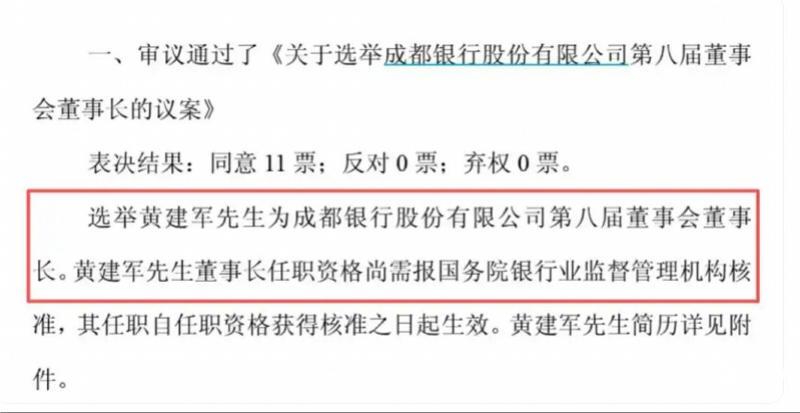
成都银行正副董事长拟任人选落定,“万亿”规模如何再上台阶
Nan Fang Du Shi Bao· 2025-09-23 09:44
Core Viewpoint - The recent leadership changes at Chengdu Bank, with the election of Huang Jianjun as Chairman and Zhang Yuming as Vice Chairman, mark a significant step in the bank's development journey, particularly in the context of the Chengdu-Chongqing economic circle [1][2]. Leadership Changes - Huang Jianjun, a long-time member of Chengdu Bank, has a robust background in banking and has previously held various leadership roles, including at Chengdu Rural Commercial Bank, where he achieved notable growth in revenue and profit [3]. - Zhang Yuming, representing Malaysian foreign strategic shareholder Hong Leong Bank, brings extensive experience from various banking roles in Malaysia and Cambodia [4]. - The new leadership team is expected to continue the bank's development trajectory, following the recent departure of former Chairman Wang Hui and the retirement of long-serving Vice Chairman He Weizhong [5]. Shareholder Dynamics - Chengdu Bank has seen increased confidence from state-owned shareholders, with recent investments exceeding 160 million yuan, raising their combined stake to approximately 30% [7]. - The bank's ownership structure includes a mix of state-owned and foreign strategic shareholders, which enhances its competitive edge by combining government support with market-driven strategies [8]. Financial Performance and Challenges - Chengdu Bank has achieved record financial results in 2024, with total assets reaching 1.25 trillion yuan, and has maintained significant growth in revenue and profit over the past four years [9]. - However, the bank faces challenges such as slowing growth rates and a high concentration of loans among its top clients, particularly in the leasing and real estate sectors [10]. - The bank's retail banking segment remains underdeveloped, with personal loans accounting for only about 18% of its total loans, indicating a need for strategic shifts to enhance this area [11]. Strategic Outlook - The ongoing development of the Chengdu-Chongqing economic circle presents opportunities for Chengdu Bank to strengthen its position and address its transformation challenges [12].