
南京银行

Search documents
南京银行:拟于12月23日全额赎回0.49亿股优先股南银优1
Mei Ri Jing Ji Xin Wen· 2025-12-17 09:56
每经AI快讯,12月17日,南京银行(601009)(601009.SH)公告称,公司拟于2025年12月23日全额赎回 0.49亿股优先股"南银优1"。为保证公平信息披露,维护投资者利益,公司拟申请于2025年12月22日对 本次优先股停牌,并于2025年12月23日对本次优先股赎回注销。 ...

又一消金公司,计划大规模增资
Zheng Quan Shi Bao· 2025-12-17 04:33
Core Viewpoint - Changyin 58 Consumer Finance plans to raise capital up to 1.55 billion yuan to enhance its capital strength and risk resistance capabilities, with the final amount subject to regulatory approval [1][2][3]. Group 1: Capital Increase Details - Changyin 58's registered capital will increase from 1.124 billion yuan to 1.945 billion yuan after the capital increase and share transfer [1][3]. - The shareholding of Changsha Bank will rise from 56.66% to 80.82%, while Beijing Wanglin and Tongcheng Holdings will see their shares decrease to 15.27% and 3.91%, respectively [3]. - The capital increase is priced at 1.8877 yuan per share, with Tongcheng Holdings planning to transfer 114 million shares to Changsha Bank for approximately 215 million yuan [2][3]. Group 2: Historical Context and Regulatory Changes - Changyin 58 was established in early 2017 with an initial registered capital of 300 million yuan, with Changsha Bank holding 51% [2]. - The company underwent a capital increase in 2019, raising its capital to 900 million yuan while maintaining the same shareholding structure [2]. - The revised "Consumer Finance Company Management Measures" will raise the minimum registered capital requirement from 300 million yuan to 1 billion yuan, effective March 2024 [2]. Group 3: Financial Performance - As of the end of last year, Changyin 58 had total assets of approximately 29.62 billion yuan, with a projected revenue of about 3 billion yuan and a net profit of 34 million yuan, reflecting a year-on-year decline of 7.6% and 95%, respectively [3]. - By the end of September this year, the company's asset scale expanded to over 34.6 billion yuan, with a net profit of 21 million yuan for the first three quarters [3]. Group 4: Industry Trends - At least seven other consumer finance companies have completed capital increases this year, indicating a trend towards strengthening capital bases across the industry [4][5][6]. - The regulatory environment is pushing companies to enhance their capital strength to meet new requirements, as seen in the recent issuance of the "Consumer Finance Company Regulatory Rating Measures" [7].


“还呗”高利率、暴力催收不断,还能在监管下“狂奔”多久?
Xin Lang Cai Jing· 2025-12-17 01:04
Core Viewpoint - "Huabei" is a lending product backed by the A-share listed company Focus Media, operated by Shanghai Shuhe Information Technology Co., Ltd. Despite its financial technology facade, it is revealed to be a high-interest trap with numerous alarming issues [1]. Summary by Sections Product and User Feedback - The annual interest rate for "Huabei" is advertised as 7.2%-35.99%, seemingly compliant with regulations, but hidden fees inflate the actual borrowing cost to the regulatory limit of 36% [3]. - Complaints indicate that fees such as "membership fees" and "guarantee fees" significantly increase the cost of borrowing, with users reporting that additional fees were not clearly disclosed at the time of borrowing [3]. Financial Performance - In 2024, Shuhe Technology reported a revenue of 9.681 billion yuan and a net profit of 942 million yuan, with year-on-year growth rates of 68.81% and 87.24% for the first half of 2025, respectively [4]. - The high profits are attributed to a combination of high-interest income and aggressive debt collection practices, raising concerns about user rights violations [4]. Collection Practices - Reports of aggressive collection tactics, including harassment and invasion of privacy, have emerged, with users receiving abusive messages and calls even after providing medical documentation for their inability to repay [5][6]. - The company's response to complaints often involves denial of responsibility, indicating a lack of accountability in managing third-party collection agencies [6]. Business Model and Regulatory Challenges - "Huabei" operates on a risk-sharing model where Shuhe Technology provides a guarantee of 5%-10% of the loan balance, transferring credit risk to the platform [7]. - The recent regulatory changes from the National Financial Regulatory Administration require banks to independently manage risk and limit the inclusion of service fees in the total borrowing cost, posing a significant threat to "Huabei's" existing business model [8]. Market Outlook - The combination of high-interest traps, poor post-loan management, and challenges in the lending model could jeopardize user rights and financial market stability [9]. - If "Huabei" fails to adapt its business strategy and address existing issues, it risks being eliminated from the market [9].


商业银行年内发行4582亿元绿色金融债券
Zheng Quan Ri Bao Zhi Sheng· 2025-12-16 16:09
Core Viewpoint - The issuance of green financial bonds by commercial banks in China is experiencing significant growth, driven by policy support and increasing investor interest in ESG initiatives, with a record issuance scale in 2023 [1][3]. Group 1: Issuance Details - Zaozhuang Bank plans to issue 900 million yuan of green financial bonds from December 18 to December 22, with a maturity of three years, aimed at funding projects listed in the "Green Financial Support Project Catalog (2025 Edition)" [1]. - As of December 16, 2023, commercial banks have issued 58 green financial bonds this year, totaling 458.2 billion yuan, representing a year-on-year increase of over 202% [1][2]. - The issuance scale of regional banks reached 92.2 billion yuan this year, surpassing the total of 61.7 billion yuan for the entire year of 2024, with 32 bonds issued [2]. Group 2: Issuance Trends - State-owned and joint-stock banks dominate the green bond market, accounting for approximately 3.66 trillion yuan of the total issuance, which is 80% of the total [2]. - Agricultural Bank issued the largest single bond of 50 billion yuan, while Industrial Bank led the joint-stock banks with 55 billion yuan in issuance [2]. - The issuance of green financial bonds is expected to maintain a high level in the coming year, with a focus on structural changes and more precise funding applications [4]. Group 3: Interest Rates and Market Dynamics - The overall issuance interest rates for green financial bonds have been declining, with state-owned and joint-stock banks offering lower rates compared to regional banks [3]. - For instance, the China Construction Bank issued a green bond in November 2023 with rates of 1.72% and 1.79%, down from 1.88% in 2024 [3]. - The market is witnessing a "green premium," as the demand for green assets increases amid loose market liquidity [3]. Group 4: Product Innovation - Financial institutions are innovating in green bond products, with new structures such as floating-rate bonds and thematic focuses emerging [4][5]. - For example, the Industrial and Commercial Bank of China issued the first floating-rate green bond in June 2023, while Industrial Bank utilized blockchain technology for enhanced transparency and efficiency [5]. - The trend towards more complex bond structures, including those linked to sustainable development, is expected to continue [5].
今年已有8家消金公司计划增资,数量超去年全年,近半为补足注册资本10亿门槛
Xin Lang Cai Jing· 2025-12-16 12:33
智通财经12月16日讯(记者 郭子硕)2025年,消费金融行业的增资热潮贯穿一整年,且临近年底动作 更加频繁。 智通财经记者日前从南京银行了解到,南银法巴消费金融有限公司(下称南银法巴消金)已完成工商变 更登记手续,其注册资本从52.15亿元大幅提升至60亿元。 而昨日晚间,长沙银行宣布计划以自有资金对湖南长银五八消费金融股份有限公司(下称长银五八消 金)进行增资,增资金额不超过15.5亿元。相应地,长沙银行的持股比例可能会从56.66%提高至 74.96%,控制权进一步得到集中。不过,最终金额将以经监管部门核准后的实际出资金额为准。 截至目前,年内已有8家机构完成或披露增资举措,数量超过去年全年,且其中50%是由注册资本不足 10亿元的消费金融公司发起。受访业内人士表示,今年消金公司增资的行业特点非常鲜明:银行系消费 金融公司主动进行规模扩张,中小机构聚焦于合规达标,第一大股东投入真金白银以提升控制权。 针对这一现象,有资深消费金融行业人士透露,当前有关部门指导已获批消金公司的注册资本要达到10 亿门槛。据此前的《消费金融公司管理办法》要求,注册资本的最低限额由3亿元提升至10亿元人民币 或者等值的可自由兑 ...
寻找科技金融“新密钥”:江苏金融创新给出科创企业融资N种解法
Mei Ri Jing Ji Xin Wen· 2025-12-16 12:23
Core Insights - The article discusses the challenges and innovations in financing technology-driven enterprises, particularly in Jiangsu Province, where traditional credit models struggle to meet the unique needs of these companies [1][4]. Group 1: Innovation in Financing - Jiangsu Province is leading in regional innovation capabilities, moving away from traditional collateral-based lending to a system using "Su Chuang Points" to evaluate innovation [2][4]. - The "Su Chuang Points Loan" product has been developed to assist enterprises in their growth, particularly in the biomedicine sector, which has high funding demands and long development cycles [3][11]. Group 2: Financial Products and Support - Since its establishment in December 2024, the Nanjing Biomedicine Sub-center has facilitated project financing totaling 225 million yuan, collaborating with banks to create tailored credit products for university research projects [3]. - By the end of Q3 2025, nearly 40,000 enterprises were classified as "priority support" or "recommended support," with a loan balance of 381.2 billion yuan under the "Su Chuang Points Loan" program [5]. Group 3: Digital Financial Innovations - Digital financial tools are enhancing the capabilities of technology finance, with banks creating comprehensive profiles and scoring systems for enterprises based on their innovation capabilities [6][7]. - The China Bank Jiangsu Branch has developed a digital financial platform that provides real-time insights into industry chains and pre-approval credit limits for technology enterprises [7]. Group 4: Policy Support and Collaboration - The People's Bank of China is working with the Jiangsu Provincial Science and Technology Department to introduce special support policies for technology finance, addressing the mismatch between traditional credit models and the needs of tech enterprises [4][8]. - The "Su Chuang Rong" product has supported technology SMEs with loans totaling 397.8 billion yuan by the end of Q3 2025, demonstrating the effectiveness of policy-driven financial support [8]. Group 5: Tailored Services for Startups - Local banks are focusing on small and micro enterprises, emphasizing non-credit services such as equity financing and resource matching to better meet the needs of early-stage technology companies [9][10]. - The establishment of specialized banking teams with expertise in finance, industry, and risk management is crucial for effectively serving technology enterprises [9]. Group 6: Comprehensive Financial Service Systems - A comprehensive financial service system has been established in Suzhou, integrating digital credit platforms and specialized financial products to support innovation and technology-driven enterprises [13][14]. - The "Innovation Index" has been developed to help financial institutions better understand and support the operational needs of innovative companies [13].

再加码!南银法巴消金注册资本增至60亿,跻身行业第四
Nan Fang Du Shi Bao· 2025-12-16 12:03
Group 1 - The core point of the article is that Nanyin Fabai Consumer Finance Co., Ltd. has increased its registered capital from 5.215 billion to 6 billion yuan, ranking fourth among 31 licensed consumer finance companies in China [4][5][6] - The capital increase is attributed to a decision by Nanjing Bank, which contributed approximately 589.3 million yuan, maintaining its 64.16% shareholding [4][5] - This is the second capital increase for Nanyin Fabai within a year, following an increase from 5 billion to 5.215 billion yuan in September 2024, funded by a new shareholder, the International Finance Corporation [4][5] Group 2 - The increase in capital has directly improved the company's industry ranking, surpassing Industrial Bank Consumer Finance, which has a registered capital of 5.32 billion yuan [5][6] - Nanyin Fabai's management team has recently expanded with the appointment of two new deputy general managers, enhancing the company's leadership [7][9] - The company reported a significant increase in revenue and net profit for the first half of 2025, with revenue reaching 2.74 billion yuan, a 33.75% increase year-on-year, and net profit of 143 million yuan, nearly doubling from the previous year [10] Group 3 - The consumer finance industry is experiencing a capital increase trend due to regulatory changes that have raised the minimum registered capital requirement from 300 million to 1 billion yuan [11][12] - Many consumer finance companies are increasing their capital to comply with new regulations, with some institutions still falling short of the new minimum capital requirements [12] - The overall sentiment in the industry remains positive, with institutions recognizing the importance of compliance and the potential for sustainable growth in the consumer finance sector [12]

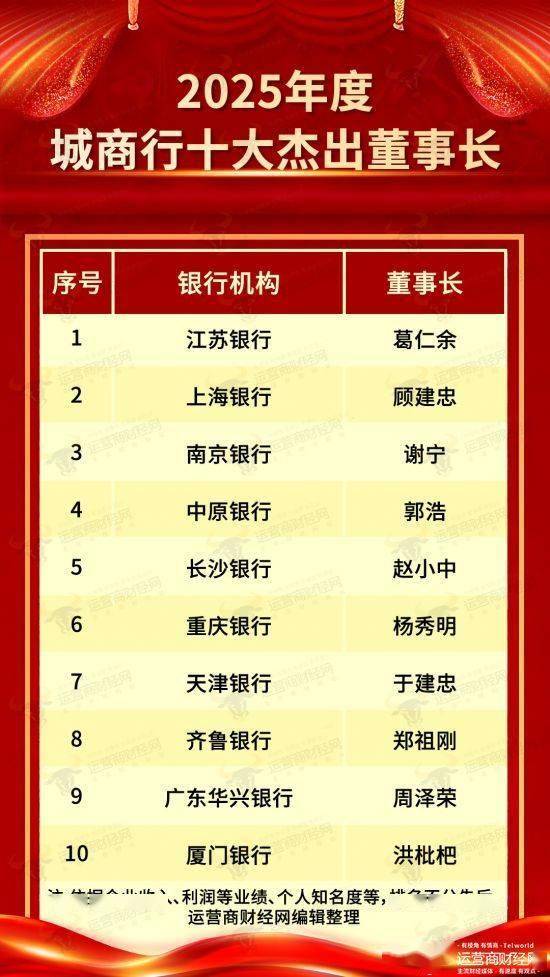
运营商财经网正式推出“2025年度城商行十大杰出董事长”榜单 为业界独家
Sou Hu Cai Jing· 2025-12-16 09:24
Core Viewpoint - The article announces the launch of the "Top Ten Outstanding Chairmen of City Commercial Banks for 2025" list by a well-known financial media platform, focusing on the comprehensive performance of major city commercial banks in China and highlighting key figures from these institutions [1]. Group 1: List of Outstanding Chairmen - The list includes the following chairmen: - Ge Renyu from Jiangsu Bank - Gu Jianzhong from Shanghai Bank - Xie Ning from Nanjing Bank - Guo Hao from Zhongyuan Bank - Zhao Xiaozhong from Changsha Bank - Yang Xiuming from Chongqing Bank - Yu Jianzhong from Tianjin Bank - Zheng Zugang from Qilu Bank - Zhou Zerong from Guangdong Huaxing Bank - Hong Pipa from Xiamen Bank [2][3]. Group 2: Evaluation Criteria - The evaluation for the list considered multiple factors, including the annual revenue, net profit, and performance scale of the banks for 2025, as well as the significant contributions and achievements of the executives [3]. - The rankings are not absolute and do not serve any commercial purpose; they aim to recognize outstanding companies and their leaders for their performance in 2025 [3].


南银法巴消费金融增资至60亿元人民币
Jing Ji Guan Cha Wang· 2025-12-16 07:32
Group 1 - The core point of the article is that Nanyin FaBa Consumer Finance has increased its registered capital from 5.215 billion RMB to 6 billion RMB, representing an approximate increase of 15% [1] - The company was established in May 2015 and is legally represented by Zhang Weinian [1] - Shareholders of the company include Nanjing Bank, BNP Paribas, the International Finance Corporation, and BNP Paribas Personal Finance [1]
专题:理财业务的收入贡献有望正向、稳定、可预期
GUOTAI HAITONG SECURITIES· 2025-12-16 06:46
Investment Rating - The report rates the industry as "Overweight" [4]. Core Insights - The establishment of wealth management companies by banks in 2025 is expected to stabilize and positively contribute to income, especially with favorable equity market conditions enhancing performance elasticity [2]. - The wealth management market has surpassed 30 trillion yuan, accounting for 18.8% of the large asset management market, indicating a shift towards standardized development [7][9]. - The risk appetite for wealth management investments has marginally increased, with a notable shift in asset allocation towards high liquidity assets and public funds [32][37]. Summary by Sections 1. Wealth Management Development - The total scale of wealth management products has exceeded 30 trillion yuan, with 4.39 million products in circulation, reflecting a 10% year-on-year growth [7]. - By the end of Q3 2025, the scale of wealth management companies reached 29.28 trillion yuan, representing 91.1% of the total market, with 14 companies managing over 1 trillion yuan each [12][17]. 2. Changes in Product Types and Asset Investment Structure - The proportion of fixed income and hybrid products has steadily increased since 2024, while cash management products have significantly decreased [23]. - By Q3 2025, fixed income products accounted for 76.5% of the total wealth management products, with a notable decline in cash management products [23][24]. 3. Future Income Expectations - Wealth management income is anticipated to show stable and positive growth, with a significant recovery from a 43.2% year-on-year decline in 2023 to a narrower decline of 2.7% in 2024 [6][7]. - The transition period for asset management regulations is nearing completion, which is expected to alleviate previous income pressures [6][7]. 4. Investment Structure and Risk Appetite - The investment structure has shifted, with a decrease in bond investments and an increase in cash and bank deposits, reflecting a strategy to enhance liquidity [34]. - The risk appetite for equity investments has improved, with a notable increase in the proportion of public fund investments [37].