晶澳科技

Search documents
钙钛矿叠层效率提升明显,量产落地加速
Guotou Securities· 2025-11-12 06:02
Investment Rating - The report maintains an investment rating of "Outperform the Market - A" [7] Core Insights - Perovskite technology is identified as a core direction for next-generation solar power generation, with theoretical efficiency limits significantly higher than traditional silicon components [1] - Leading companies are heavily investing in perovskite technology, achieving notable efficiency improvements in their products [2] - The commercialization of perovskite technology is accelerating, with several companies transitioning from pilot lines to mass production [3] - Equipment for perovskite production is being delivered, indicating a faster industrialization process [4] - The report suggests focusing on the demand within the industry chain and new technological developments, highlighting key equipment companies [5] Summary by Sections Industry Investment Rating - The report rates the industry as "Outperform the Market - A" [7] Perovskite Technology Advancements - Perovskite single-junction components have a theoretical efficiency limit of 35%, while tandem components can reach up to 45%, surpassing traditional silicon's 26% [1] - Longi's silicon-perovskite tandem solar cell achieved a certified efficiency of 34.85% [2] - Tongwei's lab reached a perovskite efficiency of 34.69%, and JA Solar's tandem solar cell efficiency exceeded 30% [2] Commercialization and Production - GCL-Poly announced the launch of its first GW-level perovskite production line [3] - Jietai Technology successfully produced its first industrialized TOPCon+ perovskite tandem cell [3] - Dazheng Micro-Nano completed a significant financing round to support the construction of a new production line for flexible perovskite solar cells [3] Equipment and Industrialization - Jiejia Weichuang won a bid for a perovskite battery production line, indicating technological breakthroughs in mass production [4] - Jing Shan Light Machine has developed a comprehensive equipment solution for perovskite production, validated by downstream customers [4] Investment Recommendations - The report advises monitoring industry demand and technological changes, with a focus on key equipment companies such as Jiejia Weichuang, Maiwei Co., and others [5]
光伏、储能概念持续调整 通威股份触及跌停
Xin Lang Cai Jing· 2025-11-12 05:33
Core Viewpoint - The photovoltaic and energy storage sectors are experiencing significant adjustments, with several companies facing substantial declines in stock prices [1] Company Performance - Tongwei Co., Ltd. hit the daily limit down, indicating a severe drop in investor confidence [1] - Hongyuan Green Energy also reached the daily limit down, reflecting broader market concerns [1] - Canadian Solar (Artes) and Airo Energy saw declines exceeding 10%, highlighting the volatility in the sector [1] - Other companies such as Shuangliang Energy, JA Solar, LONGi Green Energy, and Trina Solar also reported notable declines in their stock prices [1]

晶澳科技股价跌5.05%,景顺长城基金旗下1只基金重仓,持有18.55万股浮亏损失14.1万元
Xin Lang Cai Jing· 2025-11-12 02:51
数据显示,景顺长城基金旗下1只基金重仓晶澳科技。景顺长城景骊成长混合A(010706)三季度持有 股数18.55万股,与上期相比持股数量不变,占基金净值比例为5.35%,位居第六大重仓股。根据测算, 今日浮亏损失约14.1万元。 景顺长城景骊成长混合A(010706)成立日期2021年5月7日,最新规模4529.43万。今年以来收益 17.65%,同类排名4771/8147;近一年亏损3.45%,同类排名7835/8056;成立以来亏损4.87%。 11月12日,晶澳科技跌5.05%,截至发稿,报14.30元/股,成交7.23亿元,换手率1.51%,总市值473.28 亿元。 资料显示,晶澳太阳能科技股份有限公司位于北京市丰台区汽车博物馆东路1号院诺德中心8号楼,香港 湾仔皇后大道东248号大新金融中心40楼,成立日期2000年10月20日,上市日期2010年8月10日,公司主 营业务涉及硅片、太阳能电池片及太阳能电池组件的研发、生产和销售,以及太阳能光伏电站的开发、 建设、运营等。主营业务收入构成为:光伏组件91.10%,其他5.85%,光伏电站运营3.05%。 从基金十大重仓股角度 截至发稿,梁荣累计任职 ...

晶澳科技20251111
2025-11-12 02:18
Summary of the Conference Call for Jingao Technology Industry Overview - The global photovoltaic (PV) demand is expected to be between 580-600 GW this year, with a slight increase anticipated next year. The domestic market's installed capacity is projected to decrease from 300 GW to between 270-300 GW, while the European market remains stable and emerging markets show limited growth [2][4][9]. Company Performance and Outlook - The company anticipates a year-on-year decline of approximately 10% in total module shipments, amounting to over 700,000 units, aligning with the initial expectations of self-discipline production limits and anti-involution policies [2][4]. - The delivery prices of modules have gradually recovered in the second half of the year, but the increase in silicon material prices has outpaced that of modules, potentially leading to weaker profitability in the fourth quarter, although a slight growth is still expected [3][18][19]. Pricing and Market Dynamics - The transmission of price increases from upstream silicon wafers and materials to downstream modules is challenging due to the dispersed customer base and significant differences between domestic and international markets [2][5][6]. - Domestic module pricing is primarily based on cost, with no malicious competition allowed below cost price. Prices are gradually stabilizing under policy support, but further recovery will depend on demand release [8]. International Market Insights - The overseas market is gradually recovering, with European distributors showing increased willingness to purchase as prices stabilize. Emerging markets, particularly in the Middle East and Asia-Pacific, are performing well and have a higher acceptance of price increases [7][10]. - The company is expanding its production capacity in Oman, with plans for 6 GW of battery and 3 GW of module capacity, aimed at enhancing overseas supply chain flexibility in response to new tariff measures affecting Southeast Asian countries [10]. U.S. Market Considerations - The U.S. market, while profitable, is significantly influenced by political factors. The company is closely monitoring geopolitical changes and tariff policies, adjusting strategies accordingly to address potential challenges [11][12]. - The company has sold its U.S. component factory to comply with the Inflation Reduction Act and is considering reducing equity stakes in its Oman capacity to meet regulatory requirements [17]. Future Demand and Production Expectations - For 2026, global PV installed capacity is expected to slightly increase to around 600 GW, with China’s market potentially declining while Europe remains stable and emerging countries grow rapidly [9]. - The second quarter of next year is viewed as a critical period for demand clarity, with potential price increases if demand rises [15]. Technological and Cost Considerations - The industry is currently in a profit recovery phase, with limited motivation for new capacity expansion. New technologies like TOPCon are being improved, while others remain in the experimental stage [21]. - The decline in per-watt costs has been minimal this year, as costs are already low, and significant technological advancements are slow to materialize [22]. IPO Status - The company is in the process of an IPO on the Hong Kong Stock Exchange, currently in the queue and meeting market capitalization requirements [23].
晶澳科技11月11日获融资买入1.48亿元,融资余额8.04亿元
Xin Lang Cai Jing· 2025-11-12 01:37
Core Viewpoint - JinkoSolar Technology Co., Ltd. experienced a decline of 1.50% in stock price on November 11, with a trading volume of 1.744 billion yuan, indicating potential market volatility and investor sentiment concerns [1] Financing Summary - On November 11, JinkoSolar had a financing buy-in amount of 148 million yuan and a financing repayment of 167 million yuan, resulting in a net financing outflow of 19.16 million yuan [1] - The total financing and securities lending balance for JinkoSolar reached 807 million yuan, with the financing balance accounting for 1.61% of the circulating market value, indicating a high level of financing activity [1] - The company repaid 44,800 shares in securities lending and sold 12,700 shares, with a selling amount of 191,300 yuan, while the remaining securities lending balance was 303,460 yuan, also reflecting a high level of activity [1] Financial Performance - For the period from January to September 2025, JinkoSolar reported a revenue of 36.809 billion yuan, a year-on-year decrease of 32.27%, and a net profit attributable to shareholders of -3.553 billion yuan, a significant decline of 633.54% [2] - The number of shareholders decreased by 17.24% to 147,800, while the average circulating shares per person increased by 20.84% to 22,370 shares [2] Dividend and Shareholding Structure - Since its A-share listing, JinkoSolar has distributed a total of 3.055 billion yuan in dividends, with 2.415 billion yuan distributed over the past three years [3] - As of September 30, 2025, the top ten circulating shareholders included Hong Kong Central Clearing Limited as the second-largest shareholder with 214 million shares, a decrease of 7.3649 million shares from the previous period [3] - Other notable shareholders include GF Advanced Manufacturing Stock A and Huatai-PB CSI 300 ETF, with varying changes in their holdings [3]
新能源消纳调控迎指导意见 产业加速从“建得好”迈向“用得巧”
Zheng Quan Ri Bao· 2025-11-11 16:08
Core Insights - The "Guiding Opinions" issued by the National Development and Reform Commission and the National Energy Administration aim to establish a multi-level, efficient renewable energy consumption and regulation system by 2030, ensuring smooth grid connection and diverse utilization of renewable energy [1][2] - The policy framework emphasizes energy transition as the main line, supported by measures such as energy storage, new power systems, and ultra-high voltage construction, addressing the current challenges in renewable energy consumption [1][2] - The new policy is expected to shift the renewable energy industry from rapid growth to more refined development, particularly impacting the wind and solar sectors [2][3] Industry and Company Impacts - The establishment of a multi-layered renewable energy consumption system will provide clearer pathways for technological innovation and market expansion within the renewable energy industry [2] - Companies like Longi Green Energy and JA Solar are already adapting to the new policy by exploring integrated solutions such as electric-hydrogen collaboration and energy storage to enhance renewable energy consumption [3] - The policy encourages the development of distributed solar power stations, particularly in industrial parks and export-oriented enterprises, which will be key markets for project profitability [2][3] Future Goals and Market Opportunities - By 2035, the goal is to have a new power system that can accommodate a high proportion of renewable energy, with a unified national electricity market playing a foundational role in resource allocation [4] - The policy highlights the need to enhance cross-provincial and cross-regional transmission capabilities, which will create growth opportunities in ultra-high voltage equipment, smart substations, and flexible direct current transmission [4] - The downstream electricity sales market is expected to drive service upgrades and promote the development of the entire electricity sales industry chain, improving overall industry efficiency [4]

钙钛矿电池“大动作”:概念股大涨 产业化进程提速
Xin Hua Cai Jing· 2025-11-11 13:52
Core Insights - The perovskite solar cell sector has seen significant stock price increases, with companies like Zhonglai Co. rising by 20% and several others experiencing gains of over 10% due to advancements in perovskite solar technology [1][2]. Industry Developments - A research team from the Chinese Academy of Sciences has developed a perovskite solar cell prototype with a conversion efficiency of 27.2%, marking a critical step towards industrialization [2]. - The first GW-level perovskite photovoltaic module production line has commenced operations in Wuxi, Jiangsu, capable of producing approximately 1.8 million perovskite solar modules annually [2]. Market Trends - The perovskite solar cell technology is recognized as a potential next-generation photovoltaic technology due to its high theoretical conversion efficiency and low material costs [3]. - The industry is experiencing a shift towards supply chain autonomy and technological advancements, with significant milestones being achieved in production capabilities [4]. Investment Opportunities - Analysts suggest focusing on companies benefiting from supply-side reforms and technological upgrades, including Longi Green Energy, JA Solar, and JinkoSolar [4]. - The ongoing development of perovskite technology is expected to create long-term growth opportunities for firms like Maiwei Co. and Aisxu Co. [4].




双良节能50亿资金受限,缪氏家族的“光伏梦”碎了?
Xin Lang Cai Jing· 2025-11-11 13:01
Core Viewpoint - The financial situation of Shuangliang Energy is concerning, with significant debt pressure and a high percentage of restricted cash, raising questions about its operational sustainability and future profitability [1][3][21]. Financial Situation - As of June 30, 2025, Shuangliang Energy reported a total cash balance of 5.612 billion yuan, with 5.052 billion yuan (over 90%) being restricted [3][12]. - The company's debt-to-asset ratio stands at 84.35%, indicating a high level of leverage [3][12]. - Short-term borrowings and long-term borrowings due within one year total 8.903 billion yuan, significantly exceeding the available cash [6][12]. Customer-Supplier Relationships - A major customer, referred to as "Company B," is also the second-largest supplier, creating a complex interdependency [7][9]. - Shuangliang Energy sold 453 million yuan worth of products to "Company B" while purchasing 279 million yuan from them, raising concerns about pricing independence and potential conflicts of interest [7][9]. Industry Comparison - Shuangliang Energy's bank acceptance bill guarantee ratio is 95.13%, significantly higher than its peers, such as TCL Zhonghuan (12.28%) and Longi Green Energy (26.35%) [4][5]. - The average guarantee ratio in the industry is 39.16%, highlighting Shuangliang's unusual financial strategy [4][5]. Business Transition - The company has shifted focus from air conditioning to the photovoltaic industry, which has become its primary revenue source, accounting for 75% of total income by 2024 [10][12]. - Despite initial success in the photovoltaic sector, the company is now facing a downturn due to industry-wide overcapacity and price competition [11][12]. Future Strategies - To address financial challenges, Shuangliang Energy is pivoting towards hydrogen energy, with plans to raise 1.292 billion yuan through a new fundraising initiative [14][16]. - The company aims to develop zero-carbon intelligent manufacturing and green hydrogen equipment, reflecting a strategic shift in response to market conditions [14][16]. Historical Performance - Since its listing, Shuangliang Energy has generated a cumulative net profit of 3.624 billion yuan and distributed 4.089 billion yuan in cash dividends [19][21]. - The majority of shares are held by the founder's family, indicating a strong familial influence on corporate governance and financial decisions [19][21].

【招银研究|行业深度】电力设备行业之配电网——配电网投资提速,设备更新和市场化改革带来业务机遇
招商银行研究· 2025-11-11 09:55
Core Viewpoint - The article emphasizes the critical role of the distribution network in the power system, highlighting its function as the "capillary" that connects the transmission network to end users, and the expected significant investment growth in the distribution network driven by the rise of distributed photovoltaics and charging stations during the 14th Five-Year Plan period [2][3][4]. Distribution Network Overview - The distribution network is described as the key component responsible for the distribution and supply of electrical energy, connecting the transmission network to various users [6][9]. - It operates at lower voltage levels compared to the transmission network, which is characterized by high voltage and long-distance energy transport [10][9]. Investment Growth Drivers - The rapid development of distributed photovoltaics and charging stations is identified as the main driver for the growth of distribution network investments, with the current penetration rate of distributed photovoltaics at approximately 31.3%, indicating over twofold growth potential [3][28]. - The investment in the distribution network is projected to reach around 1.75 trillion yuan during the 14th Five-Year Plan, with an annual average investment of about 350 billion yuan, reflecting a growth rate of over 15% compared to the previous plan [3][48]. Equipment Update and Market Reform Opportunities - The article discusses the need for equipment updates in the distribution network to support the integration of high-capacity transformers and energy storage systems, driven by the requirements of distributed photovoltaics and high-speed charging stations [4][55]. - The market reform in the distribution network is expected to create financial service opportunities as more social capital enters the investment landscape, with banks potentially finding new clients among provincial grid companies [4][54]. Challenges in Integration - The article highlights the challenges faced by the traditional distribution network in accommodating the rapid growth of distributed photovoltaics, including mismatches in construction pace and existing equipment limitations [19][20]. - The integration of charging stations presents additional challenges, such as spatial imbalances and technological gaps, necessitating upgrades to the distribution network to handle increased load demands [33][35]. Policy and Regulatory Framework - The article outlines the recent policy initiatives aimed at enhancing the quality and capacity of the distribution network, including guidelines for integrating distributed energy sources and improving infrastructure [49][48]. - It notes that the government has set ambitious targets for the distribution network, including the ability to accommodate 500 million kilowatts of distributed renewable energy and 12 million charging stations by 2025 [48][47]. Financial Services and Investment Landscape - The article suggests that the financial services sector should adapt to the evolving landscape of distribution network investments, with opportunities arising from equipment updates and market reforms [54][69]. - It emphasizes the importance of developing comprehensive energy services to ensure the economic viability of new investments in the distribution network [79][69].
光伏设备板块11月11日涨0.28%,中来股份领涨,主力资金净流出1.3亿元
Zheng Xing Xing Ye Ri Bao· 2025-11-11 08:46
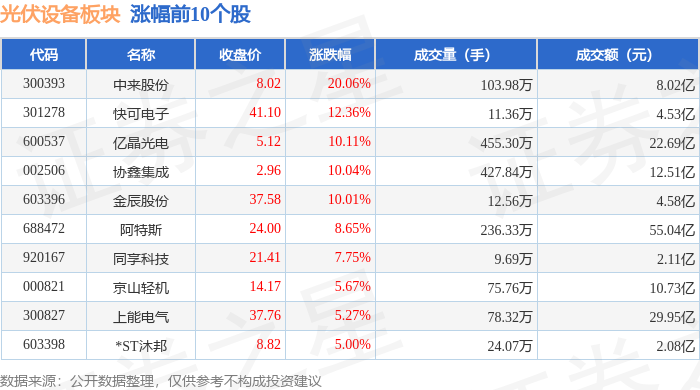
Core Viewpoint - The photovoltaic equipment sector experienced a slight increase of 0.28% on November 11, with Zhonglai Co., Ltd. leading the gains, while the overall market indices, Shanghai Composite and Shenzhen Component, saw declines of 0.39% and 1.03% respectively [1]. Group 1: Market Performance - The closing price of Zhonglai Co., Ltd. was 8.02, reflecting a significant increase of 20.06% with a trading volume of 1.0398 million shares and a transaction value of 800 million [1]. - Other notable performers included Kuake Electronics, which closed at 41.10 with a rise of 12.36%, and Yijing Photovoltaic, which saw a 10.11% increase, closing at 5.12 [1]. - The overall trading volume and transaction values for various companies in the photovoltaic sector indicate robust activity, with total transaction values reaching billions [1]. Group 2: Capital Flow - The photovoltaic equipment sector saw a net outflow of 130 million from institutional investors, while retail investors contributed a net inflow of 206 million [2]. - The capital flow data indicates that while institutional investors withdrew funds, retail investors were more active in purchasing shares, suggesting differing market sentiments [2]. - Specific companies like Xiexin Integration experienced a net inflow of 437 million from institutional investors, despite an overall negative sentiment in the sector [3].